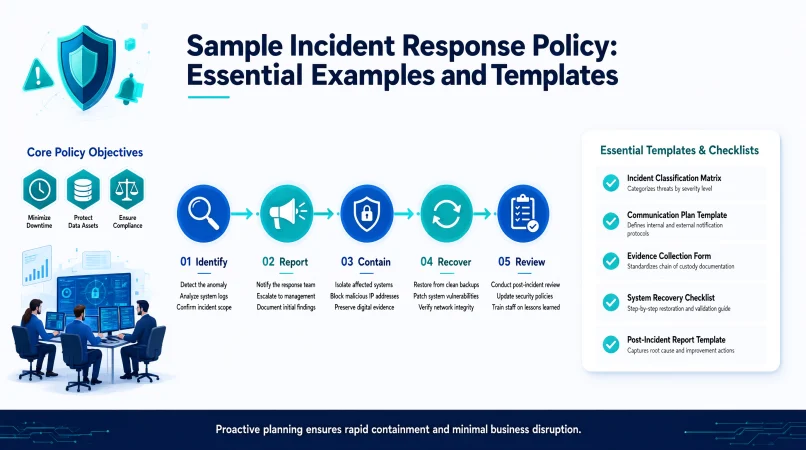
A sample incident response policy provides a practical framework for identifying, reporting, containing, and recovering from cybersecurity incidents. It helps organizations assign responsibilities, communicate clearly, and respond consistently when security problems arise.
Top alternatives: Cybersecurity Incident Response Policy, Security Incident Management Policy, IT Incident Response Plan, Data Breach Response Policy, Information Security Incident Handling Procedure.
Cybersecurity problems never arrive with a convenient calendar invite. One minute, your business is running smoothly, and the next, someone reports a suspicious email, an unexpected system outage, or a potential data breach. What happens next can make a significant difference.
That is where a sample incident response policy becomes useful. Whether you manage a small business, lead an IT team, or oversee information security, having clear response procedures helps everyone understand what to do when something goes wrong.
Without a documented policy, employees may waste valuable time figuring out whom to contact, which systems to protect, and how to communicate the problem. That is not exactly the moment for guesswork.
A well-written policy establishes reporting procedures, response responsibilities, escalation rules, and recovery expectations. It also helps organizations learn from incidents instead of repeating the same mistakes. Below, you will find practical policy examples, templates, and wording ideas to help build a reliable incident response framework.
1. Professional Incident Response Policy Examples
Professional policies establish clear expectations and responsibilities across an organization. These examples work well for formal cybersecurity documentation.
- All security incidents must be reported immediately. Example: Suitable for organizations requiring employees to notify the security team as soon as they discover suspicious activity. Meaning: Establishes prompt reporting as a company-wide responsibility.
- The incident response team shall investigate reported security events. Example: Appropriate for businesses documenting the responsibilities of their security department. Meaning: Assigns investigation duties to designated personnel.
- Every confirmed incident must be documented. Example: Useful when an organization needs a consistent record of security events and corrective actions. Meaning: Promotes accountability and traceability.
- Incident response activities must follow approved procedures. Example: Appropriate for companies with established security governance requirements. Meaning: Ensures teams use consistent and authorized response methods.
- Security incidents must be classified according to severity. Example: Useful for organizations managing incidents with different levels of business impact. Meaning: Helps prioritize response efforts according to risk.
- The designated incident manager shall coordinate response activities. Example: Suitable for businesses that need a clear decision-maker during security events. Meaning: Establishes centralized response coordination.
- Affected systems must be assessed before recovery begins. Example: Useful when technical teams need to confirm that compromised systems are safe to restore. Meaning: Reduces the risk of restoring systems before threats are addressed.
- Incident records must be retained according to organizational requirements. Example: Appropriate for businesses with documentation and retention obligations. Meaning: Supports future investigations and accountability.
- External communications require authorization from designated personnel. Example: Suitable for organizations that need coordinated messaging during incidents. Meaning: Prevents inconsistent or unauthorized statements.
- Response procedures must be reviewed following significant incidents. Example: Useful after a major outage or confirmed security compromise. Meaning: Encourages continuous improvement.
2. Simple Sample Incident Response Policy Statements
A simple policy can be effective without overwhelming employees with technical language. These examples provide a straightforward starting point.
- Report suspicious activity to the IT department. Example: Suitable for an employee handbook or internal security notice. Meaning: Gives employees a clear reporting instruction.
- Do not ignore unexpected security warnings. Example: Useful when employees encounter unusual login alerts or antivirus notifications. Meaning: Encourages employees to take potential threats seriously.
- Protect company information during security incidents. Example: Appropriate for organizations handling confidential business records. Meaning: Emphasizes the need to safeguard sensitive information.
- Follow instructions issued by the incident response team. Example: Useful when employees need guidance during an active investigation. Meaning: Promotes coordinated action.
- Avoid sharing incident details with unauthorized individuals. Example: Suitable for incidents involving confidential company information. Meaning: Helps limit unnecessary disclosure.
- Preserve suspicious emails and relevant evidence. Example: Useful when investigating phishing attempts. Meaning: Helps investigators understand what happened.
- Use approved channels to report security concerns. Example: Appropriate for organizations with established reporting procedures. Meaning: Directs employees toward reliable communication channels.
- Notify your supervisor when a security concern affects your work. Example: Useful for departments without direct access to security personnel. Meaning: Supports timely escalation.
- Do not attempt unauthorized repairs to compromised systems. Example: Suitable for employees who discover unusual computer behavior. Meaning: Reduces the risk of damaging evidence or worsening the incident.
- Keep incident information accurate and confidential. Example: Useful during internal investigations. Meaning: Encourages responsible information handling.
- Document important observations during an incident. Example: Appropriate when employees notice suspicious messages or unexpected access. Meaning: Helps preserve useful details.
- Complete required security training. Example: Suitable for annual employee compliance programs. Meaning: Improves readiness and awareness.
3. Data Breach Incident Response Policy Examples
A data breach policy focuses on protecting personal, customer, employee, and business information when unauthorized access or disclosure occurs.
- All suspected data breaches must be escalated immediately. Example: Suitable when an employee discovers customer information exposed to an unauthorized recipient. Meaning: Prioritizes rapid reporting of possible data exposure.
- The incident response team must assess the scope of the breach. Example: Useful when investigating a compromised database. Meaning: Helps determine which systems and information may be affected.
- Access to compromised information must be restricted when appropriate. Example: Suitable when unauthorized users may still have access to sensitive records. Meaning: Helps limit ongoing exposure.
- Potentially affected individuals must be identified. Example: Useful when customer or employee information may have been exposed. Meaning: Supports accurate impact assessments and notification decisions.
- Legal and regulatory notification obligations must be assessed. Example: Appropriate for organizations subject to privacy laws. Meaning: Helps determine applicable reporting requirements and deadlines.
- Evidence related to the breach must be preserved. Example: Useful during forensic investigations. Meaning: Supports reliable investigation findings.
- Compromised credentials must be secured. Example: Suitable when stolen passwords or access tokens may have contributed to a breach. Meaning: Helps prevent continued unauthorized access.
- Data breach communications must be coordinated. Example: Appropriate when customers, regulators, or business partners may need updates. Meaning: Promotes consistent and accurate communication.
- The organization must assess potential business and privacy impacts. Example: Useful after discovering exposed financial or personal information. Meaning: Helps guide containment and recovery decisions.
- Remediation actions must address the identified cause. Example: Suitable when a breach results from a vulnerable application. Meaning: Reduces the likelihood of similar incidents.
4. Cybersecurity Incident Response Policy Examples
Cybersecurity policies cover incidents involving malicious software, unauthorized access, suspicious network activity, and other digital threats.
- Security alerts must be reviewed by authorized personnel. Example: Suitable for a security operations center. Meaning: Establishes responsibility for investigating alerts.
- Suspected malware infections must be escalated promptly. Example: Useful when an employee receives an antivirus warning. Meaning: Encourages timely investigation of possible infections.
- Unauthorized access must be investigated. Example: Appropriate when login records show unfamiliar access. Meaning: Ensures suspicious activity receives proper attention.
- Compromised endpoints must be isolated when necessary. Example: Suitable when a workstation may be actively spreading malware. Meaning: Helps limit the threat while preserving investigative options.
- Security logs must be protected from unauthorized modification. Example: Useful for systems supporting forensic investigations. Meaning: Helps maintain trustworthy evidence.
- Threat intelligence must inform incident assessments when relevant. Example: Appropriate for organizations tracking emerging cyber threats. Meaning: Supports better-informed response decisions.
- Security vulnerabilities discovered during incidents must be evaluated. Example: Useful after identifying an exploited software weakness. Meaning: Helps prioritize necessary remediation.
- Privileged accounts must be reviewed after suspected compromise. Example: Suitable when an administrator account shows suspicious activity. Meaning: Helps identify and address elevated access risks.
- Network activity must be monitored according to approved procedures. Example: Appropriate for organizations with centralized security monitoring. Meaning: Supports the detection of suspicious behavior.
- Security controls must be restored and verified after remediation. Example: Useful when rebuilding a compromised server. Meaning: Confirms that required protections are functioning.
- Incident response actions must follow approved access controls. Example: Suitable for organizations handling sensitive infrastructure. Meaning: Prevents unauthorized intervention during an incident.
- Confirmed cybersecurity incidents must receive a documented resolution. Example: Appropriate when closing a security investigation. Meaning: Ensures the incident’s outcome and remaining risks are recorded.
5. IT Incident Response Policy Examples
IT incident response policies help organizations manage technical disruptions that affect systems, applications, networks, and business services.
- IT incidents must be recorded in the designated ticketing system. Example: Suitable for a company’s IT help desk. Meaning: Creates a centralized record of technical issues.
- Critical service disruptions must be escalated immediately. Example: Useful when a business-critical application becomes unavailable. Meaning: Prioritizes incidents with significant operational consequences.
- Technical teams must assess the impact of system failures. Example: Appropriate during a server outage. Meaning: Helps determine the scope and urgency of the disruption.
- System restoration must follow approved recovery procedures. Example: Suitable when restoring a failed production service. Meaning: Encourages controlled and consistent recovery.
- Changes made during incident resolution must be documented. Example: Useful when engineers modify production settings to restore service. Meaning: Maintains a reliable technical history.
- Incident priorities must reflect business impact. Example: Appropriate when several technical problems occur simultaneously. Meaning: Helps allocate limited resources effectively.
- Service owners must be informed of significant disruptions. Example: Suitable for applications used by multiple departments. Meaning: Keeps accountable stakeholders informed.
- Backups must be verified before they are used for recovery. Example: Useful when restoring data after a system failure. Meaning: Helps avoid relying on unusable or compromised backups.
- Recurring incidents must be reviewed for underlying causes. Example: Appropriate when a service repeatedly fails. Meaning: Encourages permanent fixes rather than repeated temporary solutions.
- Recovery activities must be tested before normal operations resume. Example: Suitable after repairing a critical application. Meaning: Reduces the chance of returning an unstable service to production.
6. Small Business Incident Response Policy Examples
Small businesses need practical procedures that fit their staffing, budgets, and technical capabilities.
- Employees must report suspected cyber incidents to the designated contact. Example: Suitable for a small company without a dedicated security department. Meaning: Provides a clear reporting route.
- The business owner must designate an incident coordinator. Example: Useful when several employees share IT responsibilities. Meaning: Establishes ownership of incident management.
- Critical business information must be backed up regularly. Example: Appropriate for small businesses relying on digital customer records. Meaning: Supports recovery after data loss.
- External IT support must be contacted when internal expertise is insufficient. Example: Suitable when ransomware or a complex compromise is suspected. Meaning: Encourages timely access to specialized assistance.
- Employees must use approved methods to share business information. Example: Useful for companies handling customer documents. Meaning: Reduces accidental exposure.
- Access to business systems must be limited to authorized users. Example: Appropriate for small teams sharing cloud applications. Meaning: Helps prevent unauthorized access.
- Incident priorities must reflect essential business operations. Example: Useful when a payment system becomes unavailable. Meaning: Helps protect the services most important to business continuity.
- Emergency contact details must remain current. Example: Suitable for a small company coordinating with IT vendors. Meaning: Prevents delays when assistance is needed.
- Employees must receive basic incident reporting training. Example: Appropriate for businesses with limited security resources. Meaning: Improves readiness without requiring advanced technical knowledge.
- The business must review significant incidents after resolution. Example: Useful after a customer data exposure. Meaning: Helps prevent similar problems.
7. Incident Severity and Escalation Policy Examples
Severity classifications help incident response teams determine which problems require immediate attention and which can follow routine procedures.
- Critical incidents must be escalated without delay. Example: Suitable for a confirmed attack affecting essential business services. Meaning: Prioritizes incidents with severe consequences.
- High-severity incidents require prompt management notification. Example: Useful when a compromised system handles sensitive information. Meaning: Ensures decision-makers become involved quickly.
- Medium-severity incidents must be assigned to an appropriate response owner. Example: Suitable for suspicious activity with limited confirmed impact. Meaning: Ensures the issue has clear ownership.
- Low-severity events must still be recorded when required. Example: Appropriate for minor security alerts that meet reporting criteria. Meaning: Prevents potentially useful information from being overlooked.
- Severity must be reassessed as new evidence becomes available. Example: Useful when a minor alert reveals broader unauthorized access. Meaning: Keeps the response aligned with the evolving risk.
- Escalation decisions must consider operational impact. Example: Suitable when an outage affects a critical customer service. Meaning: Connects technical urgency with business needs.
- Incident owners must communicate significant changes in severity. Example: Appropriate when an investigation identifies additional affected systems. Meaning: Keeps stakeholders informed about changing risks.
- Unresolved critical incidents must follow the approved escalation chain. Example: Useful when the initial response team cannot contain a threat. Meaning: Ensures additional authority and resources can be engaged.
- Severity criteria must be documented and accessible. Example: Suitable for organizations standardizing incident classification. Meaning: Helps teams make consistent decisions.
- Response priorities must be reviewed during major incidents. Example: Appropriate when several systems become affected. Meaning: Supports effective allocation of resources.
8. Incident Reporting Policy Examples
An effective reporting policy makes it easy for employees, contractors, and relevant third parties to raise security concerns.
- Employees must report suspicious emails through approved channels. Example: Suitable for a workplace phishing reporting process. Meaning: Encourages early detection of email-based threats.
- Reports must include the available incident details. Example: Useful when employees submit security tickets. Meaning: Helps investigators begin with relevant information.
- Employees must not delay reporting while attempting their own investigation. Example: Appropriate when someone notices an unfamiliar login. Meaning: Prevents unnecessary delays and unauthorized investigative activity.
- Incident reports must identify the affected system when known. Example: Suitable for reports involving a particular laptop or application. Meaning: Helps response teams identify the relevant asset.
- Reports should include the time the event was discovered. Example: Useful when investigating suspicious network activity. Meaning: Helps establish an incident timeline.
- Employees must report accidental disclosure of sensitive information. Example: Appropriate when a document is emailed to the wrong recipient. Meaning: Ensures accidental exposure receives timely attention.
- Security concerns must be reported even when the cause is uncertain. Example: Useful when an employee notices unusual system behavior. Meaning: Encourages early reporting without requiring proof.
- The organization must provide an accessible reporting method. Example: Suitable for businesses with employees working different shifts. Meaning: Makes reporting practical for the workforce.
- Incident reports must be handled confidentially when appropriate. Example: Useful for investigations involving employee or customer information. Meaning: Helps protect sensitive details.
- Report recipients must acknowledge incidents according to established procedures. Example: Appropriate for a managed IT support team. Meaning: Confirms that reports have entered the response process.
9. Incident Response Team Responsibility Examples
Clearly defined responsibilities reduce confusion during stressful situations and help prevent important response tasks from being overlooked.
- The incident manager shall coordinate the overall response. Example: Suitable for major incidents involving multiple departments. Meaning: Establishes central coordination.
- Security analysts shall investigate relevant alerts and evidence. Example: Appropriate for security operations teams. Meaning: Assigns technical investigation duties.
- IT administrators shall implement authorized containment measures. Example: Useful when compromised devices require isolation. Meaning: Clarifies who performs technical interventions.
- Legal personnel shall assess applicable legal obligations. Example: Suitable when an incident may involve regulated information. Meaning: Brings legal expertise into the response.
- Communications personnel shall coordinate approved external statements. Example: Appropriate for incidents attracting customer or media attention. Meaning: Promotes consistent public messaging.
- Business owners shall assess operational consequences. Example: Useful when an incident interrupts an essential service. Meaning: Connects technical findings to business priorities.
- Human resources shall support incidents involving workplace matters when appropriate. Example: Suitable when an investigation involves employee access or conduct. Meaning: Ensures relevant workplace processes are followed.
- Third-party providers shall support response activities within their agreed responsibilities. Example: Appropriate when a cloud service provider is involved. Meaning: Clarifies external support expectations.
- Evidence handlers shall document evidence collection and transfers. Example: Useful during forensic investigations. Meaning: Supports evidence integrity and traceability.
- Management shall approve decisions assigned to its authority. Example: Suitable when an incident requires significant business decisions. Meaning: Keeps decision-making within established governance.
- Recovery owners shall coordinate service restoration. Example: Appropriate after a compromised application has been secured. Meaning: Assigns responsibility for returning systems to operation.
- All assigned responders shall document significant actions. Example: Useful during a complex, multi-day investigation. Meaning: Creates a reliable record of response activities.
10. Incident Communication Policy Examples
Clear communication helps employees and decision-makers understand an incident without spreading inaccurate information or exposing sensitive details.
- Incident updates must use approved communication channels. Example: Suitable for a company coordinating a major outage. Meaning: Keeps information within authorized channels.
- Only authorized personnel may issue official incident statements. Example: Appropriate when customers or journalists request information. Meaning: Prevents unauthorized public communication.
- Internal updates must distinguish confirmed facts from assumptions. Example: Useful during an ongoing investigation. Meaning: Reduces confusion caused by speculation.
- Stakeholders must receive updates according to established communication procedures. Example: Suitable for an incident affecting several departments. Meaning: Ensures relevant people receive appropriate information.
- Sensitive incident details must be shared only when necessary. Example: Appropriate for investigations involving personal information. Meaning: Limits unnecessary disclosure.
- Communication responsibilities must be assigned before incidents occur. Example: Useful for organizations preparing incident response plans. Meaning: Prevents confusion over who communicates.
- Customer notifications must reflect verified information. Example: Suitable when customers may be affected by a service disruption. Meaning: Supports accurate and responsible messaging.
- Communication records must be retained when required. Example: Appropriate for significant security incidents. Meaning: Preserves a history of important notifications.
- Response teams must communicate urgent decisions promptly. Example: Useful when leadership approval is needed during containment. Meaning: Reduces decision-making delays.
- Incident communications must follow applicable confidentiality requirements. Example: Suitable for incidents involving confidential business records. Meaning: Protects sensitive information.
- Updates must be adjusted as the incident develops. Example: Appropriate when the scope of an investigation changes. Meaning: Keeps stakeholders informed of meaningful developments.
- A final incident summary must be shared with appropriate stakeholders. Example: Useful after a major incident has been resolved. Meaning: Communicates outcomes and relevant follow-up actions.
11. Incident Containment and Recovery Policy Examples
Containment limits an incident’s impact, while recovery focuses on restoring affected systems and services safely.
- Containment actions must be based on the assessed incident risk. Example: Suitable when deciding whether to isolate a compromised server. Meaning: Encourages proportionate and informed containment.
- Affected accounts must be secured when compromise is suspected. Example: Appropriate after discovering suspicious account activity. Meaning: Helps prevent further unauthorized access.
- Compromised systems must be isolated when necessary. Example: Useful during a suspected malware outbreak. Meaning: Limits the potential spread of malicious activity.
- Recovery must not begin until required security checks are completed. Example: Suitable when rebuilding a compromised application. Meaning: Helps avoid restoring unsafe systems.
- Recovery priorities must reflect business requirements. Example: Appropriate when several services are unavailable. Meaning: Focuses recovery on the most important operations.
- Clean backups must be verified before restoration. Example: Useful after ransomware or data corruption. Meaning: Reduces the risk of reintroducing compromised data.
- Security controls must be validated after recovery. Example: Suitable when restoring a production server. Meaning: Confirms that required protections remain effective.
- Recovery progress must be documented. Example: Appropriate during a prolonged service outage. Meaning: Provides visibility into restoration activities.
- Business owners must confirm critical service readiness. Example: Useful before returning an essential application to normal operation. Meaning: Connects technical recovery with operational needs.
- Temporary containment measures must be reviewed regularly. Example: Suitable when emergency restrictions remain in place. Meaning: Helps ensure temporary controls remain appropriate.
- Remaining risks must be communicated before service restoration. Example: Appropriate when some vulnerabilities cannot be immediately resolved. Meaning: Supports informed recovery decisions.
- Recovery procedures must be updated following significant incidents. Example: Useful after discovering weaknesses in restoration processes. Meaning: Improves future recovery readiness.
12. Incident Evidence and Documentation Policy Examples
Good documentation helps organizations understand what happened, support investigations, and demonstrate that response procedures were followed.
- Incident records must include the initial report. Example: Suitable for a centralized incident management system. Meaning: Preserves the original account of the event.
- Investigators must document significant response actions. Example: Useful when recording system isolation or credential resets. Meaning: Creates an audit trail of important decisions.
- Evidence must be protected from unauthorized alteration. Example: Appropriate for forensic investigations. Meaning: Helps maintain evidence integrity.
- Evidence collection must follow approved procedures. Example: Suitable for organizations conducting technical investigations. Meaning: Promotes consistent evidence handling.
- Incident timelines must be maintained when practical. Example: Useful when determining how an attack progressed. Meaning: Helps establish the sequence of events.
- Access to investigation records must be restricted appropriately. Example: Suitable for incidents involving confidential customer information. Meaning: Protects sensitive investigative material.
- Important findings must be recorded with supporting details. Example: Appropriate when documenting the cause of a system compromise. Meaning: Makes conclusions easier to review.
- Evidence transfers must be documented when required. Example: Useful when evidence moves between investigators. Meaning: Supports traceability and accountability.
- Incident records must follow approved retention requirements. Example: Suitable for organizations with legal or regulatory obligations. Meaning: Ensures records are maintained appropriately.
- Investigation notes must distinguish observations from conclusions. Example: Appropriate when facts are still being verified. Meaning: Prevents unsupported assumptions from being treated as established facts.
13. Incident Response Training and Testing Policy Examples
A policy is only useful when employees understand it and response teams can apply it under pressure.
- Employees must receive incident reporting training. Example: Suitable for new employee orientation. Meaning: Builds awareness of reporting responsibilities.
- Incident response teams must participate in periodic exercises. Example: Appropriate for organizations testing their response capabilities. Meaning: Helps teams practice coordinated decision-making.
- Training must cover common cybersecurity threats. Example: Useful for teaching employees to recognize phishing and suspicious activity. Meaning: Improves threat awareness.
- Response exercises must have documented objectives. Example: Suitable for tabletop exercises involving management. Meaning: Gives each exercise a clear purpose.
- Exercise findings must be documented. Example: Appropriate after a simulated ransomware scenario. Meaning: Creates a record of weaknesses and lessons learned.
- Identified response gaps must receive appropriate corrective actions. Example: Useful when an exercise reveals missing escalation contacts. Meaning: Turns testing results into improvements.
- Contact lists must be tested periodically. Example: Suitable for teams relying on emergency notifications. Meaning: Helps verify that responders can be reached.
- Training materials must reflect current procedures. Example: Appropriate when a company updates its reporting process. Meaning: Prevents employees from following outdated guidance.
- Relevant contractors must understand their incident responsibilities. Example: Useful when external IT personnel support business systems. Meaning: Extends readiness to important service providers.
- Exercises must consider different incident scenarios. Example: Suitable for testing data breach, malware, and service outage procedures. Meaning: Prepares teams for varied situations.
14. Compliance and Governance Incident Response Policy Examples
Governance requirements help organizations connect incident response activities with applicable laws, contractual commitments, and internal security standards.
- Incident response procedures must align with applicable legal obligations. Example: Suitable for businesses operating in regulated industries. Meaning: Connects response activities with relevant legal requirements.
- Regulatory reporting deadlines must be assessed for applicable incidents. Example: Useful after a suspected personal data breach. Meaning: Helps prevent missed reporting obligations.
- Policy exceptions must receive documented approval. Example: Appropriate when an emergency requires a departure from normal procedures. Meaning: Establishes accountability for exceptions.
- Incident response policies must identify accountable owners. Example: Suitable for organizations maintaining formal security governance. Meaning: Clarifies policy ownership.
- Third-party incident responsibilities must be defined in relevant agreements. Example: Useful when vendors process sensitive business information. Meaning: Establishes expectations for external providers.
- Incident records must support required audits. Example: Appropriate for organizations subject to independent reviews. Meaning: Improves audit readiness.
- Security incidents must be assessed against contractual obligations. Example: Suitable when a service agreement contains notification requirements. Meaning: Helps identify applicable contractual duties.
- Policy reviews must follow an established schedule. Example: Useful for annual security governance reviews. Meaning: Keeps documented requirements current.
- Material policy changes must be communicated to relevant personnel. Example: Appropriate after revising escalation procedures. Meaning: Helps employees follow updated requirements.
- Risk acceptance decisions must follow approved authority levels. Example: Suitable when some incident-related risks cannot be eliminated immediately. Meaning: Ensures authorized decision-making.
15. Ready-to-Adapt Sample Incident Response Policy Templates
These examples combine common policy elements into practical statements that organizations can adapt to their own environments.
- Purpose: This policy establishes procedures for identifying, reporting, managing, and resolving security incidents. Example: Suitable for the opening section of a formal policy. Meaning: Explains why the policy exists.
- Scope: This policy applies to employees, contractors, systems, and information covered by organizational security requirements. Example: Useful for defining who and what the policy covers. Meaning: Establishes the policy’s boundaries.
- Incident Definition: A security incident is an event that compromises or threatens the confidentiality, integrity, or availability of information or systems. Example: Suitable for a cybersecurity policy glossary. Meaning: Defines which events may require incident response.
- Reporting Requirement: Personnel must report suspected security incidents through designated reporting channels as soon as practicable. Example: Appropriate for the policy’s reporting section. Meaning: Establishes the reporting expectation.
- Roles and Responsibilities: The organization shall assign personnel to coordinate investigations, containment, communication, and recovery. Example: Useful for documenting response ownership. Meaning: Clarifies responsibility for incident management.
- Classification: Incidents shall be prioritized according to severity, business impact, and potential risk. Example: Suitable for the incident classification section. Meaning: Provides a basis for prioritizing response work.
- Investigation: Authorized responders shall investigate reported incidents and document relevant findings. Example: Appropriate for formal investigation procedures. Meaning: Establishes expectations for evidence-based investigation.
- Containment: The response team shall implement appropriate measures to limit incident impact. Example: Useful for documenting containment responsibilities. Meaning: Directs responders to control the threat.
- Communication: Incident communications shall be coordinated through designated personnel and approved channels. Example: Suitable for the communications section. Meaning: Establishes communication control.
- Recovery: Affected systems and services shall be restored according to approved recovery procedures. Example: Appropriate for business continuity planning. Meaning: Establishes controlled service restoration.
FAQs
What Is a Sample Incident Response Policy?
A sample incident response policy is a starting document that explains how an organization identifies, reports, manages, and resolves incidents.
Why Is an Incident Response Policy Important?
It clarifies responsibilities, supports faster decisions, limits potential damage, and helps organizations recover more consistently.
What Should an Incident Response Policy Include?
It should cover scope, reporting, roles, severity, investigation, containment, communication, recovery, documentation, and review.
Who Should Create an Incident Response Policy?
Security leaders, IT teams, risk managers, and relevant business stakeholders should collaborate on the policy.
Can Small Businesses Use a Sample Incident Response Policy?
Yes. Small businesses can adapt a simple policy to their resources, risks, systems, and available support.
How Often Should an Incident Response Policy Be Reviewed?
Review it periodically and after significant incidents, organizational changes, or changes in relevant legal requirements.
What Is the Difference Between a Policy and a Response Plan?
A policy establishes requirements and responsibilities, while a response plan explains the procedures used to carry them out.
Can an Incident Response Policy Be Used for Data Breaches?
Yes. It can establish breach reporting, investigation, containment, notification assessment, and recovery requirements.
Is an Incident Response Policy a Legal Requirement?
Requirements vary by jurisdiction, industry, contract, and applicable regulations. Organizations should assess their specific obligations.
Should an Incident Response Policy Include Response Times?
Yes. Define measurable reporting and escalation targets based on severity, business risk, and applicable obligations.
What Should You Do If You Discover a Security Incident?
Report it through approved channels, preserve relevant information, and follow authorized instructions without delaying escalation.
Should Incident Response Policies Be Tested?
Yes. Tabletop exercises and technical simulations can reveal gaps in responsibilities, communication, and recovery procedures.
Conclusion
A reliable sample incident response policy gives your organization a practical foundation for handling cybersecurity incidents with clarity and confidence. From reporting suspicious activity to coordinating investigations and restoring affected systems, every well-defined responsibility can help reduce confusion when the pressure is on.
The best policy is not necessarily the longest or most technical. It is the one your team understands, can follow, and reviews as your business changes. Start with the examples that match your organization’s needs, customize the responsibilities and escalation requirements, and test the procedures before a real incident occurs.
SEO Meta Title
Sample Incident Response Policy: 180+ Examples and Templates
SEO Meta Description
Explore sample incident response policy examples and templates for cybersecurity, data breaches, reporting, containment, recovery, and compliance.
Infographic Feature Image Prompt
Create a professional, SEO-friendly cybersecurity infographic titled “Sample Incident Response Policy: Essential Examples and Templates.” Use a clean modern layout featuring a security shield, incident alert symbols, a response team, a document checklist, and a five-step process: Identify, Report, Contain, Recover, and Review. Include concise English labels, readable typography, balanced spacing, and a polished blue, white, and teal color scheme. Make the design suitable for a cybersecurity blog featured image, with clear visual hierarchy, high contrast, a trustworthy business aesthetic, and no logos or watermarks.
SEO-Friendly URL
sample-incident-response-policy
Focus Keyword
sample incident response policy
5 SEO-Friendly Meta Title Alternatives
- Sample Incident Response Policy: 180+ Examples and Templates
- Sample Incident Response Policy for Cybersecurity Teams
- 150+ Sample Incident Response Policy Examples for Businesses
- Sample Incident Response Policy: A Practical Guide and Template
- 200+ Sample Incident Response Policy Ideas for Better Security