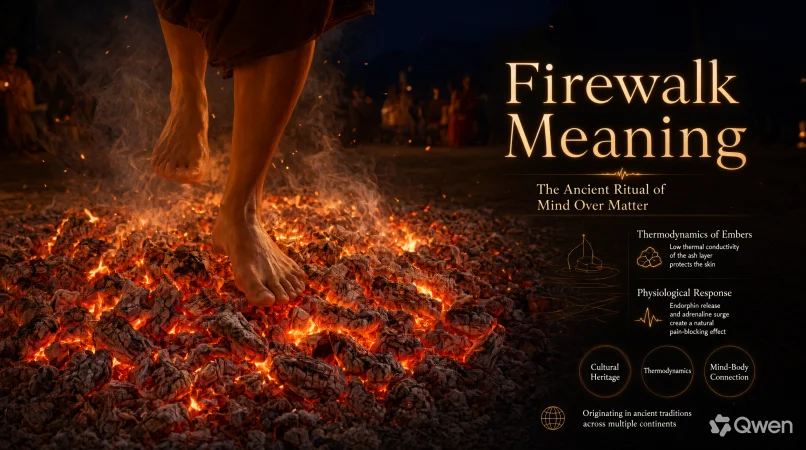
A firewalk is the act of walking barefoot across a path of hot embers or burning charcoal without sustaining serious burns under certain conditions. It is traditionally associated with spiritual ceremonies, religious practices, personal courage, and tests of mental strength. The word can also describe a symbolic journey through fear or a difficult experience. In modern settings, firewalking is sometimes used in motivational events to represent confidence, determination, and overcoming personal limitations.
A firewalk is a traditional practice in which a person walks barefoot over a surface covered with glowing hot embers. The embers are usually produced by burning wood until it becomes charcoal. Although the surface can reach extremely high temperatures, some participants complete the walk without suffering significant burns.
The word combines two simple ideas: fire and walk. Together, they describe a physical act that has developed different meanings across cultures, spiritual traditions, and modern motivational activities.
Firewalking is not simply an entertainment stunt. In many communities, it has a religious or ceremonial purpose. Participants may see the experience as a demonstration of faith, spiritual purification, courage, or devotion.
In modern motivational settings, the practice has taken on another meaning. People may view crossing the embers as a way to confront fear and challenge their beliefs about personal limitations.
Literal and Symbolic Meanings
The literal definition refers to physically walking across hot embers. The symbolic meaning is broader and often depends on the situation in which the word appears.
For example, someone might describe a difficult period in life as a firewalk. They are not necessarily talking about real flames. Instead, they are comparing their experience to crossing a dangerous or uncomfortable path.
This expression can represent:
- Courage: Facing something that seems frightening or impossible.
- Faith: Trusting a spiritual belief during a challenging experience.
- Transformation: Leaving behind old fears or habits.
- Resilience: Continuing forward despite discomfort and uncertainty.
- Self-confidence: Discovering that perceived limitations can sometimes be challenged.
These meanings explain why the term appears in discussions about spirituality, personal development, and overcoming adversity.
Origin and History of Firewalking
Firewalking has a long history, with documented traditions appearing in different parts of the world. It is difficult to identify one original location because the practice developed independently in different cultural and religious settings.
One of the best-known examples comes from the Indian subcontinent, where firewalking has been associated with Hindu religious ceremonies. In certain traditions, devotees walk across burning embers as an expression of devotion and religious commitment.
A particularly well-known example is the Theemithi festival, a Hindu firewalking ceremony associated with Draupadi, a central figure in the Indian epic Mahabharata. The festival is especially recognized in Tamil communities and is also celebrated in places such as Singapore.
Firewalking in India
In parts of southern India, firewalking is connected with local temple traditions and religious festivals. Participants may undertake the practice after making a vow or completing a period of religious preparation.
The ceremony is sometimes associated with Draupadi Amman, a form of worship connected with Draupadi. For devotees, crossing the embers can represent devotion, spiritual discipline, and the fulfillment of a religious promise.
The practice is not identical everywhere. Local customs, ceremonial procedures, and religious interpretations can vary between communities.
Firewalking in Greece
Another historical example is the Anastenaria, a firewalking tradition practiced in parts of northern Greece and neighboring regions of the Balkans.
Participants take part in ceremonies involving religious icons, music, dancing, and walking across burning embers. The tradition is connected with Orthodox Christian cultural practices and the veneration of Saints Constantine and Helen.
For participants, the experience has a spiritual meaning rather than being simply a demonstration of physical endurance.
Firewalking in Japan
Japan also has established fire-related religious ceremonies. One example is Hiwatari Matsuri, a fire-walking festival associated with certain Buddhist traditions.
At these ceremonies, practitioners may walk across a prepared bed of hot coals as part of a purification ritual. The practice is associated with mountain ascetic traditions and is sometimes performed by practitioners connected with Shugendo, a Japanese spiritual tradition combining Buddhist and indigenous religious elements.
These examples show that firewalking is not limited to one religion or country. Different communities have developed their own explanations and ceremonial purposes.
Spiritual and Cultural Symbolism
Fire has carried powerful symbolic meanings throughout human history. It can represent destruction, purification, renewal, warmth, danger, and transformation. Because of these associations, walking across fire has become a meaningful ritual in several traditions.
For some participants, the experience represents trust in a higher power. They may believe that spiritual commitment gives them the strength to complete an activity that would otherwise seem terrifying.
Others understand it as a demonstration of discipline. The preparation, ceremony, and willingness to face discomfort can be just as meaningful as the actual walk.
Fire as a Symbol of Purification
In some religious traditions, fire represents the removal of impurities. It can symbolize a fresh beginning, spiritual cleansing, or the separation of old habits from a renewed sense of purpose.
Walking across embers may therefore be interpreted as a symbolic step toward personal or spiritual renewal.
However, these interpretations are not universal. Different communities attach different meanings to the same physical practice.
Fire as a Test of Faith
In ceremonial settings, firewalking may represent a person’s commitment to their beliefs. Completing the walk can be viewed as an expression of devotion or trust.
This does not mean every participant has the same experience or interpretation. Some focus on religious duty, while others emphasize community identity and cultural tradition.
Fire as a Symbol of Transformation
The movement from one side of the ember path to the other can represent a transition from fear to confidence.
In this interpretation, the flames symbolize difficulties, while reaching the other side represents growth. The physical activity becomes a metaphor for facing something challenging rather than avoiding it.
How Does Firewalking Work?
One of the most interesting questions about this practice is how someone can walk across extremely hot embers without immediately burning their feet.
The explanation is based on physics, particularly heat transfer. Firewalking does not require supernatural protection or a suspension of the laws of nature. Several physical properties help explain why brief contact with certain types of embers may not cause an immediate serious injury.
1. Wood Charcoal Transfers Heat Slowly
The embers used in many firewalking ceremonies come from burned wood. Charcoal has relatively low thermal conductivity, meaning it does not transfer heat as efficiently as materials such as metal.
This matters because the temperature of an object is not the only factor that determines how badly it can burn someone. The speed at which heat moves into the skin also matters.
For comparison, touching a hot metal object can cause an injury very quickly because metal transfers heat efficiently. A glowing piece of charcoal behaves differently.
2. Contact Time Is Important
Firewalkers generally move across the ember bed rather than standing still. Each step involves a relatively brief period of contact between the foot and the hot surface.
The shorter the contact, the less time there is for heat to transfer into the skin. However, this does not make the activity completely safe.
A person who stops, slips, or falls may remain in contact with hot material for much longer, increasing the possibility of a serious burn.
3. The Ash Layer Can Affect Heat Transfer
A layer of ash may form around the charcoal during burning. Ash is a poor conductor of heat compared with many solid materials, so it can influence how quickly heat reaches the feet.
The condition and arrangement of the embers also matter. Different materials, temperatures, and surface conditions can produce different results.
4. Temperature Is Not the Whole Story
A common misunderstanding is that an object at a particular temperature must always cause the same level of injury. In reality, heat transfer depends on several factors.
These include:
- The temperature of the material.
- Its thermal conductivity.
- How much heat energy it can transfer.
- The size of the contact area.
- How long contact continues.
- Whether hot material sticks to the skin.
The University of California, Los Angeles (UCLA) explains that firewalking demonstrations can involve real dangers, including second-degree burns, hot spots, and injuries caused by pieces of material sticking to the feet.
UCLA Physics & Astronomy+1
The important distinction: Firewalking is physically explainable, but it is not a safe activity simply because some people complete it without injury.
Different Types of Firewalking
Firewalking is not performed in exactly the same way everywhere. Some traditions focus on religious devotion, while others emphasize cultural identity or personal development.
The following comparison shows some well-known forms of the practice.
| Type | Where it is associated | Main purpose |
| Religious firewalking | India and Tamil communities | Devotion and fulfillment of religious vows |
| Anastenaria | Greece and parts of the Balkans | Religious tradition and community identity |
| Hiwatari ceremonies | Japan | Purification and spiritual discipline |
| Motivational firewalking | Modern workshops, especially in the United States | Confidence and overcoming fear |
| Cultural firewalking | Various traditional communities | Preserving inherited customs |
These categories are broad descriptions rather than a complete classification. Each ceremony has its own history, beliefs, and rules.
Religious Firewalking
Religious ceremonies are among the oldest and best-known settings for this practice. Participants may prepare through prayer, fasting, vows, or other forms of religious discipline.
The actual walk is often only one part of a larger celebration. For devotees, the surrounding ceremonies can carry as much meaning as crossing the embers.
Traditional Cultural Firewalking
In some communities, firewalking is an important part of local heritage. It connects generations through shared ceremonies, stories, music, and collective participation.
The Anastenaria of northern Greece is a good example. Its rituals involve more than walking over fire and include music, dancing, religious icons, and community gatherings.
Motivational Firewalking
Modern personal-development events use firewalking as a symbolic challenge. Participants are encouraged to confront fear and question assumptions about what they can accomplish.
This approach became particularly visible in the United States during the late twentieth century. Workshops popularized the idea that completing a frightening physical challenge could encourage people to approach other personal challenges with greater confidence.
libres.uncg.edu
However, completing a firewalk does not prove that someone can accomplish anything or that fear disappears permanently.
Why Do People Participate in Firewalking?
People participate for different reasons, and understanding those reasons requires looking beyond the physical act.
For some, the motivation is religious. For others, it is cultural, social, or personal. The same ceremony can have different meanings for different participants.
Religious Commitment
Devotees may participate to fulfill a promise made to a deity or demonstrate their commitment to a spiritual tradition.
In some Hindu communities, firewalking is associated with vows and devotion to Draupadi Amman. The ceremony may follow an extended period of religious observance.
Personal Confidence
Modern participants sometimes approach firewalking as a challenge to their own fears.
The experience can feel significant because the person must confront an activity that appears dangerous. Successfully completing it may give them a temporary sense of achievement.
Still, confidence gained from one experience should not be confused with proof of unlimited physical or mental ability.
Community and Belonging
Traditional ceremonies can strengthen relationships between families and communities. People gather to prepare, observe, participate, and pass cultural practices to younger generations.
Theemithi in Singapore demonstrates this wider social dimension. The National Library Board of Singapore documents how the festival involves an extended cycle of religious activities connected with the Mahabharatam, rather than just the final firewalking event.
BiblioAsia
Symbolic Personal Transformation
Some people interpret the experience as a personal turning point. Crossing the ember path can represent leaving hesitation behind and moving toward a new stage of life.
This interpretation is especially common in motivational settings, where the event is presented as a metaphor for overcoming obstacles.
Firewalking vs. Other Fire-Based Practices
Firewalking is sometimes confused with other activities involving flames, hot surfaces, or ceremonial fire. Although these practices may look similar, their purposes and methods are different.
| Practice | What happens | Main meaning |
| Firewalking | A person walks barefoot across hot embers | Devotion, courage, or transformation |
| Fire dancing | A performer dances while manipulating fire props | Performance and entertainment |
| Fire worship | Fire is treated as sacred in a religious ceremony | Spiritual devotion and reverence |
| Fire jumping | Participants jump over flames or a fire | Cultural celebration or purification |
| Fire ritual | Fire is used as part of a religious or ceremonial activity | Renewal, remembrance, or spiritual practice |
Firewalking vs. Fire Dancing
Firewalking involves direct contact with a prepared bed of embers. Fire dancing, on the other hand, is a performance in which trained performers manipulate objects containing or producing flames.
Fire dancing focuses mainly on movement, coordination, and visual presentation, whereas traditional firewalking often has a deeper ceremonial purpose.
Firewalking vs. Fire Worship
Fire worship refers to religious practices in which fire receives special spiritual importance. It does not necessarily involve walking across burning materials.
For example, fire has an important place in Zoroastrian religious tradition, where it is treated as a symbol of purity and divine presence. This is a different practice from physically crossing hot embers.
Risks and Safety Considerations
Despite its cultural and symbolic importance, firewalking carries genuine physical risks. A person can suffer burns even when the event is carefully organized.
The most obvious danger is direct contact with hot embers. However, other hazards can include hidden hot materials, uneven surfaces, unexpected falls, and objects that become attached to the skin.
Possible Injuries
The severity of an injury depends on the amount of heat transferred to the body and the duration of exposure.
Potential injuries include:
- First-degree burns, which affect the outer layer of skin.
- Second-degree burns, which damage deeper skin layers and may cause blisters.
- More serious burns that require professional medical treatment.
- Injuries caused by falling onto burning materials.
The World Health Organization explains that burns can result in pain, scarring, disability, and long-term psychological distress. It also emphasizes the importance of preventing exposure to dangerous heat sources.
World Health Organization
Why Firewalking Should Not Be Tried Casually
Watching someone complete a firewalk successfully can create the impression that anyone can do it. That assumption is dangerous.
A person’s experience may depend on the materials, conditions, preparation, and circumstances of the event. Even experienced participants can suffer injuries.
Firewalking should never be treated as a casual experiment or attempted as a way to prove courage. Its symbolic meaning does not make the physical risks disappear.
Firewalk in Everyday Language
Outside traditional ceremonies, the word firewalk can also appear in everyday conversations, motivational writing, and figurative expressions.
In these situations, it often describes an experience that requires courage, determination, or emotional strength.
For example, consider the sentence:
Starting a new business after losing everything felt like a firewalk.
Here, the speaker is not describing an actual walk over burning charcoal. Instead, they are comparing a difficult personal experience to a physically challenging journey.
Other examples include:
- “Life has become a firewalk lately.” This suggests that life feels difficult, stressful, or emotionally challenging.
- “She completed her firewalk and faced her fears.” This may refer to a real ceremony or a symbolic personal challenge.
- “Getting through that difficult year was my own firewalk.” This describes a period of hardship that required determination.
- “The experience became a firewalk toward personal growth.” This presents difficulty as part of a journey toward change.
Is Firewalk a Positive or Negative Word?
The word itself is generally neutral. Its emotional meaning depends on context.
In a spiritual or motivational setting, it can carry positive associations with courage, faith, and personal achievement. In ordinary conversation, it may describe an uncomfortable or frightening situation.
For example, someone might call a difficult examination a firewalk to communicate how stressful the experience felt.
The expression is usually figurative unless the conversation specifically concerns a firewalking ceremony.
Frequently Asked Questions
1. Is Firewalk a Single Word or Two Words?
Firewalk is commonly written as one word when used as a noun or verb. Fire walking, written as two words, is also used to describe the physical practice.
2. What Is a Person Who Walks on Fire Called?
A person who participates in this activity is generally called a firewalker. The term can refer to religious participants, traditional practitioners, or people attending motivational events.
3. What Is the Opposite of Firewalk?
There is no established direct opposite. Depending on the context, words such as avoiding danger, retreating, or staying away from fire may express the opposite idea.
4. Can Firewalk Be Used as a Verb?
Yes. The verb to firewalk describes the act of walking across hot embers. It can also be used figuratively to describe facing an extremely difficult challenge.
5. Is Firewalking Recognized as a Religious Tradition?
Yes. Firewalking is part of several documented religious and cultural traditions, including Theemithi in Hindu communities and Anastenaria in Greece.
Final Thoughts
Firewalking is much more than an unusual physical activity. Across different cultures, it has represented religious devotion, cultural identity, courage, and personal transformation. Science explains how certain physical conditions can make brief contact with hot embers possible without an immediate serious injury, but the danger remains real. Understanding its meaning requires appreciating both the cultural traditions behind the practice and the physical reality of fire.