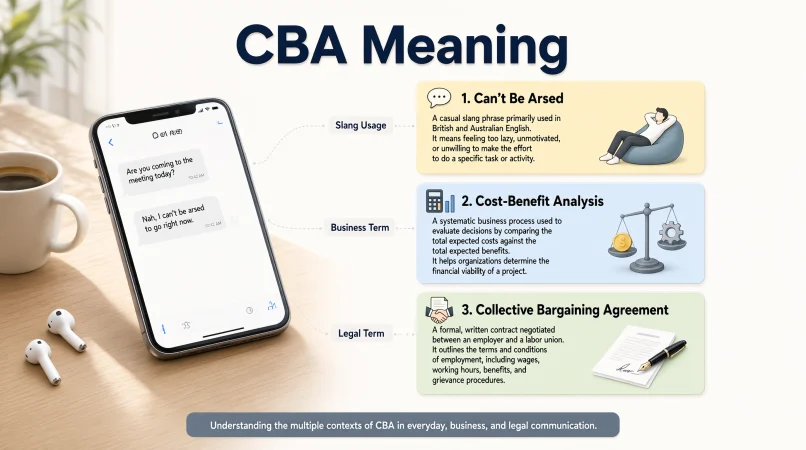
CBA most commonly means “Can’t Be Arsed” in texting and internet slang. It expresses that someone does not feel like doing something, usually because they are tired, bored, or simply not interested. In professional settings, CBA can also stand for Cost-Benefit Analysis or Collective Bargaining Agreement. Its intended meaning depends on the conversation and the situation in which it appears.
CBA is an abbreviation with several meanings, and the correct interpretation depends heavily on context. In casual conversations, particularly British internet slang, it usually stands for “Can’t Be Arsed.” People use it when they cannot be bothered to do something or lack the motivation to put in the effort.
For example, imagine a friend asks whether you want to go shopping after a long day. You might reply, “CBA today, I’m exhausted.” This communicates that you would rather relax than go out.
However, the abbreviation has a different purpose in business, economics, and employment discussions. Someone discussing a project might use CBA to mean Cost-Benefit Analysis, while an employee discussing workplace rights might use it to refer to a Collective Bargaining Agreement.
The important thing is not to assume that every person using these three letters means the same thing. Look at the surrounding words, the topic, and the relationship between the people communicating.
The Three Common Meanings at a Glance
| Abbreviation | Full Form | Common Context |
| CBA | Can’t Be Arsed | Texting, slang, and social media |
| CBA | Cost-Benefit Analysis | Business, economics, and planning |
| CBA | Collective Bargaining Agreement | Employment and labor relations |
These meanings are quite different, even though they use identical letters. Recognizing the context makes the abbreviation much easier to understand.
CBA Meaning in Texting and Social Media
Most common casual interpretation
On platforms such as WhatsApp, Snapchat, Instagram, TikTok, and Discord, CBA is commonly used as a shortcut for “Can’t Be Arsed.”
The expression communicates a lack of willingness, interest, or energy. It does not necessarily mean that someone physically cannot complete a task. Instead, they are saying they do not want to make the effort.
For example:
- “CBA getting out of bed today.”
- “I CBA dealing with all this drama.”
- “CBA cooking, let’s order pizza.”
- “I’ve got homework, but honestly, CBA.”
- “CBA watching another three-hour movie.”
Each sentence expresses a similar feeling, but the reason behind it changes.
Sometimes the person is physically tired. Other times, they are bored, frustrated, or simply choosing to spend their time doing something else.
Why Do People Use CBA in Messages?
Short abbreviations make digital conversations faster. Instead of typing an entire expression, someone can communicate their feelings with just three letters.
CBA is particularly useful in informal conversations because it conveys an attitude rather than simply describing an action.
Consider these two messages:
- “I don’t feel like going outside today.”
- “CBA going outside today.”
Both communicate a similar idea, but the second sounds more casual and conversational. It can also carry a slightly humorous or dismissive tone.
The expression is especially familiar in British and some other English-speaking online communities. However, its use is not limited to one country because social media allows slang to spread across different regions.
How CBA Is Used in Different Situations
Although the abbreviation generally communicates unwillingness, its emotional tone can change depending on the conversation.
Understanding these differences helps prevent misunderstandings, especially when messaging friends, family members, or coworkers.
1. When Someone Is Tired
One of the most common uses is expressing physical or mental exhaustion.
Example:
Friend: “Are you coming to the gym tonight?”
You: “CBA today. I barely slept last night.”
Here, the person is not necessarily rejecting exercise permanently. They simply do not have enough energy at that moment.
2. When Someone Is Bored
CBA can also describe a lack of interest in an activity.
Example:
Friend: “Let’s watch another episode.”
You: “CBA watching TV anymore. Let’s do something else.”
The abbreviation communicates that the activity no longer seems interesting.
3. When Someone Is Frustrated
Sometimes, the expression reflects irritation rather than laziness.
Example:
Friend: “You need to explain the same thing to him again.”
You: “CBA arguing with him anymore.”
In this situation, the speaker feels that continuing the discussion is not worth the effort.
4. When Someone Wants to Be Funny
Friends often use CBA jokingly to exaggerate how little motivation they have.
Example:
Friend: “Did you finish cleaning your room?”
You: “CBA. My bed is more interesting.”
The response is playful and informal. It makes the conversation feel relaxed rather than serious.
5. When Someone Is Avoiding a Task
A person may use the abbreviation when they want to postpone something.
Example:
I know I need to finish that assignment, but CBA right now.
This suggests that the person knows the task needs attention but does not currently feel motivated to complete it.
CBA in Business and Professional Communication
Outside casual messaging, CBA has an established meaning in business, finance, economics, and project management: Cost-Benefit Analysis.
A Cost-Benefit Analysis is a method of comparing the expected costs of a decision with its potential benefits. Organizations use it to determine whether a project, investment, or proposed action is financially or practically worthwhile.
Unlike the slang expression, this version has nothing to do with laziness or motivation. It is a decision-making tool.
How Does Cost-Benefit Analysis Work?
Imagine a company considering whether to purchase new computer equipment for its employees. The equipment will require an initial investment, but it may improve productivity and reduce maintenance expenses.
A basic analysis might look like this:
| Item | Estimated Amount |
| Equipment purchase | $10,000 |
| Installation costs | $1,000 |
| Training expenses | $500 |
| Expected annual savings | $5,000 |
| Expected annual productivity benefits | $4,000 |
The company compares the expected benefits against the total costs before making its decision.
The calculation is straightforward:
Net Benefit = Total Benefits − Total Costs
In this example, the company would need to consider the time period involved, recurring expenses, and whether the expected savings justify the initial investment.
Where Is This Meaning Used?
Cost-Benefit Analysis appears in several professional fields:
- Business management: Comparing the financial advantages of launching a new product.
- Government planning: Evaluating whether a public infrastructure project is worth funding.
- Healthcare: Comparing the costs and expected outcomes of different healthcare programs.
- Environmental planning: Assessing the economic effects of conservation projects.
- Project management: Deciding whether a proposed project deserves additional resources.
For instance, a local government might conduct an analysis before investing in a new public transportation system. It would consider construction expenses, maintenance, travel-time savings, and expected public benefits.
Organizations such as the World Bank use economic analysis when evaluating development projects. This is one reason the abbreviation appears frequently in formal reports and policy discussions.
CBA Meaning in Workplace Agreements
Another important interpretation is Collective Bargaining Agreement.
This is a written agreement negotiated between an employer and a labor union or employee representative organization. It establishes employment conditions and outlines the rights and responsibilities of the parties involved.
Unlike casual slang or financial calculations, this meaning is associated with employment law and labor relations.
What Does a Collective Bargaining Agreement Include?
A typical agreement may cover several aspects of employment, including:
- Wages and salary increases.
- Working hours and overtime arrangements.
- Paid holidays and vacation time.
- Health insurance and other employee benefits.
- Workplace safety requirements.
- Disciplinary procedures.
- Grievance procedures for resolving workplace disputes.
- Rules concerning promotions and job security.
For example, employees working for a large manufacturing company may be represented by a labor union. The union negotiates with management to establish fair wages, working conditions, and other employment benefits.
Once the agreement is finalized, its terms apply according to the agreement’s coverage and applicable labor laws.
Why Are These Agreements Important?
Collective bargaining provides employees with a structured way to negotiate employment conditions as a group rather than relying entirely on individual discussions with management.
It also gives employers a clearer framework for managing workplace policies and resolving disagreements.
In the United States, the National Labor Relations Board (NLRB) oversees important aspects of private-sector labor relations under the National Labor Relations Act. Collective bargaining is an established part of that system.
When you encounter CBA in an employment contract, union announcement, or labor-related news report, this is likely the intended interpretation.
Difference Between CBA and Similar Abbreviations
CBA is sometimes confused with other short expressions used in online conversations. Although some have similar meanings, they are not interchangeable.
Here are a few distinctions worth understanding.
| Abbreviation | Full Form | Meaning |
| CBA | Can’t Be Arsed | Does not feel like making an effort |
| IDK | I Don’t Know | Expresses uncertainty or lack of knowledge |
| IDC | I Don’t Care | Expresses indifference |
| TBH | To Be Honest | Introduces an honest opinion |
| NVM | Never Mind | Tells someone to disregard something |
| IMO | In My Opinion | Introduces a personal viewpoint |
| ICB | I Can’t Be | Depends on the conversation; less standardized |
CBA vs. IDC
These two abbreviations can sound similar, but they communicate different attitudes.
CBA suggests that someone does not want to make the effort to do something. IDC means that the person does not care about a particular subject or outcome.
For example:
- “CBA going to the party.” means the person does not feel like attending.
- “IDC who wins the game.” means the result does not matter to them.
One describes unwillingness, while the other expresses indifference.
CBA vs. IDK
IDK means “I Don’t Know.” It communicates uncertainty or a lack of information.
For example:
- “IDK what time the movie starts.”
- “CBA checking the schedule.”
The first person does not know the answer. The second person does not want to check.
CBA vs. TBH
TBH stands for “To Be Honest.” It is commonly used before sharing a personal thought or opinion.
For example:
- “TBH, I didn’t enjoy that movie.”
- “CBA watching it again.”
The first statement introduces an honest opinion. The second expresses a lack of willingness to repeat an activity.
Is CBA Rude or Offensive?
The slang expression “Can’t Be Arsed” is informal and mildly vulgar in some English-speaking environments. Whether it sounds rude depends on the audience, tone, and situation.
Among close friends, it is generally accepted as casual language. People may use it jokingly without intending to offend anyone.
However, using it in a professional email, formal meeting, or conversation with someone you do not know well can sound disrespectful.
When Is It Okay to Use CBA?
Here are some situations where the abbreviation is generally appropriate:
- With friends: When joking about being tired or unmotivated.
- In casual group chats: When discussing everyday activities.
- On social media: When posting humorous comments or relatable captions.
- With people familiar with the slang: When everyone understands its meaning.
When Should You Avoid It?
There are situations where using this expression might create the wrong impression.
For example, replying “CBA doing that” to your manager when they assign you a task could sound dismissive or unprofessional.
In formal communication, consider alternatives such as:
- “I don’t have the time at the moment.”
- “I’d prefer to do that later.”
- “I’m currently unavailable.”
- “I don’t think I can take that on right now.”
These expressions communicate a similar message without sounding unnecessarily casual.
Common Mistakes When Understanding CBA
Because CBA has several meanings, people sometimes misunderstand it when they encounter it in messages, articles, or professional documents.
Here are some common mistakes to avoid.
1. Assuming It Always Means Can’t Be Arsed
This is probably the most frequent misunderstanding.
Although the slang interpretation is common in casual conversations, CBA can refer to completely different concepts in professional settings.
If someone writes, “We need to complete a CBA before approving the investment,” they are almost certainly referring to Cost-Benefit Analysis.
2. Confusing It With I Don’t Care
CBA and IDC can sometimes communicate similar emotions, but their meanings are different.
Someone saying “CBA going out” does not necessarily mean they dislike their friends. They may simply be tired or unwilling to leave home.
3. Using It in Formal Communication
The slang version is not appropriate for every audience.
A message that sounds funny between friends might come across as disrespectful in a workplace conversation. Always consider who will read your message.
4. Ignoring the Surrounding Conversation
The easiest way to identify the intended meaning is to examine the words around the abbreviation.
A conversation about project expenses points toward Cost-Benefit Analysis. A discussion about employee wages may refer to a Collective Bargaining Agreement. A message about staying home probably uses the slang interpretation.
Context is usually more helpful than the abbreviation itself.
FAQ,s
1. Is CBA British slang?
Yes. “Can’t Be Arsed” is particularly associated with British English, although people in other English-speaking communities also use it online.
2. Is CBA appropriate for school assignments?
The slang version is generally unsuitable for formal academic writing. However, Cost-Benefit Analysis is perfectly appropriate when discussing economics, business, or research.
3. Can CBA be used as a reply to an invitation?
Yes. Someone might reply “CBA tonight” to indicate that they do not feel like attending. However, a friend could interpret it as dismissive, depending on the relationship.
4. Does CBA have the same meaning in American and British English?
Not always. The slang expression is more strongly associated with British English, while its recognition and frequency vary among American English speakers.
5. Should I use capital letters when writing CBA?
Both uppercase CBA and lowercase cba are common in digital conversations. Uppercase letters are more typical in professional abbreviations, while lowercase versions often appear in informal texting.
Conclusion
CBA is a useful abbreviation to recognize because its meaning changes significantly depending on where it appears. In casual messages, it usually expresses that someone cannot be bothered to do something, while in professional discussions it may refer to financial analysis or workplace agreements. Pay attention to the conversation before deciding what the speaker means. Once you understand the context, interpreting these three letters becomes much easier.