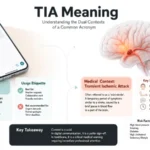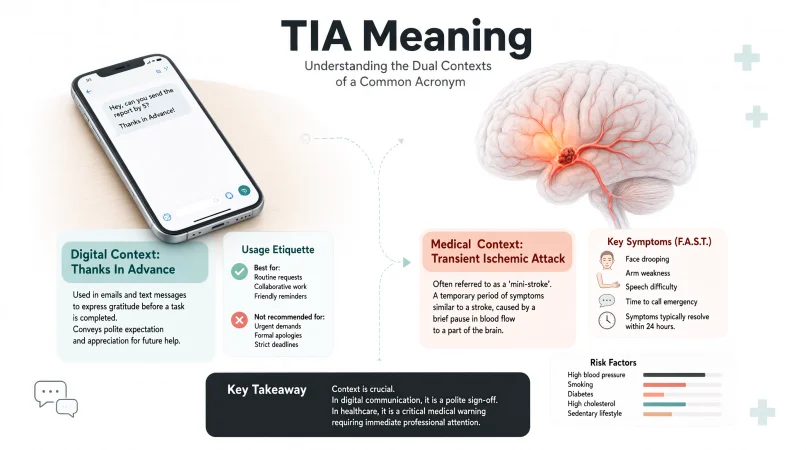
TIA most commonly means “Thanks in Advance” in texting, online conversations, and emails. People use it when asking someone for information, assistance, or a favor, usually to show appreciation before receiving help.
In healthcare, TIA stands for “Transient Ischemic Attack,” sometimes called a mini-stroke. It describes a temporary interruption of blood supply to the brain and is considered a medical emergency because it can signal an increased risk of a future stroke.
In texting, TIA usually means Thanks in Advance. It is a convenient abbreviation people use when asking friends, family members, classmates, or colleagues for help.
Instead of writing a complete thank-you sentence, someone can simply add TIA at the end of a request.
For example:
- “Can you send me the notes from yesterday’s class? TIA!”
- “Does anyone know a good restaurant nearby? TIA.”
- “Please let me know if you can help me with this assignment. TIA!”
- “Can someone explain how this application works? TIA.”
The expression communicates appreciation before the other person responds.
Why Do People Use TIA in Text Messages?
People prefer short expressions when communicating through messaging applications. Abbreviations make conversations quicker and help messages sound casual.
TIA is especially common in online communities where users ask questions and expect other members to provide answers.
You might encounter it on:
- WhatsApp conversations
- Facebook groups
- Instagram messages
- Reddit discussions
- Online forums
- School and university group chats
It is generally friendly and polite, although its tone depends on the rest of the message.
Is TIA Polite or Rude?
TIA is normally considered polite because it expresses gratitude. However, some people may interpret it differently if the request sounds demanding.
Compare these examples:
Polite: “Could you please share the presentation when you have time? TIA!”
Demanding: “Send me the presentation today. TIA.”
The abbreviation itself is not rude. The wording and attitude behind the request make the difference.
What Does TIA Mean in Emails?
In professional and personal emails, TIA also stands for Thanks in Advance.
People commonly place it near the end of an email when requesting assistance, documents, feedback, or information.
It can help communicate appreciation without adding an entire paragraph of thanks.
Professional Email Examples
Here are some situations where the abbreviation might appear:
1. Requesting Information
“Could you please share the updated project schedule before Friday? TIA.”
2. Asking for Feedback
“I’ve attached the latest version of the report. Please review it and share your suggestions. TIA.”
3. Requesting Assistance
“Would you be able to help me access the shared folder? TIA for your assistance.”
4. Asking a Colleague for Documents
“Could you forward me the meeting notes from yesterday’s discussion? TIA!”
Should You Use TIA in Formal Emails?
It depends on your workplace and relationship with the recipient.
TIA is acceptable in casual workplace communication, particularly when colleagues regularly use abbreviations. However, it may sound too informal when writing to senior executives, clients, unfamiliar contacts, or official organizations.
For more formal communication, consider these alternatives:
- Thank you in advance for your assistance.
- I appreciate your help with this request.
- Thank you for taking the time to review this.
- Your assistance would be greatly appreciated.
These expressions communicate the same basic message while maintaining a professional tone.
What Does TIA Mean in Medical Terms?
In medicine, TIA stands for Transient Ischemic Attack.
It describes a temporary episode in which blood flow to part of the brain is interrupted. This interruption can produce symptoms similar to those of a stroke, including weakness, difficulty speaking, and sudden vision problems.
A TIA is sometimes called a mini-stroke, but that nickname can make the condition sound less serious than it is.
A suspected TIA requires emergency medical assessment, even if symptoms disappear within minutes.
What Happens During a Transient Ischemic Attack?
The brain needs a continuous supply of oxygen-rich blood to function properly.
During a TIA, blood flow to an area of the brain is temporarily blocked or reduced. This can happen when a blood clot or another obstruction interferes with circulation.
Because the interruption is temporary, symptoms may disappear completely. However, the episode can indicate an underlying problem with blood vessels or circulation.
It should never be ignored.
Common Symptoms of TIA
Symptoms often begin suddenly and may resemble those of a stroke.
Common warning signs include:
- Facial weakness: One side of the face may droop or feel numb.
- Arm weakness: A person may struggle to lift or control one arm.
- Speech difficulties: Words may become unclear, or understanding speech may become difficult.
- Vision problems: Sudden blurred vision or loss of vision in one or both eyes can occur.
- Balance problems: Someone may experience sudden dizziness, difficulty walking, or loss of coordination.
- Numbness: Sudden numbness or weakness can affect one side of the body.
A useful way to remember major stroke warning signs is the FAST method:
| Letter | Meaning | What to Check |
| F | Face | Does one side of the face droop? |
| A | Arms | Is one arm weak or difficult to raise? |
| S | Speech | Is speech unclear or unusual? |
| T | Time | Seek emergency medical help immediately. |
Important: If someone experiences these symptoms, call emergency services immediately, even if the symptoms disappear. Do not wait to see whether they return.
What Causes a TIA?
Several factors can increase the likelihood of a transient ischemic attack.
Common causes and risk factors include:
- Blood clots that temporarily block blood flow.
- Narrowing of arteries supplying the brain.
- High blood pressure.
- Diabetes.
- High cholesterol.
- Smoking.
- Heart conditions such as atrial fibrillation.
- Increasing age.
Atrial fibrillation is an irregular heart rhythm that can allow blood clots to form in the heart and potentially travel toward the brain.
Not everyone with these risk factors will experience a TIA, but managing them can help reduce the risk of stroke.
Is a TIA the Same as a Stroke?
No. A TIA and a stroke are related, but they are not identical.
A TIA involves temporary neurological symptoms caused by a brief interruption of blood flow without an acute brain infarction. A stroke occurs when interrupted blood supply or bleeding causes brain injury.
Importantly, symptoms alone cannot reliably distinguish the two. Medical assessment and brain imaging may be needed to determine what happened.
A TIA is a warning sign, not a harmless event.
Different Meanings of TIA
Although two definitions are especially common, the abbreviation can represent different things in specialized settings.
Here is a simple comparison:
| TIA Meaning | Field | Explanation |
| Thanks in Advance | Texting | Expressing appreciation before receiving help. |
| Thanks in Advance | A short expression of gratitude in a request. | |
| Transient Ischemic Attack | Medicine | Temporary interruption of blood flow to the brain without acute infarction. |
| Telecommunications Industry Association | Technology | A US trade association involved in telecommunications standards and industry matters. |
| Tax Information Authorization | Taxation | A term that may be used in tax-related authorization contexts, depending on the jurisdiction. |
The first two uses are essentially the same expression in different communication settings.
The medical and technical meanings are separate concepts. This is why identifying the subject of a conversation is important before interpreting the abbreviation.
Examples of TIA in Everyday Conversations
Seeing an abbreviation in context makes its meaning easier to understand.
Here are some realistic examples of how people use it.
1. Asking a Friend for Help
Person A: “Do you know which movie we are watching tonight?”
Person B: “Not sure, but I’ll check the group chat.”
A Person: “Thanks! TIA.”
Here, the abbreviation expresses appreciation for the expected help.
2. Asking for Study Notes
“Hey, can anyone share their biology notes from Monday? I missed the lecture. TIA!”
This is a casual example of using the abbreviation in a student group.
3. Asking for Recommendations
“Looking for a good laptop under $800. Any suggestions? TIA!”
Someone uses it to thank people who might recommend suitable products.
4. Workplace Communication
“Could you please check the attached spreadsheet and confirm whether the figures are correct? TIA.”
In this situation, it is being used as a short professional courtesy.
5. Online Community Discussion
“Has anyone tried this particular photography software? I’d appreciate an honest review. TIA!”
Online communities frequently use short abbreviations when requesting opinions or experiences.
6. Medical Conversation
“My father was evaluated after experiencing sudden weakness and speech difficulties. The doctor mentioned a possible TIA.”
In this example, the abbreviation refers to a medical condition rather than a thank-you expression.
The surrounding words make the intended meaning clear.
TIA vs. Other Similar Abbreviations
TIA is not the only abbreviation used to express appreciation or communicate quickly online.
Some similar expressions have slightly different meanings and purposes.
| Abbreviation | Full Form | Typical Use |
| TIA | Thanks in Advance | Thanking someone before receiving help. |
| TY | Thank You | Expressing gratitude. |
| THX | Thanks | Casual way to say thank you. |
| TYSM | Thank You So Much | Showing stronger appreciation. |
| TTM | Talk To Me | Inviting someone to communicate. |
| BTW | By The Way | Introducing additional information. |
| FYI | For Your Information | Sharing useful information. |
TIA vs. TY
Both expressions communicate appreciation, but they are used at different moments.
TIA is generally used before someone helps you. TY is usually used after receiving assistance or something valuable.
For example:
- Before help: “Can you send me the document? TIA!”
- After help: “I received it. TY!”
TIA vs. THX
THX is a shortened version of thanks. It can be used whenever someone wants to express gratitude.
TIA specifically communicates appreciation in advance of a favor or response.
TIA vs. FYI
These abbreviations serve entirely different purposes.
TIA expresses gratitude, while FYI means “For Your Information.” The latter introduces information that someone may find useful.
Understanding these differences helps prevent confusion during online conversations.
When Should You Use TIA?
The abbreviation works best when you are asking someone for something and want to acknowledge their potential effort.
It is particularly useful in casual conversations, online discussions, and friendly workplace messages.
Good Situations for Using It
Consider using TIA when:
- Asking someone to share a document.
- Requesting recommendations.
- Asking a question in an online community.
- Requesting assistance from a colleague.
- Looking for information in a group chat.
- Asking someone to review your work.
When Should You Avoid It?
There are situations where writing the complete expression is a better choice.
Avoid relying on TIA when communicating with someone who may not understand internet abbreviations. It is also better to avoid it in highly formal correspondence, legal documents, medical reports, and official business communication.
In medical discussions, always write out the full term when clarity matters, especially if the recipient may not recognize the abbreviation.
A little extra wording can prevent significant misunderstandings.
Why Context Matters When Understanding TIA
Abbreviations often have multiple meanings because different industries and communities use the same letters.
TIA is a particularly interesting example because its everyday and medical definitions are so different.
Imagine receiving this message:
“Please send me the file when you get a chance. TIA!”
The meaning is almost certainly Thanks in Advance.
Now consider this statement:
“The patient was admitted to the hospital after experiencing symptoms consistent with a TIA.”
Here, the medical definition is clearly intended.
A few surrounding words can completely change the interpretation.
When reading unfamiliar abbreviations, consider the subject, the person using them, and the type of conversation. These clues usually provide enough information to understand the intended definition.
FAQ,s
1. What does TIA mean on social media?
On social media, TIA generally means Thanks in Advance. People use it when asking followers or community members for recommendations, information, or assistance.
2. Is TIA commonly used by younger people?
It is used across different age groups, particularly in online communities, text messages, and casual digital communication. It is not limited to one generation.
3. Should TIA have capital letters?
TIA is normally written in capital letters because it is an abbreviation. However, people may occasionally type it in lowercase during informal conversations.
4. Can TIA have a negative meaning?
The abbreviation itself is not generally negative. However, a demanding request ending with TIA may sound presumptuous depending on the wording and relationship between the people communicating.
5. Does a TIA always lead to a stroke?
No. A TIA does not mean a stroke will definitely happen. However, it is an important warning sign of increased future stroke risk and requires urgent medical evaluation.
Final Thoughts
TIA is a short abbreviation with more than one important meaning. In everyday communication, it usually stands for Thanks in Advance, making it a convenient way to express appreciation when requesting help. In healthcare, it refers to a transient ischemic attack, a serious warning sign that requires immediate medical attention. Understanding the subject and surrounding conversation will help you identify which definition is intended.