Quick Answer: Incident response examples show what organizations can say or do when something goes wrong, from phishing attacks and malware infections to data breaches, outages, and suspicious account activity. The best response depends on the incident, urgency, audience, and next action.
Phishing incident response, malware incident response, data breach response, ransomware response, security incident response
When something suddenly goes wrong, nobody wants to stare at a screen thinking, “Okay… what do we even do now?” Whether it is a suspicious email at work, a compromised account, a website outage, a malware alert, or a full-blown security incident, having clear incident response examples can make the next step much easier.
Good incident response is not just about technical fixes. It is also about communicating clearly with coworkers, customers, managers, IT teams, and security professionals while keeping panic out of the room. The right response helps people understand what happened, what is being investigated, what action is required, and what happens next.
From professional incident reports to quick workplace messages and practical response statements, these examples cover different situations and communication styles. Think of this list as your ready-to-use playbook for those “something just happened” moments.
Funny Incident Response Examples
“Well, that escalated quickly. The security team is already investigating.”
Use this internally when a minor incident suddenly becomes more complicated.
Meaning: You are acknowledging the situation with light humor while confirming action is underway.
“The server chose chaos today, but we are on it.”
Use this for a lighthearted internal update during a service disruption.
Meaning: You are making the outage feel less tense without minimizing the issue.
“Someone invited malware to the party, and security did not RSVP.”
Use this for internal cybersecurity awareness content.
Meaning: You are humorously describing an unwanted security event.
“Houston, we have an incident.”
Use this as a playful internal alert for a genuine technical problem.
Meaning: You are signaling that the team needs to pay attention.
“The firewall is having a very busy day.”
Use this when unusual network activity triggers investigation.
Meaning: You are describing increased security activity in an easygoing way.
“That login attempt was definitely not on our guest list.”
Use this when an unfamiliar login is detected.
Meaning: You are humorously pointing out suspicious account activity.
“The inbox tried something suspicious again.”
Use this for internal phishing-awareness communication.
Meaning: You are drawing attention to a potentially malicious email.
“Our systems need a tiny timeout.”
Use this during a temporary service disruption.
Meaning: You are using humor to describe a technical recovery period.
“The incident has entered its investigation era.”
Use this in an informal internal security update.
Meaning: You are saying the team is actively investigating what happened.
“Today’s surprise feature is definitely not a feature.”
Use this when an unexpected system behavior is discovered.
Meaning: You are joking about an issue that requires attention.
“Security spotted something weird, so detective mode is activated.”
Use this for a casual team update.
Meaning: You are saying the team is investigating suspicious activity.
“The good news is that someone noticed it.”
Use this when an incident is detected early.
Meaning: You are focusing on the positive value of quick detection.
Direct Incident Response Examples
“We detected suspicious activity and have started an investigation.”
Use this for an initial internal incident notification.
Meaning: You are clearly stating that an investigation has begun.
“The affected system has been isolated while we assess the situation.”
Use this after identifying a potentially compromised device.
Meaning: You are communicating that containment is underway.
“We are investigating a potential security incident.”
Use this before all facts have been confirmed.
Meaning: You are avoiding unsupported conclusions while acknowledging the issue.
“Access to the affected account has been temporarily restricted.”
Use this after detecting suspicious account behavior.
Meaning: You are explaining a containment action.
“The incident has been escalated to the appropriate security team.”
Use this when additional expertise is required.
Meaning: You are confirming that the issue has moved to the correct response level.
“We are currently assessing the scope and impact.”
Use this during the early investigation stage.
Meaning: You are saying that the team is determining how serious the incident is.
“Initial evidence indicates unauthorized activity.”
Use this when investigation findings support suspicious access.
Meaning: You are sharing an early finding without overstating certainty.
“Containment measures are currently in progress.”
Use this when the team is actively limiting the incident.
Meaning: You are confirming that immediate protective actions are being taken.
“We have identified the affected systems and are reviewing them.”
Use this after initial investigation.
Meaning: You are communicating that the scope is becoming clearer.
“The incident remains under active investigation.”
Use this when the investigation is not complete.
Meaning: You are telling stakeholders that work is still ongoing.
“Further updates will be provided as verified information becomes available.”
Use this when facts are still developing.
Meaning: You are promising factual updates without speculation.
“The immediate priority is containment, followed by recovery and review.”
Use this when explaining the response sequence.
Meaning: You are clearly outlining the main stages of the response.
Professional Incident Response Examples
“We have identified a security event and initiated our incident response procedures.”
Use this in a formal internal notification.
Meaning: You are confirming that established procedures are being followed.
“Our team is investigating the reported activity and assessing potential impact.”
Use this in a professional incident update.
Meaning: You are communicating investigation and impact assessment.
“The affected environment has been isolated as a precautionary measure.”
Use this when containment has occurred.
Meaning: You are explaining why access to a system was restricted.
“We are working to determine the nature, scope, and duration of the incident.”
Use this during an ongoing investigation.
Meaning: You are outlining the key questions investigators are addressing.
“The incident has been escalated according to our established response procedures.”
Use this for management or stakeholder communication.
Meaning: You are confirming that escalation protocols are being followed.
“At this stage, the investigation remains ongoing.”
Use this when findings are incomplete.
Meaning: You are clearly communicating uncertainty.
“We are coordinating with relevant technical and security teams.”
Use this when multiple teams are involved.
Meaning: You are showing that the response is coordinated.
“Containment actions have been implemented while the investigation continues.”
Use this after protective measures are applied.
Meaning: You are confirming that the immediate risk is being addressed.
“We are reviewing relevant logs and system activity to establish a timeline.”
Use this when forensic investigation is underway.
Meaning: You are explaining how the team is reconstructing events.
“The response team is prioritizing systems based on risk and business impact.”
Use this when multiple affected systems require attention.
Meaning: You are explaining how response priorities are determined.
“We will communicate confirmed findings through the appropriate channels.”
Use this when stakeholders are waiting for updates.
Meaning: You are emphasizing controlled and accurate communication.
“The incident response process will conclude with a documented lessons-learned review.”
Use this when explaining the full response lifecycle.
Meaning: You are confirming that post-incident improvement will be part of the process.
Cybersecurity Incident Response Examples
“A suspicious authentication event was detected and is being investigated.”
Use this after unusual login activity is identified.
Meaning: You are documenting a potential account security issue.
“The affected credentials have been secured while the investigation continues.”
Use this after suspected credential compromise.
Meaning: You are communicating an immediate protective measure.
“Endpoint security detected potentially malicious activity on the device.”
Use this when an endpoint alert triggers investigation.
Meaning: You are describing the reason the device requires attention.
“Network traffic associated with the affected host has been restricted.”
Use this during network containment.
Meaning: You are communicating that potentially risky communication has been limited.
“Security logs are being reviewed to identify related activity.”
Use this during investigation.
Meaning: You are explaining how analysts are looking for additional evidence.
“The security team is assessing whether other systems were affected.”
Use this after detecting a potentially broader incident.
Meaning: You are communicating that investigators are checking the incident’s scope.
“The suspicious process has been contained pending further analysis.”
Use this when malicious or unusual software behavior is identified.
Meaning: You are describing a precautionary containment action.
“Indicators associated with the incident are being reviewed across the environment.”
Use this during threat hunting.
Meaning: You are explaining that analysts are checking for related activity elsewhere.
“The affected account has been secured and authentication activity is being reviewed.”
Use this for a possible account takeover.
Meaning: You are communicating both containment and investigation.
“The incident has been classified for further security analysis.”
Use this after initial triage.
Meaning: You are indicating that the event requires deeper investigation.
“Security controls have been reviewed to determine whether additional protective actions are necessary.”
Use this during incident assessment.
Meaning: You are explaining that defenses are being evaluated.
“The investigation will continue until the available evidence supports closure.”
Use this when explaining why an incident remains open.
Meaning: You are emphasizing evidence-based resolution.
Phishing Incident Response Examples
“We identified a suspicious email and are investigating its origin.”
Use this after an employee reports a questionable message.
Meaning: You are confirming that the email is being examined.
“Please do not click links or open attachments in the reported message.”
Use this when a suspicious email may still be circulating.
Meaning: You are giving recipients an immediate protective instruction.
“The reported email has been forwarded to the security team for analysis.”
Use this after receiving a phishing report.
Meaning: You are confirming that security professionals are reviewing it.
“The message has been identified as potentially malicious.”
Use this when analysis has not yet reached a final conclusion.
Meaning: You are warning users without overstating certainty.
“We are checking whether any recipients interacted with the message.”
Use this during phishing investigation.
Meaning: You are assessing potential exposure.
“Users who interacted with the message should report it immediately.”
Use this in an internal awareness notice.
Meaning: You are encouraging fast reporting after possible exposure.
“The suspicious domain is being reviewed and appropriate controls are being considered.”
Use this when investigating a phishing website.
Meaning: You are communicating that technical safeguards are being assessed.
“The email has been removed from identified mailboxes where appropriate.”
Use this after a phishing campaign is confirmed.
Meaning: You are explaining a containment step.
“We are reviewing authentication activity associated with reported recipients.”
Use this if phishing credentials may have been submitted.
Meaning: You are describing an investigation into possible account compromise.
“No conclusions have been made until the investigation is complete.”
Use this when information is still developing.
Meaning: You are preventing premature assumptions.
“Thank you for reporting the message quickly.”
Use this when an employee identifies phishing.
Meaning: You are reinforcing positive security behavior.
“When in doubt, report first and investigate through the proper channel.”
Use this for security awareness communication.
Meaning: You are encouraging users to seek help instead of interacting with suspicious content.
Malware Incident Response Examples
“Malware activity was detected on an endpoint and containment has begun.”
Use this after an endpoint security alert.
Meaning: You are communicating detection and immediate response.
“The affected device has been isolated from the network.”
Use this when network isolation is performed.
Meaning: You are explaining a key containment measure.
“The suspicious file is being analyzed by the security team.”
Use this while investigating a potentially malicious file.
Meaning: You are confirming that technical analysis is underway.
“We are checking for similar indicators across other endpoints.”
Use this after malware is identified.
Meaning: You are communicating that the investigation is looking beyond one device.
“The endpoint remains isolated pending investigation.”
Use this when analysis is still underway.
Meaning: You are explaining why normal access has not been restored.
“Security tools detected behavior requiring further analysis.”
Use this when the exact malware classification is unknown.
Meaning: You are describing suspicious behavior without making an unsupported claim.
“Relevant logs and endpoint activity are being reviewed.”
Use this during malware investigation.
Meaning: You are explaining the evidence-gathering process.
“The affected system will be restored after security checks are completed.”
Use this when recovery depends on investigation.
Meaning: You are connecting recovery to verification.
“Potentially affected systems are being reviewed as a precaution.”
Use this when the scope is uncertain.
Meaning: You are communicating proactive investigation.
“The malicious activity has been contained based on current findings.”
Use this after successful containment.
Meaning: You are reporting that the immediate threat has been limited.
“The incident is being monitored for additional indicators.”
Use this after initial containment.
Meaning: You are explaining that the team remains alert for recurrence.
“Recovery will proceed after the affected environment has been validated.”
Use this when restoration requires verification.
Meaning: You are emphasizing safe recovery rather than rushing the process.
Data Breach Incident Response Examples
“We are investigating a potential unauthorized disclosure of information.”
Use this when a possible data exposure is first identified.
Meaning: You are acknowledging the possibility without declaring a confirmed breach.
“The investigation is focused on determining what information may have been accessed.”
Use this when assessing potential exposure.
Meaning: You are explaining the scope of the investigation.
“Access to the affected environment has been restricted while the investigation continues.”
Use this during containment.
Meaning: You are communicating that access controls have been strengthened.
“We are reviewing available records to establish the timeline of events.”
Use this during forensic investigation.
Meaning: You are explaining how investigators are reconstructing what happened.
“The organization is assessing whether personal or confidential information was involved.”
Use this when the data type is uncertain.
Meaning: You are communicating that data classification is part of the investigation.
“Relevant security and privacy teams have been engaged.”
Use this when a potential breach requires multiple specialists.
Meaning: You are confirming cross-functional response.
“The scope of the potential exposure remains under investigation.”
Use this before the investigation is complete.
Meaning: You are clearly stating that the facts are not yet final.
“Additional protective measures have been implemented as a precaution.”
Use this when extra controls are introduced.
Meaning: You are explaining that the organization is reducing potential risk.
“Affected parties will be notified through appropriate channels when required.”
Use this when notification obligations are being assessed.
Meaning: You are communicating that notification decisions will follow applicable requirements.
“We are continuing to validate the available evidence.”
Use this when forensic findings require confirmation.
Meaning: You are emphasizing accuracy before making conclusions.
“The investigation will determine the nature and extent of any unauthorized access.”
Use this for an early breach statement.
Meaning: You are explaining what the investigation must establish.
“We are prioritizing containment, evidence preservation, and accurate communication.”
Use this when explaining response priorities.
Meaning: You are highlighting the core goals of a careful breach response.
Ransomware Incident Response Examples
“Ransomware activity has been detected, and affected systems are being isolated.”
Use this during an initial ransomware response.
Meaning: You are communicating detection and containment.
“Potentially affected systems have been restricted from network access.”
Use this when isolation measures are applied.
Meaning: You are explaining how further spread is being limited.
“The security team is assessing the scope of affected systems.”
Use this after detecting ransomware activity.
Meaning: You are communicating that the team is determining how widespread the incident may be.
“We are preserving relevant evidence while containment continues.”
Use this during forensic response.
Meaning: You are emphasizing investigation alongside containment.
“Critical business services are being assessed for operational impact.”
Use this when ransomware affects business systems.
Meaning: You are explaining how the organization is evaluating disruption.
“Recovery priorities are being established based on business and operational requirements.”
Use this during recovery planning.
Meaning: You are explaining how systems will be prioritized for restoration.
“The affected environment remains under security investigation.”
Use this while technical analysis continues.
Meaning: You are communicating that the incident is not yet closed.
“We are reviewing available recovery resources and validated backups.”
Use this during recovery planning.
Meaning: You are explaining that restoration options are being evaluated.
“No recovery action will proceed until the relevant systems are assessed.”
Use this when safe restoration requires verification.
Meaning: You are emphasizing controlled recovery.
“The incident response team is coordinating technical and business recovery efforts.”
Use this when multiple teams are involved.
Meaning: You are communicating that recovery is being managed across the organization.
“Additional security controls are being evaluated before systems return to normal operations.”
Use this during recovery.
Meaning: You are showing that restoration includes risk reduction.
“Post-incident review will focus on strengthening resilience and response capabilities.”
Use this after containment and recovery.
Meaning: You are emphasizing improvement after the incident.
IT Outage Incident Response Examples
“We are investigating an unexpected service interruption.”
Use this for an initial outage notice.
Meaning: You are confirming that the issue is being investigated.
“The technical team is working to identify the cause.”
Use this when the root cause is unknown.
Meaning: You are communicating that troubleshooting is underway.
“Some users may experience limited service availability.”
Use this when an outage affects only part of the environment.
Meaning: You are clearly describing the expected user impact.
“Service restoration efforts are currently in progress.”
Use this during active recovery.
Meaning: You are confirming that the team is working to restore normal operation.
“We have identified an issue affecting system availability.”
Use this after confirming the problem.
Meaning: You are communicating the basic nature of the outage.
“The incident has been escalated to the infrastructure team.”
Use this when specialist support is needed.
Meaning: You are confirming that the issue has reached the appropriate team.
“We are monitoring system performance following the latest recovery action.”
Use this after making a change.
Meaning: You are checking whether the fix has worked.
“Services are gradually returning to normal operation.”
Use this during partial recovery.
Meaning: You are communicating progress without claiming full restoration.
“The underlying cause is still being investigated.”
Use this when service is restored but the root cause is unclear.
Meaning: You are distinguishing recovery from completed investigation.
“We appreciate your patience while the team works through the issue.”
Use this for customer or employee communication.
Meaning: You are acknowledging the inconvenience caused by the outage.
“The incident remains under active monitoring.”
Use this after service restoration.
Meaning: You are confirming that the team is watching for recurrence.
“A post-incident review will be completed to identify improvement opportunities.”
Use this after resolving an outage.
Meaning: You are committing to learning from the disruption.
Customer-Facing Incident Response Examples
“We are aware of the issue and our team is actively investigating.”
Use this as an initial customer update.
Meaning: You are acknowledging the problem and confirming action.
“We understand the disruption this may cause and appreciate your patience.”
Use this during a service incident.
Meaning: You are recognizing customer inconvenience respectfully.
“Our technical team is working to restore normal service.”
Use this during an outage.
Meaning: You are giving customers a clear status update.
“We have identified the issue and are working on a resolution.”
Use this when the problem has been confirmed.
Meaning: You are communicating progress without unnecessary technical detail.
“Some customers may experience intermittent service while recovery continues.”
Use this during partial restoration.
Meaning: You are setting realistic expectations.
“We will provide another update once verified information is available.”
Use this when the investigation is ongoing.
Meaning: You are promising factual communication rather than speculation.
“Your report has been received and escalated to our support team.”
Use this after a customer reports suspicious activity.
Meaning: You are confirming that the concern has reached the appropriate team.
“We are reviewing the situation and will take appropriate action based on our findings.”
Use this when the investigation is not complete.
Meaning: You are keeping the message measured and professional.
“We have implemented additional safeguards while the investigation continues.”
Use this when protective measures are introduced.
Meaning: You are reassuring customers that precautions are being taken.
“The issue has been resolved, and services are operating normally.”
Use this after successful recovery.
Meaning: You are clearly communicating restoration.
“We are continuing to monitor the environment following resolution.”
Use this after an incident has been contained.
Meaning: You are explaining that monitoring continues after recovery.
“Thank you for bringing this to our attention.”
Use this when a customer reports an issue.
Meaning: You are reinforcing the value of timely reporting.
Executive Incident Response Examples
“A security incident has been identified and response procedures are active.”
Use this for a concise executive briefing.
Meaning: You are providing leadership with the essential status.
“The immediate priority is containment and protection of critical operations.”
Use this when explaining response priorities to leadership.
Meaning: You are focusing attention on immediate risk reduction.
“The investigation is ongoing, and the current scope remains under assessment.”
Use this when facts are incomplete.
Meaning: You are clearly communicating uncertainty.
“Relevant technical and business teams are coordinating the response.”
Use this for leadership updates.
Meaning: You are confirming cross-functional coordination.
“Current evidence is being validated before further conclusions are communicated.”
Use this when executives need reliable information.
Meaning: You are emphasizing accuracy over speed.
“The incident has been escalated according to established governance procedures.”
Use this when formal escalation is required.
Meaning: You are confirming that the appropriate governance process is active.
“Operational impact is being assessed alongside security risk.”
Use this when an incident affects business operations.
Meaning: You are communicating that both security and business consequences matter.
“Recovery priorities have been established based on critical business functions.”
Use this during a major disruption.
Meaning: You are explaining how restoration decisions are being made.
“The response team is maintaining a documented timeline of key events and actions.”
Use this during a serious investigation.
Meaning: You are confirming disciplined incident management.
“Stakeholder communications will continue as material information is confirmed.”
Use this when leadership expects updates.
Meaning: You are establishing a controlled communication process.
“The current response remains focused on containment, recovery, and evidence preservation.”
Use this during an active incident.
Meaning: You are summarizing the major response objectives.
“A formal post-incident review will identify lessons and corrective actions.”
Use this after recovery.
Meaning: You are emphasizing accountability and improvement.
Incident Report Examples
“At 09:15, the security team received an alert indicating unusual authentication activity.”
Use this in a chronological incident report.
Meaning: You are documenting when the incident was first detected.
“The affected endpoint was isolated at 09:32.”
Use this when recording a containment action.
Meaning: You are creating a precise timeline of response activity.
“Initial analysis identified suspicious activity associated with the affected account.”
Use this in an investigation summary.
Meaning: You are recording an early finding without overclaiming.
“The incident was escalated for further investigation.”
Use this when the event requires additional analysis.
Meaning: You are documenting the escalation point.
“Relevant system and authentication logs were reviewed.”
Use this in the investigation section of a report.
Meaning: You are documenting the evidence reviewed.
“No additional affected systems were identified during the initial review.”
Use this when the investigation finds no further impact at that stage.
Meaning: You are reporting a limited finding while leaving room for continued review.
“Containment measures were implemented to reduce potential further impact.”
Use this when documenting protective actions.
Meaning: You are explaining why containment was performed.
“The incident was classified based on available evidence and business impact.”
Use this when documenting incident severity.
Meaning: You are explaining how the incident was categorized.
“Recovery activities began after containment was validated.”
Use this in a post-incident timeline.
Meaning: You are showing that recovery followed a controlled sequence.
“Normal service was restored after the affected environment was reviewed.”
Use this when documenting resolution.
Meaning: You are recording the transition from recovery to normal operations.
“The investigation identified opportunities to strengthen existing controls.”
Use this in the lessons-learned section.
Meaning: You are identifying improvements without assigning unnecessary blame.
“The incident was closed after required response and review activities were completed.”
Use this as a formal closing statement.
Meaning: You are confirming that the incident lifecycle has ended.
Short And Casual Incident Response Examples
“We spotted it and we’re looking into it.”
Use this for a quick internal status update.
Meaning: You are communicating detection and investigation in simple language.
“The team is on it.”
Use this when people need quick reassurance.
Meaning: You are saying that someone is actively handling the issue.
“We’ve isolated the affected system.”
Use this for a short technical update.
Meaning: You are confirming that containment has started.
“Still investigating, no final answer yet.”
Use this when the facts are incomplete.
Meaning: You are being transparent about uncertainty.
“We found the issue and are working on the fix.”
Use this after identifying the problem.
Meaning: You are communicating progress in plain language.
“The incident is being handled by security.”
Use this when another team owns the response.
Meaning: You are directing attention to the responsible team.
“We’re checking whether anything else was affected.”
Use this during scope assessment.
Meaning: You are saying that the investigation is still expanding.
“Service is coming back online.”
Use this during recovery.
Meaning: You are telling users that restoration is underway.
“We’re monitoring things closely.”
Use this after initial recovery.
Meaning: You are communicating continued observation.
“Thanks for flagging this.”
Use this when someone reports an incident.
Meaning: You are appreciating their quick action.
“More details once we verify everything.”
Use this when people are asking for information too early.
Meaning: You are prioritizing accuracy before sharing details.
“For now, please avoid the affected system.”
Use this when immediate user action is required.
Meaning: You are giving a clear protective instruction.
Confident Incident Response Examples
“We identified the issue and have containment measures in place.”
Use this when communicating a controlled response.
Meaning: You are showing that the situation is being actively managed.
“The response team has taken the necessary initial actions.”
Use this when stakeholders need reassurance.
Meaning: You are confirming that immediate response steps have occurred.
“The incident is being managed through established procedures.”
Use this for professional stakeholder communication.
Meaning: You are emphasizing that the response is structured.
“The affected environment has been secured while investigation continues.”
Use this after containment.
Meaning: You are communicating both protection and ongoing investigation.
“We are focused on verified facts and measurable next steps.”
Use this when communication risks becoming speculative.
Meaning: You are emphasizing evidence and action.
“The situation is under active control while the investigation proceeds.”
Use this when containment is established.
Meaning: You are communicating that the response is progressing.
“Response priorities have been clearly established.”
Use this when multiple teams are involved.
Meaning: You are showing that the response has direction.
“We have moved from detection into active containment.”
Use this during a cybersecurity incident.
Meaning: You are clearly identifying the current response stage.
“Recovery will begin once the environment meets the required security checks.”
Use this during restoration planning.
Meaning: You are emphasizing controlled recovery.
“The team is addressing the incident systematically.”
Use this when stakeholders need confidence in the process.
Meaning: You are communicating organized response activity.
“Current findings are being validated before they are finalized.”
Use this when investigation results are still developing.
Meaning: You are demonstrating careful decision-making.
“The next update will focus on confirmed impact and response progress.”
Use this when planning stakeholder communication.
Meaning: You are setting clear expectations for future updates.
FAQs
What Are Incident Response Examples?
Incident response examples are sample statements, actions, reports, and communications used when responding to security incidents, IT problems, outages, breaches, malware, phishing, and other unexpected events.
What Is A Good Incident Response Example?
A strong example is: “We detected suspicious activity and have started an investigation.” It communicates the issue without making unsupported claims.
What Are Common Cybersecurity Incident Response Examples?
Common examples include phishing response, malware containment, ransomware response, compromised-account investigation, data breach assessment, suspicious login investigation, and network security incidents.
How Should An Incident Response Message Sound?
It should be clear, calm, factual, concise, and appropriate for the audience. Avoid unnecessary technical jargon when communicating with nontechnical readers.
Can Incident Response Examples Be Used Professionally?
Yes. Professional examples can be adapted for incident reports, customer notices, executive updates, internal alerts, security tickets, and workplace communication.
What Should You Say If You Do Not Know What Happened Yet?
Say that the incident is under investigation and that more information will be shared when verified. Avoid guessing about the cause or impact.
Is Humor Appropriate In Incident Response?
Humor can work in informal internal communication about minor issues, but it should be avoided when communicating serious incidents, customer impact, legal matters, privacy concerns, or major security events.
What Is An Incident Response Statement?
An incident response statement is a concise message explaining what happened, what is currently known, what actions are being taken, and what people should expect next.
What Should A Cybersecurity Incident Response Include?
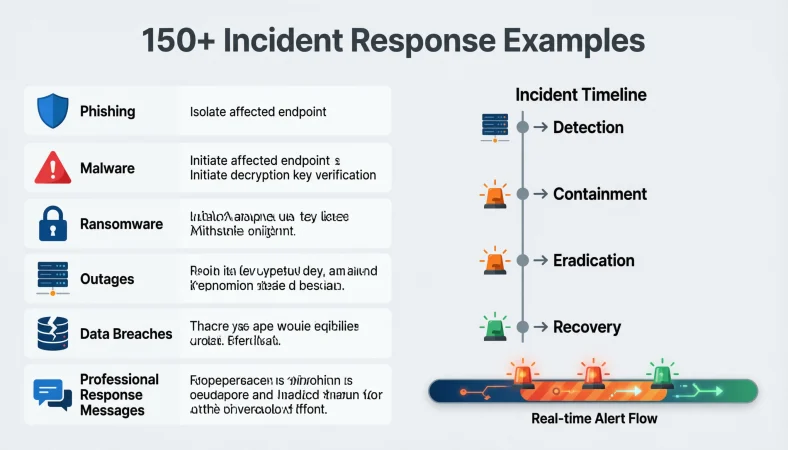
It commonly includes detection, triage, containment, investigation, eradication, recovery, communication, documentation, and lessons learned.
Why Are Incident Response Examples Useful?
They help teams communicate faster and more consistently during stressful situations while reducing vague, confusing, or premature statements.
Conclusion
Good incident response examples are more than ready-made sentences. They show how to communicate clearly when pressure is high and information is still changing. Whether you are handling a phishing attempt, malware alert, ransomware event, data exposure, system outage, or customer-impacting disruption, the right words can help people understand what happened and what they should do next.
Keep your responses factual, concise, calm, and appropriate for the audience. Mix short updates with detailed incident reports when needed, and always separate confirmed facts from assumptions. Save this list as a practical reference, share it with your team, and reuse the examples that fit your organization’s communication style. When the next incident happens, you will be ready to respond with clarity instead of confusion.