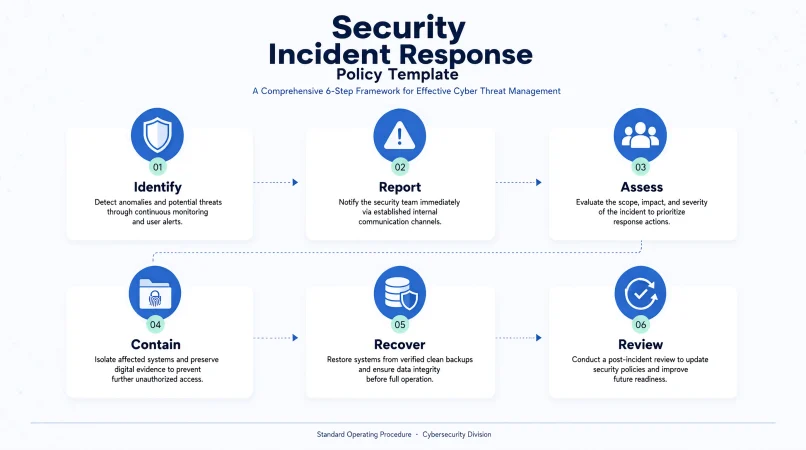
A security incident response policy template helps organizations prepare for, identify, manage, and recover from cybersecurity incidents with clear responsibilities and procedures. It provides a practical framework for handling data breaches, ransomware attacks, suspicious activity, and other security threats.
Top alternatives: Cybersecurity Incident Response Policy Template, IT Security Incident Management Policy, Data Breach Response Plan Template, Cyber Incident Response Procedure, Information Security Incident Management Framework.
Cybersecurity problems rarely arrive at a convenient time. One minute, your team is handling everyday work, and the next, someone reports a suspicious login, a ransomware alert appears, or sensitive information ends up where it should not be. Suddenly, everyone has questions, and nobody wants to be the person asking, “So, what’s the plan?”
That’s where a security incident response policy template becomes essential. It gives your organization a structured starting point for identifying threats, assigning responsibilities, containing damage, and restoring normal operations. Whether you manage a small business, lead an IT department, or oversee enterprise security, having a documented response policy can make stressful situations easier to manage.
Think of it as your cybersecurity emergency playbook. Instead of making decisions under pressure, your team follows established procedures, communicates clearly, and documents important actions. A well-prepared policy cannot prevent every attack, but it can help your organization respond faster, reduce confusion, protect critical information, and learn from every incident.
1. Professional Security Incident Response Policy Templates
A professional policy establishes the foundation for consistent incident handling across your organization. These templates are useful when defining responsibilities, approval processes, and formal security procedures.
1. Enterprise Security Response Framework
Example: Suitable for an organization formalizing its cybersecurity governance program.
Meaning: Establishes a consistent framework for managing security incidents across departments.
2. Corporate Incident Management Policy
Example: Appropriate when multiple business units need to follow the same incident reporting procedures.
Meaning: Standardizes incident management responsibilities and reporting expectations.
3. Information Security Incident Policy
Example: Useful when documenting how employees and IT personnel should report security concerns.
Meaning: Defines the organization’s approach to identifying and managing information security incidents.
4. Executive Incident Response Policy
Example: Helpful when senior leadership needs clear escalation and decision-making responsibilities.
Meaning: Clarifies executive involvement during significant cybersecurity incidents.
5. IT Security Incident Handling Template
Example: Suitable for an IT department developing repeatable incident handling procedures.
Meaning: Outlines the essential steps for managing technical security incidents.
6. Organization-Wide Security Policy
Example: Useful when employees across different departments need consistent reporting guidance.
Meaning: Establishes shared security incident responsibilities throughout the organization.
7. Formal Cybersecurity Response Policy
Example: Appropriate for organizations introducing a documented incident response program.
Meaning: Provides a formal structure for responding to cybersecurity threats.
8. Security Governance Policy Template
Example: Helpful when connecting incident response procedures with existing security governance.
Meaning: Defines how incident response decisions align with organizational oversight.
9. Centralized Incident Response Policy
Example: Suitable for businesses coordinating security incidents across multiple offices.
Meaning: Establishes consistent procedures for centralized incident management.
10. Security Operations Policy
Example: Useful when a security operations team needs documented incident handling expectations.
Meaning: Defines operational responsibilities for detecting and managing security incidents.
2. Funny but Workplace-Friendly Security Policy Ideas
Cybersecurity policies do not need to sound painfully boring. These lighthearted examples can make internal training more memorable without compromising professional standards.
1. No Clicking First, Asking Later
Example: Useful for an employee awareness campaign about suspicious email attachments.
Meaning: Encourages employees to verify unexpected links before clicking.
2. Suspicious Email, Immediate Side-Eye
Example: Suitable for a phishing awareness poster in the workplace.
Meaning: Reminds staff to question unusual messages.
3. Report It Before It Becomes a Monday Problem
Example: Helpful for encouraging early reporting of security alerts.
Meaning: Emphasizes the importance of reporting incidents promptly.
4. Passwords Are Not Public Announcements
Example: Appropriate for a security awareness presentation about credential protection.
Meaning: Reinforces the importance of keeping passwords confidential.
5. Weird Login? Raise the Alarm
Example: Useful when explaining how to report unfamiliar account activity.
Meaning: Encourages employees to report suspicious authentication events.
6. Don’t Feed the Phishing Emails
Example: Suitable for a short cybersecurity training session.
Meaning: Discourages employees from interacting with potentially malicious messages.
7. When in Doubt, Report It Out
Example: Helpful when employees are unsure whether an event qualifies as a security incident.
Meaning: Encourages reporting instead of ignoring suspicious activity.
8. Your Inbox Is Not a Trust Exercise
Example: Appropriate for teaching employees to inspect unexpected attachments.
Meaning: Promotes caution when handling unfamiliar emails.
9. Click Less, Verify More
Example: Useful for a quick reminder about safe browsing habits.
Meaning: Encourages verification before interacting with unfamiliar content.
10. Keep Calm and Follow the Playbook
Example: Suitable for a tabletop exercise involving a simulated cyberattack.
Meaning: Reminds responders to follow established procedures under pressure.
3. Strict and High-Priority Incident Response Templates
Some incidents demand immediate attention and clearly defined authority. These templates help organizations establish priorities for serious threats while avoiding unnecessary confusion.
1. Critical Incident Escalation Policy
Example: Useful when a suspected ransomware attack requires immediate leadership involvement.
Meaning: Defines when incidents must be escalated to senior responders.
2. High-Severity Incident Procedure
Example: Appropriate for a confirmed compromise of a critical business application.
Meaning: Establishes priority handling for incidents with significant potential impact.
3. Emergency Security Response Policy
Example: Suitable for a major breach affecting essential business operations.
Meaning: Documents urgent response responsibilities and decision-making procedures.
4. Mandatory Incident Reporting Policy
Example: Helpful when employees need explicit instructions for reporting suspected breaches.
Meaning: Establishes reporting obligations and approved reporting channels.
5. Critical Asset Protection Procedure
Example: Useful when an incident threatens sensitive databases or essential infrastructure.
Meaning: Prioritizes the protection of high-value organizational assets.
6. Security Incident Authority Matrix
Example: Appropriate when teams disagree about who can isolate a compromised system.
Meaning: Clarifies decision-making authority during incident response.
7. Immediate Threat Containment Policy
Example: Suitable for documenting who can disconnect an affected device from the network.
Meaning: Establishes approved containment actions and authorization requirements.
8. Major Data Breach Response Policy
Example: Helpful when sensitive customer information may have been exposed.
Meaning: Defines responsibilities for investigating and managing significant data breaches.
9. Security Incident Escalation Matrix
Example: Useful when different incident severity levels require different response teams.
Meaning: Maps incident severity to appropriate escalation pathways.
10. High-Risk Account Compromise Policy
Example: Appropriate when an administrator account shows signs of unauthorized access.
Meaning: Defines how privileged account compromises should be handled.
4. Data Breach and Privacy Incident Response Templates
Data breaches can expose customer records, employee information, financial data, or confidential business documents. A dedicated response policy helps teams coordinate investigation, containment, documentation, and any required notifications.
1. Personal Data Breach Response Policy
Example: Useful when an employee discovers that personal information may have been disclosed without authorization.
Meaning: Defines procedures for investigating and managing suspected personal data breaches.
2. Customer Information Protection Template
Example: Appropriate for businesses that store customer contact details or account information.
Meaning: Establishes responsibilities for responding to incidents involving customer data.
3. Confidential Data Exposure Policy
Example: Helpful when confidential documents appear in an unauthorized location.
Meaning: Guides the investigation and containment of sensitive information exposure.
4. Privacy Incident Escalation Procedure
Example: Suitable when a suspected privacy incident requires review by legal or privacy personnel.
Meaning: Defines when privacy-related incidents must be escalated.
5. Data Loss Incident Response Plan
Example: Useful when files disappear or become inaccessible after a security event.
Meaning: Establishes procedures for investigating and responding to potential data loss.
6. Unauthorized Data Access Policy
Example: Appropriate when an account accesses records outside its authorized permissions.
Meaning: Defines how unauthorized data access should be investigated.
7. Data Exfiltration Response Template
Example: Helpful when monitoring systems indicate that information may have been transferred externally without authorization.
Meaning: Guides investigation into suspected unauthorized data transfers.
8. Privacy Notification Procedure
Example: Suitable when a confirmed incident may trigger legal notification requirements.
Meaning: Establishes how notification obligations are assessed and fulfilled.
9. Sensitive Document Exposure Policy
Example: Useful when internal documents are accidentally shared with external recipients.
Meaning: Defines the steps for containing and assessing document exposure.
5. Ransomware and Malware Incident Response Templates
Malware incidents can disrupt systems, encrypt files, steal credentials, and interrupt business operations. A specialized response policy helps teams prepare for containment, investigation, recovery, and evidence preservation.
1. Ransomware Incident Response Policy
Example: Useful when preparing procedures for a suspected ransomware infection.
Meaning: Establishes responsibilities for containing and recovering from ransomware incidents.
2. Malware Detection and Response Template
Example: Appropriate when endpoint protection identifies a potentially malicious file.
Meaning: Defines how detected malware should be investigated and handled.
3. Infected Endpoint Isolation Policy
Example: Suitable for situations in which a workstation may be communicating with malicious infrastructure.
Meaning: Establishes approved procedures for isolating potentially compromised devices.
4. Business System Malware Procedure
Example: Helpful when malicious software affects a business-critical server.
Meaning: Coordinates investigation and recovery for affected systems.
5. Ransomware Recovery Framework
Example: Useful when documenting recovery priorities and backup restoration responsibilities.
Meaning: Provides a structured approach to restoring operations after ransomware.
6. Malicious File Investigation Policy
Example: Appropriate when an employee reports an unexpected executable attachment.
Meaning: Defines safe procedures for investigating suspicious files.
7. Malware Spread Prevention Policy
Example: Suitable when a security team suspects malware has reached multiple devices.
Meaning: Establishes containment and investigation responsibilities to limit further spread.
8. Backup Protection and Recovery Template
Example: Helpful when determining how backups should be protected during a ransomware incident.
Meaning: Documents backup protection and recovery requirements.
9. Endpoint Security Incident Procedure
Example: Useful when an endpoint displays unusual processes or unauthorized configuration changes.
Meaning: Defines how endpoint-related incidents should be investigated.
10. Server Compromise Response Policy
Example: Appropriate when monitoring indicates that a production server may be compromised.
Meaning: Establishes responsibilities for server containment, investigation, and restoration.
6. Cloud Security Incident Response Templates
Cloud environments introduce additional considerations involving identity permissions, exposed storage, virtual machines, application services, and provider responsibilities. These templates help organizations adapt incident response to cloud-based systems.
1. Cloud Security Incident Policy
Example: Useful when documenting responses to suspicious activity in a cloud environment.
Meaning: Establishes responsibilities for identifying and managing cloud security incidents.
2. Cloud Account Compromise Template
Example: Appropriate when an administrator notices unfamiliar activity in a cloud account.
Meaning: Guides investigation and containment of compromised cloud identities.
3. Exposed Cloud Storage Procedure
Example: Suitable when a storage bucket or cloud folder appears accessible to unauthorized users.
Meaning: Defines how unintended cloud data exposure should be assessed and contained.
4. Cloud Access Management Policy
Example: Helpful when investigating unauthorized changes to cloud permissions.
Meaning: Establishes incident handling procedures for cloud identity and access issues.
5. Cloud Workload Incident Response Plan
Example: Useful when a virtual machine shows signs of malicious activity.
Meaning: Coordinates the investigation and recovery of affected cloud workloads.
6. Cloud Configuration Incident Template
Example: Appropriate when a configuration change unintentionally exposes a service.
Meaning: Defines how risky cloud configuration changes should be investigated and corrected.
7. Cloud Logging and Monitoring Policy
Example: Suitable for organizations documenting the collection of relevant cloud security logs.
Meaning: Establishes logging and monitoring expectations for incident investigations.
8. Cloud Provider Coordination Procedure
Example: Helpful when an incident requires assistance from a cloud service provider.
Meaning: Defines communication and coordination responsibilities with the provider.
9. Cloud Data Breach Response Template
Example: Useful when cloud-hosted customer records may have been exposed.
Meaning: Guides the assessment and management of suspected cloud data breaches.
10. Cloud Application Compromise Policy
Example: Appropriate when suspicious requests or unauthorized changes affect a cloud-hosted application.
Meaning: Defines response responsibilities for compromised cloud applications.
7. Network and Infrastructure Security Incident Templates
Network and infrastructure incidents can affect connectivity, business applications, and essential services. These templates help technical teams document investigation, containment, and recovery responsibilities.
1. Network Intrusion Response Policy
Example: Useful when monitoring systems identify signs of unauthorized network access.
Meaning: Defines procedures for investigating and managing suspected network intrusions.
2. Firewall Security Incident Template
Example: Appropriate when unexpected firewall rule changes create a potential security exposure.
Meaning: Establishes how firewall-related incidents should be investigated.
3. Unauthorized Network Access Policy
Example: Suitable when an unknown device connects to a restricted network segment.
Meaning: Guides investigation and containment of unauthorized network access.
4. Infrastructure Compromise Response Plan
Example: Helpful when core infrastructure shows indicators of compromise.
Meaning: Coordinates incident handling across affected infrastructure components.
5. DNS Security Incident Procedure
Example: Useful when suspicious DNS changes may redirect users to unauthorized destinations.
Meaning: Defines procedures for investigating DNS-related security incidents.
6. Network Device Incident Policy
Example: Appropriate when a router or switch displays unexpected configuration changes.
Meaning: Establishes responsibilities for investigating potentially compromised network devices.
7. Distributed Denial-of-Service Response Template
Example: Suitable when a public-facing service becomes unavailable due to unusual traffic volumes.
Meaning: Coordinates detection, mitigation, communication, and recovery for suspected denial-of-service attacks.
8. Unauthorized Configuration Change Policy
Example: Helpful when network settings change without an approved maintenance request.
Meaning: Defines how unauthorized configuration changes are investigated and corrected.
9. Infrastructure Monitoring Escalation Policy
Example: Useful when monitoring alerts indicate potential compromise of essential services.
Meaning: Establishes when infrastructure alerts require incident escalation.
10. Network Segmentation Incident Plan
Example: Appropriate when an incident may have crossed intended network boundaries.
Meaning: Guides investigation into possible segmentation failures.
8. Employee Reporting and Insider Threat Templates
Employees are often the first to notice unusual activity. Clear reporting procedures help staff raise concerns without confusion, while insider threat policies establish fair, controlled methods for investigating potentially unauthorized actions.
1. Employee Security Incident Reporting Policy
Example: Useful when creating a standard reporting channel for staff.
Meaning: Explains how employees should report suspected security incidents.
2. Insider Threat Investigation Template
Example: Appropriate when authorized monitoring identifies potentially suspicious employee activity.
Meaning: Establishes a structured process for investigating possible insider threats.
3. Suspicious Email Reporting Policy
Example: Suitable for organizations teaching staff how to report suspected phishing messages.
Meaning: Defines the approved process for submitting suspicious emails for review.
4. Lost Device Incident Procedure
Example: Helpful when an employee loses a laptop or mobile device containing business information.
Meaning: Coordinates reporting, risk assessment, and protective actions for lost devices.
5. Unauthorized Employee Access Policy
Example: Useful when an employee accesses information outside their assigned permissions.
Meaning: Defines how potential access violations should be investigated.
6. Employee Credential Exposure Template
Example: Appropriate when an employee suspects that their password has been compromised.
Meaning: Establishes reporting and account protection procedures for exposed credentials.
7. Workplace Security Incident Escalation Policy
Example: Suitable when staff need to know which team handles different types of incidents.
Meaning: Clarifies reporting channels and escalation responsibilities.
8. Security Awareness Incident Procedure
Example: Helpful when an employee accidentally clicks a suspicious link.
Meaning: Encourages prompt reporting and appropriate technical assessment.
9. Employee Device Misuse Policy
Example: Useful when a managed device may have been used in violation of security requirements.
Meaning: Defines how potential device misuse is reviewed and addressed.
10. Privileged User Incident Response Template
Example: Appropriate when suspicious actions involve an account with administrative privileges.
Meaning: Establishes additional response considerations for privileged account incidents.
9. Third-Party and Vendor Security Incident Templates
Vendors, contractors, and service providers can introduce security risks through shared systems, integrations, and access privileges. These templates help organizations coordinate incident response across organizational boundaries.
1. Third-Party Security Incident Policy
Example: Useful when a service provider reports suspicious activity affecting a shared service.
Meaning: Establishes responsibilities for managing incidents involving external parties.
2. Vendor Breach Response Template
Example: Appropriate when a supplier confirms unauthorized access to its systems.
Meaning: Defines how vendor-related breaches should be assessed and managed.
3. Supplier Incident Notification Policy
Example: Suitable when contracts require vendors to report certain security incidents.
Meaning: Establishes notification expectations and escalation procedures.
4. Contractor Access Incident Procedure
Example: Helpful when a contractor’s account displays suspicious activity.
Meaning: Guides the investigation of incidents involving contractor access.
5. Managed Service Provider Incident Plan
Example: Useful when an external IT provider manages infrastructure affected by a security incident.
Meaning: Coordinates response responsibilities between the organization and its service provider.
6. Third-Party Data Exposure Policy
Example: Appropriate when a vendor accidentally exposes confidential business information.
Meaning: Establishes procedures for assessing and containing third-party data exposure.
7. Vendor Security Escalation Matrix
Example: Suitable when different suppliers require different notification and response pathways.
Meaning: Maps vendor incidents to the appropriate internal and external contacts.
8. Supply Chain Security Incident Template
Example: Helpful when a compromised supplier software update may affect business systems.
Meaning: Guides investigation and coordination for suspected supply chain security incidents.
9. External Integration Incident Policy
Example: Useful when an application integration begins making unexpected requests.
Meaning: Defines how potentially compromised integrations should be investigated.
10. Vendor Evidence Preservation Procedure
Example: Appropriate when logs and records held by a provider may support an investigation.
Meaning: Establishes procedures for requesting and preserving relevant vendor evidence.
10. Incident Communication and Escalation Templates
Even a technically strong response can become confusing when communication breaks down. Documented communication procedures help responders share accurate information, protect sensitive details, and keep decision-makers informed.
1. Security Incident Communication Policy
Example: Useful when establishing who communicates with employees during a major incident.
Meaning: Defines approved communication channels and responsibilities.
2. Executive Incident Notification Template
Example: Appropriate when senior leaders need a concise summary of a significant security event.
Meaning: Standardizes executive incident reporting.
3. Security Incident Escalation Procedure
Example: Suitable when a suspicious event exceeds the authority of the initial responder.
Meaning: Defines when and how incidents move to higher response levels.
4. Internal Incident Update Policy
Example: Helpful when several teams need consistent updates during an investigation.
Meaning: Establishes expectations for internal incident communications.
5. Customer Security Notification Procedure
Example: Useful when a confirmed incident may require communication with affected customers.
Meaning: Defines how customer notifications are assessed, approved, and delivered.
6. Legal and Compliance Escalation Policy
Example: Appropriate when an incident raises privacy, contractual, or regulatory concerns.
Meaning: Establishes when legal and compliance specialists should become involved.
7. Incident Stakeholder Contact Template
Example: Suitable for maintaining current contact details for incident decision-makers.
Meaning: Helps responders identify the appropriate people to contact.
8. Security Incident Status Reporting Policy
Example: Helpful when leadership needs regular progress updates during a prolonged incident.
Meaning: Defines how incident status and unresolved risks are communicated.
9. Public Relations Incident Procedure
Example: Useful when a significant incident may attract public attention.
Meaning: Coordinates approved external communications with relevant stakeholders.
10. Crisis Communication Escalation Matrix
Example: Appropriate when incidents may disrupt operations across multiple departments.
Meaning: Connects incident severity with communication and approval requirements.
11. Small Business Security Incident Response Templates
Small businesses may not have a dedicated security operations center or full-time incident response staff. A practical policy should therefore be straightforward, affordable to maintain, and clear about when outside assistance is needed.
1. Small Business Incident Response Policy
Example: Useful for a company creating its first formal cybersecurity response document.
Meaning: Establishes basic incident reporting, containment, and recovery procedures.
2. Small Office Security Incident Template
Example: Appropriate when a small team needs clear instructions for reporting suspicious activity.
Meaning: Provides a manageable structure for handling everyday security incidents.
3. Small Business Data Breach Plan
Example: Suitable when a business stores customer records or employee information.
Meaning: Defines the initial steps for assessing and managing a suspected data breach.
4. Basic IT Incident Response Policy
Example: Helpful when a business relies on an external IT support provider.
Meaning: Clarifies responsibilities between employees and external technical support.
5. Business Email Compromise Policy
Example: Useful when an employee receives a suspicious payment request that appears to come from an executive.
Meaning: Establishes procedures for investigating suspected email impersonation and payment fraud.
6. Small Business Device Security Procedure
Example: Appropriate when an employee reports a lost work phone or laptop.
Meaning: Defines reporting and protective actions for missing devices.
7. Basic Incident Severity Matrix
Example: Suitable for helping a small team distinguish routine alerts from serious incidents.
Meaning: Assigns response priorities based on potential business impact.
8. Small Business Vendor Incident Plan
Example: Helpful when a business depends on an external payment processor or hosting provider.
Meaning: Establishes how vendor-related security issues are reported and coordinated.
12. Incident Response Templates for Regulated Industries
Organizations operating in regulated industries may face additional legal, contractual, privacy, or recordkeeping obligations. Their policies should be tailored to applicable requirements rather than relying on a generic template alone.
1. Healthcare Security Incident Policy
Example: Useful for a healthcare organization assessing suspicious access to electronic patient information.
Meaning: Establishes incident handling responsibilities appropriate to healthcare operations and applicable privacy requirements.
2. Financial Services Incident Response Policy
Example: Appropriate for a financial organization managing a suspected compromise of customer accounts.
Meaning: Defines response responsibilities for security incidents affecting financial services.
3. Education Sector Incident Template
Example: Suitable when a school or university investigates unauthorized access to student records.
Meaning: Establishes procedures for incidents involving educational systems and information.
4. Government Security Incident Policy
Example: Helpful for public-sector organizations documenting reporting and escalation requirements.
Meaning: Provides a framework for managing incidents within applicable government security rules.
5. Payment Data Incident Procedure
Example: Useful when a payment-processing environment may have been compromised.
Meaning: Establishes procedures for investigating incidents affecting payment information and applicable security obligations.
6. Legal Services Data Breach Policy
Example: Appropriate when a law firm suspects unauthorized access to confidential client documents.
Meaning: Defines procedures for protecting client information and managing potential breaches.
7. Critical Infrastructure Incident Policy
Example: Suitable when a utility provider investigates suspicious activity affecting operational systems.
Meaning: Establishes incident response responsibilities for essential infrastructure.
8. Insurance Sector Incident Template
Example: Helpful when an insurer investigates a potential compromise of policyholder information.
Meaning: Structures the response to incidents affecting insurance systems and sensitive records
13. Incident Documentation, Evidence, and Investigation Templates
Good documentation helps incident responders reconstruct events, support decisions, and identify weaknesses. Evidence collection should follow approved procedures that protect integrity, confidentiality, and any applicable legal requirements.
1. Security Incident Report Template
Example: Useful when recording the initial details of a suspicious event.
Meaning: Captures the basic information needed to begin an investigation.
2. Incident Timeline Documentation Policy
Example: Appropriate when responders need to reconstruct the sequence of events.
Meaning: Establishes a consistent method for recording important incident milestones.
3. Digital Evidence Preservation Template
Example: Suitable when relevant logs, files, or device records may be needed for forensic analysis.
Meaning: Documents how evidence is identified, preserved, and handled.
4. Incident Investigation Procedure
Example: Helpful when a security team needs a repeatable investigation process.
Meaning: Defines the steps for examining evidence and determining incident scope.
5. Security Event Classification Policy
Example: Useful when distinguishing routine security alerts from confirmed incidents.
Meaning: Establishes criteria for classifying and prioritizing security events.
6. Incident Impact Assessment Template
Example: Appropriate when determining which systems, records, or business processes are affected.
Meaning: Records the potential operational and security impact of an incident.
7. Root Cause Analysis Procedure
Example: Suitable when reviewing how an attacker gained access to a system.
Meaning: Identifies contributing factors and underlying weaknesses.
8. Chain of Custody Documentation Policy
Example: Helpful when digital evidence must be transferred between authorized investigators.
Meaning: Records evidence handling and transfers to support its integrity.
9. Security Log Review Template
Example: Useful when analyzing authentication records and system events during an investigation.
Meaning: Standardizes the documentation of relevant log findings.
10. Incident Decision Log Template
Example: Appropriate when responders need to record why containment or recovery decisions were made.
Meaning: Preserves the rationale behind important incident response decisions.
14. Incident Recovery and Business Continuity Templates
Recovery is more than switching systems back on. Organizations need to verify that affected services are trustworthy, vulnerabilities have been addressed, and essential business functions can operate safely.
1. Security Incident Recovery Policy
Example: Useful when establishing requirements for returning affected systems to service.
Meaning: Defines recovery responsibilities and approval criteria.
2. Business Continuity Incident Plan
Example: Appropriate when a cybersecurity incident disrupts normal business operations.
Meaning: Coordinates continuity measures while affected systems are investigated.
3. Disaster Recovery Coordination Template
Example: Suitable when a major incident requires restoration of servers, applications, or data.
Meaning: Connects incident response with established disaster recovery procedures.
4. Secure System Restoration Policy
Example: Helpful when rebuilding a compromised server from trusted sources.
Meaning: Establishes requirements for safely restoring affected systems.
5. Backup Validation Procedure
Example: Useful when verifying that backup files are usable and have not been compromised.
Meaning: Defines checks for backup integrity before restoration.
6. Post-Recovery Security Verification Policy
Example: Appropriate when a restored application needs security testing before returning to production.
Meaning: Ensures recovery includes appropriate security validation.
7. Business Impact Recovery Matrix
Example: Suitable when deciding which business services should be restored first.
Meaning: Prioritizes recovery based on operational importance and business impact.
8. Incident Remediation Tracking Template
Example: Helpful when multiple teams must resolve vulnerabilities identified during an investigation.
Meaning: Tracks corrective actions, ownership, and completion status.
9. Recovery Approval Procedure
Example: Useful when system owners need formal approval before restarting affected services.
Meaning: Defines who authorizes recovery and what evidence supports that decision.
10. Operational Resilience Incident Policy
Example: Appropriate when an incident threatens essential business services.
Meaning: Connects incident response with the organization’s resilience objectives.
15. Ready-to-Customize Security Incident Response Policy Template
This final section provides a practical policy structure you can adapt to your organization’s needs. Replace the placeholders, confirm responsibilities, and align the document with your existing security, legal, and business continuity requirements.
1. Policy Purpose and Objectives
Example: Useful as the opening section of an organization’s incident response policy.
Meaning: Explains why the policy exists and what it aims to protect.
Template: This policy establishes the procedures and responsibilities for identifying, reporting, assessing, containing, investigating, and recovering from information security incidents affecting [Organization Name].
2. Policy Scope
Example: Appropriate when defining which employees, systems, and external providers must follow the policy.
Meaning: Establishes the people, assets, services, and environments covered.
Template: This policy applies to all authorized users, organizational information assets, business systems, and third-party services within the approved scope of [Organization Name].
3. Incident Definition
Example: Helpful when employees need to understand which events should be reported.
Meaning: Defines what qualifies as a suspected or confirmed security incident.
Template: A security incident is an event that compromises or threatens the confidentiality, integrity, or availability of organizational information or systems, or violates established security requirements.
4. Incident Reporting Requirements
Example: Suitable for documenting how staff should report suspicious activity.
Meaning: Establishes approved reporting channels and expectations for prompt notification.
Template: Employees and contractors must promptly report suspected security incidents through [Reporting Channel] and provide all relevant information available to them.
5. Roles and Responsibilities
Example: Useful when assigning incident ownership across IT, security, legal, and management teams.
Meaning: Clarifies who performs, approves, and oversees response activities.
Template: The Incident Response Lead coordinates incident handling, technical teams investigate and contain threats, system owners support recovery, and designated management representatives oversee significant decisions.
FAQs
What Is a Security Incident Response Policy Template?
It is a customizable document that defines how an organization identifies, reports, manages, and recovers from security incidents.
Why Is an Incident Response Policy Important?
It clarifies responsibilities, reduces confusion, supports faster decisions, and improves consistency during cybersecurity incidents.
Who Should Use a Security Incident Response Policy Template?
Businesses, IT teams, security professionals, public organizations, and other groups responsible for protecting information can use one.
What Should an Incident Response Policy Include?
It should cover scope, roles, reporting, classification, investigation, containment, communication, recovery, documentation, and review.
How Often Should an Incident Response Policy Be Updated?
Review it at least annually and after significant incidents, organizational changes, or changes in applicable requirements.
Is an Incident Response Policy the Same as an Incident Response Plan?
No. A policy defines the rules and responsibilities, while a plan explains how responders coordinate specific activities.
Can Small Businesses Use a Security Incident Response Policy Template?
Yes. Small businesses can start with a simple template and expand it as their systems, risks, and responsibilities grow.
Does an Incident Response Policy Guarantee Compliance?
No. Compliance depends on applicable requirements, implementation, supporting controls, and the organization’s actual practices.
Should Employees Receive Incident Response Training?
Yes. Employees should understand how to recognize suspicious activity, report incidents, and follow approved instructions.
What Is the First Step in a Security Incident?
Report and assess the suspected event through the approved process, then follow the organization’s procedures for triage and containment.
Conclusion
A strong security incident response policy is not just another document waiting in a shared folder. It is a practical resource that helps your organization act with confidence when cybersecurity problems appear. From suspicious emails and compromised accounts to data breaches and ransomware, the right procedures make responsibilities clearer and response activities more consistent.
Use these security incident response policy templates as a starting point, customize them for your systems and business risks, and make sure your team understands how to put them into practice. Review your policy regularly, test it through realistic exercises, and turn lessons learned into meaningful improvements.
SEO Meta Title
Security Incident Response Policy Template: Complete Guide
SEO Meta Description
Explore security incident response policy templates for data breaches, ransomware, cloud security, incident reporting, and recovery.
SEO-Friendly URL
security-incident-response-policy-template
Focus Keyword
security incident response policy template
5 SEO-Friendly Meta Title Alternatives
- Security Incident Response Policy Template: 15 Essential Examples
- Security Incident Response Policy Template for Every Business
- How to Create a Security Incident Response Policy Template
- Security Incident Response Policy Template: Complete Guide
- Free Security Incident Response Policy Template and Checklist