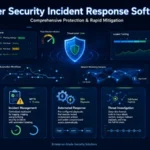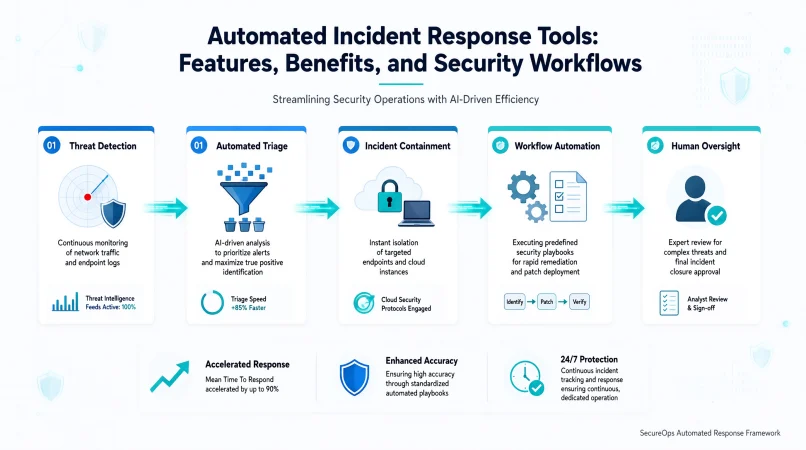
Automated incident response tools help security teams detect threats, investigate suspicious activity, and trigger predefined actions to contain incidents faster. They reduce repetitive work, improve consistency, and help organizations respond to cyber threats more efficiently.
5 Top Alternatives: Security orchestration and automation, SOAR platforms, security incident response software, automated threat detection systems, security operations automation.
Cyber threats do not wait for your security team to finish its coffee. One suspicious login can turn into a serious security incident before anyone has time to investigate, especially when alerts keep flooding the screen.
That is where automated incident response tools make a difference. These solutions help organizations identify potential threats, investigate alerts, and perform predefined security actions without requiring someone to handle every step manually. Whether a business is dealing with phishing emails, compromised accounts, malware, or unusual network activity, automation can help security teams respond more consistently.
The real advantage is not simply speed. It is giving security professionals more time to investigate complex incidents instead of repeating the same routine tasks. From small IT departments to large security operations centers, the right approach can improve visibility, reduce response delays, and strengthen incident management. However, automation still needs sensible rules, human oversight, and regular testing to prevent mistakes from becoming bigger problems.
1. Professional Automated Incident Response Tools
1. Faster Incident Handling
Example: When a security team needs to explain why automation matters during an incident review.
Meaning: Highlights how automation can reduce delays between detecting a threat and responding to it.
2. Consistent Security Workflows
Example: When a company wants every analyst to follow the same incident-handling procedure.
Meaning: Emphasizes repeatable processes that reduce inconsistency.
3. Automated Threat Containment
Example: When discussing the automatic isolation of a compromised endpoint.
Meaning: Focuses on limiting the spread or impact of a security incident.
4. Improved Alert Management
Example: When analysts receive hundreds of security notifications every day.
Meaning: Describes how automation can prioritize alerts and reduce repetitive triage work.
5. Streamlined Investigations
Example: When a security department wants to gather evidence from multiple systems more efficiently.
Meaning: Highlights faster collection and correlation of relevant incident information.
6. Centralized Incident Tracking
Example: When teams need one place to monitor active security incidents.
Meaning: Emphasizes better visibility into incident status, ownership, and progress.
7. Reliable Response Procedures
Example: When an organization wants predefined steps for common security incidents.
Meaning: Promotes structured response procedures that can be tested and improved.
8. Reduced Manual Work
Example: When analysts spend hours collecting logs and checking suspicious activity.
Meaning: Explains how automation frees staff from repetitive operational tasks.
9. Better Security Coordination
Example: When IT, security, and compliance teams must work together during an incident.
Meaning: Highlights coordinated actions and clearer communication across departments.
10. Measurable Response Performance
Example: When leadership asks whether incident response is becoming more efficient.
Meaning: Encourages tracking metrics such as response time and containment time.
11. Risk-Based Incident Prioritization
Example: When a team must decide which alerts deserve immediate attention.
Meaning: Focuses attention on incidents according to their potential impact and severity.
12. Controlled Security Automation
Example: When a company wants automated actions without sacrificing oversight.
Meaning: Emphasizes permissions, approval requirements, and safeguards for automated responses.
2. Funny Automated Incident Response Tools Observations
1. The Alert Avalanche
Example: When an analyst opens the dashboard to find hundreds of new notifications.
Meaning: Uses humor to describe overwhelming security alert volumes.
2. Coffee Before Containment
Example: When the team jokes about starting another manual investigation before breakfast.
Meaning: Highlights the appeal of reducing repetitive work.
3. The Midnight Notification Club
Example: When discussing after-hours alerts that interrupt everyone’s sleep.
Meaning: Shows how security incidents can demand attention outside normal working hours.
4. Click Less, Investigate More
Example: When analysts are tired of repeating the same administrative steps.
Meaning: Promotes automation that gives professionals more time for meaningful investigation.
5. Goodbye, Copy-Paste Marathon
Example: When security staff repeatedly transfer information between dashboards.
Meaning: Celebrates automating repetitive data-entry tasks.
6. The Suspicious Login Detective
Example: When a system flags an unusual login for investigation.
Meaning: Personifies the process of identifying potentially compromised accounts.
7. Logs for Days
Example: When a security incident produces thousands of relevant log entries.
Meaning: Jokes about the volume of information analysts must review.
8. Less Panic, More Process
Example: When a team wants a clear response plan for unexpected alerts.
Meaning: Encourages calm, structured incident handling.
9. The Phishing Email Eviction
Example: When discussing the removal of a confirmed malicious email.
Meaning: Makes email threat containment more memorable.
10. Alerts, Meet Your Match
Example: When introducing a system that helps prioritize incoming security alerts.
Meaning: Expresses confidence in better alert management.
11. Automation Takes the Night Shift
Example: When explaining how monitored workflows can run outside business hours.
Meaning: Highlights continuous monitoring and automated actions where properly configured.
12. Fewer Clicks, Happier Analysts
Example: When a team celebrates eliminating unnecessary manual steps.
Meaning: Connects efficient workflows with a better analyst experience.
3. Technical Automated Incident Response Tools Capabilities
1. Security Orchestration
Example: When connecting endpoint security, identity management, and ticketing systems.
Meaning: Coordinates actions across multiple security technologies.
2. Playbook Execution
Example: When a phishing alert triggers a predefined investigation workflow.
Meaning: Runs a documented sequence of response steps.
3. Endpoint Isolation
Example: When a confirmed compromised laptop needs to be separated from the network.
Meaning: Limits an endpoint’s ability to communicate with other systems.
4. Account Suspension
Example: When an identity system confirms that an account is compromised.
Meaning: Temporarily restricts account access according to an approved response policy.
5. Threat Intelligence Enrichment
Example: When an analyst needs context about a suspicious IP address.
Meaning: Adds relevant threat intelligence to an alert or investigation.
6. Automated Ticket Creation
Example: When a high-priority security alert requires a tracked investigation.
Meaning: Creates a case with relevant details and an assigned owner.
7. Log Correlation
Example: When suspicious activity appears across authentication and endpoint logs.
Meaning: Connects related events to provide a clearer incident picture.
8. Evidence Collection
Example: When investigators need relevant logs and endpoint details preserved.
Meaning: Gathers incident evidence for authorized investigation and analysis.
9. Workflow Integrations
Example: When a response process needs information from several security platforms.
Meaning: Enables systems to exchange data and coordinate actions.
10. Automated Enrichment
Example: When an alert needs asset ownership and user information before escalation.
Meaning: Adds context that helps analysts make informed decisions.
11. Approval-Based Actions
Example: When disabling a business-critical account requires authorization.
Meaning: Ensures sensitive response actions receive the required human approval.
12. Incident Reporting
Example: When managers need a summary of incident activity and response outcomes.
Meaning: Turns response data into useful operational reports.
4. Automated Incident Response Tools for Small Businesses
1. Affordable Security Automation
Example: When a small company wants to improve incident handling without expanding its team.
Meaning: Prioritizes useful automation within a realistic budget.
2. Simple Deployment
Example: When an IT generalist must configure a new security solution.
Meaning: Favors straightforward setup and manageable administration.
3. Essential Integrations
Example: When a business needs its endpoint protection and email security to share alerts.
Meaning: Focuses on compatibility with existing systems.
4. Phishing Response Automation
Example: When employees frequently report suspicious emails.
Meaning: Helps streamline phishing investigation and approved containment steps.
5. Centralized Alerts
Example: When a small team monitors several security dashboards.
Meaning: Brings relevant notifications into a more manageable workflow.
6. Guided Incident Handling
Example: When staff need clear instructions for common security events.
Meaning: Provides structured response steps without requiring extensive expertise.
7. Practical Reporting
Example: When a business owner wants to understand recurring security problems.
Meaning: Makes incident trends and outcomes easier to review.
8. Managed Security Compatibility
Example: When a small company works with an external security provider.
Meaning: Supports coordinated incident handling with an outsourced team.
9. Scalable Licensing
Example: When a growing business expects to add users and devices.
Meaning: Encourages choosing a solution that can expand with demand.
10. Straightforward Administration
Example: When the company has limited time for maintaining security systems.
Meaning: Reduces unnecessary configuration and maintenance complexity.
11. Essential Playbooks
Example: When a business wants standard procedures for ransomware alerts and compromised accounts.
Meaning: Establishes repeatable responses to common threats.
12. Clear Ownership
Example: When an incident needs to be assigned to the correct employee or provider.
Meaning: Prevents important security tasks from being overlooked.
5. Automated Incident Response Tools for Enterprise Security
1. Enterprise-Wide Orchestration
Example: When a multinational organization needs coordinated incident workflows across departments.
Meaning: Connects response processes across a complex technology environment.
2. Multi-Environment Visibility
Example: When security teams monitor cloud, on-premises, and hybrid infrastructure.
Meaning: Improves visibility across different computing environments.
3. Role-Based Permissions
Example: When only designated responders may isolate critical production systems.
Meaning: Restricts sensitive actions to authorized personnel.
4. Complex Playbook Support
Example: When a major incident requires several conditional investigation steps.
Meaning: Supports workflows with branching logic and multiple integrations.
5. High-Volume Alert Processing
Example: When a security operations center handles alerts from thousands of assets.
Meaning: Helps process large alert volumes efficiently.
6. Cross-Team Collaboration
Example: When security, IT, legal, and compliance teams share incident responsibilities.
Meaning: Coordinates tasks and communication across organizational boundaries.
7. Audit-Friendly Workflows
Example: When an organization must demonstrate how a response action was authorized.
Meaning: Supports accountability through records of decisions and actions.
8. Centralized Policy Management
Example: When security leaders need consistent response rules across business units.
Meaning: Helps standardize procedures while accommodating local requirements.
9. Resilient Response Operations
Example: When incident workflows must remain dependable during periods of high demand.
Meaning: Encourages reliability, redundancy, and tested recovery procedures.
10. Advanced Case Management
Example: When several alerts belong to one large security investigation.
Meaning: Organizes related events into a coordinated incident case.
11. Performance Analytics
Example: When executives need evidence of operational improvements.
Meaning: Uses response metrics to evaluate security operations.
12. Controlled Automation at Scale
Example: When automated actions affect thousands of accounts or devices.
Meaning: Combines scalability with safeguards, testing, and appropriate approval controls.
6. Cloud-Based Automated Incident Response Tools
1. Cloud-Native Workflows
Example: When an organization wants response procedures designed for cloud services.
Meaning: Supports incident handling in cloud-hosted environments.
2. Cloud Identity Monitoring
Example: When suspicious sign-ins appear in a cloud identity platform.
Meaning: Helps investigate identity-related threats.
3. Cloud Workload Containment
Example: When a cloud workload requires isolation after a confirmed compromise.
Meaning: Restricts affected resources according to approved procedures.
4. Cloud Log Integration
Example: When investigators need authentication and workload logs in one investigation.
Meaning: Connects cloud telemetry to incident workflows.
5. Multi-Cloud Coordination
Example: When a company operates workloads across multiple cloud providers.
Meaning: Helps coordinate response processes across supported environments.
6. Automated Cloud Notifications
Example: When a high-risk cloud configuration change requires immediate review.
Meaning: Routes relevant notifications to the appropriate responders.
7. Cloud Asset Context
Example: When an alert needs to identify the owner and importance of a cloud resource.
Meaning: Adds asset details to improve incident prioritization.
8. Serverless Response Actions
Example: When an approved event triggers a lightweight cloud-based workflow.
Meaning: Executes supported response steps without requiring a continuously running server.
9. Cloud Access Restrictions
Example: When a confirmed threat requires restricting access to a cloud resource.
Meaning: Applies authorized access controls to reduce exposure.
10. Cloud Incident Evidence
Example: When investigators need relevant logs and configuration history.
Meaning: Supports evidence gathering for cloud security incidents.
11. Cloud Compliance Reporting
Example: When a security team must document cloud incident handling.
Meaning: Helps produce records for internal governance and applicable compliance needs.
12. Hybrid Response Workflows
Example: When a cloud alert affects an employee’s on-premises device.
Meaning: Connects incident handling across cloud and local infrastructure.
7. Automated Incident Response Tools for Ransomware and Malware
1. Ransomware Alert Triage
Example: When endpoint monitoring identifies suspicious file-encryption behavior.
Meaning: Helps prioritize potentially serious ransomware alerts.
2. Endpoint Quarantine
Example: When a confirmed infected device must be isolated.
Meaning: Limits communication from the affected endpoint.
3. Malicious File Blocking
Example: When security intelligence identifies a file as harmful.
Meaning: Prevents access to a known malicious file where supported.
4. Malware Investigation
Example: When analysts need to examine related endpoint activity.
Meaning: Organizes information needed to understand a potential infection.
5. Suspicious Process Review
Example: When an endpoint runs a process that matches a security detection rule.
Meaning: Helps determine whether the activity represents a threat.
6. Automated Threat Enrichment
Example: When a malware alert needs reputation and detection context.
Meaning: Adds information that supports investigation and prioritization.
7. Affected Asset Identification
Example: When a team needs to determine which devices may be involved in an incident.
Meaning: Helps identify the potential scope of a compromise.
8. Recovery Task Coordination
Example: When affected systems require verified restoration after containment.
Meaning: Organizes recovery activities without assuming that automated cleanup is sufficient.
9. Backup Protection Alerts
Example: When unusual activity threatens backup systems.
Meaning: Helps responders prioritize the protection of recovery resources.
10. Malware Incident Documentation
Example: When the team must record findings and containment decisions.
Meaning: Creates a clearer record for investigation and review.
11. Human-Approved Isolation
Example: When disconnecting a critical server could disrupt business operations.
Meaning: Adds an approval step before a potentially disruptive action.
12. Post-Incident Review
Example: When a malware incident has been contained and the team evaluates its response.
Meaning: Identifies improvements for future detection, containment, and recovery.
8. Automated Incident Response Tools for Phishing and Email Security
1. Phishing Alert Prioritization
Example: When employees report several suspicious emails at once.
Meaning: Helps identify reports that require urgent investigation.
2. Suspicious Email Analysis
Example: When an email contains an unexpected attachment or unusual sender information.
Meaning: Organizes relevant details for phishing assessment.
3. Malicious Message Removal
Example: When investigators confirm that a phishing message reached multiple inboxes.
Meaning: Supports authorized removal or quarantine of the identified messages.
4. Sender Reputation Checks
Example: When a security analyst investigates an unfamiliar sender.
Meaning: Adds reputation context to the investigation.
5. Attachment Risk Assessment
Example: When an unexpected document triggers an email security alert.
Meaning: Helps assess whether an attachment presents a security risk.
6. URL Threat Analysis
Example: When a reported email contains a suspicious link.
Meaning: Evaluates the destination and available threat intelligence.
7. User Report Processing
Example: When employees submit suspicious messages through a reporting button.
Meaning: Converts user reports into trackable security cases.
8. Compromised Mailbox Investigation
Example: When a user’s mailbox shows suspicious forwarding rules or sign-in activity.
Meaning: Helps investigate potential email account compromise.
9. Credential Exposure Response
Example: When a confirmed phishing incident may have exposed login credentials.
Meaning: Coordinates approved account protection and credential-reset procedures.
10. Email Campaign Correlation
Example: When similar phishing messages appear across multiple employees’ inboxes.
Meaning: Connects related reports to reveal a wider campaign.
11. Phishing Incident Reporting
Example: When managers need a summary of an email-based security incident.
Meaning: Documents findings, affected users, and response actions.
12. Employee Awareness Feedback
Example: When a company reviews patterns in reported phishing attempts.
Meaning: Uses incident trends to improve security education.
9. Automated Incident Response Tools for Endpoint Detection
1. Endpoint Alert Correlation
Example: When several devices generate alerts that may share a common cause.
Meaning: Connects related endpoint events for investigation.
2. Device Isolation
Example: When an endpoint is confirmed to be involved in malicious activity.
Meaning: Restricts its network communications to limit potential harm.
3. Suspicious Login Investigation
Example: When endpoint activity coincides with an unusual account sign-in.
Meaning: Helps investigate whether identity and device events are connected.
4. Endpoint Telemetry Collection
Example: When analysts need process, file, or connection information.
Meaning: Gathers relevant technical details from monitored devices.
5. Automated Detection Enrichment
Example: When an endpoint alert requires additional user and asset context.
Meaning: Adds information to improve investigation quality.
6. Threat Hunting Support
Example: When analysts investigate whether similar activity exists elsewhere.
Meaning: Helps search for related suspicious behavior across supported systems.
7. Device Risk Prioritization
Example: When alerts affect both ordinary workstations and critical servers.
Meaning: Considers asset importance when determining response urgency.
8. Endpoint Policy Enforcement
Example: When a device fails a required security check.
Meaning: Applies predefined controls where authorized and supported.
9. Automated Case Creation
Example: When a high-severity endpoint alert needs investigation.
Meaning: Creates a trackable record for the response team.
10. Endpoint Remediation Coordination
Example: When a device requires cleanup after a confirmed infection.
Meaning: Organizes remediation tasks while allowing appropriate technical validation.
11. Endpoint Activity Reporting
Example: When a team reviews which devices were affected during an incident.
Meaning: Summarizes relevant endpoint findings and actions.
12. Safe Response Testing
Example: When a security team validates an isolation workflow before deployment.
Meaning: Reduces the risk of unintended disruption from automation.
10. Automated Incident Response Tools for Security Operations Centers
1. SOC Alert Triage
Example: When analysts face more incoming alerts than they can manually review.
Meaning: Helps prioritize notifications for investigation.
2. Automated Case Assignment
Example: When an alert needs to reach the team responsible for that technology.
Meaning: Routes cases according to predefined ownership rules.
3. Incident Escalation
Example: When a critical alert requires immediate attention from a senior responder.
Meaning: Sends incidents to the appropriate escalation level.
4. SIEM Integration
Example: When a security operations center needs to trigger a workflow from a correlated detection.
Meaning: Connects security information and event management systems with response processes.
5. SOAR Workflow Automation
Example: When a team wants to coordinate enrichment, ticketing, and approved containment actions.
Meaning: Uses security orchestration, automation, and response workflows to reduce manual effort.
6. Analyst Workload Reduction
Example: When repetitive tasks leave little time for complex investigations.
Meaning: Automates suitable routine work so analysts can focus on higher-value activities.
7. Incident Queue Management
Example: When the SOC needs to distinguish urgent cases from lower-priority alerts.
Meaning: Improves visibility into investigation queues and response priorities.
8. Shift Handover Summaries
Example: When an unresolved incident must pass to the next analyst on duty.
Meaning: Preserves important context between shifts.
9. Response Time Tracking
Example: When SOC leaders measure how long incidents take to handle.
Meaning: Supports operational performance analysis.
10. Alert Deduplication
Example: When repeated notifications describe the same underlying event.
Meaning: Reduces unnecessary duplicate investigation work.
11. Cross-Platform Response
Example: When an incident requires coordinated actions across identity, endpoint, and email systems.
Meaning: Connects response activities across security technologies.
12. Continuous Workflow Improvement
Example: When the SOC reviews recurring incidents and identifies process gaps.
Meaning: Uses operational findings to refine automation and response procedures.
11. Automated Incident Response Tools for Compliance and Auditing
1. Audit Trail Collection
Example: When an auditor requests records of actions taken during an incident.
Meaning: Helps document response activities and decisions.
2. Approval Records
Example: When a sensitive action requires authorization before execution.
Meaning: Preserves evidence of the required approval.
3. Policy-Based Response
Example: When different incident types require different handling procedures.
Meaning: Connects response actions to documented organizational policies.
4. Evidence Preservation
Example: When investigators must retain relevant logs and incident records.
Meaning: Supports reliable evidence handling and investigation requirements.
5. Incident Timeline Creation
Example: When reviewers need to understand the order of events during a breach.
Meaning: Organizes important events and response actions chronologically.
6. Access Control Documentation
Example: When an organization needs to show who can execute sensitive response actions.
Meaning: Helps demonstrate accountability and access governance.
7. Compliance Reporting
Example: When a team prepares an incident summary for internal review.
Meaning: Organizes information relevant to applicable reporting obligations.
8. Retention Policy Support
Example: When incident records must be stored according to organizational requirements.
Meaning: Helps manage records under defined retention policies.
9. Incident Classification
Example: When different security events have different reporting requirements.
Meaning: Categorizes incidents to support consistent handling.
10. Change History Tracking
Example: When reviewers need to understand how an incident playbook was modified.
Meaning: Documents workflow changes and supports accountability.
11. Separation of Duties
Example: When one employee must not approve and execute the same sensitive action.
Meaning: Supports controls that reduce the risk of unauthorized activity.
12. Audit Readiness
Example: When an organization prepares for a security control assessment.
Meaning: Makes relevant records and process evidence easier to locate.
12. Automated Incident Response Tools for Threat Intelligence
1. Threat Feed Enrichment
Example: When a security alert contains an IP address associated with suspicious activity.
Meaning: Adds external threat information to an investigation.
2. Indicator Reputation Checks
Example: When analysts need context about a suspicious domain.
Meaning: Uses available reputation data to support threat assessment.
3. Threat Indicator Correlation
Example: When the same indicator appears in multiple security alerts.
Meaning: Helps connect potentially related events.
4. Intelligence-Based Prioritization
Example: When an alert matches information about an actively exploited threat.
Meaning: Uses relevant intelligence to inform response urgency.
5. Indicator Expiration Management
Example: When older threat indicators may no longer be useful.
Meaning: Helps prevent stale intelligence from driving unnecessary actions.
6. Intelligence Source Validation
Example: When an automated workflow receives conflicting threat reports.
Meaning: Encourages evaluating the quality and reliability of intelligence sources.
7. Automated Context Gathering
Example: When an alert requires domain, IP, or file reputation details.
Meaning: Collects relevant context before an analyst makes a decision.
8. Threat Hunting Queries
Example: When responders search for indicators linked to a suspected campaign.
Meaning: Supports searches for related activity across available telemetry.
9. Intelligence Sharing
Example: When authorized teams need to exchange relevant threat indicators.
Meaning: Helps distribute useful security information through supported integrations.
10. Indicator-Based Blocking
Example: When a verified malicious domain must be blocked under an approved policy.
Meaning: Applies a predefined control against a known threat indicator.
11. Intelligence-Driven Playbooks
Example: When a credible threat indicator triggers additional investigation steps.
Meaning: Uses threat context to guide incident workflows.
12. Threat Trend Analysis
Example: When analysts review recurring indicators across multiple incidents.
Meaning: Helps identify patterns that may inform future defenses.
13. Automated Incident Response Tools for Identity and Access Security
1. Suspicious Login Detection
Example: When an account signs in from an unusual location or device.
Meaning: Flags authentication activity that may require investigation.
2. Account Risk Assessment
Example: When multiple suspicious events affect the same user account.
Meaning: Combines relevant signals to help assess identity-related risk.
3. Session Revocation
Example: When an account compromise requires active sessions to be terminated.
Meaning: Ends supported sessions according to an approved response procedure.
4. Temporary Account Suspension
Example: When a verified compromise requires access to be restricted.
Meaning: Limits account access while the incident is investigated.
5. Multifactor Authentication Enforcement
Example: When an organization requires stronger authentication after a suspicious sign-in.
Meaning: Applies an approved authentication control to reduce account risk.
6. Privileged Account Monitoring
Example: When an administrator account performs an unusual action.
Meaning: Helps identify activity involving highly sensitive access.
7. Impossible-Travel Investigation
Example: When sign-ins appear too far apart to be physically plausible.
Meaning: Flags potentially suspicious authentication patterns for review.
8. Identity Event Correlation
Example: When authentication alerts coincide with endpoint or email security events.
Meaning: Connects identity activity with other evidence.
9. Password Reset Coordination
Example: When a confirmed compromise requires credential changes.
Meaning: Initiates or coordinates approved account recovery steps.
10. Privilege Review
Example: When investigators discover that a compromised account has excessive permissions.
Meaning: Helps identify and address unnecessary access.
11. Identity Incident Escalation
Example: When a privileged account generates a critical security alert.
Meaning: Routes the incident to the appropriate response team.
12. Identity Recovery Verification
Example: When access is restored after a compromised account has been secured.
Meaning: Ensures required recovery checks are completed before normal access resumes.
14. Advanced Automated Incident Response Tools Strategies
1. Risk-Based Automation
Example: When low-risk alerts can be handled automatically but serious incidents require review.
Meaning: Matches the degree of automation to the potential impact.
2. Conditional Playbooks
Example: When different alert characteristics require different response steps.
Meaning: Uses defined conditions to guide workflow decisions.
3. Human-in-the-Loop Response
Example: When a security action could disrupt an essential business service.
Meaning: Keeps a human decision-maker involved in sensitive response steps.
4. Automated Incident Correlation
Example: When several separate alerts may represent one coordinated attack.
Meaning: Connects related signals into a clearer incident narrative.
5. Response Simulation
Example: When a team wants to test a playbook without affecting production systems.
Meaning: Evaluates response logic in a controlled environment.
6. Safe Rollback Planning
Example: When a workflow changes access or configuration settings.
Meaning: Establishes a recovery path if an automated change causes problems.
7. Workflow Version Control
Example: When security engineers need to review changes to a response procedure.
Meaning: Tracks workflow revisions and supports controlled deployment.
8. Automation Failure Alerts
Example: When a required integration stops responding during an incident.
Meaning: Notifies the team when an automated process cannot complete successfully.
9. Fallback Response Procedures
Example: When a security platform becomes unavailable during an investigation.
Meaning: Provides an alternative process for continuing incident handling.
10. False Positive Management
Example: When a legitimate activity repeatedly triggers a detection rule.
Meaning: Helps teams refine detections and reduce unnecessary interventions.
11. Automated Action Safeguards
Example: When a playbook could disable a critical account or system.
Meaning: Adds limits, validation checks, and approval requirements to sensitive actions.
12. Continuous Playbook Testing
Example: When teams need to confirm that updated response workflows still behave as expected.
Meaning: Verifies automation after changes and helps identify failures early.
15. Choosing the Best Automated Incident Response Tools
1. Define Your Security Priorities
Example: When a business is deciding whether phishing response or endpoint containment matters most.
Meaning: Connects purchasing decisions to real security needs.
2. Review Integration Compatibility
Example: When a company already uses several security platforms.
Meaning: Ensures the solution can exchange the information and actions required.
3. Compare Automation Capabilities
Example: When evaluating how different products handle common incidents.
Meaning: Identifies which repetitive tasks each platform can safely automate.
4. Check Deployment Requirements
Example: When deciding between cloud-hosted and self-managed solutions.
Meaning: Considers infrastructure, administration, and operational responsibilities.
5. Evaluate Ease of Use
Example: When analysts need to configure and troubleshoot workflows regularly.
Meaning: Prioritizes interfaces and processes that staff can manage effectively.
6. Understand Total Cost
Example: When comparing subscriptions, implementation expenses, and maintenance requirements.
Meaning: Evaluates the overall cost rather than the advertised price alone.
7. Verify Security Controls
Example: When reviewing access permissions and safeguards for automated actions.
Meaning: Ensures the platform supports appropriate authorization and oversight.
8. Test With Realistic Scenarios
Example: When a team wants to evaluate a phishing or compromised-account playbook.
Meaning: Measures performance using relevant, controlled incident simulations.
9. Assess Reporting Features
Example: When security leaders need reliable performance and audit reports.
Meaning: Ensures the product provides useful operational information.
10. Check Vendor Support
Example: When an organization needs help during deployment or troubleshooting.
Meaning: Evaluates the quality and availability of technical assistance.
11. Measure Response Improvements
Example: When comparing incident handling before and after implementation.
Meaning: Uses meaningful metrics to determine whether automation delivers value.
12. Plan for Future Growth
Example: When a business expects its systems, users, and alert volume to increase.
Meaning: Favors solutions that can evolve with changing security requirements.
FAQs
What Do Automated Incident Response Tools Mean?
Automated incident response tools help detect, investigate, prioritize, and respond to security incidents using predefined workflows.
Are Automated Incident Response Tools Suitable for Small Businesses?
Yes. Small businesses can use them to reduce repetitive security tasks and improve incident handling with limited staff.
Can Automated Incident Response Tools Stop Cyberattacks?
They can help contain detected threats, but effectiveness depends on detection quality, configuration, coverage, and human oversight.
Are Automated Incident Response Tools Useful for Phishing?
Yes. They can help analyze reported emails, enrich alerts, identify related messages, and support approved containment actions.
What Is the Difference Between SOAR and Incident Response Automation?
SOAR coordinates security tools and workflows, while incident response automation can also refer to individual automated response capabilities.
Do Automated Incident Response Tools Replace Security Analysts?
No. They handle suitable repetitive tasks, while analysts investigate complex incidents and make critical decisions.
Are These Tools Useful for Ransomware Incidents?
Yes. They can help identify suspicious activity, isolate affected systems, and coordinate investigation and recovery tasks.
Can Automated Incident Response Tools Work With Cloud Systems?
Yes. Many solutions support cloud logs, identity platforms, workloads, and cloud-based response workflows.
Is Humor Appropriate When Discussing Security Automation?
Light humor works in informal content, but incident reports and serious security communications should remain clear and professional.
What Should You Consider Before Choosing a Solution?
Evaluate integrations, automation capabilities, security controls, ease of use, scalability, support, and total cost.
Conclusion
The right automated incident response tools can make security operations more organized, consistent, and efficient. From handling phishing reports to coordinating endpoint isolation, automation helps teams spend less time on repetitive tasks and more time investigating meaningful threats. However, successful implementation requires more than switching on a few automated workflows. Clear policies, reliable integrations, regular testing, and human oversight remain essential.
Start with the security challenges your organization faces most often, then choose workflows that address those needs without creating unnecessary risk. Measure the results, improve your playbooks, and expand gradually as your requirements evolve. Save this guide for your next security review, share it with your team, and make your incident response strategy work smarter.