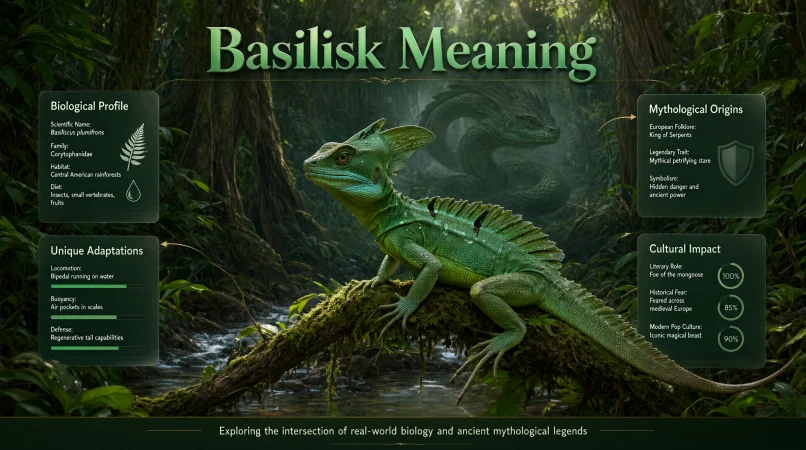
A basilisk is a legendary creature from ancient mythology, traditionally described as a deadly serpent or dragon capable of killing its enemies with a single glance or poisonous breath. The word also refers to real tropical lizards belonging to the genus Basiliscus, famous for their unusual ability to run across the surface of water. Its name comes from the ancient Greek word basiliskos, meaning “little king.” Depending on the context, it can describe a mythical monster, a fascinating reptile, or something associated with a dangerous and intimidating stare.
The word basilisk has two major meanings, and understanding the difference makes the term much easier to interpret.
In mythology, it describes a terrifying serpent-like monster believed to possess supernatural powers. Ancient stories portrayed this creature as the king of snakes, with a deadly gaze, poisonous breath, and the ability to destroy living things simply by approaching them.
In zoology, the same word identifies a group of real reptiles native to Central and parts of South America. These animals are particularly interesting because they can escape predators by sprinting across the surface of water using their powerful hind legs.
The scientific name of their genus is Basiliscus. Although they share a name with the legendary creature, these lizards are completely ordinary biological animals rather than supernatural monsters.
The term can also appear in literature, fantasy stories, games, and everyday descriptions. Someone might use it to describe a frightening character, an intimidating stare, or a fictional creature with deadly powers.
The important distinction: A mythical basilisk is a creature of folklore, while a biological basilisk is a real reptile with remarkable physical abilities.
Where Did the Word Basilisk Originate?
The history of this word goes back to ancient Greek.
It comes from basiliskos, which translates to “little king” or “young king.” The original root is basileus, meaning king. This royal connection explains why the legendary animal eventually became known as the king of serpents.
Ancient descriptions associated the creature with a crown-like marking or crest on its head. Some accounts described a small white spot that resembled a royal crown, while later illustrations gave it a more dramatic appearance.
The word entered Latin as basiliscus and eventually became part of several European languages, including English.
Its meaning changed over time. Early descriptions focused more on a dangerous serpent, while medieval writers developed increasingly elaborate stories about its appearance, powers, and unusual weaknesses.
Interestingly, the name was later applied to real tropical lizards because some species have noticeable crests on their heads and backs. Their impressive appearance made the historical comparison seem appropriate.
This is an unusual example of how mythology can influence scientific naming. A legendary animal gave its name to a real group of reptiles.
The Basilisk in Ancient Mythology and Folklore
The mythical basilisk has appeared in stories for centuries. Its reputation developed through ancient descriptions, medieval religious writings, and European folklore.
Unlike many legendary monsters that relied on physical strength, this creature was frightening because its supposed powers made ordinary confrontation almost impossible.
The Deadly Gaze
One of the most famous characteristics associated with the mythical creature is its deadly stare.
According to medieval legends, looking directly into its eyes could cause immediate death. Some stories suggested that even seeing its reflection could be dangerous, although the details varied between traditions.
This ability made it different from ordinary dragons and serpents. Its eyes were considered weapons, meaning a person did not need to touch the animal to become its victim.
The expression “basilisk stare” eventually developed from this legend. Today, it can describe an extremely intimidating, cold, or frightening look.
Poisonous Breath and Destructive Powers
Its eyes were not the only source of danger.
Some historical accounts claimed that the creature released poisonous breath capable of killing people, animals, and even damaging vegetation. Other stories suggested that the ground became barren wherever it lived.
These descriptions helped establish its reputation as one of the most dangerous creatures in European folklore.
However, the details were never consistent. Different writers gave it different physical characteristics and supernatural abilities.
The King of Serpents
The title “king of serpents” is closely connected to the creature’s Greek name.
Ancient and medieval descriptions often presented it as a ruler that other snakes feared. Its royal status was sometimes represented through a crown-shaped marking, a raised crest, or a distinctive position among other reptiles.
This image became especially popular in medieval bestiaries, which were illustrated books describing real and imaginary animals alongside moral and religious lessons.
The basilisk was frequently used as a symbol of evil, destruction, and hidden danger.
How Could the Basilisk Be Defeated?
Folklore also developed unusual explanations for how someone might survive an encounter with this monster.
One traditional belief involved using a weasel against it. The weasel was considered one of its natural enemies, and some stories claimed that its presence could overcome the creature’s poisonous influence.
Mirrors also became associated with defeating it. According to certain legends, the monster could be destroyed by seeing its own deadly gaze reflected back at itself.
These stories were imaginative explanations rather than real methods of dealing with an animal. Nevertheless, they became an important part of the creature’s identity in European storytelling.
What Does a Real Basilisk Lizard Look Like?
The real animal is considerably less frightening than its legendary counterpart.
Basilisk lizards belong to the genus Basiliscus and the family Corytophanidae. They are tropical reptiles generally found around forests, rivers, streams, and other freshwater environments.
Their physical appearance is one reason they received a name associated with an ancient monster.
Most species have elongated bodies, long tails, strong hind legs, and noticeable crests along parts of their heads, backs, or tails. These features help them move through their surroundings and recognize other members of their species.
Some important physical characteristics include:
- Long hind legs: Their powerful rear limbs help them sprint and move quickly.
- Flattened toes: Their back feet have specialized toes that help create support when running over water.
- Long tails: Their tails assist with balance and movement.
- Crested heads: Some species have prominent head crests, particularly adult males.
- Camouflaged scales: Their body colors help them blend into vegetation, branches, and forest surroundings.
Their appearance varies depending on the species. Green basilisks, for example, have striking green coloration, while striped basilisks generally display brown or olive-colored bodies.
These reptiles are primarily insectivorous, meaning insects make up a significant part of their diet. They may also eat fruits, flowers, and other plant material.
Despite their dramatic appearance, they are not dangerous supernatural animals. Their normal response to a potential threat is to escape rather than confront it.
Four Recognized Types of Basilisk Lizards
There are four widely recognized living species in the genus Basiliscus. Each has its own physical characteristics and geographical distribution.
The following table highlights their main differences.
| Species | Common Name | Main Characteristics |
| Basiliscus plumifrons | Green or Plumed Basilisk | Bright green body and prominent crests |
| Basiliscus basiliscus | Common Basilisk | Brown or greenish coloration and powerful hind legs |
| Basiliscus vittatus | Striped Basilisk | Brown coloration with noticeable body stripes |
| Basiliscus galeritus | Western Basilisk | Distinctive head crest and tropical forest habitat |
1. Green or Plumed Basilisk (Basiliscus plumifrons)
The green basilisk is probably the most visually recognizable member of this group.
It has bright green scales, a long tail, and distinctive crests running along its head, back, and tail. Adult males often have particularly noticeable crests.
This species is native to parts of Central America, including Costa Rica, Honduras, and Panama.
Its ability to sprint across water has earned it the popular nickname “Jesus Christ lizard.” The nickname refers to its unusual movement rather than any religious or supernatural connection.
2. Common Basilisk (Basiliscus basiliscus)
The common basilisk is another well-known species.
Its coloration is generally less vivid than that of the green basilisk. Brown, olive, and darker markings help it blend into its surroundings.
It is found in parts of Central and South America, particularly in areas with suitable tropical vegetation and access to water.
Like other members of its genus, it can use its powerful hind legs to move quickly across water when escaping danger.
3. Striped Basilisk (Basiliscus vittatus)
The striped basilisk is recognizable by the lighter stripes running along its body.
Its brown and olive coloration provides effective camouflage among leaves, branches, and forest vegetation.
It occurs across parts of Mexico and Central America and has also established introduced populations in Florida.
This species is another example of how basilisk lizards have adapted to environments close to freshwater sources.
4. Western Basilisk (Basiliscus galeritus)
The western basilisk is native to northwestern South America, including Colombia, Ecuador, and Panama.
It is generally associated with tropical forests and freshwater habitats.
Its appearance differs from the more familiar bright green species, with a distinctive head crest and coloration suited to its natural environment.
The International Union for Conservation of Nature (IUCN) has listed the western basilisk as Least Concern in its published assessment. This category indicates that the species was not considered to face the level of extinction risk associated with more threatened categories at the time of assessment.
Why Can Basilisk Lizards Run on Water?
One of the most remarkable characteristics of these reptiles is their ability to run across water.
This behavior looks almost impossible when seen for the first time. A lizard appears to sprint over a stream without immediately sinking beneath the surface.
However, the explanation comes from physics, anatomy, and speed rather than magic.
The Science Behind Water Running
Basilisk lizards use their powerful hind legs to strike the water rapidly.
Their long toes spread outward during movement, creating a larger surface area against the water. Small flaps of skin along their toes also help increase contact with the surface.
Each foot movement creates a small pocket of air and pushes water downward.
This produces an upward force that temporarily supports the animal’s body weight. Before the foot sinks completely, the lizard lifts it and repeats the movement with its other leg.
The result is a rapid sequence of movements that allows the animal to remain above the surface for a short distance.
Why Speed Matters
Running over water requires considerable speed.
If the animal moves too slowly, its feet cannot generate enough upward force to support its body. It will eventually sink.
Young basilisk lizards are particularly impressive because their lighter bodies make it easier for them to remain above the water.
Adult animals can also perform this movement, although they have to work harder because of their greater body weight.
Is It Really Running?
Yes, but it is a specialized form of bipedal locomotion.
Bipedal means moving using two legs. During water running, the basilisk relies primarily on its hind limbs while keeping its body relatively upright.
It cannot run across water indefinitely. Eventually, it loses enough speed to sink, after which it can swim underwater.
This ability provides an effective escape route when a predator approaches from the surrounding vegetation.
Mythical Basilisk vs. Real Basilisk Lizard
Although both share the same name, their characteristics are very different.
The legendary monster belongs to folklore, while the real animal is classified through scientific observation and biological research.
| Feature | Mythical Basilisk | Real Basilisk Lizard |
| Origin | Ancient mythology and folklore | Tropical Americas |
| Scientific classification | No biological classification | Genus Basiliscus |
| Appearance | Serpent, dragon, or hybrid creature | Real crested reptile |
| Main ability | Supposedly kills through its gaze or breath | Runs across water |
| Diet | Varies between legends | Insects and some plant material |
| Danger | Considered deadly in stories | Generally avoids human confrontation |
| Existence | Fictional | Scientifically documented |
The biggest difference is the source of their reputation.
The mythical creature became famous through stories about supernatural destruction. The living reptile became famous because of an unusual physical adaptation that scientists can observe and explain.
Interestingly, the real animal’s impressive appearance probably helped preserve the connection between the two.
Symbolism and Modern Uses of the Word Basilisk
The word has developed meanings beyond its original historical and zoological definitions.
Today, it frequently appears in fantasy literature, video games, films, and symbolic descriptions.
Basilisk as a Symbol of Fear
In traditional storytelling, the creature represents danger that cannot easily be approached or defeated.
Its deadly gaze makes it a useful symbol for overwhelming fear, destructive power, and an enemy that can harm others without physical contact.
Writers sometimes use the word to create an atmosphere of mystery or danger.
Basilisk in Fantasy Books and Games
Modern fantasy frequently borrows creatures from mythology.
Basilisks often appear as powerful monsters with poisonous attacks, stone-inducing gazes, or dangerous abilities.
One famous example is the basilisk in Harry Potter and the Chamber of Secrets. In that story, the creature is portrayed as a gigantic serpent whose gaze can kill anyone who looks directly into its eyes.
This fictional version helped introduce the legendary monster to a new generation of readers and viewers.
However, modern fantasy writers are not required to follow traditional descriptions. Some portray basilisks as dragons, while others present them as giant lizards or magical serpents.
Basilisk Stare in Everyday Language
The expression “basilisk stare” is sometimes used to describe an extremely intimidating look.
For example:
- “His basilisk stare made everyone stop talking.”
- “She gave him a basilisk look after hearing the excuse.”
- “The teacher’s expression was almost like a basilisk’s gaze.”
These sentences use the legendary creature as a comparison. They do not suggest that the person has supernatural powers.
The expression simply communicates that someone’s look feels frightening, threatening, or unusually intense.
FAQ,s
1. Is a basilisk a dragon or a snake?
The mythical basilisk has been described as a serpent, dragon-like creature, or reptilian monster. Its exact appearance changes between historical traditions and modern fantasy.
2. Can a real basilisk lizard hurt humans?
Basilisk lizards are generally not dangerous to humans. They prefer escaping from threats and may bite if handled or cornered.
3. Why is the basilisk called the king of snakes?
Its name comes from the Greek basiliskos, meaning “little king.” Ancient folklore associated it with authority over other serpents.
4. Can basilisk lizards breathe underwater?
They cannot breathe underwater like fish. However, they can remain submerged for periods while avoiding predators and using their ability to swim.
5. Are basilisk lizards good swimmers?
Yes. They can swim effectively and often enter the water to escape predators, find food, or move between nearby areas.
6. Is the basilisk mentioned in the Bible?
The word appears in some older English Bible translations, including the King James Version. However, the original Hebrew terms and their identification with particular animals are subjects of translation and interpretation.
Conclusion
The basilisk is an interesting example of how a word can connect ancient imagination with real-world science. In mythology, it represents a terrifying creature with a deadly gaze, while in nature, it identifies a remarkable group of tropical lizards capable of running across water.
Its history, unusual name, and different interpretations have kept it relevant in literature, science, and popular culture. Understanding both meanings gives the word a much richer story than either definition alone.