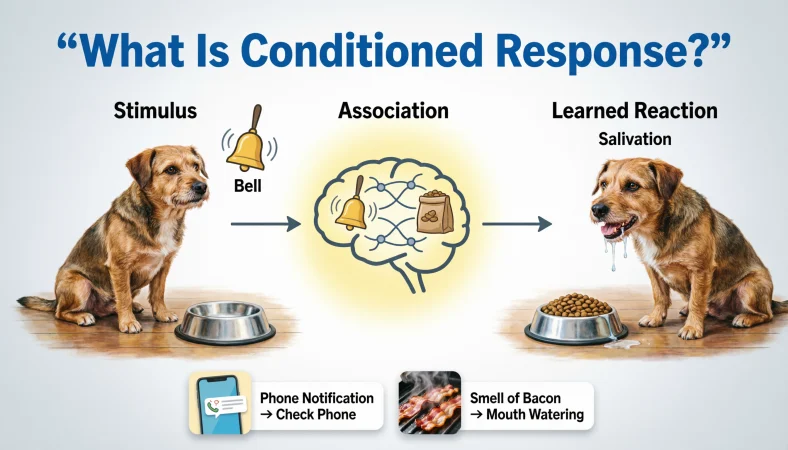
Quick Answer: A conditioned response is a learned reaction to a previously neutral stimulus after that stimulus becomes associated with something meaningful. In simple terms, your brain learns, “When this happens, expect that.”
Top alternatives: Learned response, acquired response, Pavlovian response, learned reaction, associative response
If you have ever wondered what is conditioned response while studying psychology, preparing for an exam, explaining it to a friend, or trying to make sense of Pavlov’s famous dogs, you are definitely not alone. The term sounds much more complicated than it actually is.
A conditioned response is basically a reaction that you learn through association. Your brain connects one thing with another, and eventually the first thing can trigger a response on its own. Think about hearing a notification sound and immediately reaching for your phone, feeling hungry when you smell your favorite food, or becoming nervous when you hear a sound associated with an unpleasant experience.
The idea is closely connected to classical conditioning, a form of learning famously demonstrated in experiments by Ivan Pavlov. Once you understand the basic pattern, the concept becomes surprisingly easy to recognize in everyday life. Here are simple, funny, creative, professional, and memorable ways to understand and explain it.
Simple Responses
A conditioned response is a learned reaction.
Use this when someone needs the shortest possible definition.
Meaning: The response develops through learning rather than happening naturally from birth.
It is a reaction learned through association.
Use this for a quick classroom explanation.
Meaning: The brain connects one stimulus with another experience.
Your brain learns to react to something in a certain way.
Use this when explaining the concept casually.
Meaning: Repeated association teaches the brain a predictable reaction.
It is a learned response to a previously neutral stimulus.
Use this when a basic psychology definition is needed.
Meaning: Something that originally caused little or no response eventually triggers a learned reaction.
A conditioned response happens because two things become associated.
Use this when explaining the core idea.
Meaning: Learning creates a connection between stimuli.
It is a response created by experience.
Use this when explaining the concept to a beginner.
Meaning: The reaction develops because of something the person or animal has learned.
Think of it as a learned reaction.
Use this when someone finds psychology terminology confusing.
Meaning: The phrase makes the technical concept easier to remember.
It is not automatic at first, but it becomes learned.
Use this when explaining how conditioning develops.
Meaning: The response appears after an association has been established.
A conditioned response is basically learned behavior triggered by a cue.
Use this when connecting the concept to everyday experiences.
Meaning: A learned signal can eventually produce a predictable reaction.
It is your brain making a learned connection.
Use this for an informal explanation.
Meaning: The brain associates one event with another.
A conditioned response is a reaction your brain has learned to produce.
Use this when someone wants a plain-English definition.
Meaning: Experience teaches the reaction.
It is a learned reaction that follows a specific stimulus.
Use this for a simple study note.
Meaning: A particular cue can trigger a response because of previous conditioning.
Funny Responses
Your brain basically learns a shortcut.
Use this when explaining the concept with light humor.
Meaning: Conditioning lets the brain connect a cue with an expected outcome.
It is your brain saying, “Oh, I know what happens next.”
Use this when explaining association casually.
Meaning: The learned cue predicts another event.
Basically, your brain gets trained by repetition.
Use this when making the concept easy for friends to understand.
Meaning: Repeated experiences can create learned reactions.
Pavlov’s dogs made psychology memorable before memes did.
Use this when introducing the classic example.
Meaning: Pavlov’s experiment remains one of the most recognizable examples of classical conditioning.
Your brain sees the cue and starts the reaction playlist.
Use this when you want a playful explanation.
Meaning: A learned stimulus can automatically trigger a learned response.
It is basically your brain connecting the dots.
Use this when someone wants a humorous but accurate explanation.
Meaning: The brain learns an association between events.
Your brain has basically saved the reaction as a shortcut.
Use this when explaining learned associations casually.
Meaning: Previous learning makes the response easier to trigger.
One stimulus walks in, and your learned reaction clocks in for work.
Use this for a funny classroom explanation.
Meaning: The learned response appears when the associated stimulus occurs.
Your brain said, “We’ve seen this movie before.”
Use this when explaining prediction through association.
Meaning: A familiar cue can trigger a response because of previous experience.
It is psychology’s version of connecting two clues.
Use this when keeping the explanation light.
Meaning: Conditioning happens when the brain learns that two events are related.
Your brain learns the pattern and reacts before you overthink it.
Use this for an everyday example.
Meaning: Learned associations can produce quick responses.
Basically, your brain has been taking notes.
Use this when explaining why a response becomes learned.
Meaning: Previous experiences influence later reactions.
Professional Responses
A conditioned response is a learned response elicited by a conditioned stimulus.
Use this in an academic or professional explanation.
Meaning: The response occurs because a stimulus has acquired significance through conditioning.
The response develops through classical conditioning.
Use this when connecting the term to psychological learning theory.
Meaning: The reaction is acquired through repeated stimulus associations.
A neutral stimulus can become capable of eliciting a response after conditioning.
Use this in a formal psychology context.
Meaning: Association changes the function of the previously neutral stimulus.
Conditioned responses are acquired rather than innate.
Use this when comparing learned and natural reactions.
Meaning: Experience creates the response.
The response is produced because a stimulus has been associated with another stimulus.
Use this in a classroom or study setting.
Meaning: Association is the central mechanism involved.
Classical conditioning can establish a predictable learned response.
Use this when discussing learning theory.
Meaning: Repeated associations can make a response more likely when the conditioned stimulus appears.
A conditioned response demonstrates associative learning.
Use this when writing a concise academic answer.
Meaning: The concept shows how organisms learn connections between events.
The conditioned stimulus eventually elicits the learned response.
Use this when explaining the basic conditioning sequence.
Meaning: The formerly neutral cue gains the ability to trigger a response.
The response results from a learned association rather than an unconditioned reflex alone.
Use this when distinguishing conditioned responses from innate reactions.
Meaning: Learning changes how the organism responds to the stimulus.
Conditioned responses can develop through repeated pairings.
Use this when discussing how conditioning occurs.
Meaning: Repeated association can strengthen the learned connection.
The concept illustrates how experience can modify behavior.
Use this in essays or psychology assignments.
Meaning: Learning can influence future responses to stimuli.
A conditioned response is an acquired behavioral or physiological reaction.
Use this when a more formal definition is appropriate.
Meaning: The learned reaction can involve observable behavior or bodily responses.
Creative Responses
Imagine your brain putting two events on the same contact list.
Use this when explaining association creatively.
Meaning: The brain learns to connect separate stimuli.
Think of it as a mental shortcut built by experience.
Use this when someone wants a memorable explanation.
Meaning: Learning creates a quick connection between a cue and a response.
Your brain hears one signal and remembers the story attached to it.
Use this when explaining how associations develop.
Meaning: Previous experiences can give a neutral stimulus new meaning.
It is a learned connection hiding inside an everyday reaction.
Use this when making psychology sound relatable.
Meaning: Ordinary reactions can sometimes come from learned associations.
One cue becomes the trailer for what your brain expects next.
Use this when explaining predictive associations.
Meaning: The conditioned stimulus can signal an upcoming event.
Your brain turns experience into a reaction shortcut.
Use this when explaining the concept creatively.
Meaning: Previous learning influences later responses.
It is like teaching your brain a tiny cause-and-effect story.
Use this when introducing conditioning to beginners.
Meaning: The brain learns that one event predicts another.
A neutral signal gets a new meaning through experience.
Use this when explaining the transformation caused by conditioning.
Meaning: Association gives the stimulus the ability to trigger a learned response.
The brain learns the pattern, then follows the pattern.
Use this as a memorable study phrase.
Meaning: Once an association is learned, the response can become predictable.
It is an experience-powered reaction.
Use this when you want an extremely short creative definition.
Meaning: Experience creates the learned response.
Your brain basically creates a shortcut between two events.
Use this when explaining conditioning visually.
Meaning: Association connects the stimulus and response.
The reaction is the result of a lesson your brain remembers.
Use this when giving a metaphorical explanation.
Meaning: Past learning influences the present response.
Sarcastic Responses
Because apparently the brain enjoys making associations.
Use this when explaining the concept to someone who likes dry humor.
Meaning: The brain learns connections through experience.
Yes, your brain can basically train itself to expect things.
Use this when someone finds the concept unnecessarily complicated.
Meaning: Conditioning creates learned expectations.
Nothing like psychology turning a simple reaction into a vocabulary lesson.
Use this when joking about the terminology.
Meaning: The technical term describes a relatively straightforward learning process.
Your brain saw a pattern and decided to remember it forever.
Use this when joking about learned associations.
Meaning: Repeated experiences can make a reaction automatic.
Because one reaction apparently needed a scientific name.
Use this when making fun of complicated terminology.
Meaning: The term gives a formal label to a learned reaction.
Pavlov really said, “Let’s make this a whole psychology chapter.”
Use this when introducing Pavlov humorously.
Meaning: Pavlov’s work became a famous foundation for explaining classical conditioning.
Your brain took notes without asking permission.
Use this when explaining subconscious learning humorously.
Meaning: Learning can happen through repeated associations.
Apparently repetition has consequences.
Use this when explaining why conditioning develops.
Meaning: Repeated pairings can establish learned responses.
Your brain connected two things and called it a day.
Use this when simplifying the concept.
Meaning: Association links a stimulus with a learned response.
Welcome to the fascinating world of your brain making shortcuts.
Use this when introducing conditioning playfully.
Meaning: Conditioning involves learned associations.
Because remembering patterns was not enough, your brain had to make them automatic.
Use this when discussing strong learned reactions.
Meaning: Conditioning can make responses occur readily when the cue appears.
Psychology really knows how to give simple ideas complicated names.
Use this when helping someone remember the term.
Meaning: The terminology may sound harder than the underlying concept.
Cute And Easy Responses
It is a little learned reaction your brain picks up over time.
Use this when explaining psychology to a younger learner.
Meaning: Experience teaches the brain how to respond.
Your brain learns that one thing means another thing is coming.
Use this for a gentle beginner-friendly explanation.
Meaning: Conditioning creates a predictive association.
It is like teaching your brain a new habit of reacting.
Use this when someone needs an easy analogy.
Meaning: Learning changes the response to a particular cue.
Your brain learns the connection and remembers it.
Use this when explaining the basic idea simply.
Meaning: Association creates the learned response.
It is a reaction your brain learns from experience.
Use this when giving a child-friendly definition.
Meaning: The response is acquired through experience.
One little signal can eventually trigger a bigger reaction.
Use this when explaining how a neutral cue can gain meaning.
Meaning: Conditioning can make a previously neutral stimulus trigger a response.
Think of it as your brain learning a new signal.
Use this when making the concept easier to visualize.
Meaning: A stimulus gains significance through learning.
Your brain gets familiar with the pattern.
Use this when explaining repeated associations.
Meaning: Familiarity and association can shape future responses.
It is your brain remembering what usually comes next.
Use this when explaining prediction.
Meaning: A conditioned stimulus can signal another event.
The reaction is learned, not simply born with you.
Use this when contrasting conditioned and unconditioned responses.
Meaning: Conditioning requires learning or experience.
It is basically a reaction your experiences taught you.
Use this when keeping the explanation friendly.
Meaning: Previous experiences create the association.
Your brain learns a tiny rule and follows it.
Use this as a simple metaphor.
Meaning: Conditioning establishes an association that guides future responses.
Dramatic Responses
Your brain has entered its association era.
Use this when you want a dramatic social-media-style explanation.
Meaning: The brain has learned a connection between stimuli.
One tiny cue can unleash a whole learned reaction.
Use this when emphasizing the power of conditioning.
Meaning: A conditioned stimulus can trigger a response because of prior learning.
The stimulus appears, and the learned reaction awakens.
Use this when making the concept intentionally theatrical.
Meaning: The conditioned stimulus activates the learned response.
And thus, a neutral stimulus gains meaning.
Use this when explaining the conditioning process dramatically.
Meaning: Association gives the stimulus the ability to elicit a learned response.
Your brain remembers, and the reaction follows.
Use this when summarizing conditioning in a memorable way.
Meaning: Previous learning influences the current response.
The cue arrives, and the conditioning takes the stage.
Use this for a fun classroom explanation.
Meaning: The learned association becomes evident when the stimulus appears.
A simple signal becomes the beginning of a predictable reaction.
Use this when emphasizing the sequence.
Meaning: Conditioning connects a cue with a response.
The brain has learned the pattern, and there is no plot twist.
Use this when joking about predictable reactions.
Meaning: Learned associations can make responses predictable.
One association changes the entire reaction story.
Use this when explaining how conditioning affects behavior.
Meaning: Learning can alter the significance of a stimulus.
The once-neutral cue has officially entered the reaction zone.
Use this when explaining conditioned stimuli humorously.
Meaning: The stimulus has acquired the ability to elicit a learned response.
Experience writes the script, and the brain follows it.
Use this when using a dramatic metaphor.
Meaning: Past learning can shape future responses.
And that is how a simple cue becomes surprisingly powerful.
Use this when wrapping up an explanation.
Meaning: Conditioning can give a stimulus new psychological significance.
Chill And Casual Responses
It is just a learned reaction.
Use this when someone wants the simplest casual explanation.
Meaning: The response develops through experience.
Your brain learns to connect things.
Use this in a relaxed conversation.
Meaning: Association is the basic mechanism.
It is when something starts triggering a reaction because you learned the connection.
Use this when explaining it without technical language.
Meaning: The reaction develops after association.
Basically, your brain learns what to expect.
Use this when discussing conditioning casually.
Meaning: The brain associates a cue with another event.
It is a reaction you pick up through experience.
Use this when someone asks for a quick definition.
Meaning: The response is acquired rather than innate.
Think learned reaction, not natural reflex.
Use this when clarifying the difference.
Meaning: A conditioned response comes from learning.
One thing reminds your brain of another thing.
Use this when explaining association in everyday language.
Meaning: The stimulus becomes connected to another experience.
Your brain makes the connection and reacts.
Use this when keeping the explanation short.
Meaning: Learning creates the stimulus-response association.
It is basically learned cause-and-effect in the brain.
Use this when explaining the concept casually.
Meaning: The brain learns that one event predicts another.
The reaction becomes familiar because of repetition.
Use this when discussing repeated conditioning.
Meaning: Repeated associations can strengthen the learned response.
It is your brain recognizing a learned cue.
Use this when explaining why the response happens.
Meaning: The cue has acquired meaning through experience.
Simple version: experience teaches the reaction.
Use this as a quick study reminder.
Meaning: Learning is what creates the conditioned response.
Confident Responses
A conditioned response is a learned reaction triggered by an associated stimulus.
Use this when you want a clear and confident explanation.
Meaning: The response occurs because conditioning has established an association.
The key word is learned.
Use this when someone is trying to remember the definition.
Meaning: A conditioned response is acquired through experience.
If the reaction was learned through association, it can be conditioned.
Use this when identifying examples.
Meaning: Association is central to classical conditioning.
The stimulus gains meaning through learning.
Use this when explaining why the response occurs.
Meaning: Conditioning changes the way the organism responds to the stimulus.
Conditioned means the response has been acquired.
Use this as a study shortcut.
Meaning: The response is learned rather than innate.
The reaction does not simply appear from nowhere.
Use this when explaining the role of experience.
Meaning: Conditioning results from an established association.
The brain learns the association, then responds to the cue.
Use this when confidently summarizing the process.
Meaning: Learning links the stimulus and response.
Look for the association and you will usually find the conditioning.
Use this when helping someone identify examples.
Meaning: The learned connection is the key feature.
The response is learned because the stimulus predicts something meaningful.
Use this when explaining classical conditioning.
Meaning: The conditioned stimulus becomes significant through its association with another event.
A conditioned response is acquired, not innate.
Use this when making a clear distinction.
Meaning: Learning is necessary for the response to develop.
The simplest clue is this: the reaction was learned.
Use this when helping with exam preparation.
Meaning: Learning distinguishes conditioned responses from unconditioned ones.
If experience created the connection, you are looking at conditioning.
Use this when explaining the concept with confidence.
Meaning: Experience-based association is the defining feature.
Emotional And Everyday Responses
Feeling nervous when you see a place associated with a bad experience can involve conditioning.
Use this when connecting psychology to everyday emotions.
Meaning: A place can become associated with an unpleasant event and later trigger a learned emotional response.
Feeling hungry when you smell a familiar favorite meal can illustrate learned associations.
Use this when giving an everyday example.
Meaning: Familiar cues can become connected with food-related experiences.
A notification sound making you instantly check your phone can resemble a learned response.
Use this when explaining modern examples.
Meaning: Repeated associations can make a sound strongly linked with checking behavior.
Hearing a school bell and immediately thinking about class can show learned association.
Use this when explaining conditioning in familiar settings.
Meaning: Repeated experiences connect the sound with what follows.
A song reminding you of a particular period in life shows how powerful associations can be.
Use this when discussing emotional memory.
Meaning: A stimulus can become strongly connected with past experiences.
Feeling tense when you encounter a cue linked to an unpleasant event can be a learned reaction.
Use this when explaining emotional conditioning carefully.
Meaning: Previous experiences can influence responses to related cues.
Smelling popcorn and immediately thinking about movies is a simple association.
Use this when explaining how sensory cues can gain meaning.
Meaning: Repeated experiences can connect a smell with a familiar activity.
A ringtone making you expect a message is an everyday example of learned association.
Use this when making the topic relatable.
Meaning: Repeated pairing can connect the sound with an expected event.
Seeing a uniform and expecting a particular type of interaction can reflect learned associations.
Use this when explaining how environmental cues gain meaning.
Meaning: Experience can shape expectations about certain stimuli.
A familiar classroom sound can make you mentally switch into study mode.
Use this when discussing learned reactions.
Meaning: Repeated context can associate a cue with a particular activity.
A smell can bring back a strong reaction because of what you associate with it.
Use this when discussing sensory associations.
Meaning: Past experiences can influence responses to familiar cues.
Everyday life is full of learned connections like these.
Use this when wrapping up an example-based explanation.
Meaning: Conditioning and association can appear in ordinary experiences.
Study-Friendly Responses
Remember: conditioned equals learned.
Use this as a quick exam-study trick.
Meaning: The word conditioned points toward an acquired response.
A conditioned response is the CR in classical conditioning.
Use this when reviewing psychology terminology.
Meaning: CR is commonly used as the abbreviation for conditioned response.
The conditioned stimulus triggers the conditioned response.
Use this when memorizing the basic sequence.
Meaning: After learning, the conditioned stimulus can elicit the conditioned response.
Neutral stimulus plus learning can lead to a conditioned stimulus.
Use this when reviewing how conditioning develops.
Meaning: Association can give a neutral stimulus the ability to trigger a response.
Think stimulus, association, response.
Use this when memorizing the basic pattern.
Meaning: Conditioning connects a stimulus with a learned reaction through association.
Pavlov is the classic name to remember.
Use this when preparing for an introductory psychology test.
Meaning: Pavlov’s classical conditioning experiments are foundational to the concept.
Conditioned response means acquired response.
Use this as a short revision note.
Meaning: The response develops through learning.
Unconditioned responses happen naturally, while conditioned responses are learned.
Use this when studying the difference between the two.
Meaning: Learning separates conditioned responses from unconditioned responses.
The cue becomes meaningful because of what happened before.
Use this when remembering how conditioning works.
Meaning: Previous association gives the cue its learned significance.
A conditioned response follows conditioning.
Use this as an easy exam memory phrase.
Meaning: The response develops after the relevant association has been learned.
The response is acquired through association.
Use this when writing a concise study answer.
Meaning: Associative learning produces the response.
If you remember one thing, remember that it is learned.
Use this before an exam or quiz.
Meaning: The learned nature of the response is the key concept.
Comparison-Based Responses
A conditioned response is learned, while an unconditioned response is natural.
Use this when someone confuses the two terms.
Meaning: Conditioning requires learning, whereas an unconditioned response does not.
Conditioned means acquired; unconditioned means naturally occurring.
Use this as a simple vocabulary comparison.
Meaning: The terms describe whether learning is required.
The conditioned response depends on association, while the unconditioned response does not.
Use this in a psychology study session.
Meaning: Association is central to conditioned responding.
A conditioned response develops after learning, while an unconditioned response can happen without learning.
Use this when explaining the difference clearly.
Meaning: Experience distinguishes the two types of response.
Conditioned responses are learned reactions to conditioned stimuli.
Use this when comparing terminology.
Meaning: The conditioned stimulus acquires its ability to trigger the response through learning.
Unconditioned responses are built-in reactions; conditioned responses are acquired reactions.
Use this for an easy-to-remember contrast.
Meaning: One is innate and the other is learned.
A conditioned stimulus used to be neutral before conditioning.
Use this when explaining how conditioning changes a stimulus.
Meaning: The stimulus gains the ability to trigger a response after association.
The response is conditioned because the stimulus has gained meaning through learning.
Use this when someone asks why it is called conditioned.
Meaning: Conditioning creates the learned connection.
Think natural reaction versus learned reaction.
Use this when someone wants the simplest comparison.
Meaning: The distinction is primarily about whether learning is involved.
Conditioned responses depend on experience.
Use this when explaining the role of learning.
Meaning: Previous experiences establish the association.
An unconditioned response does not need training, but a conditioned response does.
Use this as a beginner-friendly distinction.
Meaning: Conditioning requires the acquisition of an association.
The easiest comparison is innate versus learned.
Use this when reviewing both concepts.
Meaning: Innate reactions occur naturally, while conditioned reactions develop through experience.
Clever Responses
Conditioned response: when your brain learns the shortcut and actually uses it.
Use this when explaining the concept in one memorable line.
Meaning: Learning creates an efficient connection between stimulus and response.
It is the reaction that arrives because your brain learned the cue.
Use this when someone wants a clever definition.
Meaning: The cue has become associated with a particular outcome.
The stimulus gets a meaning upgrade through learning.
Use this when explaining the conditioned stimulus creatively.
Meaning: Association changes how the stimulus affects behavior.
Your brain basically turns experience into a prediction.
Use this when explaining why conditioning works.
Meaning: A learned cue can signal what the brain expects next.
It is association with a reaction attached.
Use this for an ultra-short explanation.
Meaning: Conditioning connects a stimulus with a learned response.
The cue becomes the brain’s “here we go again” signal.
Use this when explaining repeated associations.
Meaning: A familiar cue can predict a previously experienced event.
The reaction is learned because the brain has connected the dots.
Use this when explaining the concept to a friend.
Meaning: Association produces the learned response.
A conditioned response is what happens when experience changes the meaning of a cue.
Use this when you want a more thoughtful explanation.
Meaning: Learning allows a stimulus to elicit a new response.
Your brain learns the connection, then treats the cue like a signal.
Use this when explaining the role of the conditioned stimulus.
Meaning: The stimulus becomes meaningful because of prior association.
Think of it as a mental shortcut with a scientific name.
Use this when making the terminology easier to remember.
Meaning: A conditioned response is essentially a learned association expressed as a reaction.
The brain remembers the pairing, and the response follows.
Use this when summarizing classical conditioning.
Meaning: Previous stimulus associations shape later reactions.
Simple idea, fancy vocabulary: learned response.
Use this when someone finds the term intimidating.
Meaning: The basic concept is easier than the terminology suggests.
Real-Life Examples
A dog salivating after hearing a sound associated with food is the classic example.
Use this when explaining Pavlovian conditioning.
Meaning: The sound can become a conditioned stimulus after being associated with food.
Feeling excited when you hear the opening sound of a favorite show can reflect learned association.
Use this when giving a modern example.
Meaning: Repeated pairing can connect the sound with an enjoyable experience.
Feeling nervous when you enter a place associated with a difficult experience can involve conditioning.
Use this when discussing emotional responses.
Meaning: The place can become a cue associated with the earlier experience.
A school bell making you prepare to leave class is a familiar learned association.
Use this when explaining how repeated routines create expectations.
Meaning: The sound becomes associated with what normally happens next.
Smelling food and immediately expecting to eat can demonstrate learned associations.
Use this when explaining sensory cues.
Meaning: Repeated experiences can connect smells with eating.
A phone notification prompting you to check your screen can be a useful everyday analogy.
Use this when making psychology relatable.
Meaning: Repeated pairing can make the notification a strong behavioral cue.
Hearing a familiar alarm can immediately make you think about waking up.
Use this when discussing routine-based associations.
Meaning: Repetition connects the sound with the expected activity.
Seeing a movie theater can make you anticipate popcorn if the experiences have repeatedly gone together.
Use this when explaining contextual associations.
Meaning: The setting can become associated with a familiar experience.
A particular song triggering memories of a past event shows how strong learned associations can be.
Use this when explaining emotional connections.
Meaning: A stimulus can become linked with experiences through repeated exposure.
The smell of sunscreen can make someone think about vacations.
Use this as an everyday association example.
Meaning: Repeated experiences can connect a smell with a particular context.
A familiar notification sound can create an expectation that a message has arrived.
Use this when explaining learned cues in modern life.
Meaning: Repeated experience can connect the sound with communication.
These examples show how ordinary cues can acquire meaning through experience.
Use this when summarizing everyday conditioning.
Meaning: Learning can transform neutral or ordinary stimuli into meaningful signals.
FAQs
What Is A Conditioned Response?
A conditioned response is a learned reaction that develops after a stimulus becomes associated with another meaningful event. It is commonly discussed in classical conditioning.
What Is A Simple Example Of A Conditioned Response?
A classic example comes from Pavlov’s conditioning experiments. After a sound was repeatedly associated with food, dogs could learn to salivate in response to the sound.
What Is The Difference Between A Conditioned And Unconditioned Response?
A conditioned response is learned through association, while an unconditioned response occurs naturally without needing to be learned.
Is A Conditioned Response Emotional?
It can be. Conditioned responses may involve emotional, behavioral, or physiological reactions, depending on what was learned and the circumstances.
Can Humans Have Conditioned Responses?
Yes. Humans can develop learned associations involving sounds, places, smells, routines, objects, and other stimuli.
Is A Conditioned Response The Same As A Reflex?
Not necessarily. A reflex is generally an automatic response that does not require learning, while a conditioned response is acquired through learning.
What Does CR Mean In Psychology?
CR commonly stands for conditioned response. It refers to the learned reaction produced by a conditioned stimulus.
Why Is Pavlov Associated With Conditioned Responses?
Ivan Pavlov’s experiments demonstrated classical conditioning by showing how animals could learn an association between a previously neutral stimulus and food.
Can A Conditioned Response Disappear?
Yes. Through a process called extinction, a conditioned response can weaken when the conditioned stimulus is repeatedly presented without the event it previously predicted.
Can A Conditioned Response Come Back?
It can sometimes reappear after extinction. Psychology describes phenomena such as spontaneous recovery, in which a previously weakened conditioned response returns after a period of time.
Is A Conditioned Response Always Negative?
No. Conditioned responses can be associated with positive, negative, or neutral experiences. The emotional quality depends on what was learned.
Is A Conditioned Response The Same As A Habit?
Not exactly. Both involve learning, but a conditioned response specifically refers to a response elicited through an established stimulus association, particularly in classical conditioning.
Conclusion
Understanding what is conditioned response becomes much easier once you stop treating it like a complicated psychology phrase and think of it as a learned reaction. Your brain experiences something, connects it with another event, and can eventually react to the associated cue automatically.
From Pavlov’s famous dogs to everyday sounds, smells, routines, places, and notifications, learned associations are surprisingly easy to spot once you know what to look for. Use the simple definitions when studying, the funny explanations when teaching a friend, and the professional versions when writing an assignment. Save this guide for revision, share it with your study group, and revisit it whenever psychology vocabulary starts looking intimidating. Once you remember “conditioned equals learned,” the whole concept gets much easier.