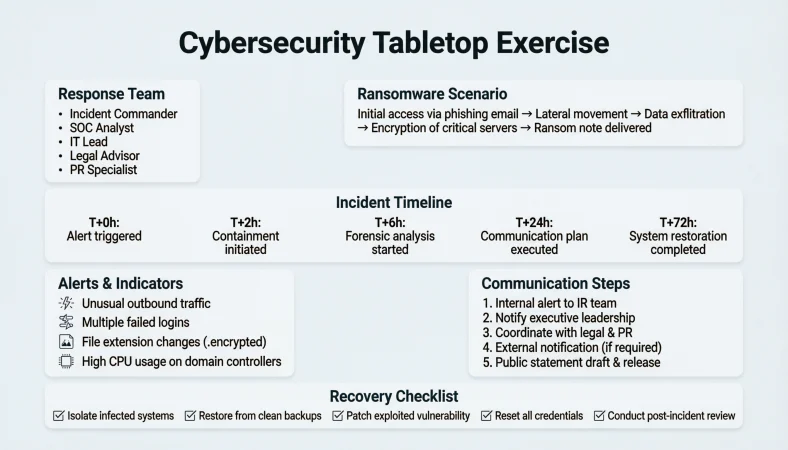
Quick Answer: An incident response tabletop exercise template gives teams a structured way to simulate a cyber incident, test roles and procedures, uncover gaps, and practice decision-making before a real emergency happens.
Top alternatives: cyber incident tabletop template, cybersecurity tabletop exercise, incident response drill template, ransomware tabletop exercise, security incident simulation
Nobody wants to discover that the incident response plan looks brilliant on paper but falls apart the moment someone says, “We have a ransomware incident.” That is exactly why an incident response tabletop exercise template can be so useful.
Whether you’re planning a cybersecurity drill at work, reviewing procedures with your IT team, testing a business continuity plan, or preparing questions for a security meeting, a good tabletop exercise turns theory into practice.
Instead of waiting for an actual incident to expose confusion, teams can safely walk through a realistic scenario and see what happens. Who makes the call? Who contacts leadership? And Who handles communications? What gets documented? Where does everyone panic slightly? A well-built tabletop exercise makes those answers clearer while revealing gaps that ordinary policy reviews can easily miss.
Incident Response Tabletop Exercise Template Basics
Start with a clear incident scenario.
Use this when creating the opening section of your tabletop exercise.
Meaning: Participants need a realistic event to guide the discussion.
Define the purpose before the exercise begins.
Use this when deciding what the session should accomplish.
Meaning: A clear objective keeps the discussion focused.
Identify the participants.
Use this when preparing the attendee list.
Meaning: The exercise should include people responsible for relevant decisions and actions.
Assign an exercise facilitator.
Use this when organizing the session.
Meaning: One person should guide the scenario and keep discussion moving.
Set the scope.
Use this when deciding which systems, teams, or processes are included.
Meaning: Defined boundaries prevent the exercise from becoming unnecessarily broad.
Create a fictional incident timeline.
Use this when preparing scenario materials.
Meaning: A timeline gives participants a sequence of events to respond to.
Document expected decisions.
Use this when preparing facilitator notes.
Meaning: Recording expected actions makes later evaluation easier.
Include realistic complications.
Use this when you want the exercise to feel practical.
Meaning: Additional developments test whether participants can adapt.
Define success criteria.
Use this before starting the exercise.
Meaning: Participants need measurable goals for evaluating performance.
Prepare an after-action review.
Use this when completing the template.
Meaning: The exercise should end with a structured review of lessons learned.
Keep the scenario realistic.
Use this when writing the fictional incident.
Meaning: Realistic situations produce more useful discussions.
Make the exercise safe to fail.
Use this when explaining the purpose to participants.
Meaning: Tabletop exercises should encourage learning rather than blame.
Professional Incident Response Tabletop Prompts
“What is the first action your team takes?”
Use this when opening a professional cybersecurity exercise.
Meaning: It tests whether the organization understands its immediate response priorities.
“Who owns the incident at this stage?”
Use this when testing leadership responsibilities.
Meaning: It identifies whether incident ownership is clearly understood.
“Who needs to be notified?”
Use this when reviewing escalation procedures.
Meaning: It tests whether notification responsibilities are defined.
“What information do you need before making a decision?”
Use this when testing investigation and decision-making.
Meaning: It shows whether teams know what evidence or context matters.
“Which systems require immediate attention?”
Use this when discussing technical priorities.
Meaning: It tests how teams prioritize affected assets.
“What business functions are currently affected?”
Use this during operational impact discussions.
Meaning: It connects technical events with business consequences.
“Who communicates with senior leadership?”
Use this when testing executive escalation.
Meaning: It clarifies responsibility for leadership communications.
“What should employees be told?”
Use this when testing internal communication plans.
Meaning: It evaluates whether staff messaging is coordinated.
“What evidence should be preserved?”
Use this during an investigation scenario.
Meaning: It tests awareness of evidence preservation requirements.
“When should the incident be escalated?”
Use this when reviewing severity thresholds.
Meaning: It identifies whether escalation criteria are understood.
“What would make you activate the continuity plan?”
Use this when connecting incident response with business continuity.
Meaning: It tests whether teams recognize when operational recovery procedures are needed.
“What decision cannot wait?”
Use this when adding urgency to the exercise.
Meaning: It tests the team’s ability to prioritize under pressure.
Funny Incident Response Tabletop Exercise Ideas
“The incident has officially entered the group chat.”
Use this as a light opening line for a team exercise.
Meaning: It introduces the scenario without making the session feel overly stiff.
“Congratulations, you have a cyber incident.”
Use this when presenting the opening scenario.
Meaning: It immediately tells participants that the simulation has begun.
“Someone clicked something they definitely should not have clicked.”
Use this for a phishing-based scenario.
Meaning: It introduces a relatable initial security event.
“The dashboard is suddenly having feelings.”
Use this when describing unusual system alerts.
Meaning: It humorously signals that something abnormal has occurred.
“Your calm Tuesday has left the building.”
Use this when introducing an escalating scenario.
Meaning: It creates urgency while keeping the exercise approachable.
“The suspicious login has entered the chat.”
Use this when starting an account-compromise scenario.
Meaning: It introduces an unexpected authentication event.
“The backup server would like to discuss your life choices.”
Use this when simulating backup problems.
Meaning: It highlights the added pressure of unavailable recovery resources.
“Everything was fine five minutes ago.”
Use this as the opening line for a sudden incident.
Meaning: It captures how quickly an ordinary workday can change.
“Plot twist: the alert is real.”
Use this when moving from an investigation phase to confirmed compromise.
Meaning: It tests how the team responds when suspicion becomes evidence.
“Your incident plan has entered its practical exam.”
Use this when beginning the exercise.
Meaning: It frames the tabletop as a test of preparedness.
“The security team has received an unwanted surprise.”
Use this for a light scenario introduction.
Meaning: It establishes that a security event requires investigation.
“Time to find out whether the plan actually plans.”
Use this before starting the simulation.
Meaning: It humorously emphasizes the difference between documentation and execution.
Ransomware Tabletop Exercise Template
Initial alert: multiple files are suddenly inaccessible.
Use this as the first inject in a ransomware scenario.
Meaning: Participants must determine whether the event represents a security incident.
An employee reports a ransom note.
Use this after the initial alert.
Meaning: It provides stronger evidence of possible ransomware activity.
Several workstations show unusual behavior.
Use this to increase the scope of the scenario.
Meaning: Participants must consider whether the incident is spreading.
A critical application becomes unavailable.
Use this when testing business impact assessment.
Meaning: It forces the team to consider operational consequences.
The backup environment cannot be immediately verified.
Use this as a complication.
Meaning: It tests whether recovery assumptions have been properly validated.
Senior leadership asks whether systems should be shut down.
Use this to test decision-making under pressure.
Meaning: Participants must balance containment against business disruption.
An external partner reports similar activity.
Use this when testing third-party incident coordination.
Meaning: It raises the possibility of a broader connected incident.
The attacker claims to have stolen data.
Use this when introducing a potential data breach.
Meaning: It expands the incident from availability concerns to confidentiality concerns.
Employees begin asking questions on internal messaging channels.
Use this during the communications phase.
Meaning: It tests whether internal communication is coordinated.
A journalist asks the organization for comment.
Use this when testing external communications.
Meaning: It introduces media pressure into the response.
Recovery teams discover a second affected system.
Use this as a late-stage inject.
Meaning: It tests whether teams validate recovery rather than assuming containment is complete.
Leadership asks when normal operations will resume.
Use this near the recovery phase.
Meaning: It tests whether recovery expectations are based on evidence.
Phishing Incident Tabletop Prompts
An employee reports a suspicious email.
Use this as the opening event in a phishing scenario.
Meaning: It tests the organization’s initial reporting and triage process.
The employee clicked the link.
Use this as the next scenario development.
Meaning: It tests how quickly the team responds to a potential compromise.
The user entered credentials.
Use this when increasing the severity.
Meaning: It creates a realistic account-compromise possibility.
The account begins authenticating from an unusual location.
Use this when testing detection.
Meaning: It provides a potential indicator of unauthorized access.
A second employee receives the same message.
Use this to test broader containment.
Meaning: It suggests the campaign may be targeting multiple users.
The attacker attempts to access internal applications.
Use this when testing identity response.
Meaning: It expands the incident beyond the original phishing email.
The security team receives conflicting reports.
Use this to test information management.
Meaning: Participants must determine which information is reliable.
The employee asks whether they should change their password.
Use this during user-response testing.
Meaning: It tests whether staff know what actions are expected.
A suspicious forwarding rule appears in the mailbox.
Use this as a technical inject.
Meaning: It introduces another potential indicator of account compromise.
The attacker sends a follow-up message.
Use this when testing continued monitoring.
Meaning: It tests whether the team expects additional attacker activity.
Leadership asks whether the incident is contained.
Use this when testing executive reporting.
Meaning: It requires participants to distinguish evidence from assumptions.
The exercise ends with a lessons-learned review.
Use this as the final scenario stage.
Meaning: It shifts the focus from response to improvement.
Data Breach Tabletop Exercise Template
Sensitive information may have been accessed.
Use this as the opening scenario for a suspected breach.
Meaning: It introduces a potential confidentiality incident.
The affected database is identified.
Use this when narrowing the investigation.
Meaning: Participants must determine the scope of potentially exposed information.
The team cannot immediately confirm what was accessed.
Use this to test uncertainty management.
Meaning: It evaluates how decisions are made when evidence is incomplete.
A customer asks whether their information was compromised.
Use this when testing customer communications.
Meaning: It introduces pressure to communicate before the investigation is complete.
Legal teams request an incident summary.
Use this when testing internal coordination.
Meaning: It checks whether technical and legal teams can exchange useful information.
A regulator inquiry arrives.
Use this when testing escalation processes.
Meaning: It introduces a formal external stakeholder.
The security team discovers additional affected records.
Use this as a scope-expansion inject.
Meaning: It tests whether the organization can update its assessment.
A third-party vendor may have been involved.
Use this when testing supply-chain coordination.
Meaning: It introduces an external dependency into the investigation.
The media asks for details.
Use this when testing communications.
Meaning: It evaluates whether public statements are coordinated and accurate.
Executives ask for an estimated impact.
Use this when testing reporting.
Meaning: It requires the team to communicate known facts and uncertainty clearly.
Customers want to know what actions they should take.
Use this when testing response messaging.
Meaning: It evaluates whether communications provide practical guidance.
The investigation reaches a recovery phase.
Use this at the end of the scenario.
Meaning: It tests how the organization transitions from investigation to remediation.
Executive-Level Tabletop Exercise Prompts
“What does leadership need to know right now?”
Use this when testing executive briefings.
Meaning: It focuses communication on decision-relevant information.
“What decision requires executive approval?”
Use this when clarifying leadership involvement.
Meaning: It tests whether escalation boundaries are understood.
“What is the business impact?”
Use this when moving beyond technical details.
Meaning: It connects cybersecurity activity to operational consequences.
“What risks are increasing?”
Use this during an escalating incident.
Meaning: It encourages leaders to consider changing exposure.
“What assumptions are we making?”
Use this when information remains incomplete.
Meaning: It helps separate confirmed facts from uncertainty.
“What happens if recovery takes longer than expected?”
Use this when testing resilience.
Meaning: It examines contingency planning.
“Who has authority to make this decision?”
Use this when testing governance.
Meaning: It identifies unclear decision rights.
“What would change our current strategy?”
Use this when adding new information.
Meaning: It tests whether the response can adapt.
“What stakeholders need a briefing?”
Use this during communications planning.
Meaning: It identifies audiences requiring timely information.
“What information should not be shared yet?”
Use this when testing communication discipline.
Meaning: It encourages appropriate handling of incomplete or sensitive information.
“What does success look like in the next hour?”
Use this when creating short-term objectives.
Meaning: It gives leadership a practical near-term goal.
“What happens after the incident is contained?”
Use this during the recovery discussion.
Meaning: It ensures leadership considers remediation and lessons learned.
Creative Incident Response Tabletop Exercise Scenarios
A major supplier reports suspicious activity.
Use this when testing third-party incident response.
Meaning: It examines how the organization handles external security dependencies.
A key administrator account is compromised.
Use this when testing privileged-access response.
Meaning: It creates a high-impact identity scenario.
A cloud application suddenly becomes unavailable.
Use this when testing cloud incident response.
Meaning: It examines how teams respond when critical services are disrupted.
Employees report unusual authentication prompts.
Use this when testing identity-related detection.
Meaning: It may indicate a coordinated credential attack.
A backup account shows unexpected activity.
Use this when testing recovery-system security.
Meaning: It introduces a potential threat to recovery capabilities.
A contractor reports a suspicious device.
Use this when testing third-party reporting.
Meaning: It tests how external personnel enter the incident process.
A security alert arrives outside normal working hours.
Use this when testing on-call procedures.
Meaning: It evaluates whether response coverage works after hours.
A critical system owner is unavailable.
Use this when testing resilience.
Meaning: It reveals whether response responsibilities depend too heavily on one person.
Two teams disagree about the severity of the incident.
Use this when testing classification procedures.
Meaning: It tests whether severity criteria are clear.
The incident overlaps with a planned maintenance window.
Use this when adding operational complexity.
Meaning: It tests whether teams can distinguish legitimate activity from malicious behavior.
A security vendor requests emergency access.
Use this when testing third-party support procedures.
Meaning: It evaluates how external assistance is authorized securely.
The organization receives contradictory technical reports.
Use this when testing information validation.
Meaning: It tests whether teams verify important facts before acting.
Sarcastic Incident Response Tabletop Scenarios
“Nothing says productivity like an unexpected security incident.”
Use this as a humorous scenario introduction.
Meaning: It lightens the atmosphere before a serious exercise begins.
“The incident response plan would like a word.”
Use this when introducing a scenario.
Meaning: It signals that participants must now use their documented procedures.
“The suspicious login has decided to become a recurring guest.”
Use this when escalating an identity scenario.
Meaning: It suggests repeated unauthorized activity.
“The backup plan has entered the storyline.”
Use this when introducing recovery complications.
Meaning: It reminds participants to consider contingency procedures.
“Your perfectly normal workday has been upgraded.”
Use this when starting an incident simulation.
Meaning: It introduces a sudden change in operational conditions.
“The alert that everyone ignored is suddenly important.”
Use this when testing alert triage.
Meaning: It demonstrates the potential consequences of missed warning signs.
“The incident has brought friends.”
Use this when multiple systems become affected.
Meaning: It signals that the scope may be expanding.
“Leadership would like an answer, preferably yesterday.”
Use this when introducing executive pressure.
Meaning: It tests decision-making under time constraints.
“The spreadsheet has officially become evidence.”
Use this when testing documentation practices.
Meaning: It highlights the importance of recording incident information.
“The vendor has entered the plot.”
Use this when introducing a third-party complication.
Meaning: It expands the scenario beyond internal systems.
“The recovery timeline has developed trust issues.”
Use this when introducing unexpected recovery delays.
Meaning: It tests whether teams have realistic recovery assumptions.
“Apparently, ‘we will figure it out’ is not a formal procedure.”
Use this when identifying process gaps.
Meaning: It encourages teams to replace assumptions with documented responsibilities.
Communication-Focused Tabletop Exercise Template
Prepare an internal incident announcement.
Use this when testing employee communications.
Meaning: It ensures staff receive consistent information during an incident.
Prepare an executive briefing.
Use this when testing leadership communications.
Meaning: It gives decision-makers concise information about the situation.
Prepare a customer notification scenario.
Use this when testing external messaging.
Meaning: It evaluates whether customer communications can be produced efficiently.
Prepare a media inquiry.
Use this when testing public relations coordination.
Meaning: It tests how the organization handles external questions.
Identify the communications owner.
Use this when assigning responsibilities.
Meaning: It prevents conflicting or unauthorized messaging.
Define the approval process.
Use this when reviewing communications governance.
Meaning: It establishes who reviews important incident statements.
Separate confirmed facts from assumptions.
Use this when drafting updates.
Meaning: It reduces the risk of communicating unverified information.
Create a holding statement.
Use this when testing early-stage communications.
Meaning: It gives the organization a prepared approach while facts are still developing.
Test communication timing.
Use this when running a realistic scenario.
Meaning: It reveals whether teams can communicate quickly enough.
Include employee questions.
Use this when adding realistic communication pressure.
Meaning: It tests whether internal teams can provide useful guidance.
Include customer concerns.
Use this when testing external response.
Meaning: It helps evaluate clarity and consistency.
Document communication lessons learned.
Use this after the exercise.
Meaning: It turns communication problems into future improvements.
Chill and Casual Tabletop Exercise Prompts
“Okay, something weird just happened. What do we do?”
Use this as an easy opening prompt.
Meaning: It gets participants thinking about their first response.
“Who is taking the lead?”
Use this when testing incident ownership.
Meaning: It checks whether responsibility is immediately clear.
“What do we know so far?”
Use this when gathering initial facts.
Meaning: It prevents assumptions from becoming treated as confirmed information.
“What should we check first?”
Use this when testing triage priorities.
Meaning: It examines how teams identify the most important early actions.
“Who needs to hear about this?”
Use this when testing escalation.
Meaning: It checks whether participants know who should be notified.
“What could make this worse?”
Use this when assessing risk.
Meaning: It encourages participants to identify possible escalation paths.
“What can wait?”
Use this when testing prioritization.
Meaning: It helps teams separate urgent actions from lower-priority tasks.
“What are we missing?”
Use this when introducing uncertainty.
Meaning: It encourages participants to identify information gaps.
“Who needs to be involved now?”
Use this when testing cross-team coordination.
Meaning: It identifies additional stakeholders required for response.
“What happens if our first plan fails?”
Use this when testing resilience.
Meaning: It encourages contingency thinking.
“What do we tell everyone else?”
Use this when testing communication.
Meaning: It examines how internal messaging should be coordinated.
“What should we fix after this?”
Use this during the final review.
Meaning: It turns the exercise into an improvement opportunity.
Confident Incident Response Tabletop Statements
“We have identified the initial incident owner.”
Use this when opening a structured response exercise.
Meaning: It establishes clear accountability.
“We are separating confirmed facts from assumptions.”
Use this when information is incomplete.
Meaning: It promotes evidence-based decision-making.
“We are prioritizing critical business services.”
Use this when defining response priorities.
Meaning: It connects technical actions with business needs.
“We have activated the appropriate escalation path.”
Use this when testing governance procedures.
Meaning: It shows that the team understands how to escalate the incident.
“We are documenting decisions as they happen.”
Use this during the exercise.
Meaning: It creates a useful record for later review.
“We are reviewing the scope before declaring containment.”
Use this when testing incident closure criteria.
Meaning: It prevents premature assumptions about resolution.
“We have identified the required stakeholders.”
Use this when reviewing coordination.
Meaning: It demonstrates awareness of who needs to participate.
“We are evaluating business impact alongside technical impact.”
Use this during executive-level discussions.
Meaning: It recognizes that cybersecurity incidents can affect operations.
“We have defined our next decision point.”
Use this when creating short-term objectives.
Meaning: It keeps the response organized and measurable.
“We are preparing for multiple possible outcomes.”
Use this when dealing with uncertainty.
Meaning: It demonstrates flexible planning.
“We will validate recovery before returning to normal operations.”
Use this during recovery planning.
Meaning: It emphasizes verification instead of assumption.
“The exercise has identified opportunities for improvement.”
Use this when closing the tabletop.
Meaning: It frames weaknesses as actionable lessons.
Emotional and High-Pressure Tabletop Scenarios
Leadership demands an immediate answer.
Use this when testing pressure during a crisis.
Meaning: It examines whether teams can communicate confidently despite uncertainty.
A critical system is unavailable.
Use this when testing operational stress.
Meaning: It forces participants to consider business continuity.
Customers begin asking questions.
Use this when testing external pressure.
Meaning: It introduces reputational and communication considerations.
Employees become concerned about their accounts.
Use this when testing internal response.
Meaning: It evaluates whether employees receive clear guidance.
The incident appears larger than initially believed.
Use this when escalating the scenario.
Meaning: It tests whether teams can reassess the response as new facts emerge.
The original incident commander becomes unavailable.
Use this when testing leadership resilience.
Meaning: It examines whether another qualified person can take ownership.
A key vendor cannot immediately respond.
Use this when testing dependency risk.
Meaning: It evaluates whether the organization can operate without immediate external assistance.
Recovery takes longer than expected.
Use this when testing resilience planning.
Meaning: It examines whether alternative operating arrangements exist.
The investigation produces conflicting evidence.
Use this when testing analytical decision-making.
Meaning: It requires participants to validate information before acting.
The incident occurs during a major business event.
Use this when testing operational pressure.
Meaning: It examines how competing priorities affect incident response.
A senior executive asks whether the organization should disclose the incident.
Use this when testing governance and communications.
Meaning: It introduces a significant decision requiring appropriate stakeholder input.
The team reaches the end of the exercise with unresolved questions.
Use this as the final discussion point.
Meaning: It encourages honest identification of knowledge gaps.
Clever Incident Response Tabletop Checklist Prompts
Who detected the incident?
Use this at the beginning of the exercise.
Meaning: It identifies the starting point for the response timeline.
When was it detected?
Use this when building the incident timeline.
Meaning: It establishes when the organization became aware of the event.
What systems are affected?
Use this during technical triage.
Meaning: It helps determine the initial scope.
What data may be involved?
Use this during impact assessment.
Meaning: It identifies potential confidentiality concerns.
Who owns the affected systems?
Use this when coordinating with technical teams.
Meaning: It identifies subject-matter experts and decision-makers.
What containment options exist?
Use this when testing response planning.
Meaning: It encourages teams to identify ways to limit further impact.
What evidence needs preservation?
Use this during investigation planning.
Meaning: It supports appropriate evidence handling.
What dependencies could complicate recovery?
Use this during resilience planning.
Meaning: It identifies systems or suppliers that could affect restoration.
Which stakeholders need updates?
Use this during communication planning.
Meaning: It ensures relevant groups remain informed.
What triggers escalation?
Use this when testing incident severity criteria.
Meaning: It checks whether escalation thresholds are understood.
How will containment be verified?
Use this when testing response completion criteria.
Meaning: It prevents teams from assuming the threat has disappeared.
How will lessons learned become action items?
Use this after the exercise.
Meaning: It connects the tabletop directly to measurable improvement.
Advanced Incident Response Tabletop Exercise Template
Begin with the initial detection event.
Use this as the first stage of an advanced exercise.
Meaning: It establishes the starting point for the incident timeline.
Introduce new information at controlled intervals.
Use this when designing facilitator injects.
Meaning: It tests how participants respond as circumstances change.
Include incomplete information.
Use this when creating realistic decision pressure.
Meaning: Real incidents rarely provide perfect information immediately.
Add a business-impact complication.
Use this when testing executive decision-making.
Meaning: It connects technical response with operational priorities.
Introduce a communication challenge.
Use this when testing coordination.
Meaning: It examines whether teams can communicate accurately under pressure.
Add a third-party dependency.
Use this when testing supply-chain resilience.
Meaning: It evaluates response when another organization is involved.
Test the incident escalation process.
Use this when evaluating governance.
Meaning: It determines whether severity and escalation procedures work as expected.
Test evidence preservation.
Use this when evaluating investigative readiness.
Meaning: It checks whether teams understand what information should be retained.
Test recovery assumptions.
Use this before declaring the incident resolved.
Meaning: It determines whether recovery capabilities have actually been validated.
Introduce a leadership decision point.
Use this when testing executive participation.
Meaning: It creates a realistic moment requiring business judgment.
End with an after-action review.
Use this when completing the exercise.
Meaning: It provides a structured opportunity to identify improvements.
Convert findings into assigned actions.
Use this after the exercise.
Meaning: It ensures lessons become practical changes rather than forgotten notes.
Simple Incident Response Tabletop Exercise Template for Beginners
Scenario: A suspicious login has been detected.
Use this as an easy starting scenario.
Meaning: Participants can practice the basic incident response process without excessive complexity.
Detection: Someone reports unusual account activity.
Use this as the opening event.
Meaning: It establishes how the incident enters the response process.
Triage: Determine what happened.
Use this during the initial investigation.
Meaning: The team identifies the available facts and potential scope.
Containment: Consider immediate protective actions.
Use this during the response phase.
Meaning: Participants explore ways to limit further impact.
Communication: Notify appropriate stakeholders.
Use this during escalation.
Meaning: The team practices coordinated information sharing.
Investigation: Determine what systems or accounts may be involved.
Use this when expanding the scenario.
Meaning: It encourages participants to investigate beyond the original alert.
Recovery: Restore affected services safely.
Use this during the final operational phase.
Meaning: It tests whether recovery can occur without reintroducing risk.
Validation: Confirm the incident is contained.
Use this before closing the scenario.
Meaning: It tests whether teams have evidence that the response succeeded.
Documentation: Record decisions and actions.
Use this throughout the exercise.
Meaning: Documentation supports accountability and later analysis.
Lessons learned: Identify what should change.
Use this during the final discussion.
Meaning: It turns the exercise into an improvement activity.
Action plan: Assign owners and deadlines.
Use this after identifying gaps.
Meaning: It transforms observations into specific follow-up work.
Repeat: Schedule another exercise later.
Use this as the final improvement step.
Meaning: Repeated practice helps determine whether corrective actions actually worked.
FAQs
What is an incident response tabletop exercise template?
An incident response tabletop exercise template is a structured framework for simulating a cybersecurity incident and guiding participants through detection, assessment, escalation, containment, communication, recovery, and lessons learned.
Why use an incident response tabletop exercise template?
It helps teams practice their responsibilities without the disruption or risk of a real incident. It can also reveal unclear roles, communication gaps, outdated procedures, and recovery assumptions.
What should an incident response tabletop exercise include?
A useful template normally includes the scenario, objectives, participants, roles, timeline, facilitator prompts, scenario injects, decision points, communications considerations, success criteria, and an after-action review.
Can a tabletop exercise be used for ransomware?
Yes. Ransomware is a common scenario because it can involve technical response, business disruption, communications, recovery, leadership decisions, third parties, and potential data exposure.
Should executives participate in a tabletop exercise?
Executives can participate when the exercise includes decisions involving business priorities, communications, operational disruption, risk, or significant escalation. Their involvement can also help clarify decision authority.
How long should an incident response tabletop exercise last?
The duration depends on the objectives and complexity. A simple exercise may take an hour, while a larger cross-functional scenario can take several hours.
What if the team does not know the answer during the exercise?
That is useful information. A tabletop exercise is designed to identify uncertainty and gaps before a real incident makes them costly or disruptive.
Can humor be used during a tabletop exercise?
Yes, light humor can make participation more comfortable and keep energy high, especially during introductions. The exercise should still maintain a professional focus when discussing serious risks and decisions.
What makes a tabletop exercise effective?
A strong exercise has realistic scenarios, clear objectives, appropriate participants, meaningful injects, defined responsibilities, honest discussion, and actionable follow-up tasks.
Conclusion
A good incident response tabletop exercise template does more than give everyone another document to stare at during a meeting. It creates a safe space to test decisions, uncover gaps, practice communication, and discover who actually knows what happens when the security alarm goes off. The best exercises feel realistic enough to challenge participants without turning into an accidental blame session.
Mix straightforward scenarios with unexpected complications, ask practical questions, and document what the team learns. Most importantly, turn those lessons into assigned actions instead of letting them disappear into the meeting notes abyss. Save this template, share it with your security or IT team, adapt the scenarios to your environment, and keep practicing until the response feels second nature.