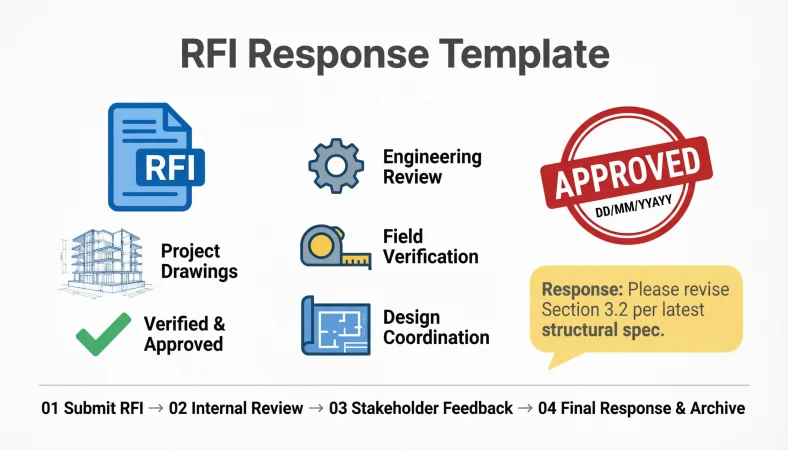
Quick Answer: An RFI response template helps you answer a Request for Information clearly, consistently, and professionally. Whether you are responding to a contractor, client, consultant, supplier, or project team, the right template keeps the question, answer, supporting details, and required action easy to follow.
Top alternatives: Formal RFI Response Template, Construction RFI Response Template, RFI Reply Format, RFI Answer Template, Request for Information Response Template
When an RFI lands in your inbox, nobody wants to spend 20 minutes wondering how to phrase three sentences. You need the answer to be clear, documented, and easy for everyone on the project to understand. That is where a good rfi response template becomes useful.
RFIs are common in construction, engineering, architecture, procurement, project management, and other professional environments. A response may confirm a detail, clarify a drawing, approve an interpretation, request more information, or explain why a proposed change cannot be accepted.
The tricky part is balancing speed with precision. A vague answer can create more questions, while an overly complicated response can bury the actual decision. The best responses make the question easy to identify, give a direct answer, mention relevant documents or specifications, and clearly state any resulting action.
Below, you will find ready-to-use RFI response examples organized by tone and situation, from concise and formal to detailed, corrective, conditional, and approval-focused.
Formal RFI Responses
We acknowledge receipt of the RFI and provide the following response.
Use this when formally acknowledging and answering an RFI.
Meaning: It confirms receipt and introduces the official response.
The information requested is provided below for your reference.
Use this when responding with specific project information.
Meaning: It directs the recipient to the requested details.
Please proceed in accordance with the information provided herein.
Use this when the response establishes the required course of action.
Meaning: It instructs the project team to follow the stated information.
The RFI has been reviewed, and the response is as follows.
Use this when documenting a completed review.
Meaning: It confirms that the question has been considered before answering.
Based on our review, the proposed approach is acceptable.
Use this when approving a proposed solution.
Meaning: It communicates acceptance of the suggested approach.
The proposed interpretation is not consistent with the project requirements.
Use this when correcting an interpretation.
Meaning: It clearly identifies that the proposed understanding is incorrect.
The work shall be completed in accordance with the approved project documents.
Use this when emphasizing existing requirements.
Meaning: It directs the team back to the governing documents.
No further action is required based on this response.
Use this when the RFI does not require additional work.
Meaning: It closes the matter without assigning another action.
Please incorporate this clarification into the applicable project documentation.
Use this when records need updating.
Meaning: It requests that the clarification be formally documented.
This response is issued for project coordination and implementation.
Use this when communicating an official project decision.
Meaning: It establishes the response as guidance for project execution.
Professional RFI Responses
Thank you for your RFI. Please see our response below.
Use this when you want a courteous professional opening.
Meaning: It acknowledges the request while moving directly to the answer.
We have reviewed your question and can confirm the following.
Use this when the requested information has been verified.
Meaning: It signals that the answer is based on review.
Please proceed with the work as described below.
Use this when the response provides clear instructions.
Meaning: It authorizes the stated approach.
We confirm that the proposed solution may be implemented.
Use this when approving a contractor or project proposal.
Meaning: It communicates approval.
The requested information has been reviewed and clarified.
Use this when resolving uncertainty.
Meaning: It confirms that the issue has been addressed.
Our response is based on the current approved project documents.
Use this when the answer depends on project records.
Meaning: It identifies the basis for the response.
Please update your records accordingly.
Use this when the RFI changes or clarifies information.
Meaning: It asks the recipient to maintain accurate documentation.
We recommend proceeding with the option identified below.
Use this when providing a professional project recommendation without unnecessary wording.
Meaning: It identifies the preferred course of action.
The proposed work is acceptable subject to the conditions stated below.
Use this when approval has limitations.
Meaning: It makes acceptance conditional.
Additional information is required before we can provide a final response.
Use this when the RFI is incomplete.
Meaning: It explains why a final answer cannot yet be issued.
Concise RFI Responses
Approved as proposed.
Use this when the proposed solution requires a very short approval.
Meaning: It confirms acceptance.
Proceed as indicated.
Use this when the RFI already contains sufficient detail.
Meaning: It authorizes the stated approach.
Please proceed per the attached drawing.
Use this when the drawing provides the answer.
Meaning: It directs the recipient to the applicable document.
See attached clarification.
Use this when the supporting document contains the response.
Meaning: It points directly to the attachment.
No change required.
Use this when existing work or documentation remains valid.
Meaning: It confirms that nothing needs to be modified.
Confirmed. Proceed accordingly.
Use this when the requested information has been verified.
Meaning: It confirms the answer and authorizes appropriate action.
Additional details are required.
Use this when the RFI lacks sufficient information.
Meaning: It clearly states that more information is needed.
Please refer to the contract documents.
Use this when the answer is already addressed by governing documents.
Meaning: It directs the recipient to the contractual source.
Clarification provided below.
Use this when the answer follows immediately.
Meaning: It introduces the clarification without extra wording.
RFI closed. No further action required.
Use this when the issue has been fully resolved.
Meaning: It formally indicates closure.
Construction RFI Responses
Proceed with the installation in accordance with Drawing A-201.
Use this when a construction installation question is resolved by a drawing.
Meaning: It gives a direct field instruction tied to a document.
Install the material as shown in the latest approved detail.
Use this when the latest approved detail controls the work.
Meaning: It identifies the governing installation information.
The proposed detail is acceptable for construction.
Use this when approving a submitted construction detail.
Meaning: It confirms that the detail can be used.
Maintain the dimensions shown on the approved drawings.
Use this when field dimensions need to remain unchanged.
Meaning: It reinforces the approved dimensional requirements.
Provide the additional blocking indicated in the attached detail.
Use this when additional construction work is required.
Meaning: It instructs the field team to include the specified blocking.
The requested material substitution is not approved.
Use this when rejecting a proposed substitution.
Meaning: It clearly communicates that the original material requirement remains.
No deviation from the approved dimensions is permitted.
Use this when dimensional compliance is critical.
Meaning: It establishes a firm dimensional requirement.
The field condition shall be verified before proceeding.
Use this when physical conditions need confirmation.
Meaning: It requires verification before work continues.
Coordinate the installation with the mechanical and electrical layouts.
Use this when several disciplines overlap.
Meaning: It calls for interdisciplinary coordination.
Any resulting cost or schedule impact shall be submitted separately for review.
Use this when an RFI response may affect project cost or schedule.
Meaning: It separates the technical answer from commercial claims.
Conditional RFI Responses
This approach is acceptable provided the specified dimensions are maintained.
Use this when approval depends on dimensional compliance.
Meaning: It makes acceptance conditional.
Proceed with the proposed solution subject to consultant approval.
Use this when another party must approve the work.
Meaning: It allows progress only after the stated approval.
The proposal may proceed provided all applicable specifications are satisfied.
Use this when compliance remains a condition.
Meaning: It makes approval dependent on specifications.
This response applies only to the condition described in the RFI.
Use this when the answer should not be generalized.
Meaning: It limits the scope of the response.
Approval is conditional upon submission of the revised detail.
Use this when revised documentation is required.
Meaning: It makes approval dependent on receiving the revision.
This clarification applies to the affected area only.
Use this when the response has a limited geographic scope.
Meaning: It prevents the answer from being applied elsewhere.
Implementation is acceptable provided no conflicts with other disciplines are identified.
Use this when coordination remains necessary.
Meaning: It makes approval dependent on interdisciplinary compatibility.
Proceed after confirming the existing site condition.
Use this when the field situation must be checked.
Meaning: It establishes verification as a prerequisite.
The proposed approach may be accepted if the revised documents reflect this clarification.
Use this when records must be updated.
Meaning: It ties acceptance to revised documentation.
This response does not authorize work outside the stated scope.
Use this when limiting the interpretation of an RFI answer.
Meaning: It prevents the response from being treated as broader authorization.
Approval RFI Responses
Approved as submitted.
Use this when the RFI proposal is fully acceptable.
Meaning: It provides direct approval.
Approved with the following clarification.
Use this when approval includes an important note.
Meaning: It confirms acceptance while adding conditions or details.
The proposed solution is approved for implementation.
Use this when formal implementation approval is needed.
Meaning: It authorizes the accepted solution.
Approved subject to the requirements noted below.
Use this when approval has conditions.
Meaning: It communicates acceptance with limitations.
The revised detail is approved for construction.
Use this when an updated construction detail has been reviewed.
Meaning: It confirms the revision can be used.
The proposed substitution is approved.
Use this when accepting an alternative material or product.
Meaning: It confirms the substitution.
Proceed with the approved option identified in the RFI.
Use this when the RFI contains multiple alternatives.
Meaning: It identifies the option that may proceed.
The submitted approach is acceptable and may be incorporated into the work.
Use this when documenting approval for implementation.
Meaning: It authorizes incorporation.
Approved provided the stated specification requirements are maintained.
Use this when approval depends on compliance.
Meaning: It makes approval conditional.
The proposed revision is approved for the affected area.
Use this when approval has a defined project location.
Meaning: It limits the approval to the specified area.
This response confirms acceptance of the proposed resolution.
Use this when formally documenting an agreed solution.
Meaning: It records the accepted resolution.
Please proceed with implementation and update the applicable records.
Use this when approval requires follow-up documentation.
Meaning: It authorizes work and requests record updates.
RFI Clarification Responses
The intent of the detail is to provide continuous support at the indicated location.
Use this when explaining design intent.
Meaning: It clarifies what the detail is intended to accomplish.
The dimension shown on the drawing should be interpreted as the finished dimension.
Use this when resolving dimensional ambiguity.
Meaning: It defines how the drawing dimension should be understood.
The referenced specification section governs this condition.
Use this when a specification controls the answer.
Meaning: It identifies the applicable requirement.
The detail should be read in conjunction with the referenced drawings.
Use this when multiple drawings must be considered together.
Meaning: It prevents the detail from being interpreted in isolation.
The indicated material is required for this application.
Use this when clarifying a material requirement.
Meaning: It confirms that the specified material should be used.
The discrepancy is resolved in favor of the latest approved document.
Use this when two project documents conflict.
Meaning: It identifies which document controls.
The noted condition does not require a design revision.
Use this when clarification resolves an issue without changing the design.
Meaning: It confirms that existing design information remains sufficient.
The opening is to be located as shown on the referenced plan.
Use this when resolving location uncertainty.
Meaning: It provides a specific positioning instruction.
The apparent discrepancy results from different drawing scales.
Use this when scale explains an apparent conflict.
Meaning: It identifies why the information appears inconsistent.
The intent is to maintain the performance requirements identified in the project specifications.
Use this when explaining the purpose behind a requirement.
Meaning: It focuses the response on required performance.
RFI Rejection Responses
The proposed solution is not approved as submitted.
Use this when the proposal needs revision.
Meaning: It clearly rejects the current submission.
Please revise the proposal and resubmit for review.
Use this when another submission is expected.
Meaning: It provides a clear next step after rejection.
The proposed material does not meet the specified requirements.
Use this when rejecting a material substitution.
Meaning: It explains the reason for nonacceptance.
The submitted detail does not align with the approved design.
Use this when the proposal conflicts with design documents.
Meaning: It identifies the basis for rejection.
Please provide an alternative solution that complies with the project specifications.
Use this when a compliant alternative is needed.
Meaning: It asks the recipient to develop another solution.
The proposed approach does not adequately address the identified condition.
Use this when the solution does not solve the stated issue.
Meaning: It explains why the proposal needs improvement.
Please revise the submission to address the comments identified below.
Use this when specific corrections are needed.
Meaning: It directs the recipient toward the required changes.
The requested change is outside the scope of this RFI response.
Use this when the request goes beyond the original question.
Meaning: It limits the response to the stated RFI scope.
No change to the approved design is authorized by this response.
Use this when preventing an RFI from being treated as a design change.
Meaning: It clearly limits the effect of the response.
The original project requirement remains applicable.
Use this when rejecting an interpretation that conflicts with the contract documents.
Meaning: It confirms that the existing requirement remains in force.
Detailed RFI Responses
Based on our review of the RFI, the proposed solution can be implemented as described, provided the applicable project requirements remain satisfied.
Use this when a detailed but controlled approval is necessary.
Meaning: It provides approval while preserving compliance requirements.
The proposed substitution has been reviewed for the stated application. It may proceed only if all specified performance requirements are satisfied.
Use this when evaluating an alternative product.
Meaning: It makes acceptance dependent on performance compliance.
The requested dimension should be interpreted as the finished dimension indicated in the approved drawing. No additional adjustment is required.
Use this when resolving a dimensional question.
Meaning: It provides a precise interpretation and closes the issue.
The proposed change has potential schedule and cost implications. Technical acceptance does not constitute approval of associated commercial impacts.
Use this when a technical response could create claims.
Meaning: It separates technical acceptance from commercial approval.
The submitted detail has been reviewed and is generally acceptable. Please incorporate the comments identified in the response before construction.
Use this when minor revisions are needed before implementation.
Meaning: It provides conditional acceptance.
The response applies only to the condition described in this RFI and should not be interpreted as a general modification to the project requirements.
Use this when limiting the scope of an answer.
Meaning: It prevents broader interpretation.
Please incorporate this clarification into the relevant shop drawings, coordination drawings, and project records as applicable.
Use this when documentation needs to reflect the response.
Meaning: It requires the clarification to be carried into project records.
Friendly RFI Responses
Thanks for sending this through. Here is the clarification.
Use this when the project relationship is professional but relaxed.
Meaning: It acknowledges the request in a friendly manner.
Thanks for flagging this. The intended approach is outlined below.
Use this when someone identifies a potential issue.
Meaning: It appreciates the observation and provides direction.
Good question. The applicable detail is the latest approved revision.
Use this when the RFI is straightforward but needs clarification.
Meaning: It gives a warm opening before the answer.
Thanks for checking this before proceeding. Please use the attached detail.
Use this when early clarification prevents field mistakes.
Meaning: It acknowledges proactive coordination.
We have reviewed the issue and can confirm the following.
Use this when you want a friendly but professional response.
Meaning: It transitions smoothly into the answer.
Appreciate you raising this. No change is required.
Use this when the RFI identifies an issue that needs no action.
Meaning: It thanks the recipient while closing the matter.
Thanks for catching the discrepancy. The latest approved drawing should be followed.
Use this when someone identifies conflicting information.
Meaning: It acknowledges the issue and provides a resolution.
That approach works, subject to the conditions noted below.
Use this when the relationship allows a conversational tone.
Meaning: It communicates conditional acceptance.
Thanks for your patience while this was reviewed.
Use this when an RFI response took longer than expected.
Meaning: It acknowledges the delay courteously.
Hopefully this clears things up and allows the work to move forward.
Use this when the RFI has been resolved.
Meaning: It signals a positive project-focused closure.
Corrective RFI Responses
Please disregard the previous response and use the clarification provided below.
Use this when an earlier answer needs correction.
Meaning: It clearly identifies which response should be followed.
The previous response contained an error. The corrected information is provided below.
Use this when accuracy requires acknowledging a mistake.
Meaning: It documents the correction directly.
Please revise the applicable documents to reflect the corrected information.
Use this when the earlier error affected project records.
Meaning: It requests documentation updates.
The correct dimension is indicated in the revised detail.
Use this when correcting a dimensional error.
Meaning: It identifies the corrected source.
The previous interpretation should no longer be used.
Use this when an earlier interpretation could cause incorrect work.
Meaning: It clearly withdraws the previous guidance.
Please use the latest approved revision for all future coordination.
Use this when outdated information caused confusion.
Meaning: It directs the team toward current documentation.
The corrected response supersedes the information previously issued.
Use this when formally replacing an earlier answer.
Meaning: It establishes the new response as controlling.
Please confirm that the revised information has been incorporated into your records.
Use this when confirmation of correction is important.
Meaning: It requests acknowledgment of the update.
The earlier response did not fully address the condition described in the RFI.
Use this when the original answer was incomplete.
Meaning: It explains why a revised response is being issued.
The following clarification is provided to eliminate any potential ambiguity.
Use this when precision is important.
Meaning: It introduces clearer replacement information.
Technical RFI Responses
The proposed solution is technically acceptable based on the information provided.
Use this when documenting a technical review.
Meaning: It confirms technical acceptability.
The installation shall comply with the applicable technical specification.
Use this when emphasizing technical requirements.
Meaning: It makes specification compliance mandatory.
The proposed assembly must maintain the performance criteria identified in the project documents.
Use this when performance matters more than a specific product.
Meaning: It focuses on required technical performance.
The submitted detail has been reviewed for compatibility with the referenced system.
Use this when evaluating technical compatibility.
Meaning: It documents the scope of review.
The connection shall be designed and installed in accordance with the approved structural detail.
Use this when responding to a structural coordination issue.
Meaning: It directs implementation according to approved engineering information.
The proposed material shall meet the specified strength and performance requirements.
Use this when reviewing material alternatives.
Meaning: It identifies technical criteria that must be satisfied.
The system shall be coordinated with adjacent assemblies before installation.
Use this when interfaces create technical risks.
Meaning: It requires coordination before field installation.
The indicated tolerance shall be maintained during installation.
Use this when installation precision matters.
Meaning: It establishes the required tolerance.
No technical deviation from the approved design is authorized by this response.
Use this when preventing unintended design changes.
Meaning: It limits the technical effect of the response.
Please submit revised technical documentation if the proposed solution differs from the approved design.
Use this when a technical change needs formal documentation.
Meaning: It establishes a submission requirement.
RFI Responses For Missing Information
Additional information is required before this RFI can be answered.
Use this when the question is incomplete.
Meaning: It clearly explains why a final response cannot be issued.
Please provide the referenced drawing for further review.
Use this when a drawing is missing.
Meaning: It identifies the required document.
Please provide the relevant dimensions and site photographs.
Use this when field evidence is needed.
Meaning: It requests specific supporting information.
The information provided is insufficient to determine the appropriate resolution.
Use this when the RFI lacks enough detail.
Meaning: It explains why further information is necessary.
Please identify the exact location affected by this RFI.
Use this when the project area is unclear.
Meaning: It requests a precise location.
Please provide the applicable specification section for review.
Use this when the requirement is unclear.
Meaning: It asks for the governing specification.
Please submit the proposed alternative with supporting technical data.
Use this when evaluating a substitution or alternative.
Meaning: It requests evidence needed for review.
Additional coordination information is required before implementation.
Use this when multiple disciplines may be affected.
Meaning: It pauses implementation until coordination information is available.
Please clarify whether the request applies to all locations or only the area identified in the RFI.
Use this when the scope is unclear.
Meaning: It asks the recipient to define the affected area.
Once the requested information is received, the RFI can be reviewed further.
Use this when the next step depends on additional documentation.
Meaning: It explains what will happen after submission.
Executive And High-Level RFI Responses
The RFI has been reviewed and the proposed resolution is acceptable.
Use this when a senior stakeholder needs a concise decision.
Meaning: It communicates the outcome without unnecessary technical detail.
The matter can proceed in accordance with the approved project documents.
Use this when no special change is required.
Meaning: It confirms that existing documentation remains sufficient.
The proposed change is acceptable subject to the conditions identified in the response.
Use this when management-level approval includes limitations.
Meaning: It communicates controlled acceptance.
No change to the approved scope is required.
Use this when an RFI does not affect project scope.
Meaning: It confirms that the existing scope remains unchanged.
The issue has been resolved through clarification of the existing requirements.
Use this when the RFI does not require a design change.
Meaning: It explains that clarification solved the issue.
The requested deviation is not approved. The existing project requirement remains applicable.
Use this when management needs a clear decision.
Meaning: It communicates rejection and confirms the governing requirement.
The proposed approach requires further review before implementation.
Use this when the issue needs additional consideration.
Meaning: It prevents premature implementation.
The response does not constitute approval of additional cost or schedule impacts.
Use this when commercial consequences may arise.
Meaning: It separates technical direction from commercial approval.
The RFI response confirms the required project direction.
Use this when documenting an established decision.
Meaning: It states that the response provides project direction.
This response closes the technical question raised by the RFI.
Use this when the issue has been fully resolved.
Meaning: It formally identifies the technical matter as closed.
FAQs
What Does RFI Mean?
RFI commonly means Request for Information. In construction, engineering, architecture, and project management, an RFI is typically used to request clarification or additional information about project documents, specifications, drawings, materials, or field conditions.
What Is An RFI Response Template?
An RFI response template is a reusable format for answering a Request for Information. It usually includes the RFI number, subject, question, response, supporting documents, required action, and any relevant conditions.
How Do You Start An RFI Response?
A simple professional opening is: “We acknowledge receipt of the RFI and provide the following response.” For a more concise format, you can begin with “The requested clarification is provided below.”
How Do You End An RFI Response?
You can close with “Please proceed accordingly”, “No further action is required”, or “Please update your records accordingly.” The closing should match the action required after the response.
Can An RFI Response Approve Work?
An RFI response can communicate technical acceptance or project direction when the person or organization issuing the response has the appropriate authority. The response should clearly state any conditions or limitations.
What If You Cannot Answer An RFI Yet?
Explain what information is missing and request it directly. For example, “Additional information is required before this RFI can be answered. Please provide the referenced drawing for further review.”
How Do You Respond To An RFI When Documents Conflict?
Identify the conflicting documents, state which approved document governs based on the applicable project procedures, and explain the required action. Avoid leaving the recipient to interpret the conflict themselves.
Should You Mention Attachments In An RFI Response?
Yes, when an attachment contains drawings, sketches, specifications, calculations, photographs, or other information necessary to understand the response. Identify the attachment clearly so the recipient can connect it to the answer.
Conclusion
A well-written RFI response does more than answer a question. It creates a clear project record, reduces confusion, supports coordination, and helps everyone understand what happens next. Whether you need a quick approval, technical clarification, conditional response, rejection, correction, or request for additional information, the wording should always match the situation.
Use these rfi response template examples as starting points, then adapt the details to your project documents, authority, scope, and communication requirements. A clear answer today can prevent a surprisingly large headache later.
Save this collection for your next RFI, share it with your project team, and keep the templates handy whenever another question lands in your inbox.