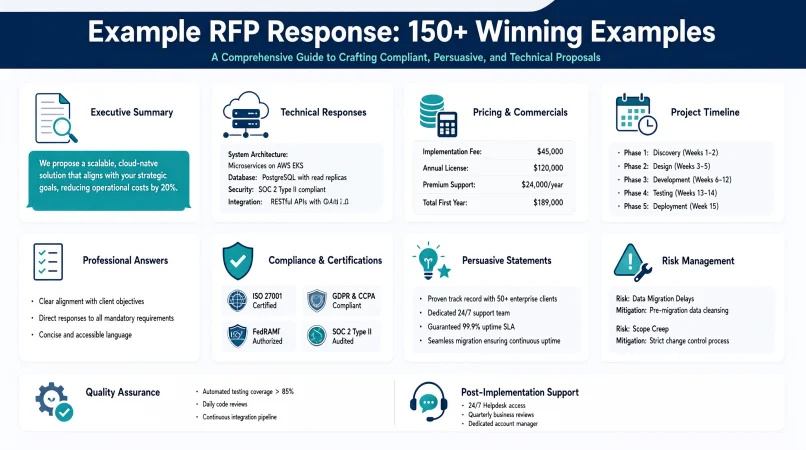
An example RFP response shows how to answer a Request for Proposal clearly, professionally, and persuasively while demonstrating your company’s ability to meet a client’s needs. A strong response highlights qualifications, pricing, experience, and measurable value.
Writing an RFP response can feel like trying to solve a puzzle when the deadline is already breathing down your neck. Whether you’re preparing a business proposal, responding to a government contract opportunity, or helping your sales team win a new client, the right words can make a meaningful difference.
A well-written example RFP response helps you understand what evaluators expect, how to organize your answers, and how to present your company as a reliable partner. From answering technical questions to explaining your pricing strategy, every section should communicate value without overwhelming the reader.
The goal isn’t to sound impressive just for the sake of it. It’s to show that you understand the client’s challenges and have a practical solution. With the examples below, you’ll find professional wording, persuasive statements, and useful templates to make your next proposal clearer, stronger, and easier to evaluate.
Top alternatives: RFP response template, RFP proposal examples, sample RFP answers, RFP response letter, winning proposal examples.
1. Professional RFP Response Examples
Professional responses establish credibility and show evaluators that your organization understands the opportunity.
1. We are pleased to submit our proposal for your consideration.
Example: Use this when formally introducing your company’s submission for a new contract.
Meaning: It communicates professionalism and genuine interest in the opportunity.
2. Our team has the expertise required to meet your project objectives.
Example: Include this when your qualifications directly match the client’s requirements.
Meaning: It emphasizes relevant skills and confidence in your team’s capabilities.
3. We have reviewed the requirements outlined in your RFP.
Example: Use this at the beginning of a response to confirm your understanding of the request.
Meaning: It shows that your proposal is based on the client’s stated needs.
4. Our proposed solution aligns with your operational priorities.
Example: Add this when explaining how your services support the client’s business goals.
Meaning: It demonstrates that your approach is tailored to the organization.
5. We appreciate the opportunity to participate in this selection process.
Example: Use this in your cover letter when submitting a competitive proposal.
Meaning: It expresses gratitude while maintaining a formal tone.
6. Our organization is committed to delivering measurable results.
Example: Include this when describing your performance standards and project objectives.
Meaning: It highlights accountability and a results-focused mindset.
7. We have developed a solution that addresses your key requirements.
Example: Use this before outlining your proposed services or implementation plan.
Meaning: It reassures evaluators that your offer responds to their priorities.
8. Our approach combines industry knowledge with practical execution.
Example: Include this in a section describing your methodology.
Meaning: It presents your team as both knowledgeable and action-oriented.
9. We prioritize quality, transparency, and consistent communication.
Example: Use this when explaining your service delivery principles.
Meaning: It establishes expectations for a professional working relationship.
10. Our proposal outlines a clear path toward successful project delivery.
Example: Place this in an executive summary introducing your solution.
Meaning: It emphasizes structure, planning, and achievable outcomes.
11. We welcome the opportunity to demonstrate our capabilities.
Example: Use this when the buyer has requested evidence of relevant experience.
Meaning: It conveys confidence without sounding overly aggressive.
12. We look forward to the possibility of working together.
Example: Add this to the closing paragraph of a formal RFP submission.
Meaning: It ends the response on a courteous and optimistic note.
2. Concise RFP Response Examples
Short, direct answers help evaluators find important information quickly.
1. Yes, we meet this requirement.
Example: Use this when responding to a clearly defined requirement your company satisfies.
Meaning: It provides a straightforward confirmation.
2. Our solution supports all listed project objectives.
Example: Include this as a summary before providing supporting details.
Meaning: It communicates alignment with the requested outcomes.
3. We can deliver the proposed services within the stated timeline.
Example: Use this when your delivery schedule has been validated.
Meaning: It confirms that the timeline is achievable.
4. Our pricing is detailed in the accompanying cost schedule.
Example: Use this when directing evaluators to a pricing section within your submission.
Meaning: It identifies where financial information can be found.
5. We have included the requested documentation.
Example: Add this when confirming that required supporting materials are attached.
Meaning: It signals that the submission includes the requested evidence.
6. Our team has experience delivering similar projects.
Example: Use this when your organization has relevant completed work.
Meaning: It establishes experience without unnecessary detail.
7. We comply with the specified security requirements.
Example: Include this only after verifying that your organization meets those requirements.
Meaning: It confirms your security position clearly.
8. Implementation can begin after contract approval.
Example: Use this when describing your planned project start.
Meaning: It identifies the condition required to begin work.
9. Our support team is available throughout implementation.
Example: Include this when explaining your onboarding arrangements.
Meaning: It reassures the client that assistance will be available.
10. We have addressed each mandatory requirement.
Example: Use this after completing a compliance review of your response.
Meaning: It communicates that the required items have been covered.
11. Our proposal includes defined performance measures.
Example: Add this when your offer contains measurable service targets.
Meaning: It highlights how performance will be assessed.
12. We are available to clarify any aspect of our submission.
Example: Use this in the final section of your proposal.
Meaning: It invites questions without creating unnecessary pressure.
3. Persuasive RFP Response Examples
Persuasive answers connect your capabilities to benefits the client can evaluate.
1. Our solution is designed to address your most important business challenges.
Example: Use this when introducing a proposal built around specific client pain points.
Meaning: It positions your offer as relevant and purpose-driven.
2. We combine reliable delivery with a practical implementation strategy.
Example: Include this when comparing your approach with more complicated alternatives.
Meaning: It emphasizes execution and dependability.
3. Our approach helps reduce avoidable delays and operational friction.
Example: Use this when your methodology can reasonably improve workflow efficiency.
Meaning: It focuses on operational benefits rather than vague promises.
4. We tailor our recommendations to your organization’s requirements.
Example: Include this when your proposal reflects the buyer’s specific environment.
Meaning: It highlights customization and relevance.
5. Our experience enables us to anticipate common project challenges.
Example: Use this when explaining how your team manages implementation risks.
Meaning: It presents experience as a practical advantage.
6. We focus on outcomes that support your long-term objectives.
Example: Add this when describing benefits beyond the initial contract.
Meaning: It connects immediate delivery with lasting business value.
7. Our delivery model balances quality, efficiency, and accountability.
Example: Use this in a section explaining your operating model.
Meaning: It communicates a balanced approach to project performance.
8. We offer a structured path from planning through completion.
Example: Include this when outlining project phases and milestones.
Meaning: It shows that your proposal covers the full delivery process.
9. Our recommendations are supported by relevant experience and evidence.
Example: Use this when your proposal includes case studies or performance data.
Meaning: It strengthens credibility through verifiable support.
10. We aim to deliver value that extends beyond the initial engagement.
Example: Include this when your services offer ongoing operational benefits.
Meaning: It emphasizes sustainable value rather than a one-time transaction.
11. Our team is prepared to adapt as project needs evolve.
Example: Use this when discussing change management and evolving requirements.
Meaning: It communicates flexibility within an agreed scope.
12. We provide a clear connection between your requirements and our proposed solution.
Example: Include this when summarizing your response matrix.
Meaning: It makes your proposal easier to evaluate against the RFP.
4. Executive Summary RFP Response Examples
An executive summary gives decision-makers a quick understanding of your proposal.
1. We propose a practical solution aligned with your strategic priorities.
Example: Use this as the opening statement of your executive summary.
Meaning: It introduces your offer in terms of business relevance.
2. Our proposal addresses your requirements through a phased delivery approach.
Example: Include this when your project has several defined implementation stages.
Meaning: It summarizes the structure of your solution.
3. We bring relevant expertise, a qualified team, and a clear delivery plan.
Example: Use this when highlighting three major strengths of your proposal.
Meaning: It gives evaluators a concise picture of your capabilities.
4. Our recommended approach prioritizes reliability and measurable performance.
Example: Include this when service quality is central to the project.
Meaning: It establishes the main principles behind your offer.
5. We have designed our response around your stated objectives and constraints.
Example: Use this when the RFP specifies budget, scope, and timing requirements.
Meaning: It demonstrates attention to the client’s operating conditions.
6. Our solution offers a structured approach to implementation and support.
Example: Add this when the engagement includes deployment and ongoing service.
Meaning: It summarizes both delivery and post-launch assistance.
7. We understand the importance of minimizing disruption during implementation.
Example: Use this when proposing changes to existing systems or processes.
Meaning: It acknowledges an important operational concern.
8. Our proposal defines the resources, milestones, and responsibilities needed for delivery.
Example: Include this when your project plan is fully documented.
Meaning: It signals readiness and planning discipline.
9. We have prioritized the requirements that matter most to successful delivery.
Example: Use this when explaining your approach to the highest-priority needs.
Meaning: It highlights purposeful planning.
10. Our team will work closely with your stakeholders throughout the engagement.
Example: Include this when collaboration is part of your delivery model.
Meaning: It emphasizes communication and coordination.
11. We propose a transparent framework for tracking project progress.
Example: Use this when your solution includes regular reporting and reviews.
Meaning: It communicates visibility and accountability.
12. We believe our capabilities and approach make us a strong candidate for this opportunity.
Example: Use this near the end of your executive summary.
Meaning: It expresses confidence while leaving the decision to the evaluator.
5. Technical RFP Response Examples
Technical responses should answer the precise requirement and provide enough evidence to support the claim.
1. Our proposed architecture supports the required system functionality.
Example: Use this when describing a verified technical design.
Meaning: It confirms alignment between the proposed architecture and the specification.
2. The solution supports integration with the systems identified in the RFP.
Example: Include this when the required integrations have been confirmed.
Meaning: It addresses interoperability with existing systems.
3. We will document the implementation and configuration process.
Example: Use this when describing technical handover deliverables.
Meaning: It emphasizes maintainability and clear documentation.
4. Our technical approach includes testing before production deployment.
Example: Include this when your implementation plan contains a formal testing stage.
Meaning: It highlights quality assurance before launch.
5. The proposed solution supports role-based access controls.
Example: Use this when the solution genuinely provides the required permissions model.
Meaning: It addresses access management and user authorization.
6. We will validate system performance against agreed acceptance criteria.
Example: Include this in your testing and acceptance section.
Meaning: It explains how technical success will be measured.
7. Our implementation plan includes documented rollback procedures where applicable.
Example: Use this when your deployment process includes recovery measures.
Meaning: It demonstrates preparation for implementation issues.
8. The solution is designed to support the required data exchange formats.
Example: Include this when your system supports the formats specified by the buyer.
Meaning: It confirms compatibility with required data workflows.
9. We will assess dependencies before beginning implementation.
Example: Use this when discussing technical discovery and planning.
Meaning: It shows that prerequisites will be identified early.
10. Our testing process includes functional and integration validation.
Example: Include this when both testing activities are part of your methodology.
Meaning: It explains how functionality and connected systems will be checked.
11. Technical documentation will be provided according to the agreed deliverables.
Example: Use this when specifying the documentation included in the contract.
Meaning: It sets clear expectations for technical handover.
12. Any technical limitations will be documented with proposed mitigation measures.
Example: Include this when a requirement needs qualification or a workaround.
Meaning: It demonstrates transparency and responsible technical planning.
6. Compliance-Based RFP Response Examples
Compliance answers must be accurate, specific, and supported by appropriate documentation.
1. We confirm compliance with this requirement as specified.
Example: Use this when the requirement has been reviewed and verified.
Meaning: It provides a formal compliance confirmation.
2. Supporting evidence is included in the designated compliance section.
Example: Add this when certificates or supporting records are included.
Meaning: It helps evaluators locate the relevant evidence.
3. Our policies address the controls identified in the RFP.
Example: Use this when your documented policies cover the specified controls.
Meaning: It connects your internal procedures to the buyer’s requirements.
4. We maintain documented procedures for reviewing operational compliance.
Example: Include this when your organization has formal review procedures.
Meaning: It demonstrates an established compliance process.
5. The requested certification is provided with our submission.
Example: Use this only when the relevant certification is current and attached.
Meaning: It confirms that the requested credential is available.
6. Our response identifies the applicable standards and supporting evidence.
Example: Include this when mapping your practices to named standards.
Meaning: It makes compliance easier to verify.
7. We have reviewed the mandatory conditions stated in the solicitation.
Example: Use this after checking the mandatory submission requirements.
Meaning: It signals that the requirements have been carefully reviewed.
8. Any exceptions are clearly identified in our response.
Example: Include this when your proposal contains disclosed deviations.
Meaning: It prevents evaluators from mistaking exceptions for full compliance.
9. Our compliance documentation reflects the current scope of our services.
Example: Use this when supporting documents relate directly to the proposed engagement.
Meaning: It keeps compliance claims relevant and accurate.
10. We will provide additional evidence where permitted by the procurement process.
Example: Use this when supplementary documentation may be requested.
Meaning: It communicates cooperation without promising an unrestricted process.
11. Our proposed controls are mapped to the relevant requirements.
Example: Include this when providing a requirement-by-requirement compliance matrix.
Meaning: It makes the relationship between controls and requirements clear.
12. We have identified the requirements that need further clarification.
Example: Use this when an ambiguous specification requires a formal question.
Meaning: It encourages clarification instead of unsupported assumptions.
7. RFP Pricing Response Examples
Pricing statements should be transparent and consistent with the commercial terms in your proposal.
1. Our pricing is based on the scope and assumptions outlined in this proposal.
Example: Use this when introducing your commercial offer.
Meaning: It explains the basis for the quoted price.
2. A detailed breakdown of proposed costs is included in the pricing schedule.
Example: Include this when providing itemized costs in an appendix or pricing section.
Meaning: It makes the financial structure easier to review.
3. Our quotation identifies the applicable fees and payment terms.
Example: Use this when summarizing your commercial conditions.
Meaning: It emphasizes clarity around financial obligations.
4. The proposed price reflects the deliverables defined in the RFP.
Example: Include this when your pricing has been mapped to the requested scope.
Meaning: It connects cost to the work being offered.
5. Optional services are listed separately for easier evaluation.
Example: Use this when presenting additional services outside the core package.
Meaning: It distinguishes required costs from optional spending.
6. Any assumptions affecting the proposed price are stated explicitly.
Example: Include this when costs depend on specified conditions.
Meaning: It reduces the risk of misunderstandings.
7. Our commercial model is structured around the agreed project requirements.
Example: Use this when explaining how the pricing model fits the engagement.
Meaning: It links the commercial approach to the project scope.
8. We have identified the payment milestones in our commercial proposal.
Example: Include this when payment depends on project stages.
Meaning: It clarifies when payments are expected.
9. The proposed fees cover the deliverables specifically listed in our scope.
Example: Use this when clarifying what the quoted amount includes.
Meaning: It defines the coverage of the offer.
10. Any applicable taxes are addressed in the pricing documentation.
Example: Include this when the commercial schedule explains tax treatment.
Meaning: It helps buyers understand the complete financial picture.
11. Changes to the agreed scope will be managed through a documented process.
Example: Use this when explaining how additional work will be priced.
Meaning: It establishes a transparent approach to scope changes.
12. Our proposal provides a clear basis for comparing cost and value.
Example: Include this when summarizing your commercial offer.
Meaning: It encourages evaluation beyond the headline price alone.
8. RFP Response Examples for Government Contracts
Government procurement responses often require close attention to mandatory instructions, formal language, and verifiable claims.
1. We submit this proposal in accordance with the solicitation requirements.
Example: Use this in a formal cover letter for a government procurement opportunity.
Meaning: It confirms the purpose and formal nature of the submission.
2. Our response addresses the evaluation criteria identified in the solicitation.
Example: Include this when introducing your structured response.
Meaning: It shows that your proposal follows the stated evaluation framework.
3. All required representations are included where applicable.
Example: Use this after checking the solicitation’s representation requirements.
Meaning: It indicates that the relevant declarations have been considered.
4. Our proposed staffing plan identifies key roles and responsibilities.
Example: Include this when the contract requires a defined delivery team.
Meaning: It clarifies how personnel will support contract performance.
5. We have documented our approach to contract performance monitoring.
Example: Use this when discussing reporting and performance oversight.
Meaning: It demonstrates a structured approach to accountability.
6. The submission follows the requested format and section order.
Example: Use this only after checking the prescribed submission structure.
Meaning: It confirms attention to formatting instructions.
7. Our response identifies the proposed deliverables and acceptance criteria.
Example: Include this when describing measurable contract outputs.
Meaning: It helps establish how completion will be assessed.
8. We have addressed the applicable contract terms in our submission.
Example: Use this when discussing reviewed contractual requirements.
Meaning: It signals attention to the proposed contractual framework.
9. Our past performance information is provided in the requested format.
Example: Include this when relevant references or performance records are required.
Meaning: It makes the supporting experience information easier to review.
10. We have identified the assumptions relevant to contract execution.
Example: Use this when the delivery approach depends on stated conditions.
Meaning: It promotes transparency around execution requirements.
11. Our project controls include documented reporting responsibilities.
Example: Include this when describing governance for contract delivery.
Meaning: It highlights oversight and clear accountability.
12. We are prepared to meet the contractual obligations defined in our accepted offer.
Example: Use this when confirming readiness to perform under agreed terms.
Meaning: It communicates commitment without overstating unverified compliance.
9. RFP Response Examples for IT Services
IT proposals should connect technical capability with security, reliability, support, and business needs.
1. Our IT services are designed to support your operational requirements.
Example: Use this when introducing managed IT services.
Meaning: It presents the services as aligned with business needs.
2. We provide structured processes for incident reporting and resolution.
Example: Include this when describing your service desk or support model.
Meaning: It highlights a consistent approach to handling incidents.
3. Our proposed service includes defined support responsibilities.
Example: Use this when explaining which team handles specific issues.
Meaning: It establishes accountability for support activities.
4. We will document the proposed system integration requirements.
Example: Include this when your services connect multiple platforms.
Meaning: It shows that technical dependencies will be documented.
5. Our approach includes appropriate access and change management controls.
Example: Use this when describing verified operational controls.
Meaning: It emphasizes controlled access and system changes.
6. We will establish reporting procedures aligned with agreed service levels.
Example: Include this when your contract defines measurable service targets.
Meaning: It explains how service performance will be monitored.
7. Our team will coordinate migration activities with designated stakeholders.
Example: Use this when describing a planned system migration.
Meaning: It emphasizes collaboration during technical change.
8. We have outlined the dependencies that may affect implementation.
Example: Include this when documenting infrastructure or vendor prerequisites.
Meaning: It helps identify risks before delivery begins.
9. Our support model includes a documented escalation process.
Example: Use this when describing how unresolved incidents move to higher-level support.
Meaning: It reassures the client that complex issues have a defined path.
10. We will assess the existing environment before finalizing the implementation plan.
Example: Include this when discovery is necessary before deployment.
Meaning: It avoids assumptions about the client’s current systems.
11. Our solution includes the monitoring capabilities specified in the proposal.
Example: Use this when the proposed service includes relevant monitoring features.
Meaning: It connects technical capabilities to the documented scope.
12. We will provide a handover plan for the agreed IT deliverables.
Example: Include this when transferring systems or responsibilities to the client.
Meaning: It supports continuity after implementation.
10. RFP Response Examples for Consulting Services
Consulting proposals should show an understanding of the business problem and explain how recommendations will be developed.
1. Our consulting approach begins with a clear understanding of your objectives.
Example: Use this when introducing a discovery-led consulting engagement.
Meaning: It places the client’s goals at the center of the work.
2. We will assess the current situation before recommending changes.
Example: Include this when the engagement starts with an evaluation phase.
Meaning: It emphasizes evidence-based recommendations.
3. Our methodology combines stakeholder input with structured analysis.
Example: Use this when explaining how you will gather and assess information.
Meaning: It highlights a balanced approach to problem-solving.
4. We will prioritize recommendations according to impact and feasibility.
Example: Include this when the client needs a practical action plan.
Meaning: It helps distinguish useful actions from unrealistic ideas.
5. Our deliverables will translate findings into actionable next steps.
Example: Use this when describing the final report or roadmap.
Meaning: It emphasizes practical outcomes rather than analysis alone.
6. We will work with your team to validate key findings.
Example: Include this when stakeholder review is part of the methodology.
Meaning: It encourages collaboration and accuracy.
7. Our engagement includes clearly defined milestones and outputs.
Example: Use this when presenting the consulting work plan.
Meaning: It makes progress and expectations easier to track.
8. We will identify opportunities to improve existing processes.
Example: Include this when reviewing operations or organizational workflows.
Meaning: It focuses on identifying potential improvements.
9. Our recommendations will reflect the constraints identified during discovery.
Example: Use this when budget, staffing, or timing affects the solution.
Meaning: It makes recommendations more realistic.
10. We will document the rationale behind our principal recommendations.
Example: Include this when delivering a strategy report.
Meaning: It helps stakeholders understand why each recommendation matters.
11. Our approach supports informed decisions through clear evidence and analysis.
Example: Use this when presenting a data-driven consulting method.
Meaning: It connects the consulting work to better decision-making.
12. We will align the final roadmap with your agreed priorities.
Example: Include this when explaining how the final recommendations will be organized.
Meaning: It ensures that the proposed next steps reflect the client’s goals.
11. RFP Response Examples for Customer Service
Customer service proposals should demonstrate how the provider will support customers and measure service quality.
1. Our service model prioritizes timely and helpful customer support.
Example: Use this when introducing your customer service capabilities.
Meaning: It highlights responsiveness and customer care.
2. We will follow the agreed process for handling customer inquiries.
Example: Include this when describing your support procedures.
Meaning: It communicates consistency in customer interactions.
3. Our team will use documented escalation procedures for complex issues.
Example: Use this when explaining how difficult cases will be managed.
Meaning: It shows that complicated inquiries will have a defined path.
4. We propose clear performance measures for service quality.
Example: Include this when presenting your quality assurance approach.
Meaning: It establishes how service standards will be evaluated.
5. Our onboarding plan includes training on your products and policies.
Example: Use this when describing agent preparation.
Meaning: It emphasizes knowledge and readiness before customer contact.
6. We will document recurring issues to identify improvement opportunities.
Example: Include this when explaining your reporting process.
Meaning: It shows how customer feedback can inform service improvements.
7. Our approach supports consistent communication across service channels.
Example: Use this when the service covers phone, email, and chat.
Meaning: It promotes a more consistent customer experience.
8. We will establish reporting procedures for agreed service metrics.
Example: Include this when describing performance dashboards or regular reports.
Meaning: It clarifies how service results will be shared.
9. Our team will follow your approved customer communication guidelines.
Example: Use this when brand voice and policy compliance are important.
Meaning: It protects consistency with the client’s standards.
10. We will review customer feedback as part of ongoing service improvement.
Example: Include this when feedback reviews are included in the contract.
Meaning: It emphasizes continuous improvement.
11. Our service plan defines ownership of unresolved customer issues.
Example: Use this when explaining case management responsibilities.
Meaning: It reduces uncertainty about who handles outstanding cases.
12. We aim to deliver a dependable and respectful customer experience.
Example: Include this when summarizing your service philosophy.
Meaning: It emphasizes reliability and positive customer interactions.
12. RFP Response Examples for Project Management
Project management responses should clarify ownership, timing, risks, and communication.
1. Our project plan defines milestones, dependencies, and deliverables.
Example: Use this when introducing the proposed delivery schedule.
Meaning: It establishes the main elements of project planning.
2. We will assign clear ownership to each major workstream.
Example: Include this when outlining team responsibilities.
Meaning: It helps prevent confusion about accountability.
3. Our approach includes regular progress reviews with key stakeholders.
Example: Use this when describing project governance meetings.
Meaning: It keeps stakeholders informed about progress.
4. We will maintain a risk register throughout the engagement.
Example: Include this when discussing risk identification and mitigation.
Meaning: It shows that project risks will be tracked systematically.
5. Our delivery schedule accounts for identified dependencies.
Example: Use this when milestones rely on approvals or third-party inputs.
Meaning: It demonstrates awareness of scheduling constraints.
6. We will communicate material project changes through agreed channels.
Example: Include this when explaining change communication.
Meaning: It establishes how important updates will be shared.
7. Our governance model defines escalation paths for unresolved issues.
Example: Use this when describing project oversight.
Meaning: It clarifies how blockers can be addressed.
8. We will track progress against the approved project baseline.
Example: Include this when explaining schedule and scope monitoring.
Meaning: It establishes a reference point for measuring progress.
9. Our project team will document decisions and action items.
Example: Use this when describing meeting management.
Meaning: It supports continuity and follow-through.
10. We will assess schedule risks and propose mitigation measures.
Example: Include this when explaining how potential delays will be handled.
Meaning: It demonstrates proactive schedule management.
11. Our completion process includes review against agreed acceptance criteria.
Example: Use this when explaining how deliverables will be approved.
Meaning: It defines how project completion will be evaluated.
12. We will provide a structured handover at the end of the project.
Example: Include this when describing transition to ongoing operations.
Meaning: It supports an organized transfer of responsibilities.
13. RFP Response Examples for Small Businesses
Small businesses can compete effectively by showing relevant expertise, clear communication, and realistic delivery plans.
1. Our team offers focused expertise and personalized service.
Example: Use this when your business provides specialized attention to each client.
Meaning: It highlights your service model without relying on company size.
2. We have tailored our proposal to your stated requirements.
Example: Include this when your offer reflects the buyer’s specific priorities.
Meaning: It demonstrates relevance rather than a generic sales pitch.
3. Our team provides direct communication throughout the engagement.
Example: Use this when clients can work closely with the people delivering the service.
Meaning: It emphasizes accessibility and coordination.
4. We have identified the resources needed to deliver the proposed scope.
Example: Include this when explaining how your team will manage the work.
Meaning: It communicates realistic planning.
5. Our proposal focuses on practical solutions and clear deliverables.
Example: Use this when describing a straightforward, results-oriented approach.
Meaning: It highlights usefulness and clarity.
6. We bring relevant experience to the specific challenges outlined in your RFP.
Example: Include this when your previous work matches the requested services.
Meaning: It connects your experience to the buyer’s needs.
7. Our delivery plan identifies key responsibilities and timelines.
Example: Use this when explaining how your business will organize the work.
Meaning: It demonstrates structure and accountability.
8. We are committed to maintaining clear communication and dependable service.
Example: Include this when describing your relationship management approach.
Meaning: It establishes expectations for working together.
9. Our proposed scope reflects the priorities identified in your request.
Example: Use this when presenting a carefully scoped offer.
Meaning: It confirms that the proposal responds to the requested work.
10. We can explain our approach and assumptions in detail during clarification.
Example: Include this when the procurement process allows clarification discussions.
Meaning: It shows openness to reasonable questions.
11. Our team will provide the agreed deliverables within the approved scope.
Example: Use this when outlining your commitment to delivery.
Meaning: It sets a clear expectation for the work covered.
12. We welcome the opportunity to build a productive working relationship.
Example: Include this in the closing section of your submission.
Meaning: It communicates interest in a collaborative partnership.
14. RFP Response Examples for Difficult Questions
Challenging questions require honest answers that explain limitations without undermining your credibility.
1. We do not currently offer this feature as a standard component.
Example: Use this when the requested feature is genuinely unavailable.
Meaning: It communicates a limitation clearly and honestly.
2. We can assess the feasibility of this requirement during discovery.
Example: Include this when further technical analysis is necessary.
Meaning: It avoids promising a capability before validating it.
3. This requirement would need to be addressed through an agreed change request.
Example: Use this when the requested work falls outside the proposed scope.
Meaning: It explains how additional work can be considered.
4. Our current proposal addresses the requirement through an alternative approach.
Example: Include this when your solution differs from the requested method.
Meaning: It invites evaluation of an alternative without claiming exact compliance.
5. We would appreciate clarification on the expected acceptance criteria.
Example: Use this when the RFP does not define how a requirement will be assessed.
Meaning: It requests the information needed for an accurate response.
6. The proposed timeline depends on receiving the required inputs on schedule.
Example: Include this when delivery relies on client approvals or information.
Meaning: It identifies a dependency that affects the schedule.
7. We have identified a potential risk and outlined mitigation measures.
Example: Use this when describing a known implementation challenge.
Meaning: It shows awareness and preparation.
8. We cannot confirm this capability without additional technical validation.
Example: Include this when the requirement needs testing or specialist review.
Meaning: It avoids making an unsupported commitment.
9. Our proposal includes an exception to the stated requirement.
Example: Use this when disclosing a deviation in the compliance matrix.
Meaning: It makes the limitation visible to evaluators.
10. We recommend confirming the final scope before establishing the delivery date.
Example: Include this when scope uncertainty affects scheduling.
Meaning: It connects realistic planning with an agreed scope.
11. The quoted price excludes the additional services identified in this section.
Example: Use this when clarifying exclusions in the commercial offer.
Meaning: It prevents confusion about what the price covers.
12. We are prepared to discuss feasible alternatives within the procurement rules.
Example: Include this when the buyer permits clarification or negotiation.
Meaning: It communicates flexibility while respecting the procurement process.
15. Winning RFP Response Examples
Strong proposals combine client understanding, evidence, realistic commitments, and a clear explanation of value.
1. Our solution directly addresses the priorities identified in your RFP.
Example: Use this when summarizing how your offer matches the buyer’s needs.
Meaning: It positions the proposal around the evaluation requirements.
2. We support our recommendations with relevant experience and documented results.
Example: Include this when you have verified case studies or performance records.
Meaning: It builds credibility through evidence.
3. Our implementation approach is designed around clear milestones and measurable outcomes.
Example: Use this when explaining your delivery strategy.
Meaning: It connects planning with results that can be evaluated.
4. We have mapped our proposed capabilities to the requirements in your solicitation.
Example: Include this when presenting a completed response matrix.
Meaning: It helps evaluators verify the fit of your offer.
5. Our team combines relevant skills with a practical delivery methodology.
Example: Use this when highlighting the experience of your proposed personnel.
Meaning: It communicates both competence and execution readiness.
6. We have identified the principal risks and proposed reasonable mitigation measures.
Example: Include this when explaining your project risk strategy.
Meaning: It shows that your team has considered potential obstacles.
7. Our commercial proposal clearly explains costs, assumptions, and deliverables.
Example: Use this when summarizing the pricing structure.
Meaning: It emphasizes transparency and comparability.
8. We will measure progress against the agreed performance indicators.
Example: Include this when your proposal contains defined performance metrics.
Meaning: It establishes a measurable approach to accountability.
9. Our solution is designed to support your requirements as they develop.
Example: Use this when the proposed service can accommodate agreed future changes.
Meaning: It highlights flexibility without promising unlimited expansion.
10. We have provided a clear explanation of how each major requirement will be addressed.
Example: Include this when introducing your completed technical response.
Meaning: It makes the proposal easier to assess.
11. Our proposed team is prepared to begin the agreed onboarding activities.
Example: Use this when staffing and start-date dependencies have been confirmed.
Meaning: It demonstrates readiness to move forward.
12. We welcome the opportunity to demonstrate how our proposal meets your needs.
Example: Use this as a closing statement in a competitive submission.
Meaning: It ends confidently while respecting the buyer’s decision-making process.
FAQs
What Does an RFP Response Mean?
An RFP response is a formal proposal explaining how a company will meet the requirements in a Request for Proposal.
Can an RFP Response Sound Persuasive?
Yes. Use relevant evidence, clear benefits, and realistic commitments to make your proposal compelling.
How Do You Respond to an RFP Professionally?
Follow the requested format, answer each requirement, provide supporting evidence, and meet the submission deadline.
What Should You Include in an RFP Response Letter?
Include the opportunity name, company introduction, understanding of requirements, key strengths, and a professional closing.
How Do You Make an RFP Response Stand Out?
Connect each proposed capability to the buyer’s needs and support important claims with verifiable evidence.
Is an RFP Response the Same as a Proposal?
An RFP response is a proposal prepared specifically to answer a buyer’s formal Request for Proposal.
Can You Use an RFP Response Template?
Yes. A template improves consistency, but every answer should be customized to the specific solicitation.
What If Your Company Cannot Meet One Requirement?
Disclose the limitation clearly, explain any feasible alternative, and follow the solicitation’s rules for exceptions.
How Should You Respond to RFP Pricing Questions?
Provide transparent costs, scope assumptions, exclusions, and payment terms consistent with your offer.
Is Humor Appropriate in an RFP Response?
Generally, avoid jokes and casual slang. Professional, clear, and evidence-based language is safer.
How Do You Respond to an RFP When You Lack Experience?
Highlight relevant team expertise, transferable experience, practical methods, and credible evidence without exaggerating qualifications.
What Is the Best Way to End an RFP Response?
Summarize your value, express appreciation, and invite permitted follow-up questions in a professional tone.
Conclusion
A strong example RFP response can help you turn a complicated proposal into a clear, convincing business case. The best responses do more than answer questions. They demonstrate that you understand the client’s priorities, have the relevant capabilities, and can deliver on your commitments. Whether you’re preparing a government bid, an IT proposal, or a small-business submission, focus on accuracy, evidence, and measurable value.
Adapt the examples to your actual services rather than copying every line unchanged. Your next proposal doesn’t need fancy language to stand out. It needs thoughtful answers that make the evaluator’s job easier. Save these examples, share them with your team, and use them as a starting point for your next winning submission.