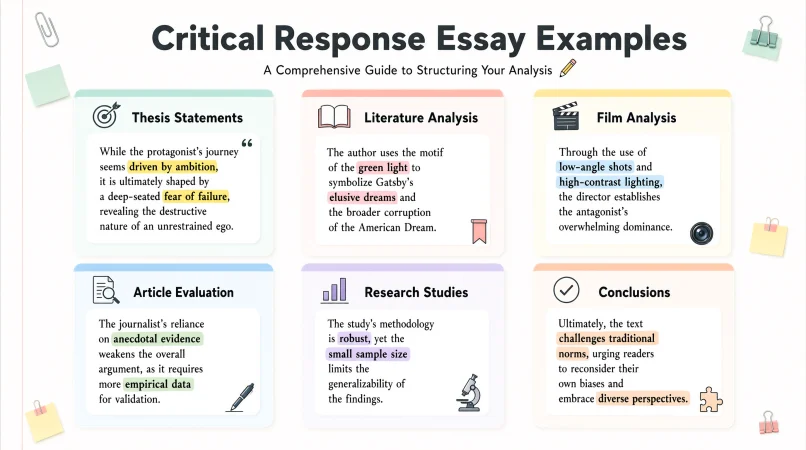
Critical response essay examples show how to analyze a book, article, film, speech, or other text while explaining your own reasoned reaction. The strongest examples combine a clear thesis, specific evidence, thoughtful interpretation, and a balanced conclusion.
A critical response essay is not simply a summary or a collection of personal opinions. It examines an author’s ideas, evaluates the evidence, and explains whether the work succeeds in achieving its purpose.
Ever finished a book, watched a film, or read an article and thought, “Okay, but does this argument actually make sense?” That question is where a critical response essay begins. Whether you’re analyzing a novel for class, evaluating a persuasive speech, or responding to an opinion article, your goal is to go beyond summarizing what happened and explain what the work means, how effectively it communicates its message, and why your interpretation matters.
Finding useful critical response essay examples can make this process much easier, especially when you’re staring at a blank document and your deadline is getting closer. A strong example shows you how to build a thesis, support your claims with evidence, and develop an insightful conclusion without sounding overly complicated. In this guide, you’ll find examples organized by subject, analytical approach, academic level, and writing purpose, along with practical thesis ideas and writing starters to help you develop a response of your own.
1. Critical Response Essay Examples About Literature
- The novel reveals how power can corrupt even well-intentioned people.
Example: Use this when analyzing a novel in which a character gradually becomes controlling.
Meaning: This response evaluates how the author develops the relationship between power and morality. - The main character’s choices reflect the conflict between personal freedom and social expectations.
Example: Use this when discussing a character who struggles to fit into society.
Meaning: It highlights the tension between individual desires and cultural pressure. - The author uses symbolism to communicate emotions that characters cannot express directly.
Example: Use this when an object repeatedly appears during emotionally important scenes.
Meaning: It examines how symbolic details add depth to the story. - The ending challenges readers to reconsider their understanding of justice.
Example: Use this when a novel concludes with an unexpected moral decision.
Meaning: It explains how the ending complicates the reader’s original judgment. - The narrator’s limited perspective makes the story more suspenseful but less reliable.
Example: Use this when the narrator misunderstands events or hides important information.
Meaning: It evaluates how narrative perspective shapes the reader’s understanding. - The author’s description of the setting reinforces the characters’ emotional struggles.
Example: Use this when gloomy weather or an isolated location reflects a character’s feelings.
Meaning: It connects the physical environment to the story’s emotional atmosphere. - The protagonist’s development demonstrates the consequences of avoiding difficult truths.
Example: Use this when a character refuses to confront a problem until it becomes unavoidable.
Meaning: It interprets the character’s development as a lesson about personal responsibility. - The novel questions whether society values reputation more than honesty.
Example: Use this when characters hide the truth to protect their public image.
Meaning: It identifies a broader social criticism within the narrative. - The contrast between the main characters exposes different interpretations of loyalty.
Example: Use this when two characters respond differently to the same betrayal.
Meaning: It compares how the author presents competing moral values. - The recurring theme of isolation reveals the emotional cost of misunderstanding.
Example: Use this when characters become separated because they fail to communicate.
Meaning: It explains how repeated conflicts support the novel’s central theme. - The author’s use of dialogue makes the characters’ motivations more convincing.
Example: Use this when conversations reveal jealousy, fear, or hidden ambitions.
Meaning: It evaluates dialogue as a tool for developing believable characters. - The story’s moral ambiguity encourages readers to question their first impressions.
Example: Use this when a seemingly villainous character has understandable motivations.
Meaning: It shows how complexity prevents simplistic judgments.
2. Critical Response Essay Examples About Articles
- The article presents a persuasive argument, but its supporting evidence remains incomplete.
Example: Use this when an opinion piece makes strong claims without enough research.
Meaning: It recognizes the argument’s strengths while identifying an evidence gap. - The author’s central claim is convincing because it connects research with practical examples.
Example: Use this when an article supports its position with relevant studies and real situations.
Meaning: It evaluates how effectively evidence supports the main argument. - The article oversimplifies a complicated issue by ignoring opposing perspectives.
Example: Use this when an article discusses a controversial topic from only one viewpoint.
Meaning: It identifies a limitation in the author’s reasoning. - The use of statistics strengthens the argument, although their context requires closer examination.
Example: Use this when an article includes percentages without explaining how they were collected.
Meaning: It evaluates both the usefulness and limitations of numerical evidence. - The author appeals to readers’ emotions more strongly than to their logical judgment.
Example: Use this when an article relies on alarming stories rather than detailed evidence.
Meaning: It analyzes the balance between emotional and logical persuasion. - The article’s structure helps readers follow the argument from problem to proposed solution.
Example: Use this when each section develops a clear stage of the discussion.
Meaning: It assesses how organization improves comprehension. - The author’s assumptions weaken an otherwise reasonable argument.
Example: Use this when a writer treats an unproven belief as an established fact.
Meaning: It identifies how unsupported assumptions affect credibility. - The article offers valuable insight but overlooks the experiences of affected communities.
Example: Use this when a policy article discusses statistics without considering personal consequences.
Meaning: It points out a missing perspective that could deepen the analysis. - The evidence supports the article’s conclusion, but the proposed solution needs further evaluation.
Example: Use this when the problem is well documented but the suggested remedy is uncertain.
Meaning: It distinguishes a convincing diagnosis from a potentially weak solution. - The author’s tone makes a complex subject accessible without sacrificing important details.
Example: Use this when a science article explains technical information in everyday language.
Meaning: It evaluates the effectiveness of the author’s communication style. - The article raises an important concern but does not fully establish a causal relationship.
Example: Use this when a writer confuses two events occurring together with proof that one caused the other.
Meaning: It challenges the logic connecting evidence and conclusion. - The article’s strongest contribution is the alternative perspective it introduces.
Example: Use this when a writer challenges a common assumption with a thoughtful interpretation.
Meaning: It explains the article’s intellectual value beyond its main conclusion.
3. Critical Response Essay Examples About Movies
- The film uses visual storytelling to communicate emotions more effectively than dialogue.
Example: Use this when facial expressions and camera movement reveal what characters cannot say.
Meaning: It evaluates how visual techniques contribute to the film’s emotional impact. - The director’s pacing creates suspense, although some scenes feel unnecessarily prolonged.
Example: Use this when a thriller builds tension but loses momentum in certain sequences.
Meaning: It identifies both effective and ineffective pacing choices. - The protagonist’s transformation gives the film a convincing emotional foundation.
Example: Use this when a character learns from mistakes and changes their behavior.
Meaning: It assesses whether character development makes the story believable. - The film’s ending reinforces its central theme without resolving every conflict.
Example: Use this when the final scene leaves important questions unanswered.
Meaning: It interprets an open ending as a deliberate artistic choice. - The cinematography reinforces the contrast between safety and danger.
Example: Use this when bright, open shots contrast with dark, confined scenes.
Meaning: It explains how visual composition supports the narrative. - The soundtrack intensifies the film’s emotional moments but occasionally becomes distracting.
Example: Use this when music makes a dramatic scene powerful but overwhelms the dialogue.
Meaning: It evaluates the soundtrack’s contribution and limitations. - The film challenges stereotypes by giving secondary characters meaningful motivations.
Example: Use this when supporting characters have independent goals and believable flaws.
Meaning: It recognizes how characterization challenges simplistic representations. - The film’s social message is compelling, although its solution appears overly idealistic.
Example: Use this when a movie addresses inequality but offers an unrealistic resolution.
Meaning: It separates the importance of the message from the plausibility of its solution. - The contrast between the opening and closing scenes reveals the protagonist’s growth.
Example: Use this when a character makes a different choice at the end than at the beginning.
Meaning: It interprets the film’s structure as evidence of character development. - The film relies on familiar plot conventions rather than developing an original perspective.
Example: Use this when a movie repeats predictable romantic or action storylines.
Meaning: It critiques the film’s limited originality. - The supporting performances add emotional complexity to an otherwise predictable story.
Example: Use this when secondary actors make familiar characters feel authentic.
Meaning: It evaluates the contribution of the supporting cast. - The film’s ambiguous symbolism invites multiple interpretations of its central conflict.
Example: Use this when recurring images can represent different emotional or moral ideas.
Meaning: It explains how symbolism encourages viewers to think beyond the surface plot.
4. Critical Response Essay Examples About Speeches
- The speaker establishes credibility by combining personal experience with verifiable evidence.
Example: Use this when evaluating a speech that includes firsthand experience and reliable facts.
Meaning: It examines how the speaker earns the audience’s trust. - The repeated use of key phrases reinforces the speech’s central message.
Example: Use this when a speaker repeats a memorable statement throughout a presentation.
Meaning: It explains how repetition improves emphasis and recall. - The speaker’s emotional appeals are powerful, but the factual support remains limited.
Example: Use this when a speech relies on moving stories without enough supporting research.
Meaning: It evaluates the balance between emotion and evidence. - The speech effectively connects an individual experience to a broader social issue.
Example: Use this when a speaker uses a personal story to explain a public problem.
Meaning: It assesses how personal narratives help audiences understand larger concerns. - The speaker’s confident delivery strengthens the presentation but does not replace evidence.
Example: Use this when a persuasive speaker sounds certain while making questionable claims.
Meaning: It distinguishes effective presentation from reliable reasoning. - The speech uses rhetorical questions to encourage the audience to reconsider familiar beliefs.
Example: Use this when a speaker asks questions that challenge common assumptions.
Meaning: It explains how questions invite reflection without requiring direct answers. - The speaker’s use of contrast makes the consequences of inaction easier to understand.
Example: Use this when a speech compares the outcomes of two possible decisions.
Meaning: It evaluates how comparison clarifies the stakes of an argument. - The speech’s strongest argument is supported by concrete examples rather than broad promises.
Example: Use this when a speaker demonstrates a proposal with specific evidence.
Meaning: It identifies the part of the argument with the clearest support. - The speaker acknowledges opposing concerns, making the overall argument more balanced.
Example: Use this when a speaker addresses reasonable objections before presenting a conclusion.
Meaning: It evaluates the speaker’s willingness to engage with different viewpoints. - The speech’s organization helps the audience understand a complex issue.
Example: Use this when a presentation introduces a problem before examining evidence and solutions.
Meaning: It explains how structure supports understanding. - The speaker’s choice of language makes the message memorable but occasionally oversimplifies the issue.
Example: Use this when a speech uses catchy slogans to explain a complicated subject.
Meaning: It considers both accessibility and the risk of losing nuance. - The conclusion effectively motivates action by connecting the audience’s values to practical steps.
Example: Use this when a speech ends with specific, realistic recommendations.
Meaning: It evaluates how the speaker turns persuasion into a call for action.
5. Critical Response Essay Examples About Social Media
- The article effectively highlights how social media can influence users’ self-perception.
Example: Use this when evaluating a text about comparing personal lives with curated online images.
Meaning: It examines how digital content can shape self-image. - The argument about social media addiction needs clearer distinctions between frequent use and harmful behavior.
Example: Use this when a writer treats all heavy social media use as equally damaging.
Meaning: It calls for a more precise and balanced argument. - The author’s discussion of online communities reveals the positive side of digital connection.
Example: Use this when an article explores how online groups provide support and belonging.
Meaning: It recognizes the social benefits of online interaction. - The text raises valid privacy concerns but gives limited attention to practical solutions.
Example: Use this when an article warns about data collection without offering realistic safeguards.
Meaning: It identifies a gap between identifying a problem and addressing it. - The author explains how algorithms influence visibility but overlooks users’ own choices.
Example: Use this when a discussion focuses on recommendation systems and ignores individual behavior.
Meaning: It evaluates whether the explanation accounts for multiple influences. - The article’s examples make online misinformation easier to recognize.
Example: Use this when a writer compares misleading headlines with verified reporting.
Meaning: It assesses how examples make abstract concerns understandable. - The text presents a convincing case for teaching digital literacy in schools.
Example: Use this when an article argues that students need to evaluate online information critically.
Meaning: It supports the educational value of digital literacy. - The author’s criticism of influencer culture is persuasive but sometimes too broad.
Example: Use this when a writer assumes every influencer promotes unrealistic standards.
Meaning: It challenges generalizations without dismissing the broader concern. - The discussion of online activism distinguishes visibility from meaningful social change.
Example: Use this when a text examines whether sharing posts leads to measurable outcomes.
Meaning: It questions the difference between awareness and action. - The article’s strongest insight is that digital communication can create both connection and misunderstanding.
Example: Use this when a text explores how short messages lose context.
Meaning: It highlights the mixed effects of online interaction. - The author relies too heavily on dramatic examples to establish a general trend.
Example: Use this when a writer uses isolated viral incidents to make claims about all users.
Meaning: It questions whether the examples adequately represent the larger population. - The text would be more persuasive if it compared different age groups and online experiences.
Example: Use this when an article makes broad claims about how people use social media.
Meaning: It suggests a way to strengthen the argument through comparison.
6. Critical Response Essay Examples About Education
- The article makes a strong case for active learning by connecting classroom participation with deeper understanding.
Example: Use this when evaluating a text about discussion-based lessons.
Meaning: It assesses how teaching methods may improve student engagement. - The author’s criticism of standardized testing overlooks the benefits of consistent assessment.
Example: Use this when a writer argues that all standardized tests are harmful.
Meaning: It introduces a counterpoint to a one-sided criticism. - The text demonstrates that supportive teacher feedback can help students identify areas for improvement.
Example: Use this when a source discusses constructive feedback on assignments.
Meaning: It highlights feedback as a potential tool for learning. - The argument for smaller classes is compelling, although it requires consideration of cost and staffing.
Example: Use this when evaluating a proposal to reduce class sizes.
Meaning: It weighs the potential benefits against practical limitations. - The author effectively connects educational inequality with differences in available resources.
Example: Use this when an article compares access to books, technology, or experienced teachers.
Meaning: It examines how resources can affect educational opportunities. - The discussion of homework would benefit from distinguishing practice from excessive workload.
Example: Use this when a text criticizes homework without considering its purpose.
Meaning: It introduces a more nuanced distinction. - The article presents a thoughtful argument for teaching critical thinking alongside subject knowledge.
Example: Use this when evaluating a curriculum proposal.
Meaning: It emphasizes the value of interpreting and questioning information. - The author’s examples reveal how classroom expectations can influence student confidence.
Example: Use this when a text examines participation and teacher attitudes.
Meaning: It considers the relationship between classroom culture and confidence. - The argument about online learning is incomplete because it assumes all students have equal access to technology.
Example: Use this when a source praises virtual education without considering internet access.
Meaning: It identifies an important practical limitation. - The text persuasively explains why inclusive teaching practices matter for diverse learners.
Example: Use this when an article discusses adapting instruction to different learning needs.
Meaning: It evaluates the importance of accommodating students’ varied experiences. - The author identifies a real problem but offers recommendations that lack measurable outcomes.
Example: Use this when an education article proposes reforms without explaining how success will be evaluated.
Meaning: It critiques the practical strength of the recommendations. - The strongest point is the author’s recognition that educational success depends on several interconnected factors.
Example: Use this when a text discusses teachers, families, resources, and student support.
Meaning: It acknowledges a broad and balanced understanding of learning.
7. Critical Response Essay Examples About Research Studies
- The study provides useful evidence, although its limited sample size affects how widely the findings can be applied.
Example: Use this when a study examines a small group of participants.
Meaning: It evaluates the limits of generalizing the results. - The researchers use an appropriate method to investigate the question, but some variables remain uncontrolled.
Example: Use this when evaluating a study that cannot account for every influencing factor.
Meaning: It assesses the method while identifying possible confounding variables. - The findings support the hypothesis, although they do not establish a definitive causal relationship.
Example: Use this when a study identifies an association between two variables.
Meaning: It distinguishes correlation from proof of causation. - The study’s transparent methodology makes its conclusions easier to evaluate.
Example: Use this when researchers clearly explain how data were collected and analyzed.
Meaning: It highlights methodological transparency as a strength. - The results are promising, but replication is needed before the conclusions can be treated as robust.
Example: Use this when reviewing a study with limited independent confirmation.
Meaning: It emphasizes the importance of reproducibility. - The authors acknowledge important limitations, which strengthens the credibility of their discussion.
Example: Use this when researchers openly discuss weaknesses in their design.
Meaning: It recognizes the value of honest interpretation. - The research question is relevant, but the chosen measurement may not fully capture the concept being studied.
Example: Use this when a survey uses a narrow measure for a complex behavior.
Meaning: It evaluates whether the measurement matches the research objective. - The researchers interpret the results cautiously, avoiding claims that exceed the available evidence.
Example: Use this when a study clearly separates findings from speculation.
Meaning: It praises appropriately limited conclusions. - The use of multiple data sources strengthens the study’s overall analysis.
Example: Use this when researchers combine interviews, surveys, and observations.
Meaning: It evaluates how different sources can provide complementary insights. - The research offers a useful contribution, but its findings may not apply equally across different populations.
Example: Use this when participants come from a narrow demographic group.
Meaning: It examines the limits of external validity. - The statistical results are important, but their practical significance deserves closer attention.
Example: Use this when a study reports a statistically significant result with a small effect.
Meaning: It distinguishes statistical significance from real-world importance. - The study opens an important research question that future investigations should examine more directly.
Example: Use this when a paper identifies an unanswered question.
Meaning: It explains how research can contribute by identifying new directions.
8. Critical Response Essay Examples With Positive Evaluation
- The author’s clear reasoning makes a complicated argument accessible to a broad audience.
Example: Use this when a text explains difficult ideas without losing accuracy.
Meaning: It praises clarity and effective communication. - The evidence is relevant, credible, and closely connected to the central claim.
Example: Use this when a source supports its argument with appropriate research.
Meaning: It identifies the relationship between strong evidence and a persuasive thesis. - The text’s balanced treatment of opposing views makes the conclusion more convincing.
Example: Use this when a writer acknowledges reasonable disagreements.
Meaning: It recognizes fairness as a strength. - The author’s original interpretation adds a valuable perspective to the existing discussion.
Example: Use this when a text offers a thoughtful reading rather than repeating familiar claims.
Meaning: It evaluates the contribution of the author’s ideas. - The organization guides readers through the argument without unnecessary repetition.
Example: Use this when each paragraph develops a distinct point.
Meaning: It praises structure and coherence. - The writer uses examples that make abstract concepts easier to understand.
Example: Use this when a theoretical idea is illustrated with a practical case.
Meaning: It explains how examples improve accessibility. - The conclusion follows logically from the evidence presented throughout the text.
Example: Use this when the final claim is supported by the preceding discussion.
Meaning: It evaluates the consistency of the reasoning. - The author’s careful word choices make the intended meaning precise.
Example: Use this when a writer avoids vague or exaggerated language.
Meaning: It recognizes the importance of precise expression. - The text combines factual support with thoughtful interpretation.
Example: Use this when a writer explains why evidence matters rather than merely listing it.
Meaning: It praises the connection between evidence and analysis. - The work encourages readers to question assumptions without dictating a single interpretation.
Example: Use this when a text leaves room for reasoned disagreement.
Meaning: It recognizes the value of intellectual openness. - The author acknowledges uncertainty without weakening the central argument.
Example: Use this when a writer explains what the evidence can and cannot establish.
Meaning: It praises an appropriately measured argument. - The work succeeds because its main ideas remain relevant beyond the immediate example.
Example: Use this when a text connects a specific situation to a broader principle.
Meaning: It explains the lasting significance of the work.
9. Critical Response Essay Examples With Negative Evaluation
- The central claim is too broad to be supported by the evidence provided.
Example: Use this when an author makes a universal statement based on a few examples.
Meaning: It identifies a mismatch between the scope of the claim and the available evidence. - The argument relies on assumptions that the author does not adequately defend.
Example: Use this when a writer expects readers to accept an unsupported premise.
Meaning: It challenges the foundation of the argument. - The article presents opposing views inaccurately, weakening its overall credibility.
Example: Use this when a writer misrepresents an opposing position.
Meaning: It critiques unfair treatment of alternative arguments. - The conclusion introduces claims that have not been established in the main discussion.
Example: Use this when the final paragraph makes a new assertion without supporting evidence.
Meaning: It identifies a gap in the argument’s development. - The author repeats the central point without adding meaningful analysis.
Example: Use this when several paragraphs restate the same idea.
Meaning: It points out unnecessary repetition. - The evidence is relevant but too limited to justify the strength of the conclusion.
Example: Use this when a small set of examples supports a sweeping recommendation.
Meaning: It questions whether the evidence is sufficient. - The author’s emotional language distracts from the need for careful reasoning.
Example: Use this when a text uses loaded wording instead of addressing counterarguments.
Meaning: It critiques the persuasive strategy. - The discussion overlooks contextual factors that could change the interpretation of the findings.
Example: Use this when an analysis ignores historical or social circumstances.
Meaning: It explains why context matters. - The text treats a complex issue as a simple choice between two opposing positions.
Example: Use this when a writer ignores reasonable middle-ground alternatives.
Meaning: It challenges false dichotomies. - The proposed solution does not directly address the causes identified in the analysis.
Example: Use this when recommendations fail to match the diagnosed problem.
Meaning: It identifies a disconnect between the argument and its solution. - The source’s credibility is difficult to assess because its evidence is poorly documented.
Example: Use this when an article makes claims without clear citations or methods.
Meaning: It explains why readers need transparent support. - The analysis describes the problem effectively but stops short of explaining its broader significance.
Example: Use this when a writer summarizes events without exploring their implications.
Meaning: It distinguishes description from deeper critical analysis.
10. Critical Response Essay Examples Using Personal Reflection
- The text challenged my original assumption by presenting evidence I had not previously considered.
Example: Use this when a reading changes your understanding of an issue.
Meaning: It demonstrates intellectual growth rather than an unsupported opinion. - I found the author’s main argument convincing because the examples reflected the wider evidence.
Example: Use this when you agree with a position and can explain why.
Meaning: It connects personal agreement with a reasoned evaluation. - My response to the text became more complicated as I considered its opposing viewpoints.
Example: Use this when reading leads you to reconsider a simple position.
Meaning: It shows how analysis can refine an initial reaction. - The reading helped me recognize how personal experiences can influence interpretation.
Example: Use this when a text reveals assumptions you previously held.
Meaning: It reflects on the relationship between experience and understanding. - I questioned the author’s conclusion because an important alternative explanation was missing.
Example: Use this when a source leaves out a plausible interpretation.
Meaning: It demonstrates reasoned disagreement. - The text was most effective when it connected abstract ideas with real-world examples.
Example: Use this when practical illustrations helped you understand a concept.
Meaning: It evaluates how the author makes ideas meaningful. - Although I disagreed with the conclusion, the text encouraged me to examine my reasoning.
Example: Use this when an argument is thought-provoking despite your disagreement.
Meaning: It recognizes the value of critical engagement. - The author’s perspective helped me understand why reasonable people may interpret the same issue differently.
Example: Use this when a reading presents competing experiences or values.
Meaning: It shows increased awareness of differing perspectives. - I appreciated the evidence but remained uncertain about the author’s final recommendation.
Example: Use this when the research is persuasive but the proposed action is less convincing.
Meaning: It separates agreement with evidence from agreement with a solution. - The text encouraged me to distinguish between an emotional reaction and an evidence-based judgment.
Example: Use this when a subject initially provokes a strong personal response.
Meaning: It demonstrates reflective and analytical thinking. - The reading changed how I interpret the issue, even though it did not completely change my position.
Example: Use this when a source adds nuance to your existing beliefs.
Meaning: It explains how learning can refine rather than replace an opinion. - My main criticism is that the author raises important questions without fully addressing their consequences.
Example: Use this when a text identifies problems but leaves key implications unexplored.
Meaning: It turns personal reflection into a focused analytical point.
11. Critical Response Essay Examples for Short Assignments
- The text’s strongest argument is its explanation of how individual choices affect wider social outcomes.
Example: Use this when a short assignment requires one central evaluation.
Meaning: It identifies a specific strength without introducing multiple unrelated claims. - The author’s evidence supports the main point, but the conclusion needs further qualification.
Example: Use this when you need to discuss a strength and a limitation briefly.
Meaning: It provides a balanced evaluation in one sentence. - The work is persuasive because its examples directly support the thesis.
Example: Use this when analyzing a short article with a clear central argument.
Meaning: It connects the quality of the examples with the argument’s effectiveness. - The text’s limited discussion of alternative explanations weakens its conclusion.
Example: Use this when a short response must identify one major weakness.
Meaning: It focuses criticism on the reasoning rather than the writer personally. - The author’s use of contrast helps clarify the difference between intention and outcome.
Example: Use this when the text compares what people intend with what actually happens.
Meaning: It explains a specific rhetorical or analytical technique. - The argument becomes less convincing when it moves beyond the evidence.
Example: Use this when the conclusion contains claims that the text has not established.
Meaning: It identifies unsupported reasoning concisely. - The work offers a useful perspective but would benefit from more precise definitions.
Example: Use this when key terms remain vague.
Meaning: It recommends a clear improvement. - The author’s tone strengthens the message by remaining measured and respectful.
Example: Use this when a text addresses disagreement without insulting its opponents.
Meaning: It evaluates the effect of tone. - The central idea is relevant, but the examples do not fully represent the issue’s complexity.
Example: Use this when a short essay must evaluate limited examples.
Meaning: It points out the gap between a complex topic and narrow evidence. - The text succeeds in raising an important question, even if its answer remains incomplete.
Example: Use this when a work stimulates thought but does not resolve the issue.
Meaning: It recognizes intellectual value without overstating success. - The strongest section connects the author’s claims with specific supporting details.
Example: Use this when evaluating how well a paragraph supports the thesis.
Meaning: It identifies effective evidence-based reasoning. - The conclusion is consistent with the main argument but needs a clearer statement of significance.
Example: Use this when a short response evaluates a text’s ending.
Meaning: It distinguishes logical consistency from broader significance.
12. Critical Response Essay Examples for College Students
- The author’s interpretation is persuasive, although the historical context complicates the conclusion.
Example: Use this when a college reading requires contextual analysis.
Meaning: It evaluates the argument in relation to its broader setting. - The study’s theoretical framework clarifies the research question but limits the range of possible interpretations.
Example: Use this when analyzing a scholarly article.
Meaning: It examines both the usefulness and constraints of a theoretical approach. - The text’s central argument becomes stronger when its claims are compared with relevant counterevidence.
Example: Use this when a college assignment requires engagement with competing sources.
Meaning: It demonstrates comparative critical reasoning. - The author’s interpretation is plausible, but the evidence supports a narrower conclusion.
Example: Use this when a scholar draws a broad inference from limited material.
Meaning: It evaluates whether the conclusion matches the evidence. - The argument’s originality lies in connecting concepts that are usually examined separately.
Example: Use this when a text brings together two related academic ideas.
Meaning: It identifies the work’s conceptual contribution. - The article’s methodology is appropriate, but its limitations affect the interpretation of the results.
Example: Use this when discussing the design of a scholarly study.
Meaning: It assesses how research methods influence conclusions. - The author’s engagement with opposing scholarship strengthens the overall analysis.
Example: Use this when a paper fairly evaluates previous researchers’ arguments.
Meaning: It recognizes the importance of academic dialogue. - The argument assumes a level of consistency that the evidence does not demonstrate.
Example: Use this when a scholarly claim generalizes across different cases.
Meaning: It challenges an inference that may exceed the data. - The text contributes to the debate by identifying a limitation in an established explanation.
Example: Use this when a scholar questions a widely accepted interpretation.
Meaning: It explains the value of challenging existing knowledge. - The analysis would benefit from clearer distinctions between correlation, causation, and interpretation.
Example: Use this when a research argument blends different kinds of claims.
Meaning: It recommends greater conceptual precision. - The author’s conclusion is theoretically interesting but requires stronger empirical support.
Example: Use this when a theoretical argument lacks sufficient practical evidence.
Meaning: It distinguishes conceptual promise from demonstrated findings. - The work’s significance lies in the questions it raises for future research.
Example: Use this when a scholarly text opens new avenues of investigation.
Meaning: It evaluates the work’s contribution beyond its immediate conclusions.
13. Critical Response Essay Examples for High School Students
- The story shows that honesty can be difficult when people fear the consequences.
Example: Use this when discussing a character who hides the truth.
Meaning: It connects a character’s actions with a clear moral theme. - The author uses the setting to create a mood that supports the main conflict.
Example: Use this when describing how a stormy night adds tension.
Meaning: It explains how setting contributes to the story. - The article makes a strong point, but it needs more facts to support its claims.
Example: Use this when responding to an opinion piece with few examples.
Meaning: It identifies a straightforward weakness in the evidence. - The main character learns that actions can have consequences beyond personal intentions.
Example: Use this when a character’s decision affects friends or family.
Meaning: It interprets the story’s message about responsibility. - The author makes the topic interesting by connecting it to everyday experiences.
Example: Use this when a nonfiction text uses familiar situations to explain a concept.
Meaning: It evaluates how examples help readers connect with the topic. - The ending is effective because it makes readers think about what might happen next.
Example: Use this when a story finishes with an unresolved question.
Meaning: It explains how uncertainty can keep readers engaged. - The writer’s main argument is reasonable, but another point of view deserves consideration.
Example: Use this when you partly agree with an article.
Meaning: It shows balanced thinking. - The repeated image helps readers understand the character’s changing emotions.
Example: Use this when an object appears during important moments in a story.
Meaning: It identifies symbolism as a method of developing meaning. - The article’s examples are interesting, although they do not prove every part of its argument.
Example: Use this when the evidence supports some claims but not all of them.
Meaning: It separates useful examples from complete proof. - The speech is memorable because its message is clear and easy to connect with.
Example: Use this when evaluating a speech with a focused main idea.
Meaning: It explains how clarity supports audience engagement. - The character’s mistake helps readers understand the importance of taking responsibility.
Example: Use this when a character admits fault and tries to make amends.
Meaning: It interprets character development as a lesson about accountability. - The work encourages readers to look beyond appearances before judging others.
Example: Use this when a story challenges first impressions.
Meaning: It identifies the broader lesson about fairness and understanding.
14. Critical Response Essay Thesis Examples
- The author’s use of emotional appeals makes the argument engaging, but its limited evidence reduces its credibility.
Example: Use this as a thesis when analyzing a persuasive article.
Meaning: It presents a balanced, arguable judgment about the author’s strategy. - The novel critiques social inequality through the contrasting experiences of its main characters.
Example: Use this when analyzing how different characters experience the same society.
Meaning: It identifies a central theme and the technique used to communicate it. - The film’s visual symbolism deepens its central message about memory and identity.
Example: Use this when repeated visual images contribute to a film’s meaning.
Meaning: It establishes a focused claim about artistic technique. - The speech persuades its audience through credibility and repetition, although it gives insufficient attention to counterarguments.
Example: Use this when evaluating a public speech.
Meaning: It combines strengths and weaknesses in one arguable statement. - The research supports an association between the variables but does not establish that one causes the other.
Example: Use this when critically reviewing a correlational study.
Meaning: It states a precise limitation of the research conclusion. - The article’s proposed solution is promising, but its practical limitations remain insufficiently addressed.
Example: Use this when analyzing a policy recommendation.
Meaning: It evaluates the gap between a proposal’s promise and feasibility. - The narrator’s limited perspective shapes the reader’s sympathy while concealing important details.
Example: Use this when studying narrative point of view.
Meaning: It links storytelling technique to reader interpretation. - The author’s comparison of competing viewpoints reveals the complexity of the ethical issue.
Example: Use this when a text considers different moral positions.
Meaning: It explains how comparison develops a nuanced argument. - The article raises a relevant concern, but its broad generalizations weaken its overall reasoning.
Example: Use this when a source makes sweeping claims about a group or behavior.
Meaning: It establishes a clear critical position. - The text’s organization improves readability, although repeated claims reduce the efficiency of its argument.
Example: Use this when analyzing a long article or chapter.
Meaning: It evaluates both structure and concision. - The author successfully connects personal experience to a broader issue without treating one example as universal proof.
Example: Use this when analyzing a reflective essay.
Meaning: It recognizes the value of personal evidence while respecting its limits. - The work’s lasting significance comes from its challenge to assumptions that readers may initially accept without question.
Example: Use this when evaluating a thought-provoking book, film, or article.
Meaning: It explains the work’s broader intellectual impact.
15. Critical Response Essay Examples for Conclusions and Final Evaluations
- Overall, the work succeeds in communicating its central message, despite limitations in its supporting evidence.
Example: Use this when your final assessment is positive but not uncritical.
Meaning: It offers a balanced judgment of the work’s effectiveness. - Ultimately, the author’s argument is strongest when supported by specific examples rather than broad claims.
Example: Use this when concluding an essay about persuasive writing.
Meaning: It summarizes the main lesson of your analysis. - Although the text leaves some questions unanswered, it provides a valuable starting point for further discussion.
Example: Use this when evaluating a work that opens a debate.
Meaning: It recognizes the work’s contribution without overstating its completeness. - The work’s main weakness is not its subject but the limited reasoning used to support its conclusion.
Example: Use this when you agree that the topic matters but disagree with the author’s argument.
Meaning: It distinguishes the importance of an issue from the quality of its treatment. - The evidence supports the central interpretation, although alternative explanations remain possible.
Example: Use this when your analysis supports one reading but acknowledges uncertainty.
Meaning: It presents a defensible conclusion without claiming absolute certainty. - The author’s approach is effective because it combines clear reasoning with relevant contextual details.
Example: Use this when concluding a positive evaluation of a nonfiction text.
Meaning: It identifies the qualities that make the argument persuasive. - The text’s relevance extends beyond its immediate topic by raising questions about wider social values.
Example: Use this when a reading connects to broader ethical or cultural concerns.
Meaning: It explains why the work matters beyond its original context. - The analysis reveals that the work is more complex than a simple judgment of success or failure suggests.
Example: Use this when a text has meaningful strengths and weaknesses.
Meaning: It emphasizes the need for a nuanced evaluation. - The author’s conclusion is reasonable, but its implications require further examination.
Example: Use this when the main argument is persuasive but its consequences are unclear.
Meaning: It identifies an area for continued critical inquiry. - The work encourages readers to question familiar beliefs and evaluate evidence more carefully.
Example: Use this when concluding an analysis of a challenging or persuasive text.
Meaning: It emphasizes the value of critical engagement. - The text makes a meaningful contribution, although its limitations should remain part of the final assessment.
Example: Use this when a work is useful but imperfect.
Meaning: It combines appreciation with responsible criticism. - A careful reading shows that the work’s value depends on both what it establishes and what it leaves unresolved.
Example: Use this when a book or article has an open-ended conclusion.
Meaning: It recognizes that unanswered questions can be part of a work’s significance.
FAQs
What is a critical response essay?
A critical response essay evaluates a text’s ideas, evidence, methods, and meaning rather than simply summarizing it.
How do you start a critical response essay?
Introduce the work, identify its main argument or theme, and present your thesis about its effectiveness.
What is the difference between a critical response and a summary?
A summary explains what a text says; a critical response evaluates how well it communicates its ideas and why they matter.
Can a critical response essay include personal opinions?
Yes. Personal reactions are useful when supported by specific evidence and clear reasoning.
What makes a critical response essay strong?
A strong essay has a focused thesis, relevant evidence, detailed analysis, fair criticism, and a clear conclusion.
How long should a critical response essay be?
Length depends on the assignment. Follow your instructor’s word count and required structure.
Can I disagree with the author in a critical response essay?
Absolutely. Explain your disagreement respectfully and support it with evidence rather than unsupported personal opinion.
Should a critical response essay include quotations?
Yes, when useful. Select relevant quotations and explain how each one supports your analysis.
What are good topics for a critical response essay?
Books, films, speeches, research papers, opinion articles, advertisements, and social issues can all work well.
What is a critical response essay thesis?
It is a focused, debatable statement expressing your overall evaluation of the work.
Can humor be appropriate in a critical response essay?
Sometimes, but academic assignments usually benefit from a measured tone rather than jokes that distract from the analysis.
How do I end a critical response essay?
Restate your central evaluation, summarize your most important insight, and explain the work’s broader significance.
Conclusion
Writing a strong critical response essay becomes much easier when you stop treating it like a summary and start asking meaningful questions about the work. What is the author trying to communicate? Does the evidence support the argument? Which techniques make the message effective, and where does the reasoning fall short?.
These questions help transform ordinary observations into thoughtful analysis. Use the critical response essay examples in this guide as starting points, then adapt the ideas to your assigned text, academic level, and own interpretation. Remember to support your claims with evidence and explain why that evidence matters. Save this collection for your next assignment, revisit your favorite examples, and share it with a classmate who could use a little writing inspiration.