Quick Answer: Call and response classroom examples are simple teacher-and-student exchanges where one side gives a prompt, phrase, rhythm, or question and the other responds together or individually. They can boost attention, participation, memory, and classroom energy without making every lesson feel like a lecture.
Ever say “Class?” and hear absolutely nothing back? Yep, every teacher knows that moment. Call and response classroom examples can turn that awkward silence into instant participation. Whether you’re starting the morning, getting students’ attention, reviewing a lesson, practicing vocabulary, adding rhythm to music, or simply bringing some energy back after lunch, call and response makes the classroom feel more interactive. It works because students are not just listening.
They are expected to respond, move, think, repeat, or participate. The best examples are short, memorable, and easy enough to use without interrupting the lesson. From funny classroom chants to confident attention signals and subject-specific prompts, the ideas below give teachers plenty of ways to keep students involved. And yes, a little silliness is absolutely allowed. Sometimes the fastest way to get everyone focused is to make participation feel like a game.
Funny Call And Response Examples
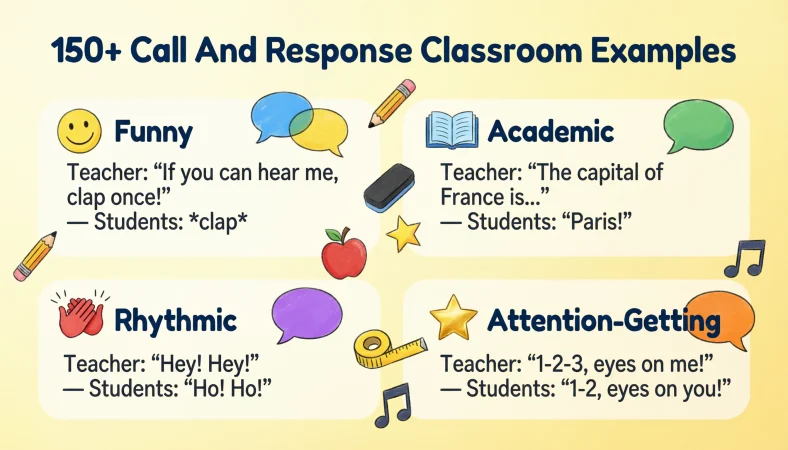
Teacher: “Are we ready?” Students: “Ready enough!”
Use this when you want a playful opening before starting a lesson.
Meaning: It creates energy while reminding students to prepare.
Teacher: “Brains on?” Students: “Brains on!”
Use this before beginning a challenging activity.
Meaning: It encourages students to mentally switch into learning mode.
Teacher: “Who’s awake?” Students: “We are!”
Use this after a long break or quiet activity.
Meaning: It playfully brings attention back to the classroom.
Teacher: “Can you hear me?” Students: “Loud and clear!”
Use this when you need everyone focused quickly.
Meaning: It combines an attention check with a fun response.
Teacher: “Ready to learn?” Students: “Let’s roll!”
Use this when transitioning into a new activity.
Meaning: It creates enthusiasm for getting started.
Teacher: “What time is it?” Students: “Learning time!”
Use this as a playful transition signal.
Meaning: It tells students that the next activity is about to begin.
Teacher: “Too much noise?” Students: “Indoor voice!”
Use this when the room becomes louder than expected.
Meaning: It reminds students to lower their voices without a long lecture.
Teacher: “Who brought their brain?” Students: “Me!”
Use this before a discussion or problem-solving activity.
Meaning: It encourages students to feel ready and involved.
Teacher: “Are we focused?” Students: “Mostly!”
Use this with a class that enjoys humor.
Meaning: It uses playful honesty to bring attention back.
Teacher: “Ready or not?” Students: “Here we learn!”
Use this before launching a lesson.
Meaning: It turns the transition into a memorable classroom ritual.
Teacher: “What do we do?” Students: “Think, learn, repeat!”
Use this when establishing a classroom routine.
Meaning: It reinforces active learning.
Teacher: “Class, class!” Students: “Yes, yes!”
Use this as a simple attention-getting routine.
Meaning: It gives students an easy and predictable response.
Confident Call And Response Examples
Teacher: “We show up!” Students: “We learn up!”
Use this when setting a positive classroom tone.
Meaning: It connects attendance with active participation.
Teacher: “Eyes forward!” Students: “Ready to learn!”
Use this before giving important instructions.
Meaning: It encourages students to focus visually and mentally.
Teacher: “We can do this!” Students: “Yes, we can!”
Use this before a challenging assignment.
Meaning: It builds collective confidence.
Teacher: “Who is ready?” Students: “We are ready!”
Use this when starting a group activity.
Meaning: It creates a confident transition into learning.
Teacher: “Think first!” Students: “Then answer!”
Use this before discussion questions.
Meaning: It encourages thoughtful participation.
Teacher: “Speak clearly!” Students: “Listen closely!”
Use this during speaking activities.
Meaning: It promotes respectful communication.
Teacher: “Try again!” Students: “I can!”
Use this after mistakes or difficult questions.
Meaning: It encourages persistence.
Teacher: “What do we bring?” Students: “Curiosity!”
Use this at the beginning of an inquiry-based lesson.
Meaning: It encourages students to approach learning with questions.
Teacher: “Ready for a challenge?” Students: “Bring it!”
Use this before a difficult classroom task.
Meaning: It creates confidence and excitement.
Teacher: “We don’t quit!” Students: “We keep trying!”
Use this during challenging assignments.
Meaning: It reinforces persistence.
Teacher: “One team!” Students: “One goal!”
Use this during group activities.
Meaning: It encourages collaboration.
Teacher: “How do we learn?” Students: “By doing!”
Use this when introducing hands-on work.
Meaning: It reinforces active participation.
Creative Call And Response Examples
Teacher: “Open your minds!” Students: “Let ideas in!”
Use this before brainstorming.
Meaning: It encourages students to think creatively.
Teacher: “Question?” Students: “Ask it!”
Use this during inquiry activities.
Meaning: It reminds students that questions are part of learning.
Teacher: “Imagine!” Students: “Create!”
Use this during art, writing, or design lessons.
Meaning: It connects imagination with action.
Teacher: “What comes next?” Students: “Let’s discover!”
Use this before an exploration activity.
Meaning: It builds curiosity.
Teacher: “Think outside?” Students: “The box!”
Use this during creative problem-solving.
Meaning: It encourages unconventional thinking.
Teacher: “Ideas ready?” Students: “Always!”
Use this before brainstorming or group discussion.
Meaning: It creates a positive creative mindset.
Teacher: “Dream it!” Students: “Build it!”
Use this during project-based learning.
Meaning: It connects imagination with practical action.
Teacher: “Words ready?” Students: “Story time!”
Use this during creative writing.
Meaning: It signals the beginning of a storytelling activity.
Teacher: “What do artists do?” Students: “Create!”
Use this during art class.
Meaning: It reinforces creativity and participation.
Teacher: “What do scientists do?” Students: “Ask why!”
Use this during science lessons.
Meaning: It emphasizes curiosity and investigation.
Teacher: “What do writers do?” Students: “Tell stories!”
Use this during language lessons.
Meaning: It connects writing with storytelling.
Teacher: “What do thinkers do?” Students: “Explore ideas!”
Use this during discussion-based lessons.
Meaning: It encourages deeper thinking.
Professional Call And Response Examples
Teacher: “Are we prepared?” Students: “Prepared and focused.”
Use this before a formal classroom activity.
Meaning: It establishes a focused learning environment.
Teacher: “What is our goal?” Students: “Learn and apply.”
Use this at the start of a lesson.
Meaning: It reminds students that understanding should lead to practical use.
Teacher: “What comes first?” Students: “Listen and understand.”
Use this before giving detailed instructions.
Meaning: It encourages careful listening.
Teacher: “What do we respect?” Students: “Every voice.”
Use this during discussions.
Meaning: It promotes respectful participation.
Teacher: “How do we work?” Students: “Together and responsibly.”
Use this during group projects.
Meaning: It reinforces teamwork and accountability.
Teacher: “What matters?” Students: “Effort and progress.”
Use this during goal-setting activities.
Meaning: It emphasizes improvement rather than perfection.
Teacher: “Ready for instructions?” Students: “Yes, teacher.”
Use this before explaining a multi-step task.
Meaning: It prepares students to listen carefully.
Teacher: “What makes learning work?” Students: “Participation.”
Use this when encouraging quieter students to join in.
Meaning: It emphasizes active engagement.
Teacher: “What do we bring?” Students: “Respect and curiosity.”
Use this when establishing classroom expectations.
Meaning: It highlights positive learning behaviors.
Teacher: “What do we practice?” Students: “Clear communication.”
Use this during speaking or teamwork activities.
Meaning: It reinforces communication skills.
Teacher: “What is our standard?” Students: “Do our best.”
Use this before an assessment or project.
Meaning: It encourages students to give genuine effort.
Teacher: “What happens when we struggle?” Students: “We ask for help.”
Use this when teaching classroom independence.
Meaning: It normalizes asking questions when something is difficult.
Cute Call And Response Examples
Teacher: “Good morning, stars!” Students: “Good morning, teacher!”
Use this during morning arrival.
Meaning: It creates a warm start to the school day.
Teacher: “Ready, little learners?” Students: “Ready!”
Use this with younger students.
Meaning: It makes the beginning of a lesson feel welcoming.
Teacher: “Happy hearts?” Students: “Happy minds!”
Use this during a positive classroom routine.
Meaning: It connects emotional positivity with learning.
Teacher: “Kind words?” Students: “Kind hearts!”
Use this when reinforcing kindness.
Meaning: It links respectful language with positive behavior.
Teacher: “Helping hands?” Students: “Always!”
Use this during cooperative activities.
Meaning: It encourages students to support classmates.
Teacher: “Big smiles?” Students: “Coming right up!”
Use this during a cheerful transition.
Meaning: It adds lighthearted energy to the classroom.
Teacher: “Ready, friends?” Students: “Ready, ready!”
Use this with younger learners.
Meaning: It makes participation simple and rhythmic.
Teacher: “We learn together!” Students: “We grow together!”
Use this during group activities.
Meaning: It reinforces community.
Teacher: “Kind classroom?” Students: “Kind people!”
Use this when teaching classroom behavior.
Meaning: It reminds students that a positive environment comes from everyone.
Teacher: “Who can shine?” Students: “We all can!”
Use this during confidence-building activities.
Meaning: It encourages every student to participate.
Teacher: “Little steps?” Students: “Big progress!”
Use this during skill-building lessons.
Meaning: It reminds students that improvement happens gradually.
Teacher: “Learning friends?” Students: “Best friends!”
Use this during community-building activities.
Meaning: It creates a playful sense of classroom belonging.
Rhythmic Call And Response Examples
Teacher: “Clap, clap!” Students: “Focus back!”
Use this when regaining attention after group work.
Meaning: It combines rhythm with an attention cue.
Teacher: “Tap once!” Students: “Eyes up!”
Use this as a quick classroom signal.
Meaning: It pairs a sound with visual attention.
Teacher: “Beat by beat!” Students: “Learn and repeat!”
Use this during music or rhythm activities.
Meaning: It connects repetition with learning.
Teacher: “One, two!” Students: “Listen through!”
Use this before giving instructions.
Meaning: It prepares students to listen.
Teacher: “Clap it out!” Students: “Say it loud!”
Use this during pronunciation or rhythm practice.
Meaning: It encourages vocal participation.
Teacher: “Tap, tap!” Students: “Focus back!”
Use this during transitions.
Meaning: It gives students a rhythmic reminder to refocus.
Teacher: “Count the beat!” Students: “Feel the beat!”
Use this during music activities.
Meaning: It encourages students to connect counting with rhythm.
Teacher: “Ready to rhyme?” Students: “Every time!”
Use this during poetry or phonics lessons.
Meaning: It creates playful anticipation.
Teacher: “Hear the sound!” Students: “Say it back!”
Use this during language practice.
Meaning: It encourages listening and repetition.
Teacher: “Keep the rhythm!” Students: “Keep it going!”
Use this during musical activities.
Meaning: It encourages sustained participation.
Teacher: “Beat is strong!” Students: “Sing along!”
Use this during music lessons.
Meaning: It encourages students to join the rhythm.
Teacher: “Make some noise!” Students: “Use your voice!”
Use this during speaking or music activities.
Meaning: It encourages confident vocal participation.
Subject-Based Call And Response Examples
Teacher: “What is two plus two?” Students: “Four!”
Use this during a quick mathematics review.
Meaning: It reinforces basic arithmetic through group participation.
Teacher: “Water freezes at?” Students: “Zero degrees!”
Use this during science review.
Meaning: It reinforces a basic scientific fact.
Teacher: “Past tense of go?” Students: “Went!”
Use this during grammar practice.
Meaning: It strengthens recall through repetition.
Teacher: “What is a noun?” Students: “A person, place, or thing!”
Use this during language lessons.
Meaning: It reinforces a basic grammar definition.
Teacher: “What planet do we live on?” Students: “Earth!”
Use this during an elementary science lesson.
Meaning: It reinforces basic science knowledge.
Teacher: “Three times three?” Students: “Nine!”
Use this during multiplication practice.
Meaning: It gives students a quick recall exercise.
Teacher: “What do plants need?” Students: “Light and water!”
Use this during elementary science.
Meaning: It reviews essential plant needs.
Teacher: “Who wrote the story?” Students: “The author!”
Use this during reading lessons.
Meaning: It reinforces literary vocabulary.
Teacher: “What is the opposite of hot?” Students: “Cold!”
Use this during vocabulary practice.
Meaning: It reinforces opposite-word recognition.
Teacher: “What shape has three sides?” Students: “Triangle!”
Use this during geometry lessons.
Meaning: It reinforces shape identification.
Teacher: “What is photosynthesis?” Students: “How plants make food!”
Use this during science review.
Meaning: It gives students a simple way to recall the concept.
Teacher: “What does a verb show?” Students: “An action!”
Use this during grammar practice.
Meaning: It reinforces the basic function of verbs.
Attention-Getter Call And Response Examples
Teacher: “Class, class!” Students: “Yes, yes!”
Use this when students need to stop talking and listen.
Meaning: It creates a predictable attention signal.
Teacher: “If you can hear me…” Students: “We can hear you!”
Use this when the classroom is noisy.
Meaning: It encourages students to acknowledge the teacher.
Teacher: “Hands up!” Students: “Eyes up!”
Use this before giving instructions.
Meaning: It encourages students to stop other activities and focus.
Teacher: “Ready?” Students: “Ready!”
Use this before starting a new task.
Meaning: It creates a quick readiness check.
Teacher: “Freeze!” Students: “Focus!”
Use this when transitioning from movement to instruction.
Meaning: It tells students to stop and pay attention.
Teacher: “Look here!” Students: “Right here!”
Use this when directing attention toward a board or demonstration.
Meaning: It creates immediate visual focus.
Teacher: “Stop and listen!” Students: “Ready to listen!”
Use this when important instructions are coming.
Meaning: It clearly signals a listening moment.
Teacher: “Voices off?” Students: “Eyes on!”
Use this when bringing a noisy class back together.
Meaning: It combines quietness with visual attention.
Teacher: “Ready for the next step?” Students: “Bring it on!”
Use this during energetic transitions.
Meaning: It creates enthusiasm while refocusing students.
Teacher: “Attention, please!” Students: “Attention here!”
Use this when the class needs a clear formal signal.
Meaning: It creates a direct attention routine.
Teacher: “Pause!” Students: “Listen!”
Use this when interrupting an activity briefly.
Meaning: It creates a simple stop-and-focus cue.
Teacher: “Eyes and ears?” Students: “Ready!”
Use this before giving instructions to younger students.
Meaning: It encourages both visual and auditory attention.
Morning Meeting Call And Response Examples
Teacher: “Good morning, everyone!” Students: “Good morning!”
Use this to open the school day.
Meaning: It establishes a friendly classroom atmosphere.
Teacher: “How are we feeling?” Students: “Ready to learn!”
Use this during morning meeting.
Meaning: It shifts students toward a learning mindset.
Teacher: “New day?” Students: “New opportunities!”
Use this as a positive morning affirmation.
Meaning: It encourages optimism.
Teacher: “Fresh start?” Students: “Fresh minds!”
Use this at the beginning of a new day.
Meaning: It reminds students that each day offers another chance to learn.
Teacher: “What do we bring?” Students: “Kindness!”
Use this when reviewing classroom values.
Meaning: It establishes kindness as a daily expectation.
Teacher: “Morning energy?” Students: “Right here!”
Use this when students need a cheerful start.
Meaning: It encourages participation and enthusiasm.
Teacher: “Today is a…” Students: “Learning day!”
Use this during morning routines.
Meaning: It sets a positive academic tone.
Teacher: “Who is ready?” Students: “Everyone!”
Use this as an inclusive morning greeting.
Meaning: It encourages every student to feel included.
Teacher: “What do we choose?” Students: “Kindness and courage!”
Use this during social-emotional learning.
Meaning: It reinforces positive classroom values.
Teacher: “New lesson?” Students: “New adventure!”
Use this to make learning feel exciting.
Meaning: It frames the school day as an opportunity to explore.
Teacher: “Good morning, thinkers!” Students: “Good morning!”
Use this for a warm academic greeting.
Meaning: It celebrates students as active learners.
Teacher: “Ready for today?” Students: “Let’s go!”
Use this as a simple morning transition.
Meaning: It creates energy for the day’s activities.
Encouraging Call And Response Examples
Teacher: “Can you try?” Students: “I can try!”
Use this when students face a difficult task.
Meaning: It encourages effort instead of avoidance.
Teacher: “Mistakes happen?” Students: “We learn!”
Use this after students make errors.
Meaning: It presents mistakes as opportunities to improve.
Teacher: “Not yet?” Students: “Keep going!”
Use this when students have not mastered a skill.
Meaning: It encourages persistence.
Teacher: “Need help?” Students: “Ask for it!”
Use this when teaching students to seek support.
Meaning: It normalizes asking questions.
Teacher: “Feeling stuck?” Students: “Try another way!”
Use this during problem-solving activities.
Meaning: It encourages flexible thinking.
Teacher: “Small steps?” Students: “Big progress!”
Use this during long-term learning tasks.
Meaning: It celebrates gradual improvement.
Teacher: “Can we improve?” Students: “Every day!”
Use this during growth-focused classroom routines.
Meaning: It encourages continuous development.
Teacher: “Hard work?” Students: “Worth it!”
Use this before a challenging activity.
Meaning: It reinforces persistence.
Teacher: “What if we fail?” Students: “We learn!”
Use this when encouraging students to take healthy academic risks.
Meaning: It reduces fear around mistakes.
Teacher: “Who believes?” Students: “I do!”
Use this during confidence-building activities.
Meaning: It encourages self-belief.
Teacher: “One more try?” Students: “Let’s do it!”
Use this when students need motivation.
Meaning: It encourages another attempt.
Teacher: “Ready to grow?” Students: “Every day!”
Use this during motivational classroom routines.
Meaning: It reinforces continuous learning.
Interactive And Playful Call And Response Examples
Teacher: “Simon says focus!” Students: “Focused!”
Use this as a playful transition into instruction.
Meaning: It blends a familiar game format with attention practice.
Teacher: “Show me your thinking!” Students: “Here it is!”
Use this during problem-solving activities.
Meaning: It encourages students to explain their reasoning.
Teacher: “Question time!” Students: “Answer time!”
Use this during review games.
Meaning: It creates a quick interactive rhythm.
Teacher: “Who knows?” Students: “We know!”
Use this before a review question.
Meaning: It builds confidence before participation.
Teacher: “Guess what?” Students: “What?”
Use this when introducing a surprising lesson topic.
Meaning: It creates curiosity.
Teacher: “Ready to play?” Students: “Ready to learn!”
Use this before an educational game.
Meaning: It connects fun with learning.
Teacher: “Pick a partner!” Students: “Let’s collaborate!”
Use this before pair work.
Meaning: It encourages students to work together.
Teacher: “Think fast!” Students: “Think smart!”
Use this during quick-review activities.
Meaning: It adds energy to recall practice.
Teacher: “Who has an idea?” Students: “I might!”
Use this when encouraging participation.
Meaning: It makes sharing ideas feel low-pressure.
Teacher: “Ready, set?” Students: “Learn!”
Use this before an activity begins.
Meaning: It gives a playful start signal.
Teacher: “Question?” Students: “Bring it!”
Use this during review games.
Meaning: It makes answering questions feel energetic.
Teacher: “Learning mode?” Students: “Activated!”
Use this when transitioning into focused work.
Meaning: It uses playful language to signal concentration.
Clever Call And Response Examples
Teacher: “What creates knowledge?” Students: “Questions and practice!”
Use this during lessons focused on learning strategies.
Meaning: It highlights curiosity and repetition as learning tools.
Teacher: “What makes progress?” Students: “Practice!”
Use this during skill-building activities.
Meaning: It reinforces the importance of repeated effort.
Teacher: “What beats guessing?” Students: “Evidence!”
Use this during science or critical-thinking lessons.
Meaning: It encourages students to support ideas with evidence.
Teacher: “What makes ideas stronger?” Students: “Reasons!”
Use this during argument or discussion activities.
Meaning: It teaches students to support claims.
Teacher: “What comes after a question?” Students: “Investigation!”
Use this during inquiry-based learning.
Meaning: It connects curiosity with research.
Teacher: “What makes teamwork work?” Students: “Communication!”
Use this during group projects.
Meaning: It emphasizes communication as a teamwork skill.
Teacher: “What turns mistakes into progress?” Students: “Reflection!”
Use this after assignments or assessments.
Meaning: It encourages students to learn from errors.
Teacher: “What makes reading powerful?” Students: “Understanding!”
Use this during literacy lessons.
Meaning: It emphasizes comprehension over simply reading words.
Teacher: “What makes answers better?” Students: “Thinking deeper!”
Use this during discussion or writing practice.
Meaning: It encourages deeper reasoning.
Teacher: “What makes practice useful?” Students: “Feedback!”
Use this during skill development.
Meaning: It teaches students that feedback improves practice.
Teacher: “What should evidence do?” Students: “Support the claim!”
Use this during writing or research lessons.
Meaning: It reinforces evidence-based reasoning.
Teacher: “What makes learning stick?” Students: “Use it!”
Use this when reviewing practical skills.
Meaning: It emphasizes applying knowledge.
Energetic Call And Response Examples
Teacher: “Energy up!” Students: “Let’s learn!”
Use this after lunch or a quiet activity.
Meaning: It brings positive energy back into the room.
Teacher: “Ready to move?” Students: “Ready to learn!”
Use this before a movement-based activity.
Meaning: It combines physical activity with learning.
Teacher: “Let’s get loud!” Students: “With our answers!”
Use this during a group review.
Meaning: It encourages enthusiastic participation.
Teacher: “Hands high!” Students: “Brains higher!”
Use this during an energetic lesson opening.
Meaning: It combines movement with mental focus.
Teacher: “Wake up, class!” Students: “We’re here!”
Use this when students look tired.
Meaning: It playfully restores attention.
Teacher: “Bring the energy!” Students: “Bring the focus!”
Use this before a collaborative task.
Meaning: It balances enthusiasm with concentration.
Teacher: “Ready to go?” Students: “Let’s go!”
Use this before starting an activity.
Meaning: It creates a clear and energetic transition.
Teacher: “Clap it out!” Students: “Learn it out!”
Use this during rhythm-based review.
Meaning: It turns repetition into an energetic activity.
Teacher: “Feet ready?” Students: “Brains ready!”
Use this before a movement break or interactive task.
Meaning: It prepares students physically and mentally.
Teacher: “Energy check!” Students: “Full charge!”
Use this as a playful attention reset.
Meaning: It encourages students to re-engage.
Teacher: “Ready for action?” Students: “Ready for learning!”
Use this before hands-on work.
Meaning: It connects action with academic participation.
Teacher: “Let’s make some noise!” Students: “Let’s make some knowledge!”
Use this during a lively review.
Meaning: It playfully connects enthusiasm with learning.
FAQs
Why Is Call And Response Useful In The Classroom?
It encourages active participation and can help students refocus, remember information, follow routines, and feel more involved in lessons.
Can Call And Response Be Used With Young Students?
Yes. Short phrases, clapping, rhymes, movement, and simple repeated responses work especially well with younger learners.
Can Older Students Use Call And Response Too?
Absolutely. Older students can use more sophisticated prompts involving subject knowledge, critical thinking, discussion, vocabulary, and classroom expectations.
Are Call And Response Activities Professional?
They can be. The wording and delivery should match the classroom environment. Simple, structured responses can work well in formal educational settings.
Can Call And Response Help With Classroom Attention?
Yes. A consistent call and response can become a recognizable attention signal that tells students when to pause and focus.
Can Call And Response Be Used For Academic Review?
Yes. Teachers can use quick questions and group answers to review vocabulary, mathematics, science facts, grammar, history, and other subjects.
Can Call And Response Be Funny?
Definitely. Age-appropriate humor can make participation more memorable and help students become comfortable joining in.
What If Students Do Not Respond?
Keep the routine simple, model the response first, and practice it several times. A predictable rhythm usually makes participation easier.
Can Call And Response Be Used During Morning Meetings?
Yes. Greetings, motivational phrases, classroom values, and simple readiness questions are great options for morning meetings.
Conclusion
The best call and response classroom examples do more than make a classroom louder. They create rhythm, encourage participation, strengthen routines, and give students a simple way to feel involved. Whether you’re welcoming students in the morning, reviewing vocabulary, getting attention, practicing math facts, or adding some fun to a lesson, a short response can completely change the energy in the room.
Try different styles and see what your students naturally enjoy. Keep the phrases short, make them memorable, and don’t be afraid to add a little personality. Save this list for your next lesson, share your favorite examples with another teacher, and turn ordinary classroom moments into interactive ones. Now pick a call, teach the response, and let the whole class join in.