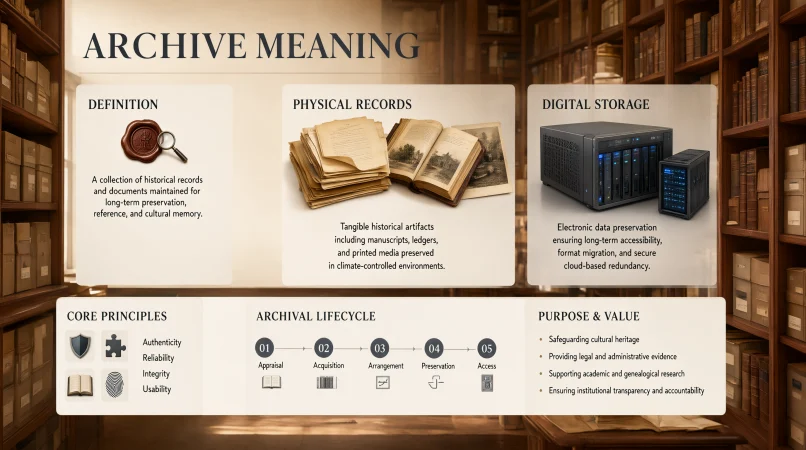
An archive is a collection of documents, records, photographs, messages, or other information kept for future reference. The word can describe a physical place where historical records are stored or a digital location where old files and emails are saved. As a verb, to archive means to move or store something for long-term preservation rather than delete it. In everyday communication, archiving usually means keeping something available without allowing it to clutter your active workspace.
The word archive refers to a place, system, or collection used to preserve information that may be useful or important in the future. This information can include written documents, photographs, business records, historical materials, videos, audio recordings, and digital files.
Think about an old family photograph album. Even if you rarely open it, you probably keep it because the pictures hold memories that you do not want to lose. That album works like a personal archive.
The same idea applies to businesses, governments, schools, libraries, and websites. They preserve information because it may be needed for research, legal purposes, historical records, or future decisions.
The term has two common grammatical uses:
- Noun: A collection of historical records or a place where those records are preserved.
- Verb: The action of storing documents, messages, or information for future use.
For example:
- Noun: “The university maintains an archive of historical photographs.”
- Verb: “I decided to archive my old emails.”
Both examples involve keeping information rather than throwing it away.
Simple Definition in Everyday Language
In simple terms, an archive is a safe place to keep things you do not currently need but might want to access later.
It does not necessarily mean that something is extremely old or historically important. Even a collection of last year’s school assignments, old text messages, or completed office projects can be considered an archive.
The main idea is preservation and future access.
Origin and History of the Word Archive
The word has a long history connected to public records, government administration, and the preservation of important documents.
It comes through Latin and Old French from the Greek word arkheion, which referred to a government building or the residence of a chief magistrate where official records were kept. The Greek word was connected to arkhē, meaning authority or government.
Originally, archives were closely associated with official documents. Governments and public institutions needed reliable ways to preserve laws, decisions, agreements, property records, and other important information.
Over time, the meaning expanded.
Libraries, universities, religious organizations, museums, private families, and businesses began maintaining their own collections. As photography, sound recording, film, and computing developed, the materials considered suitable for preservation also increased.
Today, an archive can contain anything from handwritten letters and ancient manuscripts to emails, digital photographs, websites, and electronic business records.
The basic idea has remained the same: information is kept because it has lasting value.
Different Types of Archives
Archives are not all organized in the same way. Their structure usually depends on the information they preserve and the people who need to access it.
Here are several common categories.
1. Historical Archives
Historical archives contain records that help people understand the past. These collections may include government documents, personal letters, old photographs, maps, newspapers, and official agreements.
Historians use these materials to study important events, communities, political decisions, and changes in society.
For example, the United States National Archives preserves important historical documents, including the Declaration of Independence, the Constitution, and the Bill of Rights.
2. Digital Archives
Digital archives store information in electronic formats. Instead of keeping everything in physical boxes or filing cabinets, organizations preserve files on digital storage systems.
Examples include:
- Old photographs saved on a computer.
- Historical newspapers available online.
- Electronic business documents.
- Digital recordings of interviews.
- Archived websites and online publications.
Digital collections make it easier to search, organize, and share information without physically handling original materials.
3. Institutional Archives
Institutional archives are maintained by organizations such as universities, hospitals, government departments, and nonprofit institutions.
They may preserve administrative documents, meeting minutes, research materials, policy records, and historical information about the organization.
A university, for instance, might keep records of its founding, former presidents, academic programs, and important campus events.
4. Personal Archives
Personal archives contain information belonging to an individual or family.
These collections might include family photographs, birth certificates, personal letters, diaries, certificates, old videos, and important documents.
Unlike institutional collections, personal archives are usually maintained for private reference, family history, or sentimental reasons.
5. Business Archives
Businesses preserve records that help them understand their history and manage their operations.
These materials can include contracts, financial documents, employee records, product designs, marketing campaigns, and previous business reports.
Some records must be retained to meet legal or regulatory requirements. Others are preserved because they may help with future planning or company research.
| Archive Type | What It Preserves | Common Example |
| Historical archive | Records from the past | Government documents |
| Digital archive | Electronic information | Archived websites |
| Institutional archive | Organizational records | University documents |
| Personal archive | Individual or family materials | Old family photographs |
| Business archive | Company information | Contracts and reports |
Each type serves a different purpose, but all are built around preserving information.
Archive Meaning in Everyday Life
You do not need to work in a museum, library, or government office to use this word. It appears regularly in everyday conversations, especially when people discuss organizing their belongings or digital information.
For example, someone might say:
“I archived our old conversations because I wanted to clean up my inbox.”
This means the person moved those conversations out of the main inbox while keeping them available for later.
Similarly, someone might say:
“All my previous project files are in the archive.”
Here, the speaker is referring to a collection of older files that are no longer actively used.
Other everyday examples include:
- “I keep my old photographs in a family archive.”
- “The company archived its completed projects.”
- “You can find the previous newsletters in our archive.”
- “I archived the documents instead of deleting them.”
In these situations, the word suggests organization and preservation.
It can also describe something that is no longer active but remains accessible. For example, an old blog post may be placed in a website’s archive after it stops appearing on the homepage.
This distinction is important. Archived information is not necessarily useless. It has simply moved out of the active collection.
What Does Archive Mean in Technology?
Technology has made the term particularly common because people regularly store, organize, and retrieve digital information.
Almost every computer user encounters an archive feature in some form. It may appear in an email application, file manager, cloud storage service, messaging platform, or website.
However, the exact function depends on the application.
Archive in Gmail
In Gmail, archiving an email removes it from the Inbox without permanently deleting it.
The message remains available in the account, generally under All Mail, and can still appear in search results.
For example, suppose you receive a delivery confirmation email. You have already received your package, so you no longer need the message in your inbox. Instead of deleting it, you can archive it.
This keeps your inbox organized while preserving the email.
Archive on WhatsApp
WhatsApp includes an archive feature that allows users to move chats out of their main chat list.
For example, you might archive a conversation with a friend because you do not want it appearing at the top of your chat screen.
Archiving a conversation does not automatically delete its messages. You can access the archived conversation later.
The exact behavior of archived chats, including whether new messages return them to the main list, can depend on your archive settings.
Archive on Websites
Websites and blogs often use archive pages to organize older content.
For example, a blog might have separate archive sections for:
- Articles published in previous months.
- Posts from a particular year.
- Content grouped by category.
- Older news stories.
- Previous announcements.
Visitors can use these pages to find information that is no longer displayed on the website’s homepage.
Archive Files on Computers
In computing, an archive file can also refer to a file that contains one or more files or folders packaged together.
Formats such as ZIP, TAR, and 7Z are commonly used for this purpose.
For instance, if you have 15 documents related to one project, you can place them into a ZIP archive. This makes the collection easier to transfer, download, or store.
Some archive formats also support compression, which reduces the amount of storage space required.
One important distinction: creating an archive file does not always mean preserving information for many years. Sometimes it is simply a convenient way to package files.
Real-World Examples of Archives
Several well-known organizations demonstrate how different types of information can be preserved and made available for research.
1. The National Archives (United States)
The United States National Archives and Records Administration (NARA) preserves federal government records that document the country’s history and government activities.
Its collections include founding documents, military records, photographs, and other historical materials.
The agency was established in 1934, making it an important example of an organized national records institution.
2. The National Archives (United Kingdom)
The National Archives in the United Kingdom preserves official government records and historical documents.
Researchers, students, and members of the public can use its collections to investigate British history, government decisions, military events, and family history.
Its records demonstrate how public documents can remain valuable long after their original administrative purpose has ended.
3. Internet Archive
The Internet Archive is a nonprofit digital library founded in 1996.
It preserves digital materials, including books, audio recordings, videos, software, and archived web pages.
One of its best-known services is the Wayback Machine, which allows users to explore historical captures of websites.
This is especially useful when researching how a website looked in the past or locating information that has disappeared from its original online location.
4. National Archives of India
The National Archives of India preserves historical records of the Indian government.
Its collections include official documents, manuscripts, and other materials that help researchers understand the country’s administrative and political history.
It provides a useful example of how national institutions protect records for future generations.
5. Vatican Apostolic Archive
The Vatican Apostolic Archive preserves historical documents associated with the Holy See.
Its collections contain records connected to church administration, historical correspondence, and diplomatic activities.
It is an example of an archive maintained by a religious institution rather than a national government.
These organizations differ in their collections and responsibilities, but they share one purpose: keeping important records available for future use.
Why Are Archives Important?
Preserving information is more than an organizational habit. It allows individuals and institutions to retain evidence, understand earlier decisions, and learn from previous experiences.
1. They Protect Historical Information
Without archives, many important records could disappear over time.
Paper documents can become damaged, photographs can fade, and digital files can become inaccessible when technology changes.
Preservation methods help reduce these risks. They may include controlled storage conditions, digitization, careful handling, and maintaining additional copies.
For historians, these collections provide primary sources. A primary source is original material created during the period or event being studied.
2. They Support Research and Education
Students, journalists, researchers, and historians often depend on archived materials.
An old newspaper can provide details about a historical event. A collection of letters may reveal how people communicated during a particular period. Government records can help explain how a policy developed.
These sources allow people to examine original information instead of relying entirely on later summaries.
3. They Provide Evidence and Accountability
Organizations often need to demonstrate what decisions were made, when they were made, and who was responsible.
Archived contracts, meeting minutes, financial records, and correspondence can help establish an accurate record.
This can be important during audits, legal reviews, investigations, and internal assessments.
However, not every record should be retained indefinitely. Organizations must follow applicable privacy laws, retention schedules, and data protection requirements.
4. They Preserve Personal Memories
Personal collections have a different kind of value.
A photograph from childhood, an old handwritten letter, or a recording of a family member’s voice may become more meaningful as time passes.
Keeping these materials together creates a record that future family members can explore.
Sometimes the most valuable archive is not the largest one. It is the collection that preserves something meaningful.
Archive vs. Backup vs. Repository vs. Storage
These terms are related, but they do not describe exactly the same thing.
Understanding the differences helps avoid confusion, especially when discussing computers, websites, and business records.
| Term | Main Purpose | Example |
| Archive | Preserve information for future reference | Old company reports |
| Backup | Create a recoverable copy of information | Copy of a computer’s files |
| Repository | Organize and manage a collection of resources | Software code repository |
| Storage | Keep information or files in a location | Cloud storage account |
Archive vs. Backup
An archive is generally intended for retaining information that is no longer actively used but may be needed later.
A backup is a copy created to help restore information if the original becomes damaged, lost, or corrupted.
For example, a business might archive completed projects while regularly backing up its current working files.
Both are useful, but they solve different problems.
Archive vs. Repository
A repository is a place where resources are collected and organized.
It may contain active documents, research materials, software code, or other resources that people regularly access and update.
An archive, by comparison, usually focuses more on preserving existing records over time.
Archive vs. Storage
Storage is a broad term describing where information is kept.
A computer hard drive, USB flash drive, and cloud account are all storage options.
An archive is a collection or system with a preservation purpose. It may use any of these storage methods.
Common Uses of the Word Archive
The term appears in many professional and personal situations. Understanding the context makes its intended meaning easier to recognize.
Here are some common expressions:
1. Archive a file: Move or store a file for future reference.
2. Archived messages: Messages removed from the main conversation or inbox list but retained.
3. Email archive: A collection of saved emails.
4. Historical archive: A collection of documents and materials from the past.
5. Archive folder: A folder used to keep older or inactive files.
6. Website archive: A section containing previously published website content.
7. Archive records: Preserve documents and information for future use.
8. Digital archive: An electronically maintained collection of preserved materials.
9. Public archive: A collection of records available for public access, subject to applicable restrictions.
10. Archive collection: A group of related records preserved together.
The meaning may change slightly depending on the situation, but the central idea remains the same.
FAQs
1. Is an archive permanent?
Not necessarily. Archives are generally intended for long-term preservation, but records can eventually be removed according to retention policies, legal requirements, or collection management decisions.
2. Can archived files be edited?
Yes, depending on the application and file permissions. An archived document stored on a computer may still be editable, while certain institutional archives restrict changes to original records to protect their authenticity.
3. What is an archive folder?
An archive folder is a location used to keep older, completed, or inactive files. It helps separate information that is no longer needed regularly from current working documents.
4. What does archive mean in a relationship or conversation?
In casual communication, archiving a conversation generally means moving it out of the main chat list without deleting it. It does not automatically indicate that someone is ending a relationship or avoiding another person.
5. What is the opposite of archive?
There is no single perfect opposite because the meaning depends on context. In digital communication, deleting is often contrasted with archiving. In record management, actively using or updating a document may be contrasted with preserving it as an inactive record.
6. Is an archive the same as a library?
No. A library generally provides organized resources for reading, borrowing, or research. An archive preserves records, often in their original context, as evidence of activities, events, or personal history. Some institutions operate both libraries and archives.
Conclusion
An archive is much more than a folder filled with old documents. It is a way of preserving information, memories, and records that may become valuable in the future. Whether you are saving an email, organizing family photographs, or exploring historical government documents, the idea remains the same: keep useful information accessible instead of allowing it to disappear. Understanding this term makes it easier to recognize how information is stored and preserved in everyday life.