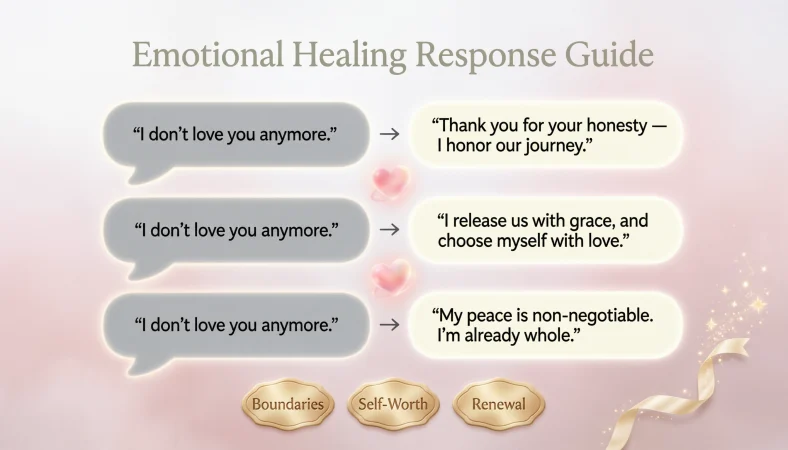
Quick Answer: When someone says “I don’t love you anymore,” the best response depends on what you truly feel. You can answer with dignity, honesty, sadness, humor, or calm acceptance without begging for affection that has changed.
Top alternatives: “I understand, even if it hurts,” “Thank you for being honest,” “I won’t force you to stay,” “I still care about you, but I respect your decision,” “I deserve someone who chooses me”
Few texts can make your stomach drop faster than “I don’t love you anymore.” Whether it arrives in a late-night text, a serious conversation, a DM after a messy breakup, or a relationship talk you secretly hoped would go differently, those six words can change the entire mood in seconds. Knowing the right responses to i dont love you anymore can help you protect your dignity while still being honest about your feelings. You might want closure, a calm goodbye, a heartfelt response, or simply a sentence that says, “That hurts, but I’ll be okay.” And no, you do not need to deliver a five-page emotional monologue worthy of a season finale. Sometimes the strongest response is short, sincere, and respectful. Here are thoughtful, confident, emotional, funny, and mature replies for whatever your heart needs in that moment.
Calm And Mature Responses
“I understand. Thank you for being honest with me.”
Use this when you want to acknowledge their feelings without creating another argument.
Meaning: You’re hurt, but you respect their honesty.
“I’m not going to force you to feel something you no longer feel.”
Use this when you want to respond with emotional maturity.
Meaning: You recognize that love cannot be demanded.
“That’s difficult to hear, but I appreciate you telling me the truth.”
Use this when the conversation is serious and you want to stay composed.
Meaning: You’re acknowledging the pain while valuing honesty.
“I respect how you feel, even though I wish things were different.”
Use this when you still have feelings but want to avoid pressure.
Meaning: You accept their feelings without pretending you’re unaffected.
“I think we both deserve honesty, even when it hurts.”
Use this when you want to end the conversation on a mature note.
Meaning: You believe honesty matters more than false hope.
“I hear you. I need some time to process this.”
Use this when you’re too emotional to continue the discussion immediately.
Meaning: You’re creating space to handle your feelings.
“I’m sad, but I respect your decision.”
Use this when you want to be honest without becoming confrontational.
Meaning: You’re admitting your pain while accepting their choice.
“I won’t try to change your mind.”
Use this when you want to make your boundaries clear.
Meaning: You understand that genuine feelings cannot be negotiated.
“I appreciate the time we shared.”
Use this when you want to acknowledge the good parts of the relationship.
Meaning: You can value the past even though the relationship is ending.
“I wish this conversation were different, but I understand.”
Use this when you hoped the relationship could continue.
Meaning: You’re disappointed but refusing to fight reality.
“I respect your feelings, and I hope you respect mine too.”
Use this when you want mutual emotional respect.
Meaning: You’re asking for space for both people to feel what they feel.
“I’m going to take some time for myself now.”
Use this when you need distance after hearing something painful.
Meaning: You’re prioritizing your emotional wellbeing.
Heartfelt Responses
“I still love you, so hearing that hurts more than I can explain.”
Use this when you want to be completely honest about your feelings.
Meaning: You’re expressing pain without trying to manipulate them.
“A part of me hoped we’d always find our way back to each other.”
Use this when the relationship carried deep emotional significance.
Meaning: You’re acknowledging the hope you once had.
“I’m grateful for every moment that was real between us.”
Use this when you want to remember the relationship with warmth.
Meaning: You believe the past mattered even if the future has changed.
“I wish love had been enough for us.”
Use this when the relationship ended despite genuine feelings.
Meaning: You’re grieving the fact that affection alone could not fix everything.
“I never wanted to hear those words from you.”
Use this when the breakup feels especially painful.
Meaning: You’re honestly acknowledging how deeply the statement affected you.
“I’ll always care about what we meant to each other.”
Use this when you want to honor the relationship without asking them to return.
Meaning: You can care about the history without holding onto the relationship.
“You mattered to me in ways I’ll never forget.”
Use this when you want a sincere goodbye.
Meaning: Their presence had a lasting emotional impact.
“I wish I could make this different, but I know I can’t.”
Use this when you’re accepting something you cannot control.
Meaning: You recognize the limits of your own influence.
“I’m hurting, but I’m thankful for the love we did share.”
Use this when you want to leave bitterness out of your response.
Meaning: You’re choosing gratitude alongside grief.
“This isn’t the ending I wanted, but I’ll respect it.”
Use this when you need to accept a painful ending.
Meaning: You’re choosing dignity despite disappointment.
“I hope someday this hurts less for both of us.”
Use this when the breakup is emotional but not hostile.
Meaning: You’re wishing for healing rather than resentment.
“I’ll miss who we were.”
Use this when you want a short but emotionally meaningful response.
Meaning: You’re grieving the relationship you once shared.
Strong And Confident Responses
“I deserve to be loved by someone who is sure about me.”
Use this when you want to affirm your self-worth.
Meaning: You refuse to settle for uncertain affection.
“I won’t chase someone who has already chosen to leave.”
Use this when you want a firm response without bitterness.
Meaning: You’re choosing self-respect over chasing.
“It hurts, but I’ll be okay.”
Use this when you want to acknowledge pain without losing your composure.
Meaning: You believe you can recover from the heartbreak.
“I can accept the truth without losing myself.”
Use this when you want a powerful but grounded response.
Meaning: Their decision does not determine your worth.
“If your heart has changed, I won’t ask it to pretend.”
Use this when you want a poetic but confident reply.
Meaning: You accept that genuine feelings cannot be forced.
“I’d rather be alone than be loved out of obligation.”
Use this when you want to emphasize emotional standards.
Meaning: You value authentic love over forced commitment.
“You’re allowed to leave, and I’m allowed to choose myself.”
Use this when you want to establish emotional independence.
Meaning: Their decision does not prevent you from protecting your own wellbeing.
“I won’t beg for a place in someone’s heart.”
Use this when you need a strong boundary.
Meaning: You refuse to plead for affection.
“I know what I bring to a relationship.”
Use this when you want to remind yourself of your value.
Meaning: You don’t believe another person’s feelings define your worth.
“Your feelings changed. My self-respect didn’t.”
Use this when you want a concise, powerful response.
Meaning: Their decision has not diminished your confidence.
“I’m disappointed, not defeated.”
Use this when you want to sound resilient.
Meaning: The breakup hurts, but it will not break you.
“I’ll respect your choice and keep moving forward.”
Use this when you want to close the chapter confidently.
Meaning: You’re accepting the ending and choosing your future.
Short And Text-Ready Responses
“I understand.”
Use this when you need a simple response because emotions are running high.
Meaning: You’ve heard them without immediately reacting.
“Thank you for being honest.”
Use this when you want to acknowledge their truth.
Meaning: You value honesty despite the pain.
“That hurts, but I respect it.”
Use this when you want to be honest and composed.
Meaning: You’re admitting the pain while accepting their decision.
“I hear you.”
Use this when you don’t have the energy for a long message.
Meaning: You’re acknowledging what they said.
“I need some space.”
Use this when you need time before continuing the conversation.
Meaning: You’re protecting your emotions.
“I wish you well.”
Use this when you’re ready to close the conversation.
Meaning: You’re choosing goodwill instead of resentment.
“I won’t argue with your feelings.”
Use this when you want to avoid a pointless debate.
Meaning: You know feelings cannot be debated into existence.
“I’m hurt, but I’ll be okay.”
Use this when you want to show vulnerability and strength together.
Meaning: You acknowledge the pain without surrendering your hope.
“I respect your decision.”
Use this when you want a clean and mature reply.
Meaning: You accept their choice.
“I think I need time to process this.”
Use this when the news feels overwhelming.
Meaning: You need emotional space before responding further.
“Take care of yourself.”
Use this when you want to end things peacefully.
Meaning: You’re offering a final gesture of kindness.
“I’ll be okay eventually.”
Use this when you’re honest that healing will take time.
Meaning: You trust that the pain will not last forever.
Gentle And Kind Responses
“I hope you find the happiness you’re looking for.”
Use this when you want to respond without anger.
Meaning: You’re wishing them well despite your hurt.
“I don’t hate you for feeling differently.”
Use this when you want to avoid turning heartbreak into resentment.
Meaning: You recognize that changing feelings do not automatically make someone a villain.
“I hope life is kind to you.”
Use this when you want a soft goodbye.
Meaning: You’re ending things with compassion.
“Thank you for the memories we made.”
Use this when you want to acknowledge the relationship positively.
Meaning: You’re choosing gratitude over bitterness.
“I hope you find what your heart needs.”
Use this when you want to offer a thoughtful farewell.
Meaning: You want them to find genuine happiness.
“I’ll always be grateful for the good moments.”
Use this when you want to remember the relationship respectfully.
Meaning: The difficult ending does not erase the good memories.
“I’m sorry things changed between us.”
Use this when neither person necessarily did anything wrong.
Meaning: You’re grieving the change without assigning blame.
“You don’t have to feel guilty for being honest.”
Use this when they seem uncomfortable about telling you.
Meaning: You prefer the truth to forced affection.
“I hope we both heal from this.”
Use this when the breakup has affected both people emotionally.
Meaning: You want recovery rather than prolonged conflict.
“I’m grateful our paths crossed.”
Use this when you want a meaningful goodbye.
Meaning: You see the relationship as an important part of your life.
“I’ll remember the good more than the pain.”
Use this when you want to leave with positivity.
Meaning: You’re choosing which parts of the relationship to carry forward.
“I wish you nothing but good things.”
Use this when you want a peaceful final message.
Meaning: You’re letting go without wishing them harm.
Sad And Emotional Responses
“I don’t know what to say because I never expected this.”
Use this when the news catches you completely off guard.
Meaning: You’re being honest about your emotional shock.
“I wish I could say I’m fine, but I’m really not.”
Use this when pretending to be unaffected feels impossible.
Meaning: You’re allowing yourself to acknowledge the pain.
“That’s heartbreaking for me to hear.”
Use this when you need to express how deeply the statement affects you.
Meaning: Their words have caused genuine emotional pain.
“I’m going to need some time to let this sink in.”
Use this when you’re too overwhelmed for a longer conversation.
Meaning: You need time to process the breakup.
“I thought we had more time.”
Use this when the ending feels sudden.
Meaning: You’re grieving the future you expected.
“I didn’t realize we had reached the end.”
Use this when you were unaware that their feelings had changed.
Meaning: The breakup feels unexpected and painful.
“I’m trying to understand how we got here.”
Use this when you need emotional clarity.
Meaning: You’re processing the journey that led to the breakup.
“I wish things had worked out differently.”
Use this when you still feel affection for the relationship.
Meaning: You’re mourning the future you wanted.
“I know I’ll heal, but right now this hurts.”
Use this when you want to be vulnerable while remaining hopeful.
Meaning: You accept that healing will come even though today is painful.
“I’m grieving something that meant a lot to me.”
Use this when you want to describe the emotional weight honestly.
Meaning: You’re recognizing the breakup as a genuine loss.
“I still have so many feelings to process.”
Use this when the breakup leaves you emotionally overwhelmed.
Meaning: You need time to understand what you’re feeling.
“I’m not ready to pretend this doesn’t hurt.”
Use this when you want emotional honesty.
Meaning: You’re giving yourself permission to grieve.
Funny But Respectful Responses
“Well, that escalated quickly.”
Use this when the relationship conversation takes an unexpectedly serious turn.
Meaning: You’re using light humor to acknowledge the shock.
“Okay, my heart just submitted a formal complaint.”
Use this when humor helps you cope with emotional discomfort.
Meaning: You’re joking about how much the statement hurts.
“Cool, cool, cool. Definitely not emotionally devastating.”
Use this only when both people can handle humor during difficult conversations.
Meaning: You’re jokingly hiding how painful the moment feels.
“My heart would like to speak to management.”
Use this when you want a meme-friendly response without insulting them.
Meaning: You’re playfully expressing emotional disbelief.
“Well, that was not on today’s schedule.”
Use this when the breakup comes unexpectedly.
Meaning: You’re humorously acknowledging the surprise.
“I’d like to unsubscribe from this character development.”
Use this when you use humor to cope with heartbreak.
Meaning: You’re joking about being forced into an unwanted life lesson.
“Plot twist accepted, emotionally pending.”
Use this when you want a clever but vulnerable reply.
Meaning: You understand the situation even though your emotions have not caught up.
“My emotional support playlist is about to get very busy.”
Use this when music is your favorite way to process feelings.
Meaning: You’re joking about preparing yourself for heartbreak.
“Well, that certainly wasn’t the plot I ordered.”
Use this when you want to soften an awkward breakup moment.
Meaning: You’re humorously acknowledging that the outcome was unexpected.
“I guess my heart missed the meeting where this was decided.”
Use this when the breakup feels sudden.
Meaning: You’re jokingly expressing that you were unprepared.
“Okay, adding this to the list of things I did not want to hear today.”
Use this when you want gentle humor without mocking their feelings.
Meaning: You’re admitting that their words hurt.
“I’m laughing because otherwise I might dramatically stare at the ceiling.”
Use this when humor genuinely helps you cope.
Meaning: You’re acknowledging your emotional reaction in a playful way.
Direct And Honest Responses
“When did you realize you stopped loving me?”
Use this when you genuinely need clarity about what changed.
Meaning: You want to understand when their feelings shifted.
“I appreciate the honesty, but I need to know why.”
Use this when you want context rather than an argument.
Meaning: You’re seeking understanding.
“Do you mean you’ve fallen out of love, or that you never felt it?”
Use this when their wording leaves important questions unanswered.
Meaning: You want clarity about the relationship’s history.
“I respect your feelings, but I need honesty about what happened.”
Use this when the breakup feels confusing.
Meaning: You’re asking for a truthful explanation.
“Is this something you’ve been feeling for a while?”
Use this when you suspect their feelings changed gradually.
Meaning: You want to understand the timeline.
“I need to know whether this decision is final.”
Use this when you’re unsure whether the relationship is actually ending.
Meaning: You need clarity before deciding your next step.
“I’m not going to convince you to love me.”
Use this when you want to establish a firm emotional boundary.
Meaning: You recognize that affection cannot be forced.
“If you’re certain, I’ll accept your decision.”
Use this when you need confirmation before letting go.
Meaning: You’re willing to accept the ending if they truly mean it.
“I’d rather hear the truth than receive false hope.”
Use this when you want direct communication.
Meaning: You prefer painful honesty to uncertainty.
“I need some honest answers before we say goodbye.”
Use this when unresolved questions are making closure difficult.
Meaning: You want understanding before moving forward.
“I won’t fight you on your feelings.”
Use this when you want to make your position clear.
Meaning: You refuse to argue someone into loving you.
“If this is what you truly want, tell me clearly.”
Use this when you need certainty rather than mixed signals.
Meaning: You’re asking for a direct decision.
Self-Respecting Responses
“I want love that feels mutual, not uncertain.”
Use this when you want to express your relationship standards.
Meaning: You believe both people should genuinely choose each other.
“I won’t compete for affection.”
Use this when you feel someone has emotionally checked out.
Meaning: You refuse to fight for love that is no longer freely given.
“I care about you, but I care about myself too.”
Use this when you still have feelings but need boundaries.
Meaning: Your love for them does not require abandoning yourself.
“I can love someone and still let them go.”
Use this when you’re accepting a painful breakup.
Meaning: Love and letting go can exist at the same time.
“I deserve consistency, not confusion.”
Use this when the relationship has become emotionally uncertain.
Meaning: You want dependable affection rather than mixed signals.
“I’m not going to shrink myself to make someone stay.”
Use this when you feel tempted to change who you are for them.
Meaning: You’re protecting your identity and self-worth.
“I hope you find what you need, and I hope I find what I need too.”
Use this when you want a balanced goodbye.
Meaning: Both people deserve fulfilling relationships.
“I won’t take your decision as a statement about my worth.”
Use this when you need to separate rejection from self-esteem.
Meaning: Someone’s changed feelings do not define your value.
“I want someone who chooses me without hesitation.”
Use this when you’re ready to move forward.
Meaning: You’re setting a healthy standard for future love.
“I’m hurt, but I’m not going to lose myself over this.”
Use this when the breakup feels overwhelming.
Meaning: You’re committed to protecting your identity during heartbreak.
“I can respect your choice without abandoning my own needs.”
Use this when you want mature boundaries.
Meaning: Acceptance does not mean ignoring your emotional needs.
“This hurts, but I know I deserve genuine love.”
Use this when you need a hopeful ending.
Meaning: You’re reminding yourself that heartbreak does not lower your worth.
Bittersweet Responses
“I wish I could be angry, but mostly I’m just sad.”
Use this when resentment isn’t what you genuinely feel.
Meaning: Your main emotion is grief rather than anger.
“I guess sometimes love has an expiration date we never see coming.”
Use this when you want a reflective response.
Meaning: You’re acknowledging how unexpectedly relationships can change.
“I wish we could have stayed the way we were.”
Use this when you’re mourning the earlier version of the relationship.
Meaning: You miss the connection you once had.
“Some endings hurt because the beginning meant so much.”
Use this when you want a poetic but grounded response.
Meaning: The pain reflects how meaningful the relationship was.
“I’ll miss us, even if I understand why we’re ending.”
Use this when you want to hold two emotions at once.
Meaning: You can understand the breakup while still grieving it.
“I’m grateful for what we had, even though I wanted more time.”
Use this when you want to acknowledge both gratitude and sadness.
Meaning: You value the past while wishing it had lasted longer.
“I suppose we became memories before we realized it.”
Use this when the relationship feels like it ended gradually.
Meaning: You’re reflecting on how relationships can change quietly.
“I wish the timing, feelings, and future had lined up differently.”
Use this when there was no simple villain in the breakup.
Meaning: You’re grieving circumstances rather than blaming someone.
“I’ll carry the good with me and leave the pain behind.”
Use this when you want a hopeful farewell.
Meaning: You’re choosing to remember the relationship without staying trapped in it.
“It’s strange saying goodbye to someone who once felt like home.”
Use this when the emotional connection was especially deep.
Meaning: You’re expressing the unfamiliar feeling of losing closeness.
“I guess not every love story gets the ending we imagine.”
Use this when you want a reflective response.
Meaning: You’re accepting that relationships do not always follow our plans.
“I’m sad this is where our story ends, but I’m grateful it happened.”
Use this when you want to close the relationship with warmth.
Meaning: You can mourn the ending while appreciating the experience.
Sarcastic And Witty Responses
“Well, that’s one way to ruin my afternoon.”
Use this when humor is appropriate despite the awkward situation.
Meaning: You’re lightly expressing that the news hurts.
“Fantastic. My emotional stability was getting too comfortable.”
Use this when you naturally use sarcasm to cope.
Meaning: You’re joking about the emotional impact.
“Love that for absolutely nobody involved.”
Use this when you want dry humor without directly attacking them.
Meaning: You’re acknowledging that the situation is unpleasant for both sides.
“Well, my heart definitely did not approve that update.”
Use this when you want a playful response to difficult news.
Meaning: You’re jokingly expressing heartbreak.
“That was not the plot twist I requested.”
Use this when the breakup feels unexpected.
Meaning: You’re using humor to acknowledge the surprise.
“Cool. I’ll just casually process an entire emotional earthquake.”
Use this when dramatic humor matches your personality.
Meaning: You’re joking about the intensity of your feelings.
“My heart would like to appeal this decision.”
Use this when you want a playful line without genuinely arguing.
Meaning: You’re humorously expressing that you wish the decision were different.
“I see we’ve chosen emotional chaos today.”
Use this when the conversation becomes unexpectedly intense.
Meaning: You’re using humor to lighten an uncomfortable moment.
“Noted. Extremely unfortunate, but noted.”
Use this when you want to sound composed with dry humor.
Meaning: You accept what they said while admitting it hurts.
“Well, that conversation went from zero to heartbreak.”
Use this when the news arrives suddenly.
Meaning: You’re acknowledging how quickly the mood changed.
“I’ll add ‘unexpected heartbreak’ to today’s agenda.”
Use this when you want a witty response to an uncomfortable breakup.
Meaning: You’re joking about something you definitely did not plan for.
“Okay, emotional damage received.”
Use this when both people are comfortable with internet-style humor.
Meaning: You’re playfully admitting that the words hurt.
Romantic And Vulnerable Responses
“I still love you, but I won’t ask you to stay.”
Use this when you still have strong feelings but respect their decision.
Meaning: You’re expressing love without trying to control them.
“If I could choose, I’d still choose us.”
Use this when you want to be honest about your preference.
Meaning: You still value the relationship even if they no longer do.
“I wish your heart still felt the way mine does.”
Use this when you want to express the sadness of unequal feelings.
Meaning: You’re grieving the emotional distance between you.
“I loved you sincerely, and I don’t regret that.”
Use this when you want to leave the relationship without shame.
Meaning: You see your love as something meaningful rather than foolish.
“You were a huge part of my heart.”
Use this when you want to express the relationship’s importance.
Meaning: They held a significant emotional place in your life.
“I would have kept choosing you.”
Use this when you want to acknowledge how committed you were.
Meaning: Your feelings remained strong even as theirs changed.
“I wish I could give you a reason to feel differently.”
Use this only when you’re expressing vulnerability rather than trying to pressure them.
Meaning: You wish the situation could change but recognize that it may not.
“I’ll always care about you, even from a distance.”
Use this when you want a gentle farewell.
Meaning: Your care can remain even when the relationship ends.
“I hope someone loves you as deeply as I wanted to.”
Use this when you’re ready for a bittersweet goodbye.
Meaning: You’re wishing them genuine love despite your sadness.
“I loved what we were, and I’ll miss it.”
Use this when you want a simple romantic farewell.
Meaning: You’re grieving the relationship without blaming them.
“I wanted forever, but I won’t force forever.”
Use this when the relationship once felt long-term.
Meaning: You’re accepting that your hopes cannot dictate their feelings.
“My heart needs time to catch up with what you’ve decided.”
Use this when the breakup feels emotionally sudden.
Meaning: You understand their decision intellectually but need time emotionally.
Peaceful Goodbye Responses
“I hope you have a beautiful life ahead.”
Use this when you’re ready to let the relationship go peacefully.
Meaning: You’re wishing them well as you move forward.
“Thank you for the chapter we shared.”
Use this when you want to close the relationship with grace.
Meaning: You’re recognizing its place in your life story.
“I’ll remember the good, learn from the difficult, and move forward.”
Use this when you want a mature final message.
Meaning: You’re choosing growth rather than resentment.
“Goodbye is hard, but sometimes it’s necessary.”
Use this when the relationship needs a clear ending.
Meaning: You recognize that letting go can be painful but healthy.
“I hope we both find peace after this.”
Use this when the breakup has been emotionally exhausting.
Meaning: You want healing for both people.
“I’m letting go with love, not anger.”
Use this when you want to avoid ending things bitterly.
Meaning: You’re choosing compassion over resentment.
“I wish you happiness, even if I’m no longer part of it.”
Use this when you’re ready to accept the separation.
Meaning: You genuinely want them to be happy despite losing the relationship.
“Our story mattered to me, and I’ll leave it there.”
Use this when you want to stop revisiting the relationship.
Meaning: You’re honoring the past while closing the door.
“I’ll take the memories and leave the rest behind.”
Use this when you want emotional closure.
Meaning: You’re keeping what was meaningful without carrying the pain.
“I hope the future is kind to both of us.”
Use this when you want a gentle final message.
Meaning: You’re looking ahead rather than dwelling on the breakup.
“Thank you for the love we once shared.”
Use this when you want to acknowledge the relationship’s positive moments.
Meaning: You’re ending with appreciation rather than bitterness.
“Take care. I genuinely wish you well.”
Use this when you’re ready to end contact respectfully.
Meaning: You’re offering a final gesture of kindness and closure.
When You Still Want To Save The Relationship
“I don’t want to pressure you, but I’d like to understand if there’s anything left to work on.”
Use this when you believe the relationship may have unresolved problems rather than completely changed feelings.
Meaning: You’re asking for clarity without demanding another chance.
“If there’s a part of you that still wants to try, I’m willing to talk.”
Use this when you genuinely want one honest conversation before ending things.
Meaning: You’re leaving the door open without chasing.
“I’d rather understand what changed than assume.”
Use this when the statement feels sudden.
Meaning: You want honest communication before making a final decision.
“If you’re certain, I’ll respect that. If you’re confused, we can talk.”
Use this when you want to distinguish certainty from temporary emotional overwhelm.
Meaning: You’re offering conversation without forcing reconciliation.
“I care enough about us to have one honest conversation about where we are.”
Use this when the relationship deserves a thoughtful discussion.
Meaning: You want clarity rather than an impulsive ending.
“I’m willing to work on what’s broken, but I can’t do it alone.”
Use this when relationship problems may be repairable.
Meaning: You’re open to effort but recognize that both people must participate.
“Before we end this, I’d like to know whether your feelings are gone or whether we’ve simply lost our connection.”
Use this when you need to understand what they mean.
Meaning: You’re trying to distinguish emotional change from relationship problems.
“I won’t beg you to stay, but I would listen if you want to talk.”
Use this when you want to leave space for honest communication.
Meaning: You’re available without sacrificing your dignity.
“If this is truly what you want, I’ll accept it.”
Use this when you want to give them room to be certain.
Meaning: You’re willing to respect a genuine decision.
“I still believe what we had was worth fighting for.”
Use this when you want to express your feelings honestly.
Meaning: You still see value in the relationship.
“I’d rather have one honest conversation than a lifetime of wondering.”
Use this when you need closure before moving on.
Meaning: You want to understand what happened rather than live with unanswered questions.
“I’m open to fixing things, but only if we both genuinely want to.”
Use this when reconciliation is possible but cannot be one-sided.
Meaning: You’re willing to try without forcing the relationship.
Clever And Thoughtful Responses
“Feelings can change, but that doesn’t erase what was real.”
Use this when you want to acknowledge the past without denying the present.
Meaning: A relationship can have been genuine even if it has ended.
“I can’t argue with a heart that has changed.”
Use this when you want a poetic but mature response.
Meaning: You understand that feelings cannot be debated.
“Sometimes closure is accepting that there isn’t a version of the past we can return to.”
Use this when you’re ready to stop looking backward.
Meaning: You’re accepting that the relationship cannot simply become what it was.
“I’d rather be remembered honestly than loved reluctantly.”
Use this when you want to emphasize authentic emotion.
Meaning: You prefer truth over forced affection.
“The hardest part isn’t losing you, it’s accepting that you already let go.”
Use this when the emotional distance feels especially painful.
Meaning: You’re grieving the fact that their heart moved on first.
“Maybe love didn’t fail. Maybe we simply reached the end of what we could give each other.”
Use this when the breakup was not caused by one obvious betrayal or mistake.
Meaning: You’re viewing the ending with nuance rather than blame.
“I won’t rewrite our history just because our future changed.”
Use this when you want to remember the relationship fairly.
Meaning: The breakup does not make every past moment meaningless.
“You changed your feelings, not my worth.”
Use this when you need a concise reminder of self-respect.
Meaning: Their emotional decision does not determine your value.
“Some people leave your life without becoming strangers to your memories.”
Use this when you want a reflective goodbye.
Meaning: A person can remain meaningful even after the relationship ends.
“I’m learning that acceptance can hurt and still be healthy.”
Use this when you’re trying to move forward.
Meaning: Accepting reality does not mean the process is painless.
“I wanted an ending together, but I can still choose how I leave.”
Use this when you want to regain a sense of control.
Meaning: You cannot control their choice, but you can control your response.
“Maybe the most loving thing left is letting each other go.”
Use this when continuing the relationship would cause more pain.
Meaning: Sometimes love means accepting separation.
Responses For Closure
“I need to know that we’re truly finished so I can start healing.”
Use this when uncertainty is preventing you from moving forward.
Meaning: You need a clear ending.
“I forgive what I can, I’ll learn what I need, and I’ll move forward.”
Use this when you want to focus on personal growth.
Meaning: You’re choosing healing rather than staying stuck.
“I don’t need every answer to know that I deserve peace.”
Use this when the relationship has left unanswered questions.
Meaning: Closure can come from within rather than from another person.
“I’m going to stop looking for reasons to stay.”
Use this when you know the relationship has ended.
Meaning: You’re choosing acceptance over false hope.
“I loved you, but I won’t live in a relationship that no longer exists.”
Use this when you need to draw a firm emotional boundary.
Meaning: You recognize that the relationship has changed fundamentally.
“I’m choosing healing over holding on.”
Use this when you’re ready to move forward.
Meaning: You’re prioritizing recovery over attachment.
“I’ll give myself permission to grieve and then rebuild.”
Use this when you’re starting the healing process.
Meaning: You accept that recovery takes time.
“I don’t want another explanation if the answer is simply that your feelings changed.”
Use this when you’re tired of searching for a perfect reason.
Meaning: Sometimes changed feelings are the only explanation needed.
“I’m closing this chapter without pretending it meant nothing.”
Use this when you want a respectful ending.
Meaning: You can move on without invalidating the past.
“I’m not taking this into my next chapter.”
Use this when you’re determined not to carry resentment forward.
Meaning: You’re choosing emotional freedom.
“I hope one day I can remember this without feeling the same pain.”
Use this when heartbreak is still fresh.
Meaning: You’re hopeful that healing will change how the memory feels.
“This hurts now, but it won’t always hurt like this.”
Use this when you need a hopeful final statement.
Meaning: You trust that time and healing will soften the pain.
FAQs
What does “I don’t love you anymore” really mean?
Usually, it means the person no longer feels the same romantic attachment they once did. The exact reason can vary, so asking for clarity may help if you genuinely need an explanation.
What is the best response to “I don’t love you anymore”?
There is no single perfect response. A calm line such as “I’m hurt, but I respect your feelings” is a strong choice because it acknowledges the pain without begging or attacking.
Should I tell them I still love them?
You can if it is true and you feel emotionally safe doing so. Saying “I still love you, but I respect your decision” communicates your feelings without putting pressure on them.
What if I want them back?
Be honest about wanting to work things out, but avoid begging or repeatedly trying to change their mind. A healthy reconciliation requires genuine willingness from both people.
What if I don’t love them anymore either?
You can keep it simple: “I understand. I think we’ve both reached the same place.” You do not need to manufacture heartbreak if the feeling is no longer mutual.
Can I use humor after someone says they don’t love me anymore?
Sometimes, but read the room carefully. If the breakup is serious or they are genuinely distressed, humor can feel dismissive, so a compassionate response is usually safer.
Is “I deserve better” a good response?
It can be empowering, but context matters. If you say it to protect your self-worth, it can be healthy; if you use it purely to hurt the other person, it may escalate the situation.
What should I say if they say it over text?
Keep your first response short if you’re overwhelmed. “I need some time to process this, but I hear you” gives you space before deciding whether a longer conversation is necessary.
What is a mature response?
A mature response acknowledges the other person’s feelings while respecting your own. Something like “This hurts, but I won’t force you to stay” is honest, calm, and self-respecting.
Should I ask why they stopped loving me?
You can ask if understanding the change will genuinely help you. Just remember that their explanation may provide context without making the breakup easier.
Can someone fall in love again after saying this?
It is possible for feelings to change over time, but you should not build your healing around the possibility. Respect what they are telling you now and focus on your own wellbeing.
What if they say they don’t love me but still want to stay together?
That situation deserves an honest conversation about what both people want from the relationship. Love, commitment, attachment, and companionship can overlap differently, but neither person should feel trapped or misled.
Conclusion
Hearing “I don’t love you anymore” can feel like the emotional equivalent of your phone falling face-down on concrete. It hurts, but you still get to choose how you respond. The best responses to i dont love you anymore are not necessarily the longest or most dramatic. They are the ones that match your truth, protect your dignity, and respect the reality of the situation. You can be heartbroken and still be composed or you can still love someone and choose to let them go and you can even use a little humor when the moment allows it. Save these responses for when words are hard to find, share them with someone navigating heartbreak, and remember: sometimes the strongest reply is simply choosing yourself and moving forward.