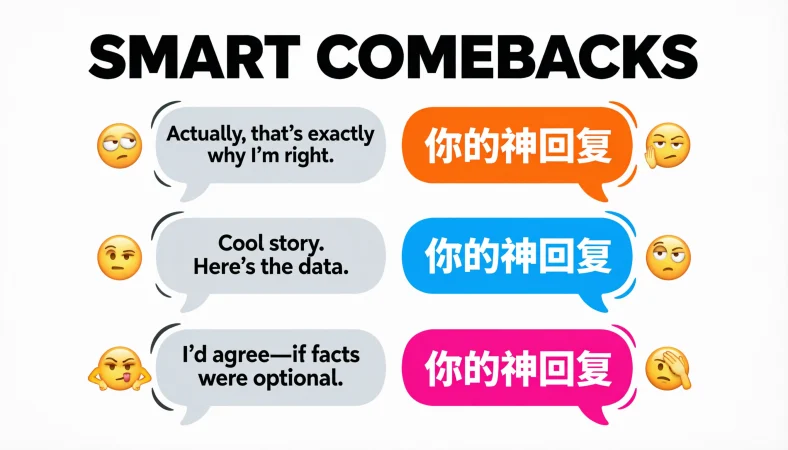
Quick Answer: The best comebacks in an argument are clever enough to make your point without making the situation worse. Whether you need a witty text, a calm response, or a perfectly timed one-liner, these smart and funny comebacks keep you confident and quick on your feet.
Top alternatives: “That sounded better in your head, didn’t it?”, “Interesting opinion, but I’ll pass”, “Let’s agree that you’re entitled to your wrong opinion”, “I’d explain it, but I left my crayons at home”, “You make a strong case for silence”
We’ve all been there. One minute you’re having a normal conversation, and suddenly you’re mentally searching your entire vocabulary for the perfect comeback. Maybe it happens during a group chat debate, a playful argument with friends, a disagreement at work, or a text exchange with someone who has decided they absolutely must have the last word. That’s exactly where smart and funny comebacks to use in any argument can save the moment. A good comeback doesn’t have to be rude or unnecessarily harsh. Sometimes the smartest move is a witty line that makes your point, keeps your confidence intact, and adds just enough humor to stop the conversation from becoming a full courtroom drama. From clever one-liners to polished responses, these comebacks give you plenty of ways to stay sharp without losing your cool.
Funny Responses
“Did you rehearse that one?”
Use this when someone delivers an overly confident argument that sounds suspiciously prepared.
Meaning: You’re playfully questioning how seriously they’re taking themselves.
“That sounded funnier in your head, huh?”
Use this after someone makes a weak attempt at winning an argument.
Meaning: You’re lightly pointing out that their comment didn’t land.
“I’d agree with you, but then we’d both be wrong.”
Use this when you want a classic witty comeback for a pointless disagreement.
Meaning: You’re humorously rejecting their argument.
“Interesting theory. Let’s keep it fictional.”
Use this when someone presents an obviously questionable opinion.
Meaning: You’re jokingly suggesting their argument belongs in a story.
“You brought confidence. I’ll give you that.”
Use this when someone is extremely certain despite weak reasoning.
Meaning: You’re teasing their confidence without directly insulting them.
“That argument needs a software update.”
Use this for a playful debate with someone who enjoys internet humor.
Meaning: You’re saying their reasoning feels outdated.
“I’m listening, but my eyebrows have concerns.”
Use this when someone says something that makes little sense.
Meaning: You’re humorously showing disbelief.
“We’ve officially entered the bonus round.”
Use this when an ordinary disagreement becomes unnecessarily long.
Meaning: You’re joking about how far the argument has gone.
“Bold statement for someone with that evidence.”
Use this when someone makes a huge claim without backing it up.
Meaning: You’re calling attention to the gap between confidence and proof.
“Okay, debate champion, breathe.”
Use this when someone is becoming overly competitive.
Meaning: You’re reminding them that the conversation isn’t a championship match.
“I’d respond seriously, but this is becoming premium entertainment.”
Use this when their argument has become unintentionally funny.
Meaning: You’re treating the disagreement as amusing rather than threatening.
“And somehow, that made even less sense the second time.”
Use this when someone repeats a weak argument.
Meaning: You’re playfully highlighting that repetition didn’t improve it.
Clever Responses
“Confidence is impressive. Accuracy would be better.”
Use this when someone sounds certain but lacks facts.
Meaning: You’re separating confidence from correctness.
“That’s an opinion, not a conclusion.”
Use this when someone presents a personal belief as undeniable truth.
Meaning: You’re reminding them that opinions are not automatically facts.
“Let’s separate what you feel from what you can prove.”
Use this when emotions are replacing evidence.
Meaning: You’re asking for a more logical discussion.
“You’ve made your point. It just hasn’t made mine disappear.”
Use this when someone thinks repeating themselves settles the argument.
Meaning: You’re acknowledging their position without accepting it.
“A louder argument isn’t automatically a stronger one.”
Use this when someone raises their voice or becomes aggressive.
Meaning: You’re pointing out that volume does not equal validity.
“That’s one interpretation, not the only one.”
Use this when someone acts as though their perspective is universal.
Meaning: You’re calmly challenging their certainty.
“Let’s not confuse confidence with evidence.”
Use this when someone is making bold claims without support.
Meaning: You’re bringing the conversation back to facts.
“You’re arguing the conclusion without addressing the point.”
Use this when someone keeps avoiding the actual issue.
Meaning: You’re calling attention to their weak reasoning.
“We can disagree without turning this into a competition.”
Use this when a debate becomes unnecessarily personal.
Meaning: You’re setting a mature boundary.
“That’s a response, but it isn’t really an answer.”
Use this when someone dodges your actual question.
Meaning: You’re pointing out their avoidance.
“I understand your point. I just don’t find it convincing.”
Use this when you want to disagree without being disrespectful.
Meaning: You’re separating understanding from agreement.
“You don’t need to win every conversation.”
Use this when someone is clearly arguing just to have the final word.
Meaning: You’re reminding them that disagreement is not a scoreboard.
Sarcastic Responses
“Wow, what a groundbreaking discovery.”
Use this when someone states something painfully obvious.
Meaning: You’re sarcastically exaggerating how impressive their statement supposedly is.
“Thank you for that completely unsolicited masterpiece.”
Use this when someone offers an unnecessary opinion.
Meaning: You’re playfully mocking the timing of their input.
“I’ll add that to the folder labeled ‘interesting but no.’”
Use this when you want a witty rejection of their argument.
Meaning: You’re dismissing the idea with humor.
“Congratulations, you’ve changed absolutely nothing.”
Use this when someone thinks they have ended the debate.
Meaning: You’re teasing them for having no impact on your position.
“Your confidence deserves its own award.”
Use this when someone is remarkably certain about something questionable.
Meaning: You’re sarcastically praising their certainty.
“That was certainly a sentence.”
Use this when someone says something confusing or unnecessary.
Meaning: You’re humorously avoiding giving their comment any real credit.
“I’ll pretend that was convincing.”
Use this when their argument clearly failed to persuade you.
Meaning: You’re sarcastically acknowledging their attempt.
“Fascinating. Still no.”
Use this when you want an extremely short sarcastic response.
Meaning: You heard them but remain completely unconvinced.
“And yet, somehow, the facts remain.”
Use this when someone tries to argue against something factual.
Meaning: You’re reminding them that reality has not changed.
“You almost had a point there.”
Use this when someone makes a nearly convincing but ultimately weak argument.
Meaning: You’re teasing them about falling short.
“I appreciate the enthusiasm.”
Use this when someone is arguing passionately without making a strong case.
Meaning: You’re acknowledging their energy rather than their logic.
“That’s adorable. Anyway…”
Use this only with people who understand playful sarcasm.
Meaning: You’re lightly dismissing their argument and moving on.
Confident Responses
“I know what I said, and I stand by it.”
Use this when someone pressures you to back down from your position.
Meaning: You’re showing confidence without attacking them.
“You don’t have to agree with me.”
Use this when someone acts as though disagreement is unacceptable.
Meaning: You’re comfortable holding your own opinion.
“I’m comfortable disagreeing with you.”
Use this when you want to end a circular debate calmly.
Meaning: You’re refusing to let disagreement become personal.
“You’ve made your case. I’m still not convinced.”
Use this when someone expects their argument to automatically win.
Meaning: You’re acknowledging them while maintaining your position.
“I don’t need the last word to know where I stand.”
Use this when someone keeps trying to get the final response.
Meaning: Your confidence doesn’t depend on winning the exchange.
“I can respect your opinion without adopting it.”
Use this when you want a mature but firm response.
Meaning: You’re setting a clear boundary around your beliefs.
“We’re allowed to see this differently.”
Use this when a disagreement is going nowhere.
Meaning: You’re choosing confidence over unnecessary conflict.
“I said what I meant.”
Use this when someone repeatedly questions your position.
Meaning: You’re making it clear that you won’t be pressured.
“You can disagree. I’m still good with my decision.”
Use this when someone challenges a personal choice.
Meaning: You trust your own judgment.
“I’m not changing my mind just because you’re louder.”
Use this when someone uses intensity instead of reasoning.
Meaning: You’re refusing to be intimidated.
“Respectfully, I’m going to stick with my position.”
Use this when you need firmness without hostility.
Meaning: You’re standing your ground politely.
“We can leave this at disagreement.”
Use this when the discussion has reached a natural stopping point.
Meaning: You’re choosing peace instead of endless debate.
Chill And Casual Responses
“Fair enough, we see it differently.”
Use this when you want to disagree without creating tension.
Meaning: You’re accepting that both people have different perspectives.
“Agree to disagree?”
Use this when the argument is going in circles.
Meaning: You’re suggesting a peaceful ending.
“Okay, I hear you.”
Use this when you want to acknowledge someone without agreeing.
Meaning: You’re listening but not surrendering your position.
“That’s fair. I still disagree though.”
Use this when you want to stay relaxed and honest.
Meaning: You can recognize their point without changing yours.
“No hard feelings.”
Use this when you want to keep a disagreement from becoming personal.
Meaning: You’re separating the argument from the relationship.
“We’re clearly reading the same book differently.”
Use this when both sides understand the situation differently.
Meaning: You’re using humor to acknowledge the disagreement.
“Let’s not turn this into a whole season.”
Use this when the discussion has gone on too long.
Meaning: You’re ready to move past the argument.
“I’m not pressed about it.”
Use this when you want to show that the disagreement isn’t bothering you.
Meaning: You’re staying emotionally detached.
“Noted. I’ll respectfully ignore that.”
Use this when someone gives an opinion you don’t plan to follow.
Meaning: You heard them but are choosing your own path.
“We can disagree and still be cool.”
Use this with friends or people you care about.
Meaning: You value the relationship more than being right.
“I get your point. It’s just not my point.”
Use this when you want a relaxed but clever disagreement.
Meaning: You recognize their perspective without adopting it.
“Anyway, peace has entered the chat.”
Use this when you want to end a playful argument.
Meaning: You’re choosing to stop debating and keep things friendly.
Polite Responses
“I understand your perspective, even though I disagree.”
Use this when you need to disagree respectfully.
Meaning: You’re showing maturity while maintaining your position.
“I appreciate your opinion, but I see it differently.”
Use this in personal or professional conversations.
Meaning: You’re acknowledging them without agreeing.
“I think we may have to leave this one as a disagreement.”
Use this when neither side is changing their mind.
Meaning: You’re suggesting a respectful ending.
“I hear what you’re saying.”
Use this when someone needs to feel acknowledged.
Meaning: You’re listening without automatically agreeing.
“That’s a reasonable perspective, but it isn’t mine.”
Use this when you want to sound thoughtful and calm.
Meaning: You’re recognizing their view while protecting your own.
“I’d rather focus on the actual issue.”
Use this when the discussion starts becoming personal.
Meaning: You’re redirecting the conversation toward the real problem.
“Let’s keep this respectful.”
Use this when the tone starts becoming hostile.
Meaning: You’re setting a clear conversational boundary.
“I’m happy to discuss it, but not argue about it.”
Use this when you want constructive conversation instead of conflict.
Meaning: You’re open to dialogue but not hostility.
“We clearly have different views on this.”
Use this when you want to acknowledge a disagreement neutrally.
Meaning: You’re recognizing the difference without escalating it.
“I don’t think continuing this will change either of our minds.”
Use this when an argument has become repetitive.
Meaning: You’re suggesting it is time to stop.
“I respect your right to see it that way.”
Use this when someone strongly disagrees with you.
Meaning: You’re offering respect without surrendering your view.
“Let’s agree to leave it there.”
Use this when you want a calm ending.
Meaning: You’re choosing closure over another round of debate.
Brutal But Witty Responses
“You’re entitled to your opinion, not your own facts.”
Use this when someone presents misinformation as truth.
Meaning: You’re drawing a firm line between opinions and facts.
“That argument had potential. Unfortunately, it went missing.”
Use this when someone makes a weak case.
Meaning: You’re humorously pointing out the lack of substance.
“You’re talking a lot for someone saying very little.”
Use this when someone keeps repeating themselves.
Meaning: You’re calling out a lack of useful content.
“I’d take that seriously if it made sense.”
Use this when someone makes a poorly reasoned claim.
Meaning: You’re explaining why their argument isn’t persuasive.
“Being confident doesn’t make you correct.”
Use this when someone relies heavily on certainty.
Meaning: You’re separating attitude from accuracy.
“That’s a lot of attitude for such little evidence.”
Use this when someone is overly forceful without proof.
Meaning: You’re pointing out the mismatch between tone and substance.
“You’re arguing like the facts personally offended you.”
Use this when someone refuses to accept evidence.
Meaning: You’re humorously highlighting their resistance to facts.
“If repetition made arguments stronger, you’d be unstoppable.”
Use this when someone keeps saying the same thing.
Meaning: You’re pointing out that repetition does not create validity.
“You made a point. It just wasn’t a good one.”
Use this when you want to be direct.
Meaning: You’re acknowledging their effort while rejecting the argument.
“That sounded convincing until I thought about it.”
Use this when their argument initially sounds persuasive but falls apart.
Meaning: You’re saying closer examination exposed its weakness.
“Your argument is doing a lot of heavy lifting with very little evidence.”
Use this when someone makes a broad claim without support.
Meaning: You’re challenging the foundation of their reasoning.
“I’d debate the point, but there doesn’t seem to be one.”
Use this when someone’s argument is particularly unclear.
Meaning: You’re saying there is nothing substantial to debate.
Creative Responses
“Let’s put that opinion in the museum of questionable ideas.”
Use this when you want a playful response to a strange argument.
Meaning: You’re jokingly treating their idea as something worth displaying.
“Your argument just took a scenic route away from the point.”
Use this when someone goes wildly off-topic.
Meaning: You’re pointing out that they avoided the actual issue.
“That take needs a map.”
Use this when someone’s reasoning is completely off course.
Meaning: You’re joking that their argument has lost direction.
“We’ve wandered so far from the point that GPS gave up.”
Use this when a disagreement becomes unnecessarily complicated.
Meaning: You’re highlighting how far the discussion has drifted.
“I’m putting that argument on airplane mode.”
Use this when you want to dismiss an unhelpful comment playfully.
Meaning: You’re choosing not to engage with it.
“That explanation has more plot holes than a bad movie.”
Use this when someone’s reasoning has obvious gaps.
Meaning: You’re saying their argument doesn’t hold together.
“Your logic just took an unexpected vacation.”
Use this when someone makes an illogical leap.
Meaning: You’re humorously questioning their reasoning.
“That argument arrived without its supporting documents.”
Use this when someone makes a claim without evidence.
Meaning: You’re asking where the proof is.
“Let’s give that thought a second draft.”
Use this when someone makes a poorly considered point.
Meaning: You’re suggesting their idea needs improvement.
“I respect the creativity, if not the conclusion.”
Use this when someone presents an imaginative but unconvincing argument.
Meaning: You appreciate their originality but reject their reasoning.
“That was less an argument and more an artistic performance.”
Use this when someone becomes dramatically passionate.
Meaning: You’re teasing the theatrical nature of their argument.
“Your point has entered the group chat and been left on read.”
Use this when you want a modern, meme-friendly dismissal.
Meaning: You’re joking that their argument received no support.
Dramatic Responses
“And thus begins another chapter of unnecessary debate.”
Use this when a tiny disagreement suddenly becomes enormous.
Meaning: You’re joking about the drama of the moment.
“I fear we may never recover from this disagreement.”
Use this when friends are playfully arguing over something trivial.
Meaning: You’re exaggerating the situation for comedic effect.
“This argument has more episodes than a streaming series.”
Use this when the disagreement refuses to end.
Meaning: You’re joking about its length.
“Someone alert the historians.”
Use this when the argument is being treated far too seriously.
Meaning: You’re exaggerating its supposed importance.
“This is becoming an award-winning production.”
Use this when the conversation gets overly dramatic.
Meaning: You’re poking fun at the theatrical energy.
“We’ve officially lost the plot.”
Use this when neither person remembers how the argument started.
Meaning: You’re joking that the discussion has gone off track.
“I didn’t realize we were filming a courtroom drama today.”
Use this when someone starts presenting evidence dramatically.
Meaning: You’re teasing how serious they’re acting.
“The tension. The drama. The unnecessary sequel.”
Use this when an old disagreement resurfaces.
Meaning: You’re humorously acknowledging the repeated conflict.
“This debate deserves an intermission.”
Use this when everyone needs a break from arguing.
Meaning: You’re suggesting a pause before things get worse.
“I came for a conversation and accidentally entered a season finale.”
Use this when a simple discussion becomes intense.
Meaning: You’re making light of the unexpected drama.
“Someone pass the popcorn.”
Use this when an argument among others becomes entertaining rather than serious.
Meaning: You’re jokingly treating the debate like a show.
Professional Responses
“Let’s focus on the facts rather than assumptions.”
Use this during a workplace disagreement that is becoming speculative.
Meaning: You’re redirecting the discussion toward evidence.
“I think we’re approaching the issue from different perspectives.”
Use this when colleagues disagree about a decision.
Meaning: You’re acknowledging different viewpoints without assigning blame.
“Can we come back to the specific issue?”
Use this when a meeting discussion becomes distracted.
Meaning: You’re bringing the conversation back to the main topic.
“I’m happy to discuss the reasoning behind my position.”
Use this when someone challenges your professional decision.
Meaning: You’re open to constructive discussion.
“Let’s avoid making this personal.”
Use this when a disagreement crosses professional boundaries.
Meaning: You’re establishing a respectful limit.
“I understand the concern, but I don’t agree with the conclusion.”
Use this when you need to challenge a coworker respectfully.
Meaning: You acknowledge the concern while rejecting the interpretation.
“Perhaps we should look at the evidence before deciding.”
Use this when opinions are dominating a work discussion.
Meaning: You’re encouraging fact-based decision-making.
“I think we’re repeating ourselves.”
Use this when a workplace debate has become circular.
Meaning: You’re suggesting the conversation needs to move forward.
“Let’s find the part we actually agree on.”
Use this when you want to turn conflict into collaboration.
Meaning: You’re searching for common ground.
“I’m open to being convinced by stronger evidence.”
Use this when you want to sound confident and reasonable.
Meaning: You’re showing that your position is not based on stubbornness.
“Let’s keep the discussion focused on solutions.”
Use this when people are spending too much time assigning blame.
Meaning: You want productive progress instead of conflict.
“We can disagree while keeping the conversation constructive.”
Use this when a professional disagreement becomes tense.
Meaning: You’re setting the expectation for respectful dialogue.
Cute And Playful Responses
“Okay, tiny debate warrior.”
Use this with a friend who loves playful arguments.
Meaning: You’re teasing them affectionately.
“You’re cute when you think you’ve won.”
Use this when playful flirting is already part of the relationship.
Meaning: You’re turning the disagreement into affectionate teasing.
“I’ll let you have that one for emotional support.”
Use this when the argument is completely harmless.
Meaning: You’re jokingly pretending to surrender.
“Fine, I’ll put your opinion in my imaginary notes.”
Use this when you want to tease without being harsh.
Meaning: You’re humorously pretending to consider their argument.
“Okay, professor, class is dismissed.”
Use this when someone is overexplaining a simple point.
Meaning: You’re playfully ending their lecture.
“You really came prepared today, huh?”
Use this when someone has an unusually detailed argument.
Meaning: You’re teasing their commitment to the debate.
“I admire the dedication.”
Use this when someone refuses to let a tiny disagreement go.
Meaning: You’re affectionately teasing their persistence.
“You make arguing almost adorable.”
Use this when the disagreement is clearly playful.
Meaning: You’re turning the tension into a cute compliment.
“Okay, I’ll give you a gold star for effort.”
Use this when someone makes a determined but weak argument.
Meaning: You’re teasing them while keeping the mood light.
“Your commitment to being right is honestly impressive.”
Use this when a friend refuses to back down.
Meaning: You’re playfully admiring their stubborn determination.
“I’ll consider your application for being right.”
Use this when you want a silly response to a harmless debate.
Meaning: You’re jokingly acting like you’re the decision-maker.
“We’ll call this a tie and protect the friendship.”
Use this when you want to end a playful argument positively.
Meaning: You’re choosing the relationship over winning.
Flirty Responses
“You’re pretty cute when you’re trying to prove a point.”
Use this when a disagreement has obvious romantic chemistry.
Meaning: You’re turning the argument into playful flirting.
“I could argue with you all day, but I’d rather flirt.”
Use this when you want to completely shift the mood.
Meaning: You’re choosing romance over debate.
“You can have the last word if I get the last smile.”
Use this when you want a playful romantic comeback.
Meaning: You’re keeping the disagreement light and flirtatious.
“Are we arguing or flirting? I’m genuinely confused.”
Use this when the tension feels more playful than serious.
Meaning: You’re openly acknowledging the chemistry.
“You’re making it very difficult to stay annoyed with you.”
Use this when you’re pretending to be irritated with someone you like.
Meaning: Their charm is weakening your argument.
“I’d disagree with you more, but you’re distracting.”
Use this when you want a cheeky romantic response.
Meaning: You’re admitting that attraction is getting in the way.
“Fine, you win this round. Don’t get comfortable.”
Use this when you want playful competitive flirting.
Meaning: You’re pretending to surrender while keeping the banter alive.
“Your argument is questionable, but your face is convincing.”
Use this when you already have a comfortable flirty dynamic.
Meaning: You’re prioritizing attraction over logic for comedic effect.
“I’m not saying you’re right. I’m saying you’re cute.”
Use this when you want to dodge the debate playfully.
Meaning: You’re complimenting them without conceding.
“Keep arguing like that and I might start enjoying it.”
Use this when playful tension is already established.
Meaning: You’re teasing them about the chemistry.
“I’d explain my point, but I’m enjoying watching you try.”
Use this when the banter is clearly affectionate.
Meaning: You’re playfully enjoying their determination.
“Maybe we should settle this over coffee.”
Use this when you want to turn a debate into a casual date suggestion.
Meaning: You’re using the argument as an excuse to spend time together.
Smart And Calm Responses
“Let’s slow down and look at what we actually know.”
Use this when emotions are making the argument less productive.
Meaning: You’re encouraging a fact-based discussion.
“I’m willing to listen if we can keep this respectful.”
Use this when you want to continue the conversation without accepting hostility.
Meaning: You’re setting a healthy boundary.
“I don’t think anger is going to solve this.”
Use this when someone becomes emotionally heated.
Meaning: You’re encouraging a calmer approach.
“We can challenge ideas without attacking people.”
Use this when an argument starts becoming personal.
Meaning: You’re separating disagreement from personal criticism.
“Let’s talk about the issue, not each other.”
Use this when the discussion has shifted toward insults.
Meaning: You’re redirecting attention to the actual problem.
“I’d rather understand your reasoning than guess your intentions.”
Use this when there is a misunderstanding.
Meaning: You’re inviting clarification instead of assuming the worst.
“Maybe we’re both right about different parts of this.”
Use this when the situation has multiple valid perspectives.
Meaning: You’re looking for nuance instead of forcing a winner.
“I’m not interested in winning if we both leave frustrated.”
Use this when the relationship matters more than the debate.
Meaning: You value resolution over victory.
“Let’s solve the problem instead of competing over who caused it.”
Use this when blame is dominating the discussion.
Meaning: You want to move toward a solution.
“I can change my mind when the reasoning changes.”
Use this when someone accuses you of being stubborn.
Meaning: You’re open-minded but not easily pressured.
“I’d rather be accurate than simply sound convincing.”
Use this when a debate becomes focused on appearances.
Meaning: You value truth over performance.
“The goal should be understanding, not scoring points.”
Use this when someone treats the conversation like a competition.
Meaning: You’re encouraging healthier communication.
One-Liner Comebacks
“Noted. Still disagree.”
Use this when you need a quick response that ends the debate.
Meaning: You acknowledge their point without changing your position.
“That’s a bold take.”
Use this when someone makes an unexpected or questionable claim.
Meaning: You’re expressing skepticism without starting a bigger fight.
“Respectfully, no.”
Use this when you want a short but confident refusal.
Meaning: You’re firmly rejecting their point.
“Good argument. Wrong conclusion.”
Use this when part of their reasoning is valid but the final point is not.
Meaning: You’re separating good reasoning from an incorrect conclusion.
“We tried logic. You brought vibes.”
Use this when someone is relying on feelings instead of reasoning.
Meaning: You’re humorously highlighting the difference.
“I’ll take that under advisement.”
Use this when you want to acknowledge someone without committing to their opinion.
Meaning: You’re politely saying you’ll consider it.
“That’s not the win you think it is.”
Use this when someone celebrates a weak point.
Meaning: You’re challenging their sense of victory.
“Let’s not make this deeper than it is.”
Use this when someone is overcomplicating a simple issue.
Meaning: You want to reduce unnecessary tension.
“We’re going in circles.”
Use this when the same points keep repeating.
Meaning: You think the argument has stopped being productive.
“I heard you the first time.”
Use this when someone repeats their argument aggressively.
Meaning: You’re making it clear that repetition won’t change your answer.
“Different opinion, same planet.”
Use this when you want a playful way to acknowledge disagreement.
Meaning: You’re reminding them that disagreement is normal.
“And that’s where we disagree.”
Use this when you want a clean, mature ending.
Meaning: You’re accepting the difference without escalating it.
FAQs
What does “smart and funny comebacks to use in any argument” mean?
It refers to witty responses that help you handle disagreements with confidence, humor, and quick thinking without automatically becoming insulting.
Are funny comebacks good for arguments?
They can be, especially during harmless disagreements with friends or people who enjoy banter. Humor works best when it lowers tension rather than humiliates someone.
Can these comebacks be used in professional arguments?
Yes, but choose carefully. Professional disagreements are usually better handled with calm, clever responses focused on facts, solutions, and respectful communication.
What if I don’t actually want to argue?
You can simply say, “I’m not interested in arguing about this” or “Let’s agree to disagree.” You never have to keep debating just because someone else wants to.
Can a comeback be flirty?
Definitely. If you already have romantic chemistry, playful lines like “You’re pretty cute when you’re trying to prove a point” can turn harmless disagreement into fun banter.
Should I use humor during a serious argument?
Use caution. If someone is genuinely upset, hurt, or dealing with a sensitive issue, a sarcastic comeback may make things worse. A calm and empathetic response is usually better.
What is the smartest way to win an argument?
Sometimes, it’s not about winning. Staying calm, listening carefully, separating facts from opinions, and knowing when to walk away is often more effective than having the cleverest final line.
How can I sound confident without being rude?
Keep your response focused on the issue instead of attacking the person. Lines such as “I understand your point, but I disagree” can be both firm and respectful.
What is a good comeback when someone keeps repeating themselves?
Try, “I heard you the first time.” It’s short, confident, and makes it clear that repetition isn’t changing your position.
What if someone wants the last word?
Let them have it. Sometimes the most confident response is no response at all, especially when the discussion has stopped being productive.
Conclusion
The best comeback isn’t always the harshest one. Sometimes it’s the line that makes everyone laugh, sometimes it’s the calm response that quietly shuts down unnecessary drama, and sometimes it’s simply knowing when the conversation isn’t worth another round. These smart and funny comebacks to use in any argument give you plenty of options for staying confident, clever, and composed. Pick your response based on the person, the situation, and the mood. A little humor can make your message memorable, while a little restraint can make it powerful. Save this list for your next debate, share it with your favorite quick-witted friend, and keep these one-liners ready for whenever the group chat gets spicy.