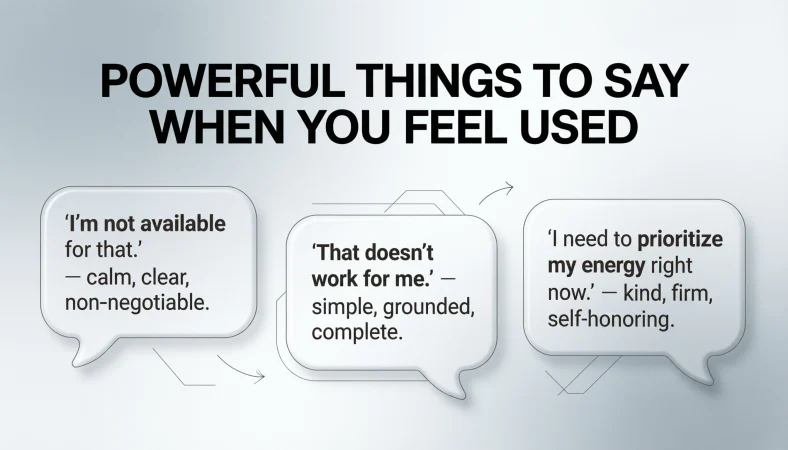
Quick Answer: Things To Say When You Feel Used is something honest that clearly explains how their actions made you feel and what you need going forward. You can be calm, direct, emotional, witty, or firm without losing your self-respect.
Top alternatives: I feel taken for granted, I deserve better than this, I don’t feel valued, I feel like I’m only contacted when you need something, I need to set a boundary
There is a special kind of disappointment that hits when you realize someone may have been treating you like a convenience instead of a person. Maybe a friend only texts when they need a favor, a coworker keeps taking credit for your effort, or someone you like suddenly becomes very interested whenever they want something.
Even DMs and everyday conversations can leave you wondering, “Wait, was I actually being appreciated or just useful?” Knowing the right things to say when you feel used can help you express that feeling without turning every conversation into a courtroom drama. Your words matter because they can set boundaries, protect your peace, and make your expectations clear. You do not have to scream, insult, or write a seven-page paragraph at 2 a.m. Sometimes one honest sentence says everything.
Calm And Honest Responses
1. “I feel like I’ve been taken for granted.”
Use this when someone’s repeated behavior has made you feel undervalued.
Meaning: You feel your kindness has become something they expect rather than appreciate.
2. “Lately, I haven’t felt valued in this relationship.”
Use this when you want to discuss a pattern without immediately attacking the person.
Meaning: You are honestly explaining how their behavior has affected you.
3. “I need to be honest about how this has made me feel.”
Use this when starting a serious conversation about feeling used.
Meaning: You are preparing to communicate your emotions openly.
4. “I don’t feel like this relationship is balanced anymore.”
Use this when you have been giving much more than you receive.
Meaning: You believe the relationship has become one-sided.
5. “I feel like I’m only important when you need something.”
Use this when someone regularly contacts you only for favors or assistance.
Meaning: Their behavior makes you feel useful rather than genuinely cared about.
6. “This situation doesn’t feel good to me.”
Use this when you want to express discomfort without being confrontational.
Meaning: Something about the relationship is emotionally bothering you.
7. “I need more mutual effort than this.”
Use this when you have been carrying most of the relationship.
Meaning: You want both people to contribute.
8. “I’ve noticed a pattern that I can’t ignore anymore.”
Use this when repeated behavior has become impossible to overlook.
Meaning: You are ready to address an ongoing issue.
9. “I want to feel appreciated, not just needed.”
Use this when someone seems interested only when they need help.
Meaning: You want genuine appreciation rather than convenience.
10. “I care about you, but I also need to feel respected.”
Use this when you still value the relationship but need better treatment.
Meaning: Your care does not cancel your need for respect.
11. “I don’t want to keep pretending this is okay.”
Use this when you have been staying quiet about feeling used.
Meaning: You are ready to acknowledge the problem.
12. “I think we need to talk about what’s really happening here.”
Use this when the situation requires a deeper conversation.
Meaning: You want clarity rather than continuing with unresolved feelings.
Strong And Direct Responses
1. “I’m not here to be used whenever it’s convenient.”
Use this when someone repeatedly takes advantage of your availability.
Meaning: You are setting a firm boundary.
2. “I deserve to be treated like a person, not a resource.”
Use this when your kindness has become something someone expects to exploit.
Meaning: You are demanding basic respect.
3. “I’m done being available only when you need something.”
Use this when the pattern has happened too many times.
Meaning: You are withdrawing from a one-sided dynamic.
4. “I won’t keep giving to something that gives nothing back.”
Use this when you feel emotionally exhausted.
Meaning: You are no longer willing to accept an unequal relationship.
5. “My kindness is not an invitation to take advantage of me.”
Use this when someone has confused generosity with unlimited access.
Meaning: You are making your boundary unmistakable.
6. “I’m not going to keep making excuses for your behavior.”
Use this when you have repeatedly overlooked the same issue.
Meaning: You are taking the situation seriously now.
7. “If you only value me when you need me, we have a problem.”
Use this when someone’s attention appears entirely conditional.
Meaning: You are directly challenging the imbalance.
8. “I’m choosing myself this time.”
Use this when stepping away from a relationship that drains you.
Meaning: Your wellbeing is becoming the priority.
9. “You don’t get unlimited access to me anymore.”
Use this when you need a firm personal boundary.
Meaning: You are limiting their ability to rely on you whenever convenient.
10. “I’m not accepting this treatment anymore.”
Use this when someone has repeatedly crossed your boundaries.
Meaning: You are refusing to continue the pattern.
11. “Being nice does not mean I have no limits.”
Use this when someone has mistaken your kindness for weakness.
Meaning: You are making your boundaries clear.
12. “If respect is missing, I’m stepping back.”
Use this when you are prepared to create distance.
Meaning: Respect is a non-negotiable for you.
Emotional Responses
1. “Honestly, this really hurt me.”
Use this when you want someone to understand the emotional impact of their behavior.
Meaning: Their actions caused genuine pain.
2. “I thought our connection meant more than this.”
Use this when feeling disappointed by someone you trusted.
Meaning: Their behavior did not match your understanding of the relationship.
3. “I feel like my feelings were ignored.”
Use this when your emotional needs have repeatedly been dismissed.
Meaning: You feel unseen and unheard.
4. “It hurts realizing I may have been valued for what I could do.”
Use this when you suspect someone appreciated your usefulness more than you.
Meaning: You feel reduced to what you could provide.
5. “I gave you genuine care, and I expected the same in return.”
Use this when you feel emotionally disappointed.
Meaning: You wanted mutual care rather than one-sided effort.
6. “I never wanted to feel like a convenience to you.”
Use this when someone’s behavior has made you question their intentions.
Meaning: You wanted a genuine connection.
7. “I’m disappointed because I trusted you.”
Use this when trust has been damaged.
Meaning: Their behavior has changed how you view them.
8. “I feel emotionally drained by this.”
Use this when repeated interactions have exhausted you.
Meaning: The relationship is taking more from you than it gives.
9. “I deserved honesty from you.”
Use this when you believe their intentions were hidden or unclear.
Meaning: You feel you were not treated transparently.
10. “I wanted to feel cared about, not useful.”
Use this when the difference between genuine affection and convenience hurts.
Meaning: You want emotional connection rather than conditional attention.
11. “This changed the way I see our relationship.”
Use this when someone’s actions have affected your trust.
Meaning: The experience has permanently influenced your perspective.
12. “I’m hurt, but I’m finally listening to that feeling.”
Use this when you are ready to stop ignoring your emotional discomfort.
Meaning: You are taking your own feelings seriously.
Polite Responses
1. “I appreciate our relationship, but something has been bothering me.”
Use this when you want to raise the issue respectfully.
Meaning: You want honest communication without unnecessary conflict.
2. “I’d like to talk about how I’ve been feeling lately.”
Use this when you want a calm conversation.
Meaning: You are opening the door to respectful discussion.
3. “I hope you understand where I’m coming from.”
Use this when explaining why certain behavior affected you.
Meaning: You want them to consider your perspective.
4. “I don’t think this dynamic is working for me anymore.”
Use this when you need to step away politely.
Meaning: You recognize that the relationship no longer feels healthy for you.
5. “I need to be more careful about what I agree to.”
Use this when you want to establish a boundary without blaming someone.
Meaning: You are changing how much you give.
6. “I would appreciate more consideration going forward.”
Use this when you want their behavior to change.
Meaning: You are politely asking for more respect.
7. “I’m not comfortable continuing like this.”
Use this when a situation repeatedly crosses your comfort level.
Meaning: You are clearly expressing a boundary.
8. “I hope we can find a healthier balance.”
Use this when you still want the relationship to work.
Meaning: You want more mutual effort.
9. “I value our connection, which is why I’m saying this.”
Use this when you want to make clear that honesty comes from caring.
Meaning: You are addressing the issue because the relationship matters.
10. “I think my boundaries need to be clearer.”
Use this when you realize you have allowed too much.
Meaning: You are taking responsibility for communicating your limits.
11. “I don’t want there to be resentment between us.”
Use this when you want to address the issue before it grows.
Meaning: You prefer honest communication over silent frustration.
12. “I hope we can respect each other’s needs.”
Use this when asking for healthier mutual treatment.
Meaning: You want both people’s needs to matter.
Confident Responses
1. “I know what I bring to the table.”
Use this when reminding yourself not to accept being undervalued.
Meaning: You recognize your own worth.
2. “I’m not going to shrink my standards to keep someone around.”
Use this when someone expects you to tolerate poor treatment.
Meaning: You are choosing self-respect over approval.
3. “I know the difference between being needed and being valued.”
Use this when someone’s behavior has made that distinction painfully clear.
Meaning: You want genuine appreciation rather than dependence.
4. “I’m allowed to say no.”
Use this when someone expects constant favors from you.
Meaning: You are asserting your right to set limits.
5. “I don’t need to prove my worth by overgiving.”
Use this when you have been doing too much to earn someone’s appreciation.
Meaning: Your value does not depend on constant sacrifice.
6. “I’m choosing relationships that feel mutual.”
Use this when moving away from one-sided connections.
Meaning: You expect balanced effort.
7. “My time and energy have value.”
Use this when someone repeatedly expects free access to your attention or help.
Meaning: You respect your own resources.
8. “I’m no longer confusing loyalty with tolerating disrespect.”
Use this when someone has crossed repeated boundaries.
Meaning: Loyalty should not require accepting poor treatment.
9. “I can care about you and still walk away.”
Use this when distance is necessary despite lingering feelings.
Meaning: Caring does not obligate you to stay.
10. “I’m not settling for being someone’s backup plan.”
Use this when someone only approaches you when other options disappear.
Meaning: You expect to be valued consistently.
11. “I deserve relationships that choose me too.”
Use this when your effort has not been reciprocated.
Meaning: Mutual commitment matters to you.
12. “I’m protecting my peace now.”
Use this when creating distance from a draining situation.
Meaning: Your emotional wellbeing comes first.
Sarcastic Responses
1. “Nice to know my emergency services are still open.”
Use this when someone only contacts you when they need help.
Meaning: You are sarcastically pointing out their pattern.
2. “Ah yes, the classic ‘I need something’ message.”
Use this when someone’s sudden attention feels predictable.
Meaning: You recognize that their contact appears conditional.
3. “Glad my usefulness remains appreciated.”
Use this when someone thanks you but rarely values you otherwise.
Meaning: You are highlighting the difference between usefulness and genuine appreciation.
4. “I see my customer-service hours are being respected.”
Use this with someone whose requests have become excessive.
Meaning: You are joking about feeling treated like a service provider.
5. “Nice of you to remember I exist.”
Use this when someone disappears until they need something.
Meaning: You feel overlooked when you are not useful.
6. “Apparently I’m everyone’s favorite when they need a favor.”
Use this when repeated requests have become frustrating.
Meaning: You feel your value is conditional.
7. “My free trial has officially expired.”
Use this when you are done providing unlimited help.
Meaning: You are setting a playful but firm limit.
8. “I should start sending invoices.”
Use this when someone constantly expects your time or effort.
Meaning: You feel like your support has become unpaid labor.
9. “The convenience department is closed.”
Use this when refusing another unnecessary favor.
Meaning: You are no longer available on demand.
10. “Five stars for consistency, zero stars for reciprocity.”
Use this when someone repeatedly takes but rarely gives.
Meaning: Their behavior has been consistently one-sided.
11. “I didn’t realize I was running a personal help desk.”
Use this when someone constantly asks for assistance.
Meaning: You feel reduced to a source of solutions.
12. “Good to know my value comes with a request button.”
Use this when someone’s attention always arrives with an ask.
Meaning: You feel appreciated mainly when you are useful.
Short And Powerful Responses
1. “I feel used.”
Use this when you want maximum honesty with minimum explanation.
Meaning: You believe someone has taken advantage of your kindness.
2. “I feel taken for granted.”
Use this when someone has stopped appreciating your effort.
Meaning: Your support feels expected rather than valued.
3. “This feels one-sided.”
Use this when the relationship lacks mutual effort.
Meaning: You feel you are giving more than you receive.
4. “I deserve better.”
Use this when you need to remind yourself and the other person of your standards.
Meaning: You will not accept being undervalued.
5. “I need boundaries here.”
Use this when someone repeatedly crosses your limits.
Meaning: You are ready to establish clearer limits.
6. “I’m stepping back.”
Use this when you need distance without a lengthy explanation.
Meaning: You are reducing your involvement.
7. “I’m not comfortable with this anymore.”
Use this when something has crossed your personal boundary.
Meaning: You are clearly withdrawing your consent or participation.
8. “I need more from this relationship.”
Use this when you want mutual effort and emotional investment.
Meaning: The current dynamic is not enough for you.
9. “I won’t keep doing this.”
Use this when repeated behavior has exhausted your patience.
Meaning: You are drawing a firm line.
10. “I’m choosing myself.”
Use this when prioritizing your emotional wellbeing.
Meaning: You are refusing to abandon your needs for someone else.
11. “I need reciprocity.”
Use this when you want equal effort and care.
Meaning: Mutual contribution matters to you.
12. “I’m done feeling like an option.”
Use this when someone treats you as convenient rather than important.
Meaning: You want to be valued consistently.
Gentle But Firm Responses
1. “I care about you, but this doesn’t feel fair.”
Use this when you want to preserve the relationship while addressing an imbalance.
Meaning: Your feelings remain, but the situation needs to change.
2. “I’m willing to support you, but I need boundaries too.”
Use this when you want to remain helpful without being overextended.
Meaning: Support should exist alongside healthy limits.
3. “I want to be there for you, not feel obligated to be there.”
Use this when requests have started feeling like expectations.
Meaning: You want your support to remain voluntary.
4. “I need our relationship to feel mutual.”
Use this when you are tired of always giving.
Meaning: You want both people to contribute emotionally and practically.
5. “I’m happy to help sometimes, but I can’t always be available.”
Use this when someone frequently expects your assistance.
Meaning: You are establishing a realistic boundary.
6. “I hope you can understand why I need some space.”
Use this when creating emotional distance.
Meaning: You need time to protect your wellbeing.
7. “I don’t want to hold this against you, but I need to be honest.”
Use this when you want to communicate before resentment builds.
Meaning: You prefer honesty over silently keeping score.
8. “I want to feel appreciated for who I am, not only what I do.”
Use this when your usefulness seems to dominate the relationship.
Meaning: You want to be valued as a whole person.
9. “I’m going to be more selective with my energy.”
Use this when you are changing how much effort you give.
Meaning: You are becoming more intentional with your time and attention.
10. “I hope we can make this feel healthier for both of us.”
Use this when you still want to repair the relationship.
Meaning: You want positive change rather than blame.
11. “I need to take care of myself too.”
Use this when you have been prioritizing someone else’s needs constantly.
Meaning: Your needs deserve attention as well.
12. “I’m not angry, I just need things to change.”
Use this when you want to separate your boundary from hostility.
Meaning: You are asking for a healthier dynamic rather than starting a fight.
Text Message Responses
1. “I need to be real with you. I’ve been feeling used lately.”
Use this when texting feels easier than starting the conversation face-to-face.
Meaning: You want to communicate your feelings directly.
2. “I feel like you only reach out when you need something.”
Use this when someone’s texting pattern has become obvious.
Meaning: Their attention feels conditional.
3. “I’m tired of feeling like I’m only useful when you need help.”
Use this when repeated requests have become emotionally exhausting.
Meaning: You want to be valued beyond what you can provide.
4. “This friendship has started feeling one-sided to me.”
Use this when a friend rarely checks in unless they need something.
Meaning: You feel the friendship lacks balance.
5. “I don’t want to keep giving when I’m not getting the same energy back.”
Use this when effort has consistently been unequal.
Meaning: You want reciprocity.
6. “I’m not comfortable with how this has been going.”
Use this when you want a calm but serious text.
Meaning: The current dynamic is bothering you.
7. “I need to take a step back for my own peace.”
Use this when you need temporary or permanent distance.
Meaning: You are prioritizing your emotional wellbeing.
8. “I care, but I can’t keep being available whenever you need something.”
Use this when you want to remain kind while setting limits.
Meaning: Caring does not mean unlimited availability.
9. “I feel like my kindness has been taken advantage of.”
Use this when someone repeatedly expects favors.
Meaning: You believe your generosity has been exploited.
10. “I need you to understand that this has hurt me.”
Use this when the emotional impact has been significant.
Meaning: You want them to acknowledge the damage caused.
11. “I’m not trying to argue. I’m just telling you how I feel.”
Use this when you want to prevent the discussion from becoming defensive.
Meaning: You are expressing emotions rather than attacking.
12. “I deserve relationships where the effort goes both ways.”
Use this when deciding to stop chasing someone.
Meaning: You expect mutual care and effort.
Workplace Responses
1. “I’d like my contributions to be recognized as well.”
Use this when a coworker repeatedly receives credit for your work.
Meaning: You want fair acknowledgment.
2. “I’m happy to help, but I need reasonable boundaries around my workload.”
Use this when colleagues repeatedly depend on you for extra tasks.
Meaning: You are willing to contribute without being overloaded.
3. “I want to make sure responsibilities are being shared fairly.”
Use this when your workload has become noticeably uneven.
Meaning: You want a more balanced professional arrangement.
4. “I’m concerned that my support has become an expectation.”
Use this when people routinely assume you will handle additional work.
Meaning: You feel your willingness to help is being taken for granted.
5. “Could we clarify who is responsible for this task?”
Use this when work keeps being passed to you.
Meaning: You are preventing responsibilities from being unfairly assigned.
6. “I’m happy to collaborate, but I can’t take ownership of everything.”
Use this when teamwork has become one-sided.
Meaning: Collaboration needs shared responsibility.
7. “I’d appreciate clearer recognition of my role in this project.”
Use this when your contribution has been overlooked.
Meaning: You want professional credit for your work.
8. “I need to prioritize my existing responsibilities.”
Use this when declining unnecessary additional work.
Meaning: You are protecting your workload.
9. “I’m willing to assist, but I can’t be the default person for every request.”
Use this when colleagues constantly turn to you.
Meaning: You are setting a workplace availability boundary.
10. “I think we need a more balanced approach.”
Use this when responsibilities are consistently uneven.
Meaning: You want fairness without creating unnecessary conflict.
11. “I value teamwork, and that means shared effort.”
Use this when others rely too heavily on your contribution.
Meaning: You believe collaboration should be mutual.
12. “I’d like to discuss how we can distribute this work more fairly.”
Use this when you want a constructive workplace solution.
Meaning: You are addressing the problem professionally.
Witty Responses
1. “I’m a person, not a convenience store.”
Use this when someone expects you to be available whenever they need something.
Meaning: You want to be treated as a person rather than a source of favors.
2. “My kindness has limits, plot twist.”
Use this when someone assumed you would always say yes.
Meaning: You are reminding them that generosity has boundaries.
3. “Being helpful was never supposed to become my full-time job.”
Use this when someone constantly depends on you.
Meaning: You are tired of carrying their responsibilities.
4. “I came for connection, not a subscription service.”
Use this when someone’s attention always comes with requests.
Meaning: You want a genuine relationship rather than transactional contact.
5. “I’m retiring from the role of convenient person.”
Use this when you are finally stepping away from an unfair dynamic.
Meaning: You are no longer accepting being treated as an easy option.
6. “Apparently my generosity needed a user manual.”
Use this when someone has pushed your kindness too far.
Meaning: You are joking about the need for boundaries.
7. “I’m unavailable for unlimited favors today and forever.”
Use this when someone repeatedly asks for your help.
Meaning: You are drawing a long-term boundary.
8. “Plot twist: I have needs too.”
Use this when someone has ignored your side of the relationship.
Meaning: You are reminding them that your needs matter.
9. “I’m closing the free-help department.”
Use this when someone repeatedly expects unpaid assistance.
Meaning: You are no longer offering unlimited support.
10. “Turns out I’m not an emotional vending machine.”
Use this when someone expects you to provide attention on demand.
Meaning: Your emotional energy is not endlessly available.
11. “My availability is not a public resource.”
Use this when someone treats your time as automatically accessible.
Meaning: You have ownership over your time and energy.
12. “I’m putting my generosity back behind a paywall.”
Use this when jokingly announcing stronger boundaries.
Meaning: You are no longer giving unlimited access to your effort.
Self-Respect Responses
1. “I won’t abandon myself just to keep someone else happy.”
Use this when you have been sacrificing too much for a relationship.
Meaning: Your wellbeing matters alongside theirs.
2. “I deserve to feel valued without having to earn it constantly.”
Use this when appreciation has always seemed conditional.
Meaning: You believe your worth is inherent.
3. “I’m learning to stop overgiving.”
Use this when you recognize a pattern of giving more than you can sustain.
Meaning: You are becoming more protective of your energy.
4. “I don’t need to chase people who only show up when it benefits them.”
Use this when someone’s effort feels completely conditional.
Meaning: You refuse to pursue one-sided relationships.
5. “I’m allowed to outgrow relationships that no longer feel healthy.”
Use this when deciding whether to move on.
Meaning: Leaving can be part of protecting yourself.
6. “I won’t confuse being needed with being loved.”
Use this when someone depends on you but does not genuinely care for you.
Meaning: Dependence and affection are not the same thing.
7. “My boundaries are not punishments.”
Use this when someone reacts badly to your limits.
Meaning: Setting boundaries is about self-protection, not revenge.
8. “I can be kind without being endlessly available.”
Use this when redefining how you help others.
Meaning: Kindness and boundaries can coexist.
9. “I’m done proving that I’m worth choosing.”
Use this when someone repeatedly makes you feel like an option.
Meaning: You will no longer seek validation through overgiving.
10. “My peace is worth protecting.”
Use this when a relationship has become emotionally exhausting.
Meaning: Your inner wellbeing deserves priority.
11. “I want connections that feel safe, mutual, and genuine.”
Use this when describing what you expect from relationships.
Meaning: You are setting healthier standards.
12. “I know I deserve better treatment.”
Use this when reminding yourself why you need to step away.
Meaning: You recognize your own worth.
Final Boundary Responses
1. “I’m going to step back from this relationship.”
Use this when repeated conversations have not changed the situation.
Meaning: You are choosing distance to protect yourself.
2. “I won’t be available for this anymore.”
Use this when someone repeatedly crosses the same boundary.
Meaning: Your participation is ending.
3. “I’ve explained how I feel, and now I’m choosing what’s best for me.”
Use this when you have already tried to communicate your concerns.
Meaning: You are moving from explanation to action.
4. “I’m not comfortable continuing this dynamic.”
Use this when the relationship consistently leaves you feeling used.
Meaning: You are refusing to maintain the current pattern.
5. “I need some distance right now.”
Use this when emotions are still intense.
Meaning: You need space before deciding what comes next.
6. “I’m no longer willing to accept one-sided effort.”
Use this when someone repeatedly gives little in return.
Meaning: Mutual effort is now a firm requirement.
7. “If things don’t change, I’ll need to walk away.”
Use this when you are giving one final opportunity for improvement.
Meaning: The relationship has reached a serious boundary.
8. “I’m choosing not to participate in this anymore.”
Use this when you want to end a recurring pattern without insults.
Meaning: You are withdrawing your involvement.
9. “I wish you well, but I need to move forward.”
Use this when ending a relationship respectfully.
Meaning: You can leave without holding onto hostility.
10. “I’m protecting my time, energy, and peace.”
Use this when explaining why you are creating distance.
Meaning: Your personal wellbeing is guiding your decision.
11. “I hope you respect the boundary I’m setting.”
Use this when clearly communicating a new limit.
Meaning: You expect your decision to be honored.
12. “I’m done accepting less than mutual respect.”
Use this when you have reached your final limit.
Meaning: Respect and reciprocity are essential to you.
FAQs
What should you say when you feel used?
Start with a clear statement such as “I feel taken for granted” or “I feel like I’m only contacted when you need something.” Focus on the behavior and how it affects you.
How do you tell someone you feel used without starting a fight?
Use calm language focused on your feelings rather than accusations. Saying “I feel like this relationship has become one-sided” is often more productive than attacking the person’s character.
What does it mean when you feel used by someone?
Feeling used usually means you believe someone is benefiting from your time, attention, kindness, money, emotional support, or effort without offering genuine care or reciprocity in return.
Can feeling used happen in friendships?
Absolutely. A friendship can feel one-sided when someone mainly contacts you for favors, advice, money, emotional support, introductions, transportation, or other benefits while rarely showing up for you.
What if I still care about the person who used me?
You can care about someone and still establish boundaries or walk away. Caring about them does not require you to continue accepting behavior that hurts you.
Can you feel used in a romantic relationship?
Yes. You may feel used if affection, attention, intimacy, money, emotional support, or companionship seems to appear mainly when the other person wants something.
Conclusion
Feeling used can make you question everything, especially when you genuinely cared about the person involved. But you do not need the perfect speech to reclaim your confidence. Sometimes the most powerful response is simply telling the truth, setting a boundary, and refusing to keep overgiving.
The things to say when you feel used can help you communicate that you want respect, reciprocity, and genuine connection. Choose words that match your personality and the seriousness of the situation. You can be gentle without being passive and firm without being cruel. Save this list for the next time you need the right words, share it with someone who needs a little reminder of their worth, and remember: your kindness deserves boundaries too.
Discover More Articles About
- 180+ Best Responses To “Come Visit Me” That Keep The Conversation Fun In 2026
- 180+ Best Replies To Keep Shining That Are Funny, Flirty And Perfect For 2026
- 150+ Thoughtful Ways To Reply When Someone Says “I’m Feeling Better Now” In 2026
- 180+ Fun And Flirty Responses When Someone Calls You A Snack In 2026