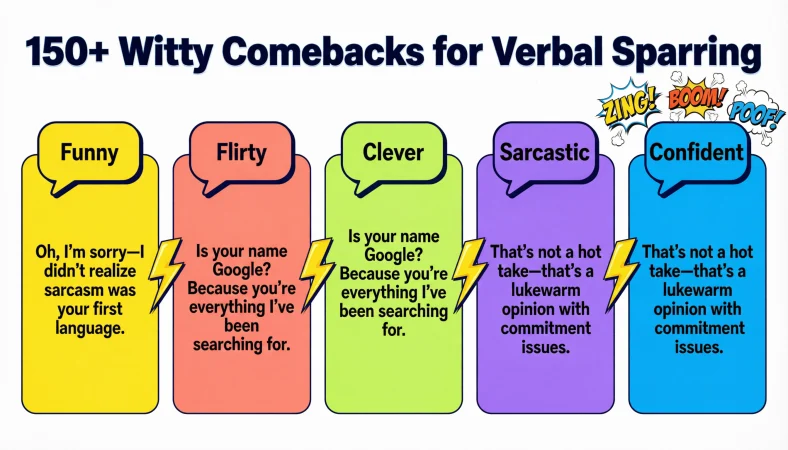
Quick Answer: Witty comebacks for verbal sparring are clever, playful, and confident replies that help you handle teasing, debates, and quick-fire banter without losing your cool. The best comeback is sharp enough to be memorable and fun enough to keep the conversation going.
Top alternatives: Clever comebacks, quick-witted replies, playful retorts, smart responses, humorous comebacks.
Ever had someone deliver a perfectly timed comeback and leave you thinking, “I should have said that!” five minutes later? Verbal sparring is everywhere, from playful texting and group chats to workplace banter, friendly debates, and flirty DMs. Sometimes, someone teases you. Sometimes, they challenge your opinion. And sometimes, your brain simply decides to take a coffee break when you need it most.
That is where witty comebacks for verbal sparring come in. A clever response can turn an awkward moment into a laugh, show confidence during a debate, or keep a playful exchange alive with your crush. The trick is knowing when to be funny, when to be sharp, and when to let someone have the last word. Whether you prefer clever wordplay, light sarcasm, or cool confidence, this list has a response for almost every situation.
Funny Responses
- “Was that your final answer?” Use it when someone delivers a questionable argument with total confidence. Meaning: You are playfully challenging their certainty.
- “I’ll give that a participation trophy.” Use it when a friend makes a weak attempt at winning an argument. Meaning: You are teasing them without taking the debate too seriously.
- “That sounded better in your head, didn’t it?” Use it after someone makes an awkward comeback. Meaning: You are humorously pointing out that their reply missed the mark.
- “Interesting theory, professor.” Use it when someone presents an overly complicated explanation. Meaning: You are playfully questioning their expertise.
- “Please submit that argument in writing.” Use it when someone keeps changing their point. Meaning: You are joking about needing evidence before continuing.
- “I admire your commitment to being incorrect.” Use it during a friendly disagreement. Meaning: You are teasing their confidence while disagreeing.
- “That comeback needs a software update.” Use it when someone repeats an old insult. Meaning: You are suggesting their humor feels outdated.
- “You almost had me. Almost.” Use it when someone makes a nearly convincing point. Meaning: You are giving playful credit while keeping the banter alive.
- “Let’s put that in the comedy archives.” Use it after someone makes an unintentionally funny statement. Meaning: You are treating their comment like a memorable joke.
- “I would respond, but I respect my screen time.” Use it when someone sends an unnecessarily dramatic message. Meaning: You are joking that the argument is not worth your attention.
- “That was a bold choice of words.” Use it when someone says something questionable. Meaning: You are humorously highlighting their risky statement.
- “Your confidence is doing all the heavy lifting.” Use it when someone sounds certain but lacks a strong argument. Meaning: You are teasing their confidence rather than attacking them personally.
Playful Responses
- “Careful, I might start taking you seriously.” Use it when someone makes a surprisingly good point. Meaning: You are giving them playful recognition.
- “You make arguing look almost adorable.” Use it during lighthearted banter with someone you like. Meaning: You are turning disagreement into friendly affection.
- “I see we woke up choosing opinions.” Use it when a friend starts a debate over something small. Meaning: You are playfully acknowledging their argumentative mood.
- “You bring the drama; I’ll bring snacks.” Use it when someone makes a minor issue sound huge. Meaning: You are treating the situation like entertaining theater.
- “That was cute. Try again.” Use it when someone gives a weak teasing remark. Meaning: You are inviting a better attempt in a playful way.
- “You’re making this far too entertaining.” Use it when a debate becomes amusing. Meaning: You are enjoying the exchange.
- “I respect the enthusiasm, honestly.” Use it when someone argues passionately about a silly topic. Meaning: You are acknowledging their energy with humor.
- “You’ve clearly rehearsed this moment.” Use it when someone delivers a polished comeback. Meaning: You are teasing them for seeming prepared.
- “I’ll let you have that one for character development.” Use it when you decide not to challenge a friend’s point. Meaning: You are playfully pretending their win is educational.
- “You’re lucky you’re entertaining.” Use it when someone is being mildly annoying but funny. Meaning: You are balancing teasing with affection.
- “That argument has personality, I’ll admit.” Use it when someone makes an unusual point. Meaning: You are appreciating their originality.
- “Okay, comedian, your turn is over.” Use it when a friend keeps teasing you. Meaning: You are playfully calling time on their performance.
Flirty Responses
- “Are we flirting or debating? I’m enjoying both.” Use it when a playful argument develops romantic energy. Meaning: You are acknowledging the chemistry.
- “You’re dangerously good at keeping my attention.” Use it when someone gives a clever reply. Meaning: You are expressing attraction through playful admiration.
- “I disagree, but I wouldn’t mind discussing it over coffee.” Use it when you want to turn a debate into a date. Meaning: You are showing interest while keeping the exchange witty.
- “You talk a lot for someone trying to impress me.” Use it when a crush playfully argues with you. Meaning: You are teasing them while hinting at attraction.
- “Your confidence is kind of charming.” Use it when someone stands their ground. Meaning: You are complimenting their self-assurance.
- “Keep talking. I like your voice.” Use it when someone is playfully making their case. Meaning: You are turning the disagreement into flirtation.
- “I might let you win if you ask nicely.” Use it when you want to add a playful challenge. Meaning: You are teasing someone with romantic undertones.
- “You’re making it difficult to stay focused.” Use it when a crush distracts you with clever banter. Meaning: You are suggesting that you find them attractive.
- “That comeback deserves a date.” Use it after someone impresses you with their wit. Meaning: You are playfully rewarding their cleverness.
- “I like your attitude. Don’t change it.” Use it when someone confidently teases you. Meaning: You are showing appreciation for their personality.
- “You’re cute when you think you’ve won.” Use it when a crush celebrates a small victory. Meaning: You are combining affection with playful competition.
- “Argue with me again sometime.” Use it when a fun debate is ending. Meaning: You are subtly asking to continue spending time together.
Sarcastic Responses
- “Brilliant observation. Truly groundbreaking.” Use it when someone states something obvious. Meaning: You are humorously exaggerating how impressive their comment is.
- “Thank you for that life-changing information.” Use it when someone offers an unnecessary remark. Meaning: You are playfully emphasizing its lack of importance.
- “I’ll alert the newspapers immediately.” Use it when someone makes a minor announcement sound significant. Meaning: You are exaggerating the importance of their statement.
- “Your argument has certainly made an entrance.” Use it when someone presents a questionable point dramatically. Meaning: You are teasing their delivery.
- “I’ll pretend that was convincing.” Use it when someone gives a weak explanation. Meaning: You are humorously expressing doubt.
- “What a plot twist. I never saw that coming.” Use it when someone repeats an expected point. Meaning: You are pretending to be surprised.
- “Please, continue. This is educational.” Use it when someone gives an overly confident lecture. Meaning: You are playfully mocking their seriousness.
- “I’m writing that down under ‘interesting choices.’” Use it when someone makes a questionable decision. Meaning: You are lightly criticizing their judgment.
- “That was almost a convincing argument.” Use it when someone makes a weak case. Meaning: You are teasing them about falling short.
- “You’ve really outdone the obvious today.” Use it when someone says something predictable. Meaning: You are joking about how unsurprising their comment is.
- “I appreciate the confidence, if nothing else.” Use it when someone is boldly incorrect. Meaning: You are sarcastically separating their confidence from their accuracy.
- “Let’s all take a moment to process that.” Use it after a particularly questionable statement. Meaning: You are humorously emphasizing how unusual it sounds.
Confident Responses
- “I heard you. I’m still not convinced.” Use it when someone tries to change your opinion. Meaning: You are standing firm without being aggressive.
- “You can disagree without expecting me to fold.” Use it during a serious debate. Meaning: You are calmly defending your position.
- “I’m comfortable with my answer.” Use it when someone keeps challenging your opinion. Meaning: You are showing self-assurance.
- “That’s your perspective, not the final verdict.” Use it when someone presents their opinion as fact. Meaning: You are reminding them that viewpoints can differ.
- “I don’t need the last word to know my point stands.” Use it when a discussion becomes competitive. Meaning: You are showing confidence without chasing victory.
- “You made your point. I made mine.” Use it when a disagreement is going in circles. Meaning: You are setting a calm boundary.
- “I’m open to facts, not pressure.” Use it when someone tries to force agreement. Meaning: You are prioritizing reason over intimidation.
- “Confidence doesn’t require your approval.” Use it when someone questions your self-assurance. Meaning: You are reinforcing your independence.
- “I respect your opinion, and I’m keeping mine.” Use it when you want to disagree respectfully. Meaning: You are showing confidence and maturity.
- “You don’t have to agree for me to be right for myself.” Use it during a personal disagreement. Meaning: You are emphasizing personal judgment.
- “I know what I meant, and I stand by it.” Use it when someone misinterprets your words. Meaning: You are calmly defending your intentions.
- “A different opinion doesn’t scare me.” Use it when someone treats disagreement as a threat. Meaning: You are showing emotional confidence.
Clever Responses
- “That argument has more holes than a slice of Swiss cheese.” Use it when someone makes a logically weak point. Meaning: You are highlighting flaws through a humorous comparison.
- “You brought confidence to a fact-checking contest.” Use it when someone is certain without evidence. Meaning: You are contrasting confidence with accuracy.
- “Let’s separate the facts from the fireworks.” Use it when someone gets dramatic during a debate. Meaning: You are encouraging a more logical discussion.
- “That was a sentence, but was it an argument?” Use it when someone says something without supporting it. Meaning: You are questioning the substance of their point.
- “You’ve confused volume with validity.” Use it when someone raises their voice to seem convincing. Meaning: You are pointing out that loudness does not prove correctness.
- “A strong opinion is not automatically a strong case.” Use it when someone relies only on confidence. Meaning: You are distinguishing belief from evidence.
- “Let’s not let enthusiasm outrun logic.” Use it when someone gets excited about a weak idea. Meaning: You are encouraging more thoughtful reasoning.
- “Your conclusion arrived before the evidence.” Use it when someone jumps to an assumption. Meaning: You are pointing out their rushed reasoning.
- “That explanation took the scenic route.” Use it when someone gives a long, confusing answer. Meaning: You are joking about their lack of clarity.
- “You’ve made a compelling case for reconsidering your case.” Use it when someone accidentally weakens their own argument. Meaning: You are cleverly pointing out the contradiction.
- “I see the point, but the logic is still buffering.” Use it when someone’s reasoning is unclear. Meaning: You are asking for a more coherent explanation.
- “That’s an interesting conclusion from very little information.” Use it when someone makes a bold assumption. Meaning: You are challenging their reasoning politely.
Polite Responses
- “I see where you’re coming from, but I view it differently.” Use it during a respectful disagreement. Meaning: You are acknowledging their perspective while maintaining your own.
- “That’s a fair point, although I have another perspective.” Use it when someone makes a reasonable argument. Meaning: You are keeping the discussion balanced.
- “I appreciate your honesty, even if we disagree.” Use it when someone expresses a different opinion. Meaning: You are valuing open communication.
- “Let’s agree that we see this differently.” Use it when a debate is becoming repetitive. Meaning: You are ending the disagreement respectfully.
- “I understand your reasoning, but I’m not persuaded.” Use it when someone explains their position carefully. Meaning: You are disagreeing without dismissing them.
- “That’s worth considering.” Use it when someone shares a thoughtful idea. Meaning: You are showing openness without immediate agreement.
- “I’d be happy to discuss that calmly.” Use it when someone approaches a disagreement respectfully. Meaning: You are encouraging constructive conversation.
- “Thank you for sharing your perspective.” Use it when you want to respond maturely. Meaning: You are acknowledging their contribution.
- “I respect your view, even though mine is different.” Use it when a discussion involves personal opinions. Meaning: You are protecting mutual respect.
- “Perhaps we’re focusing on different parts of the issue.” Use it when two people seem to misunderstand each other. Meaning: You are suggesting a possible source of disagreement.
- “Let’s focus on the point rather than the person.” Use it when a debate becomes personal. Meaning: You are redirecting the discussion toward the issue.
- “I think we can disagree and still get along.” Use it when a friend takes a different position. Meaning: You are prioritizing the relationship over winning.
Professional Responses
- “I understand your position, but the available information suggests otherwise.” Use it during a workplace discussion involving conflicting facts. Meaning: You are disagreeing professionally.
- “Let’s review the details before reaching a conclusion.” Use it when someone makes a rushed claim. Meaning: You are encouraging evidence-based reasoning.
- “That’s one perspective; let’s consider the alternatives.” Use it during a team meeting. Meaning: You are broadening the discussion.
- “I’m happy to discuss the issue, provided we keep it constructive.” Use it when workplace banter becomes tense. Meaning: You are setting a professional boundary.
- “Could you clarify the reasoning behind that point?” Use it when someone makes an unsupported statement. Meaning: You are requesting a clearer explanation.
- “I respect the suggestion, although I recommend another approach.” Use it when proposing a different solution. Meaning: You are disagreeing diplomatically.
- “Let’s focus on the outcome we’re trying to achieve.” Use it when colleagues argue over minor details. Meaning: You are bringing attention back to the shared goal.
- “I believe the facts deserve a closer look.” Use it when someone makes a confident but questionable claim. Meaning: You are encouraging careful evaluation.
- “We may have different interpretations of the situation.” Use it when a professional disagreement arises. Meaning: You are acknowledging differing views.
- “I’d prefer to resolve this through a productive discussion.” Use it when someone becomes confrontational. Meaning: You are promoting respectful communication.
- “Let’s avoid assumptions and work from the information available.” Use it when someone speculates during a meeting. Meaning: You are encouraging accuracy.
- “I’m open to changing my view if new evidence supports it.” Use it when someone challenges your position. Meaning: You are showing confidence and intellectual flexibility.
Chill And Casual Responses
- “Fair enough, I’ll let you have that one.” Use it when a friend makes a decent point. Meaning: You are accepting a playful loss.
- “We can debate this after snacks.” Use it when a casual argument gets too involved. Meaning: You are keeping the mood relaxed.
- “You do you, professor.” Use it when a friend explains something with unnecessary seriousness. Meaning: You are playfully acknowledging their expertise.
- “Noted, but I’m still vibing with my opinion.” Use it when someone challenges your perspective. Meaning: You are staying relaxed while disagreeing.
- “Okay, I hear you.” Use it when you want to acknowledge someone without extending the debate. Meaning: You are showing that you are listening.
- “That’s one way to look at it.” Use it when someone offers a different opinion. Meaning: You are recognizing their perspective casually.
- “Let’s not turn this into a documentary.” Use it when a small disagreement becomes a long discussion. Meaning: You are encouraging everyone to relax.
- “I’m going to pretend we both won.” Use it when neither person wants to concede. Meaning: You are ending the banter on friendly terms.
- “You make a strong case for changing the subject.” Use it when the debate becomes boring. Meaning: You are jokingly suggesting a new topic.
- “I’ll think about it for approximately three seconds.” Use it when a friend offers an amusing suggestion. Meaning: You are playfully pretending to consider it.
- “We’re both committed to this nonsense, apparently.” Use it during a silly argument. Meaning: You are acknowledging the humorous situation.
- “Cool story, now tell me what we’re eating.” Use it when you want to redirect casual banter. Meaning: You are prioritizing something more important to you.
Brutally Honest Responses
- “That sounded confident, but it didn’t sound convincing.” Use it when someone presents a weak argument with certainty. Meaning: You are directly questioning their reasoning.
- “You’re defending the point more than you’re explaining it.” Use it when someone avoids giving evidence. Meaning: You are pointing out a weakness in their argument.
- “I think we both know that isn’t your strongest point.” Use it during a familiar debate with a friend. Meaning: You are honestly identifying a weak argument.
- “Being loud doesn’t make the argument stronger.” Use it when someone becomes unnecessarily forceful. Meaning: You are calling attention to their tone.
- “You’re entitled to that opinion, not to automatic agreement.” Use it when someone expects everyone to agree. Meaning: You are defending independent judgment.
- “That explanation needs more substance.” Use it when someone offers a vague response. Meaning: You are asking for stronger reasoning.
- “You’re arguing around the point.” Use it when someone avoids addressing the main issue. Meaning: You are highlighting their lack of focus.
- “I expected a stronger argument from you.” Use it when someone makes a surprisingly weak point. Meaning: You are expressing honest disappointment.
- “That’s not a fact; that’s a guess with confidence.” Use it when someone treats speculation as certainty. Meaning: You are distinguishing assumptions from evidence.
- “You can challenge my point without misrepresenting it.” Use it when someone twists your words. Meaning: You are demanding a fair discussion.
- “I’m listening, but I’m not ignoring the flaws.” Use it when someone gives a mixed-quality argument. Meaning: You are showing openness while remaining critical.
- “Let’s be honest about what the evidence actually says.” Use it when a debate becomes detached from facts. Meaning: You are encouraging an honest evaluation.
Dramatic Responses
- “This debate will be remembered for generations.” Use it when friends argue about something completely unimportant. Meaning: You are exaggerating the situation for comedy.
- “I have prepared my closing statement.” Use it when a playful argument reaches its peak. Meaning: You are pretending the exchange is a courtroom drama.
- “The courtroom is now in session.” Use it when someone makes a bold accusation. Meaning: You are turning casual banter into a theatrical trial.
- “I refuse to let history judge me for this.” Use it after making a questionable choice in a debate. Meaning: You are exaggerating the seriousness of the moment.
- “This is the plot twist nobody requested.” Use it when someone introduces an unexpected argument. Meaning: You are making the situation sound like a dramatic story.
- “My patience has entered its final season.” Use it when a friend keeps repeating the same point. Meaning: You are humorously exaggerating your frustration.
- “I shall recover from this intellectual defeat.” Use it when someone makes a good comeback. Meaning: You are playfully admitting they scored a point.
- “The tension is unbearable, pass the popcorn.” Use it when a friendly debate becomes entertaining. Meaning: You are treating the argument like a movie.
- “I demand a rematch at a later date.” Use it when someone wins a playful argument. Meaning: You are keeping the competition going.
- “The council will review your statement.” Use it when someone makes a ridiculous claim. Meaning: You are pretending their comment needs official approval.
- “I have been personally affected by that opinion.” Use it when a friend makes a teasing remark. Meaning: You are exaggerating your reaction for humor.
- “And just like that, the peace treaty has collapsed.” Use it when playful disagreement begins again. Meaning: You are making the conflict sound comically historic.
Cute Responses
- “You’re lucky your arguments come with that cute face.” Use it when teasing someone you care about. Meaning: You are combining affection with playful disagreement.
- “I disagree, but I still like you.” Use it during a friendly argument. Meaning: You are reassuring someone that the disagreement is harmless.
- “You can have the last word and a cookie.” Use it when ending a playful debate. Meaning: You are offering a cute reward for peace.
- “That was a tiny argument with enormous confidence.” Use it when someone makes a small issue sound important. Meaning: You are gently teasing their dramatic certainty.
- “I’m not convinced, but I’m listening.” Use it when someone explains their opinion sweetly. Meaning: You are staying open and affectionate.
- “You’re making disagreement look adorable.” Use it when a loved one playfully challenges you. Meaning: You are expressing fondness during banter.
- “Okay, little debater, I hear you.” Use it when a friend or partner keeps making their case. Meaning: You are responding with gentle humor.
- “I’ll forgive that argument this time.” Use it when someone makes a teasing remark. Meaning: You are playfully pretending they committed a small offense.
- “Your point is questionable, but your effort is precious.” Use it when someone gives a funny explanation. Meaning: You are teasing them while remaining warm.
- “Let’s disagree nicely and share dessert.” Use it when you want to end a friendly debate. Meaning: You are prioritizing affection and togetherness.
- “You’re my favorite little opponent.” Use it when you regularly banter with someone. Meaning: You are showing that the competition is affectionate.
- “I still choose you, even when you’re wrong.” Use it during a playful disagreement with a partner. Meaning: You are expressing love while teasing them.
Creative Responses
- “Your argument has entered its experimental era.” Use it when someone presents an unusual opinion. Meaning: You are describing their idea as creatively unconventional.
- “That point deserves its own museum exhibit.” Use it when someone makes a memorable statement. Meaning: You are humorously exaggerating its uniqueness.
- “I’m adding that to the collection of questionable theories.” Use it when a friend shares a strange explanation. Meaning: You are playfully cataloging their idea.
- “Your logic just took a scenic detour through imagination.” Use it when someone makes an imaginative but weak argument. Meaning: You are teasing their creative reasoning.
- “That comeback arrived wearing sunglasses.” Use it when someone delivers a particularly confident retort. Meaning: You are giving their reply a stylish personality.
- “I can practically hear the dramatic soundtrack.” Use it when someone makes a theatrical statement. Meaning: You are emphasizing their dramatic delivery.
- “Your opinion has entered the group chat with no invitation.” Use it when someone offers an unexpected viewpoint. Meaning: You are playfully treating their opinion like an uninvited guest.
- “That argument needs a title and a book cover.” Use it when someone gives a long explanation. Meaning: You are joking about how elaborate it has become.
- “I see you brought the deluxe edition of confidence.” Use it when someone sounds extremely certain. Meaning: You are teasing their impressive level of self-belief.
- “That was a plot twist with excellent timing.” Use it when someone surprises you with a clever point. Meaning: You are praising their unexpected response.
- “Your reasoning has its own cinematic universe.” Use it when someone connects unrelated ideas. Meaning: You are humorously describing their elaborate thinking.
- “I’ll frame that comeback for future reference.” Use it when someone gives a memorable reply. Meaning: You are playfully acknowledging their cleverness.
Smart And Witty Responses
- “A confident statement still needs a solid foundation.” Use it when someone makes an unsupported claim. Meaning: You are emphasizing the importance of evidence.
- “I appreciate the creativity, but the logic needs work.” Use it when someone gives an inventive yet weak argument. Meaning: You are recognizing originality while pointing out flaws.
- “Let’s not confuse a conclusion with a demonstration.” Use it when someone states an answer without explaining it. Meaning: You are asking for reasoning.
- “That’s an opinion wearing a fact costume.” Use it when someone presents a personal belief as objective truth. Meaning: You are separating opinion from fact.
- “Your point is interesting; your evidence is taking a day off.” Use it when someone makes an unsupported claim. Meaning: You are humorously questioning their proof.
- “You’ve made a strong argument for checking the details.” Use it when someone overlooks important information. Meaning: You are encouraging accuracy.
- “I’m following your words, but the logic took a different route.” Use it when an explanation becomes confusing. Meaning: You are pointing out a reasoning gap.
- “Let’s give the facts a chance to speak.” Use it when emotions dominate a discussion. Meaning: You are encouraging a more objective conversation.
- “That’s a bold interpretation of the situation.” Use it when someone makes a questionable assumption. Meaning: You are gently challenging their conclusion.
- “You’ve presented a possibility, not a certainty.” Use it when someone sounds overly sure. Meaning: You are reminding them of the difference between speculation and proof.
- “I see the connection, but I’m not sure it holds.” Use it when someone links unrelated ideas. Meaning: You are politely questioning their logic.
- “Let’s test that theory before we celebrate it.” Use it when someone announces an unproven idea. Meaning: You are encouraging verification before acceptance.
Friendly Debate Responses
- “Let’s compare reasons instead of raising voices.” Use it when a discussion starts getting heated. Meaning: You are encouraging a respectful debate.
- “I’m ready to hear your strongest point.” Use it when you want someone to explain their position. Meaning: You are inviting a meaningful exchange.
- “That’s a fair challenge. Here’s my response.” Use it when someone raises a legitimate objection. Meaning: You are engaging thoughtfully.
- “We might be closer in opinion than we think.” Use it when two people focus on small differences. Meaning: You are looking for common ground.
- “Let’s examine the idea, not attack each other.” Use it when a debate starts becoming personal. Meaning: You are protecting mutual respect.
- “I’m willing to reconsider if you have new evidence.” Use it when someone offers a different perspective. Meaning: You are showing intellectual openness.
- “That’s a good question; let me think about it.” Use it when someone challenges you unexpectedly. Meaning: You are taking time to respond thoughtfully.
- “I understand the argument, but the conclusion feels incomplete.” Use it when someone makes a partially convincing point. Meaning: You are acknowledging strengths while identifying gaps.
- “We can test both ideas and see what works.” Use it when debating possible solutions. Meaning: You are encouraging practical problem-solving.
- “I’ll challenge the point, not your character.” Use it when a disagreement needs a respectful tone. Meaning: You are separating ideas from personal attacks.
- “That’s worth a second look.” Use it when someone raises an idea you had not considered. Meaning: You are showing a willingness to learn.
- “I think we’ve both made some solid points.” Use it when a debate has been balanced. Meaning: You are recognizing the value of both perspectives.
Chill Confidence Responses
- “I’m good with my opinion, but you do you.” Use it when someone disagrees casually. Meaning: You are staying confident without creating tension.
- “No hard feelings, just different takes.” Use it when a friendly debate ends. Meaning: You are keeping the relationship comfortable.
- “I’m not competing; I’m just participating.” Use it when someone treats a discussion like a contest. Meaning: You are refusing unnecessary pressure.
- “I can disagree and still enjoy the conversation.” Use it when someone worries about a difference of opinion. Meaning: You are showing emotional maturity.
- “You made your point. I’m still standing over here.” Use it when someone tries to change your mind. Meaning: You are calmly maintaining your position.
- “I’m relaxed, but I’m paying attention.” Use it when someone mistakes calmness for weakness. Meaning: You are showing quiet confidence.
- “That’s fair. I’m taking a different route.” Use it when someone offers an alternative view. Meaning: You are acknowledging their position while choosing your own.
- “I don’t need a debate trophy today.” Use it when you want to end playful competition. Meaning: You are prioritizing peace over winning.
- “We can leave this one unresolved.” Use it when neither person will change their mind. Meaning: You are accepting that not every disagreement needs a winner.
- “I’m cool with being misunderstood for a minute.” Use it when someone misreads your point. Meaning: You are refusing to become defensive.
- “Different opinions keep conversations interesting.” Use it when a friend disagrees with you. Meaning: You are presenting disagreement positively.
- “All good. We’ll survive this disagreement.” Use it when a minor argument ends. Meaning: You are reassuring everyone that the issue is not serious.
Sharp But Respectful Responses
- “You can challenge my idea without dismissing it.” Use it when someone responds disrespectfully to your opinion. Meaning: You are asking for fair treatment.
- “Let’s keep the criticism useful.” Use it when someone offers an unhelpful insult. Meaning: You are encouraging constructive feedback.
- “I’m open to correction, not condescension.” Use it when someone talks down to you. Meaning: You are setting a clear boundary.
- “If we’re discussing the issue, let’s stay with the issue.” Use it when someone brings up unrelated personal matters. Meaning: You are redirecting the conversation.
- “Your tone is stronger than your argument.” Use it when someone relies on aggression. Meaning: You are pointing out that attitude does not prove correctness.
- “I’ll consider your point when it comes with evidence.” Use it when someone makes an unsupported claim. Meaning: You are requesting substance.
- “That comment says more about the delivery than the idea.” Use it when someone expresses a valid point rudely. Meaning: You are separating content from tone.
- “You’re welcome to disagree, but please be accurate.” Use it when someone misrepresents your words. Meaning: You are defending clarity and fairness.
- “I’m not taking that personally, but I am correcting it.” Use it when someone makes a false claim about you. Meaning: You are remaining calm while defending yourself.
- “Let’s avoid turning a discussion into a personal contest.” Use it when someone becomes competitive. Meaning: You are encouraging a healthier exchange.
- “I respect strong opinions; I don’t respect unfair assumptions.” Use it when someone jumps to conclusions. Meaning: You are distinguishing confidence from unfairness.
- “We can keep talking when the conversation becomes constructive.” Use it when someone refuses to communicate respectfully. Meaning: You are setting a firm boundary.
FAQs
What Does Verbal Sparring Mean?
Verbal sparring is a quick exchange of words involving teasing, playful arguments, clever challenges, or competing viewpoints. It can be humorous, competitive, or intellectually engaging.
Are Witty Comebacks Always Meant To Be Funny?
No. A witty comeback can be funny, clever, confident, sarcastic, or thoughtful. The best choice depends on the mood and the relationship.
Can Witty Comebacks Be Flirty?
Absolutely. Playful disagreement can create chemistry when both people are comfortable with teasing. Replies such as “I like your attitude” or “Argue with me again sometime” can add a flirty touch.
How Do I Use Witty Comebacks Professionally?
Keep professional comebacks respectful, concise, and focused on the issue. Avoid personal insults, sarcasm that could be misunderstood, and humor that embarrasses colleagues.
What If I Don’t Actually Mean The Comeback?
Choose a softer reply or explain your intention. You can say, “I’m only teasing,” or “I meant that playfully.” Clear communication helps prevent unnecessary misunderstandings.
Is Humor Appropriate During Every Argument?
No. Humor works best when the disagreement is lighthearted and both people feel comfortable. During serious, emotional, or sensitive conversations, a calm and direct response is usually better.
How Can I Become Better At Verbal Sparring?
Listen carefully, stay calm, notice the tone of the conversation, and avoid rushing your reply. Practice clever wordplay, but remember that timing and kindness often make a comeback more effective.
Conclusion
A great comeback is not always the loudest or most cutting response. Sometimes, it is a perfectly timed joke, a confident sentence, or a clever observation that makes everyone smile. The right reply can turn an ordinary conversation into memorable banter, strengthen friendships, and show that you can handle pressure with personality.
Whether you prefer playful teasing, sharp logic, gentle humor, or flirty confidence, there is a response for every mood. Try different styles, adapt them to the situation, and remember that a little kindness makes even the cleverest comeback land better. Save this list for your next debate, share it with your funniest friend, and let the wordplay begin!