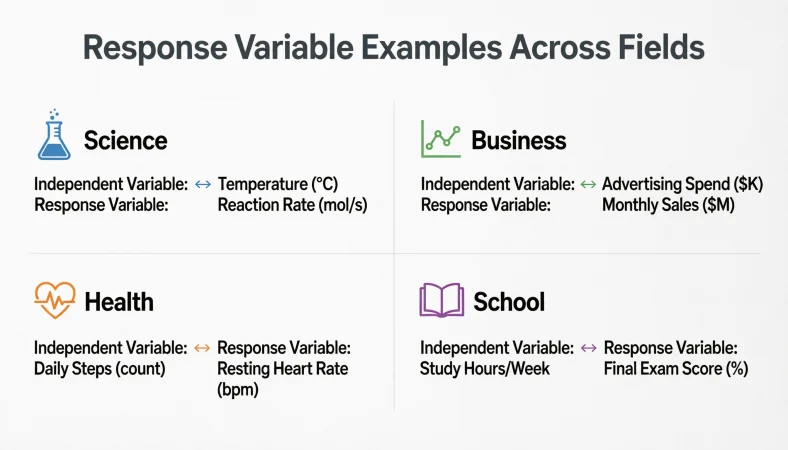
Quick Answer: A response variable example shows the outcome a researcher measures in an experiment or study. Also called a dependent variable or outcome variable, it helps explain how results change when another factor, such as a treatment, temperature, or study method, changes.
Top alternatives: dependent variable examples, outcome variable examples, statistical response variables, experimental variable examples, explained response variable examples
Ever wondered how researchers figure out whether a new study method improves grades, fertilizer helps plants grow, or exercise changes heart rate? The secret is knowing what to measure. That is where a response variable example comes in. In science classes, statistics homework, research projects, and data analysis, understanding response variables helps you make sense of what an experiment is actually testing.
The term might sound technical, but the idea is pretty simple: it is the result you observe or measure. Think of it as the answer to your experiment’s big question. Once you understand the difference between a response variable and the factor that might influence it, experiments become much easier to plan and explain. Let’s explore practical examples, memorable explanations, and useful ways to describe response variables without making your brain feel like it needs a software update.
Simple Response Variable Examples
“Plant height is the response variable.”
Use this when measuring how tall plants grow after receiving different amounts of water.
Meaning: Plant height is the outcome being measured.
“Test score is the response variable.”
Use this when investigating whether a new teaching method affects student performance.
Meaning: The score shows the measured learning outcome.
“Heart rate is the response variable.”
Use this when studying how exercise affects the body.
Meaning: Heart rate is the result recorded during the experiment.
“Daily sales are the response variable.”
Use this when examining whether a promotion affects business performance.
Meaning: Sales are the outcome being observed.
“Reaction time is the response variable.”
Use this when comparing reaction speeds under different conditions.
Meaning: Reaction time measures the participant’s response.
“Battery life is the response variable.”
Use this when testing whether screen brightness affects device usage time.
Meaning: Battery life is the outcome being measured.
“Weight change is the response variable.”
Use this when studying how a lifestyle program affects body weight.
Meaning: The measured change is the study’s outcome.
“Germination rate is the response variable.”
Use this when comparing how seeds grow under different conditions.
Meaning: Germination rate shows the proportion of seeds that sprout.
“Customer satisfaction is the response variable.”
Use this when examining whether a service change influences customer opinions.
Meaning: Satisfaction is the outcome recorded by the study.
“Fuel consumption is the response variable.”
Use this when testing how driving speed affects fuel efficiency.
Meaning: Fuel consumption measures how much fuel the vehicle uses.
“Sleep duration is the response variable.”
Use this when examining whether evening screen use affects sleep.
Meaning: Sleep duration is the measured outcome.
“Error rate is the response variable.”
Use this when comparing the accuracy of two software systems.
Meaning: The error rate shows how often mistakes occur.
Funny Response Variable Examples
“The number of coffees consumed is the response variable.”
Use this when joking about whether exam stress affects coffee consumption.
Meaning: Coffee consumption is the measured outcome.
“The number of yawns is the response variable.”
Use this when studying whether lecture length relates to student tiredness.
Meaning: Yawns are counted as an observable result.
“Time spent scrolling is the response variable.”
Use this when examining whether phone notifications affect screen time.
Meaning: Scrolling duration is the measured outcome.
“The number of snacks eaten is the response variable.”
Use this when investigating whether a long study session affects snacking.
Meaning: Snack count is the result being recorded.
“The number of times someone checks the clock is the response variable.”
Use this when studying whether waiting time affects impatience.
Meaning: Clock checks are the measured behavior.
“The amount of homework completed is the response variable.”
Use this when comparing productivity under different study conditions.
Meaning: Completed homework measures productivity.
“The number of times a student says ‘I need a break’ is the response variable.”
Use this when joking about whether study duration affects break requests.
Meaning: Break requests are the recorded outcome.
“The time it takes to find a missing sock is the response variable.”
Use this in a playful example about household organization.
Meaning: Search time is the measured result.
“The number of tabs left open is the response variable.”
Use this when investigating whether task complexity affects browser clutter.
Meaning: Open tabs are counted as the outcome.
“The number of times someone says ‘just five more minutes’ is the response variable.”
Use this when studying bedtime procrastination.
Meaning: Repeated requests for extra time are recorded.
“The number of unread emails is the response variable.”
Use this when comparing email volume across different workdays.
Meaning: Unread messages are the measured outcome.
“The time it takes to choose a movie is the response variable.”
Use this when studying how many options influence decision time.
Meaning: Decision time is the outcome being measured.
Scientific Response Variable Examples
“Blood pressure is the response variable.”
Use this when studying how a treatment or activity affects blood pressure.
Meaning: Blood pressure is the physiological outcome measured.
“Enzyme activity is the response variable.”
Use this when testing how temperature influences an enzyme.
Meaning: Enzyme activity shows the measured reaction rate.
“Bacterial growth is the response variable.”
Use this when examining how environmental conditions affect bacteria.
Meaning: Growth is the biological outcome being recorded.
“Reaction yield is the response variable.”
Use this when testing how changes in experimental conditions affect a chemical reaction.
Meaning: Yield measures the amount of product obtained.
“Dissolved oxygen concentration is the response variable.”
Use this when studying how water temperature relates to oxygen levels.
Meaning: Oxygen concentration is the measured water-quality outcome.
“Leaf area is the response variable.”
Use this when studying how light exposure affects plant development.
Meaning: Leaf area measures part of the plant’s growth.
“Respiration rate is the response variable.”
Use this when studying how activity or environmental conditions affect respiration.
Meaning: Respiration rate is the measured physiological outcome.
“The concentration of a substance is the response variable.”
Use this when testing how a process changes a chemical concentration.
Meaning: Concentration is the outcome being measured.
“Seedling survival rate is the response variable.”
Use this when comparing plant survival under different growing conditions.
Meaning: Survival rate shows the proportion of seedlings that remain alive.
“Cell growth is the response variable.”
Use this when examining how a treatment affects cultured cells.
Meaning: Cell growth is the biological outcome measured.
“Water turbidity is the response variable.”
Use this when testing whether filtration changes water clarity.
Meaning: Turbidity measures how cloudy the water is.
“The number of species observed is the response variable.”
Use this when examining how habitat conditions relate to biodiversity.
Meaning: Species count is the measured ecological outcome.
Statistical Response Variable Examples
“Income is the response variable in a model predicting earnings.”
Use this when examining how education and experience relate to income.
Meaning: Income is the outcome the model predicts.
“House price is the response variable in a property analysis.”
Use this when investigating how location and size relate to property prices.
Meaning: House price is the measured or predicted outcome.
“Monthly revenue is the response variable in a sales model.”
Use this when examining how advertising expenditure relates to revenue.
Meaning: Revenue is the outcome being analyzed.
“Exam scores are the response variable in an education study.”
Use this when testing whether attendance relates to academic performance.
Meaning: Scores represent the measured educational outcome.
“Customer churn is the response variable in a retention model.”
Use this when studying whether service quality relates to customers leaving.
Meaning: Churn is the outcome being predicted or explained.
“Disease status is the response variable in a medical study.”
Use this when examining associations between potential risk factors and disease.
Meaning: Disease status is the outcome of interest.
“Unemployment status is the response variable in a labor study.”
Use this when investigating how demographic or economic factors relate to employment.
Meaning: Employment status is the outcome being analyzed.
“Delivery time is the response variable in a logistics model.”
Use this when examining whether distance and traffic relate to delivery duration.
Meaning: Delivery time is the measured outcome.
“Crop yield is the response variable in an agricultural model.”
Use this when studying how rainfall and fertilizer relate to harvest size.
Meaning: Crop yield is the outcome being predicted or measured.
“Customer spending is the response variable in a marketing study.”
Use this when analyzing how loyalty programs relate to purchasing behavior.
Meaning: Spending is the outcome of interest.
“Employee turnover is the response variable in a workplace study.”
Use this when investigating how job satisfaction relates to staff departures.
Meaning: Turnover is the measured workforce outcome.
“Website conversion rate is the response variable in a digital marketing analysis.”
Use this when comparing how page designs relate to purchases or sign-ups.
Meaning: Conversion rate measures the proportion of visitors who complete a desired action.
Educational Response Variable Examples
“Final exam marks are the response variable.”
Use this when comparing different revision strategies.
Meaning: Exam marks measure academic performance.
“Reading speed is the response variable.”
Use this when testing whether daily reading practice changes fluency.
Meaning: Reading speed is the measured result.
“Vocabulary test scores are the response variable.”
Use this when examining whether a learning app supports vocabulary development.
Meaning: Test scores measure vocabulary performance.
“Attendance rate is the response variable.”
Use this when studying whether transport access relates to school attendance.
Meaning: Attendance rate is the outcome being measured.
“Assignment completion time is the response variable.”
Use this when comparing different ways of organizing homework.
Meaning: Completion time measures how long the task takes.
“The number of correct answers is the response variable.”
Use this when comparing two teaching approaches.
Meaning: Correct answers measure performance.
“Student participation is the response variable.”
Use this when investigating whether group activities influence classroom involvement.
Meaning: Participation is the outcome being observed.
“Typing speed is the response variable.”
Use this when studying whether practice sessions improve typing performance.
Meaning: Typing speed is the measured result.
“Spelling accuracy is the response variable.”
Use this when examining whether a learning activity improves spelling.
Meaning: Accuracy measures how many words are spelled correctly.
“Time taken to solve a problem is the response variable.”
Use this when comparing different problem-solving strategies.
Meaning: The time records how quickly the task is completed.
“Quiz completion rate is the response variable.”
Use this when investigating whether reminders affect student participation.
Meaning: Completion rate measures how many students finish the quiz.
“Course completion is the response variable.”
Use this when examining whether support programs relate to course completion.
Meaning: Completion status is the educational outcome.
Business Response Variable Examples
“Monthly profit is the response variable.”
Use this when studying how operating costs relate to business profitability.
Meaning: Profit is the financial outcome being measured.
“Sales volume is the response variable.”
Use this when comparing sales before and after a promotion.
Meaning: Sales volume measures the number of units sold.
“Customer satisfaction scores are the response variable.”
Use this when examining whether delivery improvements affect customer opinions.
Meaning: Scores measure reported satisfaction.
“Average order value is the response variable.”
Use this when investigating whether product recommendations influence spending.
Meaning: Average order value measures the typical amount spent per order.
“Employee productivity is the response variable.”
Use this when studying how work arrangements relate to output.
Meaning: Productivity is the measured work outcome.
“Product return rate is the response variable.”
Use this when examining whether packaging changes affect returns.
Meaning: Return rate measures the proportion of products returned.
“Lead conversion rate is the response variable.”
Use this when comparing different sales approaches.
Meaning: Conversion rate measures how many leads become customers.
“Customer waiting time is the response variable.”
Use this when testing whether staffing levels affect service speed.
Meaning: Waiting time is the measured service outcome.
“Website traffic is the response variable.”
Use this when studying whether marketing campaigns affect visits.
Meaning: Traffic measures the number of visits or visitors, depending on the study’s definition.
“Inventory turnover is the response variable.”
Use this when examining how stock policies relate to inventory movement.
Meaning: Turnover measures how frequently inventory is sold and replaced.
“Employee absence rate is the response variable.”
Use this when investigating how workplace policies relate to absenteeism.
Meaning: Absence rate measures employee absence over a defined period.
“Complaint frequency is the response variable.”
Use this when testing whether service changes affect customer complaints.
Meaning: Complaint frequency measures how often complaints occur.
Health And Fitness Response Variable Examples
“Resting heart rate is the response variable.”
Use this when examining whether a training program changes resting heart rate.
Meaning: Resting heart rate is the measured physiological outcome.
“Running time is the response variable.”
Use this when comparing running performance before and after training.
Meaning: Running time measures performance over a defined distance.
“Daily step count is the response variable.”
Use this when studying whether reminders influence physical activity.
Meaning: Step count measures daily movement.
“Sleep quality score is the response variable.”
Use this when examining whether a bedtime routine relates to reported sleep quality.
Meaning: The score measures the outcome of a sleep assessment.
“Blood glucose level is the response variable.”
Use this when studying how a meal or intervention relates to glucose levels.
Meaning: Blood glucose is the measured physiological outcome.
“Muscle endurance is the response variable.”
Use this when comparing different training programs.
Meaning: Endurance measures how long a person can sustain an activity.
“Flexibility score is the response variable.”
Use this when testing whether stretching changes flexibility.
Meaning: The score measures the outcome of a flexibility assessment.
“Recovery time is the response variable.”
Use this when examining how training intensity relates to recovery.
Meaning: Recovery time measures how long recovery takes under defined conditions.
“Perceived stress score is the response variable.”
Use this when studying whether a relaxation program changes reported stress.
Meaning: The score measures participants’ reported stress levels.
“Exercise duration is the response variable.”
Use this when examining whether music affects workout duration.
Meaning: Duration measures how long the exercise session lasts.
“Balance performance is the response variable.”
Use this when studying whether balance exercises improve stability.
Meaning: Performance measures the result of a balance assessment.
“Respiratory rate is the response variable.”
Use this when examining how activity relates to breathing rate.
Meaning: Respiratory rate measures breaths taken over a defined period.
Environmental Response Variable Examples
“Air pollution concentration is the response variable.”
Use this when studying whether traffic levels relate to local pollution.
Meaning: Pollution concentration is the measured environmental outcome.
“River water temperature is the response variable.”
Use this when examining how weather conditions relate to river temperature.
Meaning: Temperature is the outcome being recorded.
“Soil moisture is the response variable.”
Use this when investigating how rainfall relates to soil water content.
Meaning: Soil moisture measures the water present in the soil.
“Plant species diversity is the response variable.”
Use this when comparing biodiversity across different habitats.
Meaning: Diversity measures the variety of species in an area.
“Noise level is the response variable.”
Use this when examining how traffic volume relates to urban noise.
Meaning: Noise level is the measured sound intensity.
“Waste collected is the response variable.”
Use this when testing whether a recycling campaign changes waste collection.
Meaning: The amount collected is the outcome being measured.
“Water pH is the response variable.”
Use this when studying whether an environmental treatment changes acidity.
Meaning: pH measures how acidic or alkaline the water is.
“Carbon dioxide concentration is the response variable.”
Use this when measuring how ventilation relates to indoor carbon dioxide levels.
Meaning: Concentration is the measured air-quality outcome.
“Soil erosion rate is the response variable.”
Use this when examining how ground cover affects erosion.
Meaning: Erosion rate measures how quickly soil is lost.
“Local bird abundance is the response variable.”
Use this when studying how habitat changes relate to bird populations.
Meaning: Abundance measures the number of birds observed under defined conditions.
“Water clarity is the response variable.”
Use this when testing whether a filtration process improves clarity.
Meaning: Clarity is the observed water-quality outcome.
“The number of plastic items collected is the response variable.”
Use this when comparing litter levels before and after a cleanup campaign.
Meaning: The item count measures the observed cleanup result.
Creative Response Variable Examples
“The number of plants that bloom is the response variable.”
Use this when testing whether light exposure influences flowering.
Meaning: Bloom count is the measured plant outcome.
“The time a phone takes to charge is the response variable.”
Use this when comparing charging cables or power adapters.
Meaning: Charging time measures how long the process takes.
“The number of pages read is the response variable.”
Use this when studying whether reading reminders affect reading habits.
Meaning: Pages read measure reading activity.
“The number of successful app logins is the response variable.”
Use this when testing whether a new login design improves usability.
Meaning: Successful logins measure a system outcome.
“The number of customers who return is the response variable.”
Use this when studying whether a loyalty program affects repeat visits.
Meaning: Returning customers measure repeat engagement.
“The amount of paint used is the response variable.”
Use this when comparing painting techniques.
Meaning: Paint consumption is the measured outcome.
“The number of errors in a game is the response variable.”
Use this when testing whether practice improves game performance.
Meaning: Errors measure mistakes during play.
“The time needed to assemble furniture is the response variable.”
Use this when comparing instruction formats.
Meaning: Assembly time measures how long the task takes.
“The number of successful plant cuttings is the response variable.”
Use this when testing different propagation conditions.
Meaning: Successful cuttings measure propagation outcomes.
“The number of items sold at a market stall is the response variable.”
Use this when comparing display arrangements.
Meaning: Items sold measure sales performance.
“The number of correct predictions is the response variable.”
Use this when comparing forecasting methods.
Meaning: Correct predictions measure prediction performance.
“The percentage of tasks completed is the response variable.”
Use this when studying whether a new planning method improves task completion.
Meaning: Completion percentage measures the proportion of tasks finished.
Response Variable Examples With Independent Variables
“Water amount affects plant height.”
Use this when the independent variable is water volume and the outcome is plant growth.
Meaning: Water amount is the independent variable, while plant height is the response variable.
“Study time relates to exam score.”
Use this when examining whether additional revision is associated with better results.
Meaning: Study time is the predictor, and exam score is the response variable.
“Exercise duration relates to heart rate.”
Use this when recording heart rate after different exercise durations.
Meaning: Exercise duration is the independent variable, and heart rate is the measured response.
“Fertilizer type affects crop yield.”
Use this when comparing harvest results under different fertilizer treatments.
Meaning: Fertilizer type is the independent variable, and crop yield is the response variable.
“Screen brightness affects battery life.”
Use this when testing a device under different brightness settings.
Meaning: Brightness is the independent variable, and battery life is the response variable.
“Room temperature relates to ice melting time.”
Use this when measuring how quickly ice melts at different temperatures.
Meaning: Temperature is the independent variable, and melting time is the response variable.
“Advertising expenditure relates to sales revenue.”
Use this when studying marketing spending and sales outcomes.
Meaning: Advertising expenditure is the predictor, and revenue is the response variable.
“Teaching method relates to test performance.”
Use this when comparing outcomes across teaching approaches.
Meaning: Teaching method is the explanatory variable, and test performance is the response variable.
“Light intensity affects plant growth.”
Use this when measuring growth under different light levels.
Meaning: Light intensity is the independent variable, and plant growth is the response variable.
“Packaging type relates to product damage.”
Use this when comparing damage rates across packaging methods.
Meaning: Packaging type is the explanatory variable, and product damage is the response variable.
“Practice frequency relates to typing speed.”
Use this when measuring typing speed after different amounts of practice.
Meaning: Practice frequency is the predictor, and typing speed is the response variable.
“Traffic volume relates to travel time.”
Use this when studying journeys under different traffic conditions.
Meaning: Traffic volume is the explanatory variable, and travel time is the response variable.
Response Variable Examples For Research Projects
“The average test score will be the response variable.”
Use this when writing the methods section of an education project.
Meaning: The study measures students’ average scores.
“Plant survival percentage will be the response variable.”
Use this when planning an experiment about growing conditions.
Meaning: The study measures the proportion of plants that survive.
“Customer satisfaction ratings will be the response variable.”
Use this when planning a customer experience survey.
Meaning: The study measures reported satisfaction.
“Average waiting time will be the response variable.”
Use this when investigating service efficiency.
Meaning: The study measures how long customers wait.
“The change in blood pressure will be the response variable.”
Use this when studying an intervention’s possible effects.
Meaning: The study measures the difference in blood pressure across defined time points.
“The number of errors will be the response variable.”
Use this when comparing the accuracy of two procedures.
Meaning: The study measures how many errors occur.
“The percentage of seeds that germinate will be the response variable.”
Use this when investigating seed-growing conditions.
Meaning: The study measures germination success.
“Weekly sales will be the response variable.”
Use this when examining how a promotion relates to sales.
Meaning: The study records sales over each week.
“The time needed to complete the task will be the response variable.”
Use this when comparing task difficulty or different instructions.
Meaning: The study measures task completion time.
“The number of returning customers will be the response variable.”
Use this when examining customer retention.
Meaning: The study measures repeat customer activity.
“Reported stress levels will be the response variable.”
Use this when evaluating a stress-management program.
Meaning: The study measures participants’ reported stress.
“The percentage of defects will be the response variable.”
Use this when comparing manufacturing processes.
Meaning: The study measures the proportion of items that fail quality checks.
Clever Ways To Explain A Response Variable
“It is the result your experiment is trying to measure.”
Use this when explaining the concept to a beginner.
Meaning: The response variable is the measured outcome.
“It is the answer to your research question.”
Use this when helping someone identify the outcome in a study.
Meaning: It represents what the researcher wants to understand.
“It is what changes, or might change, when conditions change.”
Use this when explaining experiments involving treatments or conditions.
Meaning: The response variable is the outcome that may respond to another factor.
“It is the ‘what happened?’ part of the experiment.”
Use this when teaching the basics of experimental design.
Meaning: It identifies the result being observed.
“It is the number or result you record at the end.”
Use this when explaining a simple measurement-based experiment.
Meaning: It is the observed outcome, although it may be categorical rather than numeric.
“It is the outcome you compare across groups.”
Use this when explaining experiments with control and treatment groups.
Meaning: Researchers compare the response variable across conditions.
“It is what your graph often places on the vertical axis.”
Use this when explaining graphing conventions.
Meaning: Response variables commonly appear on the y-axis, though graph choices depend on the analysis.
“It is the result your statistical model predicts.”
Use this when discussing regression or predictive analysis.
Meaning: The response variable is the model’s target outcome.
“It is the measured outcome, not the suspected cause.”
Use this when distinguishing independent and response variables.
Meaning: The response variable differs from the explanatory factor.
“It is the part of the experiment that gives you evidence.”
Use this when explaining why measurement matters.
Meaning: The outcome provides data for evaluating the research question.
“It is the result you compare, not the factor you change.”
Use this when distinguishing the two main experimental variables.
Meaning: The response variable is measured, while the independent variable is manipulated or used as a predictor.
“It turns a research question into something you can measure.”
Use this when planning a study.
Meaning: A clearly defined response variable makes the question measurable.
FAQs
What Is A Response Variable?
A response variable is the outcome measured in a study or experiment.
What Is A Simple Response Variable Example?
Plant height is a response variable when studying how water affects plant growth.
Is A Response Variable The Same As A Dependent Variable?
Usually, yes. Both terms commonly describe the outcome being measured or predicted.
What Is The Difference Between An Independent And Response Variable?
The independent variable is a predictor or factor being changed or examined. The response variable is the outcome measured.
Can A Response Variable Be Categorical?
Yes. Examples include disease status, pass or fail, and whether a customer returns.
Is A Response Variable Always Numerical?
No. It can be numerical, binary, ordinal, or another categorical outcome.
Can You Have More Than One Response Variable?
Yes. A study can measure several outcomes, such as plant height and leaf count.
Is A Response Variable Always Caused By The Independent Variable?
No. An association does not automatically prove causation.
How Do You Identify A Response Variable?
Ask what outcome the researcher measures to answer the research question.
Where Does The Response Variable Go On A Graph?
It commonly goes on the vertical axis in a standard x-y graph, depending on the analysis.
Conclusion
Understanding response variables makes research questions, experiments, and statistics much easier to tackle. Whether you are studying plant growth, exam results, customer behavior, health outcomes, or environmental changes, the key is to identify exactly what you are measuring. Remember the simple rule: the response variable is the outcome, while the independent variable is the factor or predictor being examined.
Once you spot that difference, even complicated examples start to make sense. Save this guide for your next assignment, share it with a classmate who needs a quick explanation, and use the examples to build your own research questions. Keep learning, keep questioning, and let the data tell its story.










