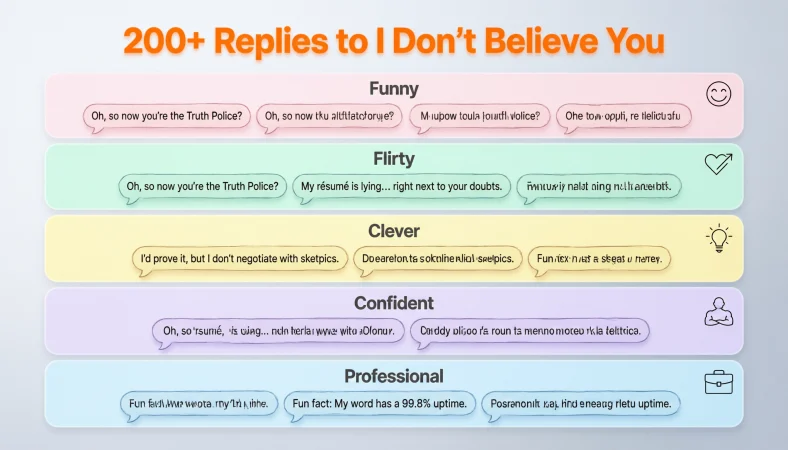
Quick Answer: The best Replies to I don’t believe you depend on the mood, from playful teasing to calm confidence. Pick a response that matches your relationship and the situation.
Top alternatives: “Give me a reason to prove it,” “You don’t have to believe me,” “Fair enough, your loss,” “What would convince you?”, “I guess I’ll have to prove it.”
When someone says, “I don’t believe you,” the conversation can instantly become interesting. Maybe your friend thinks your story sounds too wild, your crush suspects you are flirting, or a coworker wants proof before accepting what you said. Sometimes the phrase is serious, and sometimes it is basically an invitation to tease each other.
That is why having the right Replies to I don’t believe you can make a difference. A funny answer can keep the mood light, while a confident response can show that you are not bothered. If the person matters to you, a sweet or emotional reply may work better than sarcasm.
Whether you are texting, replying to a DM, joking with friends, talking to a crush, or handling a workplace conversation, the best response sounds natural. Here are plenty of ready-to-send options for almost every mood, personality, and situation.
Funny Responses
“Then I’ll need a witness.”
Use this when someone playfully doubts your story and you want to exaggerate the situation.
Meaning: You are jokingly saying that your claim needs official evidence.
“Wow, trust issues already?”
Use this with a friend when their disbelief is clearly playful.
Meaning: You are teasing them for not trusting you.
“I can’t believe you don’t believe me.”
Use this when you want to make their disbelief part of the joke.
Meaning: You are humorously turning their accusation back on them.
“Should I bring supporting documents?”
Use this when someone wants proof for something silly or obvious.
Meaning: You are joking that your explanation deserves a full presentation.
“My credibility just left the chat.”
Use this in a casual text when someone questions your honesty.
Meaning: You are playfully pretending your reputation has been destroyed.
“Fine, I’ll make a PowerPoint.”
Use this when a friend refuses to accept your story without evidence.
Meaning: You are exaggerating the amount of proof needed.
“Believe me or believe the plot twist.”
Use this when your story sounds unbelievable but is actually true.
Meaning: You are confidently adding humor to the mystery.
“I didn’t prepare for this courtroom drama.”
Use this when someone starts demanding proof over a casual claim.
Meaning: You are joking that the conversation has become an interrogation.
“Okay, Detective, what’s your theory?”
Use this when someone is suspicious about what you said.
Meaning: You are playfully inviting them to explain their doubts.
“My honesty needs better marketing.”
Use this when you want a clever joke after being doubted.
Meaning: You are humorously blaming your communication rather than taking offense.
“Guess I need a certified truth stamp.”
Use this when the person keeps asking for proof.
Meaning: You are joking that your word apparently is not enough.
“I promise I’m not writing fan fiction.”
Use this when someone thinks your story sounds completely made up.
Meaning: You are joking that your story is real despite sounding fictional.
Brutal Responses
“You don’t have to believe me.”
Use this when you want to stay composed without arguing.
Meaning: You are making it clear that their opinion does not control your confidence.
“That sounds like a you problem.”
Use this with someone whose disbelief does not affect you.
Meaning: You are confidently refusing to take responsibility for their doubt.
“Believe me later.”
Use this when you know the truth will eventually become obvious.
Meaning: You are calmly suggesting that time will prove your point.
“Your doubt doesn’t change the facts.”
Use this when someone dismisses something you know is true.
Meaning: You are separating their opinion from reality.
“I said what I said.”
Use this when you do not want to keep defending yourself.
Meaning: You are standing firmly behind your statement.
“You can doubt me from there.”
Use this when someone is being unnecessarily dismissive.
Meaning: You are confidently creating distance from their skepticism.
“Not my job to convince you.”
Use this when you have already explained yourself clearly.
Meaning: You are setting a boundary instead of continuing the argument.
“Your disbelief is noted.”
Use this when you want a cool and slightly sharp response.
Meaning: You acknowledge their doubt without giving it importance.
“You’ll find out eventually.”
Use this when the truth can speak for itself.
Meaning: You are choosing patience over a pointless debate.
“Doubt me if it makes you feel better.”
Use this when someone is being stubborn about accepting your statement.
Meaning: You are showing that their skepticism does not bother you.
“I’m not here to run a courtroom.”
Use this when someone keeps demanding evidence unnecessarily.
Meaning: You are ending the argument with a firm attitude.
“That’s fine. I know what happened.”
Use this when you want to stay calm while standing by your version.
Meaning: You are confident without becoming defensive.
Flirty Responses
“Then I guess I’ll have to prove it to you.”
Use this when your crush playfully doubts something you said.
Meaning: You are turning skepticism into a flirtatious challenge.
“Maybe you just want me to convince you.”
Use this when the conversation already has playful chemistry.
Meaning: You are teasing that their disbelief might be an excuse for more attention.
“I could make you believe me.”
Use this when you want a confident and slightly mysterious flirt.
Meaning: You are suggesting that you have a way to change their mind.
“Keep doubting me, it’s cute.”
Use this when their skepticism feels playful rather than serious.
Meaning: You are turning their doubt into a compliment.
“You’ll believe me when you see me.”
Use this when the situation naturally allows a future meeting.
Meaning: You are adding a flirty reason to see each other.
“I think you secretly believe me.”
Use this when you want to tease someone who keeps denying your claim.
Meaning: You are playfully suggesting they are pretending to be skeptical.
“Challenge accepted.”
Use this when you want a short, confident flirt.
Meaning: You are happily accepting the task of proving yourself.
“Then let me change your mind.”
Use this when the conversation has a romantic or teasing vibe.
Meaning: You are confidently inviting them to give you a chance.
“You’re making this way too fun.”
Use this when their disbelief creates playful tension.
Meaning: You are enjoying the teasing dynamic between you.
“Maybe I like convincing you.”
Use this when you want to make the exchange more personal.
Meaning: You are hinting that you enjoy their attention.
“Your doubt is giving me an excuse to see you.”
Use this when meeting in person would naturally prove your point.
Meaning: You are turning skepticism into a reason for a date or meetup.
“Careful, I might actually prove it.”
Use this when you want a playful warning with romantic energy.
Meaning: You are confidently teasing them about what could happen next.
Polite Responses
“I understand why you might feel that way.”
Use this when you want to acknowledge someone’s doubt respectfully.
Meaning: You are showing understanding without agreeing that you are wrong.
“That’s okay, I understand.”
Use this when you want to keep the interaction peaceful.
Meaning: You are accepting their skepticism without taking offense.
“I respect your perspective.”
Use this when the conversation is becoming more serious.
Meaning: You recognize their viewpoint while maintaining your own.
“I can see why it sounds unbelievable.”
Use this when your statement genuinely sounds surprising.
Meaning: You are acknowledging why they might question it.
“No worries, you can take your time.”
Use this when there is no need for an immediate answer.
Meaning: You are giving the other person space to process what you said.
“I’m happy to explain if you’d like.”
Use this when someone seems genuinely uncertain.
Meaning: You are offering clarification without becoming defensive.
“That’s fair. I understand the hesitation.”
Use this when their doubt has a reasonable basis.
Meaning: You are respectfully acknowledging their concern.
“I appreciate your honesty.”
Use this when someone openly admits they are skeptical.
Meaning: You value their directness even if they disagree with you.
“I hope I can earn your trust.”
Use this when trust is important to the situation.
Meaning: You are expressing a willingness to build credibility.
“I understand, but I’m being truthful.”
Use this when you want to calmly stand behind your statement.
Meaning: You are being respectful while clearly maintaining your position.
“You’re welcome to ask questions.”
Use this when the person needs more information.
Meaning: You are inviting an honest discussion.
“That’s completely okay.”
Use this when you want to avoid unnecessary tension.
Meaning: You are calmly accepting their current level of trust.
Professional Responses
“I understand your concern.”
Use this in a workplace discussion when someone questions your information.
Meaning: You are acknowledging their concern professionally.
“I can provide the relevant details.”
Use this when someone needs evidence or clarification.
Meaning: You are offering factual support for your statement.
“Let me clarify what I meant.”
Use this when your original message may have been misunderstood.
Meaning: You want to remove confusion professionally.
“I’m happy to provide supporting information.”
Use this when your claim needs documentation.
Meaning: You are offering evidence instead of arguing.
“Please feel free to verify it.”
Use this when you are confident your information can be checked.
Meaning: You are inviting independent confirmation.
“I understand the need for confirmation.”
Use this when accuracy matters in a professional setting.
Meaning: You recognize why someone wants evidence.
“Let’s review the information together.”
Use this when disagreement can be solved by checking the facts.
Meaning: You want to resolve the issue collaboratively.
“I’ll double-check and get back to you.”
Use this when you are not completely certain about the information.
Meaning: You are prioritizing accuracy over pretending to know.
“I appreciate you raising the question.”
Use this when someone challenges information during a work discussion.
Meaning: You are responding constructively to their skepticism.
“Here are the details for reference.”
Use this when you can support your statement with relevant information.
Meaning: You are shifting the discussion toward evidence.
“I understand that you need confirmation.”
Use this when the situation requires verification.
Meaning: You are recognizing the practical reason behind their doubt.
“Let’s confirm the facts before moving forward.”
Use this when accuracy is more important than winning an argument.
Meaning: You are suggesting a professional fact-checking approach.
Creative Responses
“My truth is currently under investigation.”
Use this when you want to turn doubt into a playful mystery.
Meaning: You are creatively pretending your honesty is being investigated.
“The evidence is hiding in plain sight.”
Use this when your story has clues the other person has missed.
Meaning: You are suggesting that proof already exists.
“Welcome to the plot twist.”
Use this when your statement sounds unbelievable but is true.
Meaning: You are presenting the situation like an unexpected story development.
“Reality has entered the chat.”
Use this when facts are about to prove your point.
Meaning: You are humorously suggesting that reality will settle the issue.
“Believe me when the receipts arrive.”
Use this when you expect to have proof later.
Meaning: You are confidently waiting for evidence to back you up.
“The truth has entered stealth mode.”
Use this when proof is not immediately available.
Meaning: You are playfully describing hidden evidence.
“Plot twist: I’m actually telling the truth.”
Use this when someone is convinced your story is made up.
Meaning: You are using storytelling humor to reinforce your honesty.
“Consider this your trust-building episode.”
Use this when you want to make a serious point sound playful.
Meaning: You are framing the situation as part of building trust.
“The receipts are loading.”
Use this when you are about to provide evidence.
Meaning: You are jokingly announcing that proof is coming.
“Truth doesn’t always sound believable.”
Use this when something genuinely surprising has happened.
Meaning: You are pointing out that reality can be stranger than fiction.
“This story has a surprise ending.”
Use this when the other person will soon discover you were right.
Meaning: You are creating suspense around the outcome.
“File this under: things you’ll believe later.”
Use this when you expect future evidence to settle the matter.
Meaning: You are confidently predicting that they will eventually accept your claim.
Sarcastic Responses
“Of course, because I’m famously terrible at telling the truth.”
Use this when someone jokingly doubts your honesty.
Meaning: You are sarcastically pretending that lying is your specialty.
“Right, because everything I say must be fictional.”
Use this when their skepticism is becoming amusing.
Meaning: You are exaggerating their disbelief for comedic effect.
“Thank you for your trust, it means so much.”
Use this when you want obvious sarcasm.
Meaning: You are pretending to appreciate their doubt.
“I’ll alert the authorities about your disbelief.”
Use this when the situation is clearly playful.
Meaning: You are exaggerating their skepticism into a ridiculous emergency.
“Noted. Your detective work continues.”
Use this when someone keeps questioning you.
Meaning: You are teasing them for investigating your story.
“I’ll try to recover from this shocking accusation.”
Use this when someone playfully suggests you are lying.
Meaning: You are humorously acting offended.
“What a devastating lack of faith.”
Use this when you want dramatic sarcasm.
Meaning: You are jokingly treating their doubt as a personal tragedy.
“I’ll inform my lawyer.”
Use this when someone turns a casual claim into an interrogation.
Meaning: You are joking that the accusation is getting serious.
“Fine, I’ll submit the evidence by Friday.”
Use this when someone demands proof in a playful setting.
Meaning: You are pretending the conversation is official business.
“Your skepticism has been beautifully documented.”
Use this when you want a clever sarcastic comeback.
Meaning: You are playfully acknowledging their refusal to believe you.
“Imagine doubting me with that much confidence.”
Use this when you want a teasing response.
Meaning: You are poking fun at how certain they are.
“I didn’t realize we were conducting an investigation.”
Use this when their questions are getting excessive.
Meaning: You are sarcastically highlighting their intense skepticism.
Cute Responses
“Aww, you really don’t believe me?”
Use this when you want to sound playful and affectionate.
Meaning: You are gently teasing them without creating tension.
“I’ll prove it, promise.”
Use this when you want a simple reassuring reply.
Meaning: You are promising to support what you said.
“You’re too cute when you’re suspicious.”
Use this with someone you have a warm or romantic connection with.
Meaning: You are turning their doubt into a compliment.
“Okay, I’ll earn that trust.”
Use this when you want to respond sincerely.
Meaning: You are showing that their trust matters to you.
“Just give me a little chance.”
Use this when you want to sound gentle and hopeful.
Meaning: You are asking them not to dismiss you immediately.
“I promise I’m being honest.”
Use this when reassurance matters more than humor.
Meaning: You are directly communicating sincerity.
“You’ll see, I promise.”
Use this when proof will come with time.
Meaning: You are asking them to wait for confirmation.
“Don’t make me bring receipts.”
Use this when you want cute humor instead of an argument.
Meaning: You are playfully offering proof.
“I’m offended, but in a cute way.”
Use this when you want to pretend their doubt hurt your feelings.
Meaning: You are keeping the mood light and affectionate.
“Trust me just a tiny bit.”
Use this when you want a soft and playful request.
Meaning: You are asking for a small amount of confidence from them.
“I’ll make you a believer.”
Use this when you want confident but friendly energy.
Meaning: You are promising to change their mind.
“Okay, I’ll let the truth do the talking.”
Use this when you want to stay sweet and calm.
Meaning: You trust that the facts will eventually prove you right.
Dramatic Responses
“My own words have been betrayed.”
Use this when a friend doubts you over something silly.
Meaning: You are pretending their disbelief is an emotional catastrophe.
“After everything I’ve done for this friendship?”
Use this when you want exaggerated dramatic humor.
Meaning: You are jokingly acting betrayed by their skepticism.
“This is the beginning of my villain origin story.”
Use this when you want playful dramatic energy.
Meaning: You are joking that their doubt has changed you forever.
“I cannot believe I’m being questioned like this.”
Use this when the conversation is clearly playful.
Meaning: You are pretending the situation is much more serious than it is.
“My heart may never recover.”
Use this when someone jokingly refuses to believe you.
Meaning: You are exaggerating your reaction for humor.
“And this is how trust disappears.”
Use this when you want to make their doubt sound hilariously serious.
Meaning: You are pretending their skepticism is destroying the relationship.
“I thought we had something special.”
Use this when teasing a friend or crush.
Meaning: You are playfully framing disbelief as betrayal.
“The betrayal is real.”
Use this when you want a short dramatic comeback.
Meaning: You are exaggerating their doubt for comedic effect.
“I’ll never be the same after this.”
Use this when someone refuses to accept your story.
Meaning: You are jokingly acting deeply affected.
“This friendship has entered a dark chapter.”
Use this when you want an over-the-top response.
Meaning: You are turning a tiny disagreement into fictional drama.
“I have been emotionally defeated.”
Use this when their disbelief is obviously not serious.
Meaning: You are pretending that their skepticism has crushed you.
“Tell my story when I’m gone.”
Use this when you want maximum dramatic exaggeration.
Meaning: You are jokingly presenting disbelief as a tragic event.
Chill And Casual Responses
“Fair enough.”
Use this when you want to acknowledge their doubt without making it a big deal.
Meaning: You are calmly accepting their reaction.
“Haha, you’ll see.”
Use this when you expect proof to appear later.
Meaning: You are staying relaxed while standing by your statement.
“No worries.”
Use this when you want to keep the conversation easygoing.
Meaning: You are showing that their doubt does not bother you.
“That’s okay, I get it.”
Use this when you understand why they are skeptical.
Meaning: You are responding with patience rather than defensiveness.
“Guess you’ll have to wait and see.”
Use this when the truth will become clear later.
Meaning: You are leaving the matter open without arguing.
“All good, honestly.”
Use this when you want to move past the disagreement.
Meaning: You are making it clear that there are no hard feelings.
“Haha, believe what you want.”
Use this when the situation is casual and low stakes.
Meaning: You are refusing to stress over their opinion.
“You’ll believe me eventually.”
Use this when you are confident that evidence will appear.
Meaning: You are calmly expecting them to change their mind.
“I’m not worried about it.”
Use this when their disbelief does not affect you.
Meaning: You are showing emotional confidence.
“Okay, I’ll let you be skeptical.”
Use this when you want to end the discussion casually.
Meaning: You are allowing them their opinion without arguing.
“No pressure, you’ll find out.”
Use this when you want a relaxed and confident tone.
Meaning: You are letting time provide the answer.
“Haha, we’ll see.”
Use this when you want the shortest possible playful reply.
Meaning: You are keeping things open and light.
Confident Responses
“I know what I’m saying is true.”
Use this when you want to communicate certainty without aggression.
Meaning: You are standing confidently behind your words.
“You don’t need to believe me right now.”
Use this when you are comfortable letting evidence speak later.
Meaning: Your confidence does not depend on immediate approval.
“I have nothing to hide.”
Use this when someone questions your honesty.
Meaning: You are communicating openness and confidence.
“I’m comfortable with what I said.”
Use this when you want to stay composed during disagreement.
Meaning: You are not backing away simply because someone doubts you.
“The truth will speak for itself.”
Use this when you do not want to argue.
Meaning: You trust future evidence to settle the issue.
“I stand by my words.”
Use this when you want a direct and firm response.
Meaning: You are clearly maintaining your position.
“You can question it, but I know the truth.”
Use this when someone continues to doubt you.
Meaning: You acknowledge their skepticism while remaining certain.
“I’m not here to convince anyone.”
Use this when you want to avoid unnecessary debate.
Meaning: You value your own certainty over external approval.
“Give it time.”
Use this when future events will clarify the situation.
Meaning: You are confident that the truth will become evident.
“I said it because I meant it.”
Use this when you want to reinforce sincerity.
Meaning: Your statement was deliberate and genuine.
“I trust my own word.”
Use this when you want a strong but calm response.
Meaning: You are showing self-confidence.
“You’ll understand when the time comes.”
Use this when the situation needs patience.
Meaning: You believe future circumstances will make your statement clear.
Emotional Responses
“It honestly hurts that you don’t trust me.”
Use this when their disbelief genuinely affects your feelings.
Meaning: You are openly expressing emotional disappointment.
“I wish you could trust my word.”
Use this when trust is important in the relationship.
Meaning: You are asking for greater confidence in your honesty.
“I’m being honest with you.”
Use this when you want to communicate sincerity directly.
Meaning: You are reassuring them that your words are genuine.
“I thought you knew me better.”
Use this when someone close to you doubts something important.
Meaning: You feel disappointed because you expected more trust.
“I don’t want to argue, I just want you to understand.”
Use this when emotions are rising during a disagreement.
Meaning: Your priority is mutual understanding rather than winning.
“Your trust means a lot to me.”
Use this when you want to explain why their reaction matters.
Meaning: You value the relationship and the confidence they place in you.
“I hope you can believe me someday.”
Use this when trust may take time to rebuild.
Meaning: You are expressing hope for greater trust in the future.
“I’m not trying to deceive you.”
Use this when someone believes you have a hidden motive.
Meaning: You are directly denying an intention to mislead.
“I wish you could see it from my side.”
Use this when the disagreement comes from different perspectives.
Meaning: You want them to understand your experience.
“I’m telling you this because I trust you.”
Use this when sharing something personal or meaningful.
Meaning: You are explaining why their response matters emotionally.
“I don’t know how else to explain it.”
Use this when you have already tried several explanations.
Meaning: You feel frustrated but are not trying to attack them.
“I just hope my actions can show you.”
Use this when words are no longer enough.
Meaning: You want your behavior to demonstrate your sincerity.
Sweet Responses
“You can take my word for it.”
Use this when you want a warm and reassuring response.
Meaning: You are asking them to trust your honesty.
“I’ll prove it with actions.”
Use this when words alone are not convincing.
Meaning: You believe behavior can demonstrate your sincerity.
“I really am telling you the truth.”
Use this when you want to reassure someone gently.
Meaning: You are emphasizing genuine honesty.
“I hope you’ll trust me.”
Use this when the relationship matters to you.
Meaning: You are expressing a sincere desire for their confidence.
“I wouldn’t lie to you about this.”
Use this when the person has reason to question the situation.
Meaning: You are reassuring them that you value honesty with them.
“Give me a chance to show you.”
Use this when you want to replace promises with evidence.
Meaning: You are asking for an opportunity to demonstrate the truth.
“You matter too much for me to lie.”
Use this when you want an affectionate and sincere response.
Meaning: You are connecting honesty with the importance of the relationship.
“I’m being completely genuine with you.”
Use this when the conversation is personal.
Meaning: You are emphasizing sincerity and openness.
“I hope you know I mean it.”
Use this when your words carry emotional importance.
Meaning: You want the other person to understand that you are sincere.
“I’ll let my actions speak.”
Use this when you do not want to keep explaining yourself.
Meaning: You prefer demonstrating sincerity through behavior.
“I understand your doubt, but I’m being honest.”
Use this when you want both warmth and reassurance.
Meaning: You respect their feelings while maintaining your truthfulness.
“You’ll see that I meant every word.”
Use this when future actions will confirm what you said.
Meaning: You are gently promising that your sincerity will become clear.
Clever Responses
“Belief isn’t required for facts to remain facts.”
Use this when someone confuses personal doubt with reality.
Meaning: You are making the distinction between opinion and evidence.
“Interesting theory. Mine comes with evidence.”
Use this when someone challenges your claim playfully.
Meaning: You are confidently suggesting that your position has support.
“Skepticism is healthy, but so is checking the facts.”
Use this when the conversation involves something that can be verified.
Meaning: You encourage questioning while pointing toward evidence.
“You can doubt the story without changing the ending.”
Use this when you know the outcome will prove your point.
Meaning: Their disbelief does not alter what actually happened.
“Maybe the truth just sounds unusual.”
Use this when your statement seems unlikely but is genuine.
Meaning: You are explaining why something true can still sound surprising.
“Your doubt is not evidence against me.”
Use this when someone treats skepticism as proof you are wrong.
Meaning: You are logically separating disbelief from factual evidence.
“Let’s separate what sounds true from what is true.”
Use this when a serious discussion needs clarity.
Meaning: You are encouraging evidence-based thinking.
“I’ll take proof over assumptions any day.”
Use this when someone makes conclusions without checking facts.
Meaning: You prefer evidence over speculation.
“Maybe we need fewer assumptions and more receipts.”
Use this when you want a modern, clever response.
Meaning: You are suggesting that evidence is more useful than guessing.
“You’re allowed to doubt me, but check first.”
Use this when you want to remain confident and reasonable.
Meaning: You invite verification rather than blind acceptance.
“The truth doesn’t need a popularity vote.”
Use this when someone thinks everyone must agree with them.
Meaning: Facts are not determined by how many people believe them.
“Let’s see what the evidence says.”
Use this when you want to move the conversation toward verification.
Meaning: You are prioritizing facts over personal opinions.
Playful Teasing Responses
“You really woke up suspicious today.”
Use this when a friend is questioning everything you say.
Meaning: You are teasing them for being unusually doubtful.
“Who hurt your trust button?”
Use this when someone is being dramatically skeptical.
Meaning: You are joking that something made them suspicious.
“Okay, Sherlock, relax.”
Use this when their questioning becomes playful investigation.
Meaning: You are teasing them for acting like a detective.
“You’re making this way too entertaining.”
Use this when you enjoy the back-and-forth.
Meaning: You are showing that their skepticism is fun rather than annoying.
“I see we’re choosing disbelief today.”
Use this when you want a playful observation.
Meaning: You are jokingly accepting their skeptical mood.
“Your trust subscription expired, huh?”
Use this when someone suddenly stops believing you.
Meaning: You are turning their doubt into a funny imaginary service problem.
“Should I send you a trust renewal link?”
Use this when you want to extend the subscription joke.
Meaning: You are humorously suggesting they need to start trusting you again.
“You’re really committed to not believing me.”
Use this when someone refuses to accept your explanation.
Meaning: You are playfully calling attention to their persistence.
“Okay, suspicious one.”
Use this when you want a short teasing reply.
Meaning: You are affectionately labeling them as skeptical.
“I’ll add ‘professional doubter’ to your résumé.”
Use this when a friend repeatedly questions you.
Meaning: You are joking about their impressive skepticism.
“Your detective badge is showing.”
Use this when they keep investigating your story.
Meaning: You are teasing them for acting like an investigator.
“Fine, keep your theories.”
Use this when you want to end the playful debate.
Meaning: You are letting them keep their assumptions without arguing.
Confident And Classy Responses
“I respect your doubt, and I stand by what I said.”
Use this when you want confidence without unnecessary attitude.
Meaning: You acknowledge their position while maintaining yours.
“You’re entitled to your doubts.”
Use this when you want a mature response.
Meaning: You recognize their right to question you.
“I don’t need immediate agreement.”
Use this when you are comfortable with disagreement.
Meaning: Your confidence does not depend on instant validation.
“I’d rather let the facts settle it.”
Use this when you want to avoid an emotional argument.
Meaning: You prefer evidence to confrontation.
“I’m comfortable being questioned.”
Use this when you want to show emotional composure.
Meaning: Skepticism does not automatically make you defensive.
“There’s no need to argue about it.”
Use this when the discussion is becoming repetitive.
Meaning: You want to keep the interaction calm and productive.
“Take whatever time you need.”
Use this when someone needs time before accepting your statement.
Meaning: You are confident enough to allow them space.
“I’ll let the outcome speak.”
Use this when future events can confirm your claim.
Meaning: You are choosing patience over persuasion.
“I know what I experienced.”
Use this when someone questions your personal experience.
Meaning: You are calmly affirming your own perspective.
“We can disagree without making it personal.”
Use this when skepticism is becoming argumentative.
Meaning: You are setting a respectful boundary.
“I’m not offended by your question.”
Use this when you want to keep communication mature.
Meaning: You are showing that questioning you does not automatically create conflict.
“Let’s keep it respectful and check the facts.”
Use this when the conversation needs a calm reset.
Meaning: You want both respect and accuracy.
Short And Punchy Responses
“You’ll see.”
Use this when you want a simple confident reply.
Meaning: Future proof will settle the matter.
“Watch me.”
Use this when you want playful confidence.
Meaning: You are challenging their doubt.
“Fair enough.”
Use this when you want to acknowledge skepticism without arguing.
Meaning: You accept their reaction calmly.
“Bet.”
Use this when the conversation is casual and competitive.
Meaning: You confidently accept the challenge to prove yourself.
“Just wait.”
Use this when evidence is coming later.
Meaning: You expect the truth to become obvious.
“Give it time.”
Use this when you want a calm response.
Meaning: You believe future events will clarify everything.
“Challenge accepted.”
Use this when you enjoy proving a point.
Meaning: You are confidently accepting their skepticism as a challenge.
“You’ll learn.”
Use this when you want a short teasing answer.
Meaning: You expect them to discover that you were right.
“Stay tuned.”
Use this when you want to create playful suspense.
Meaning: You are suggesting that proof is coming.
“Receipts incoming.”
Use this when you can provide evidence.
Meaning: You are announcing that proof will follow.
“Believe me later.”
Use this when you do not want to argue now.
Meaning: You are confident that time will prove your point.
“Your call.”
Use this when you want to leave the decision to them.
Meaning: You are not forcing them to accept your statement.
FAQs
What Does “I Don’t Believe You” Mean?
It usually means someone doubts what you said or thinks your claim is untrue. Depending on the context, it can be serious, playful, sarcastic, or even flirtatious.
Can “I Don’t Believe You” Be Flirty?
Yes. If the person is teasing you, playful disbelief can create romantic tension. Replies such as “Then I’ll have to prove it” can keep the interaction fun.
What Should I Say If I Don’t Actually Mean What I Said?
If you realize your statement was inaccurate, being honest is usually better than creating a bigger story. A simple “Okay, you caught me” can work well in a casual situation.
How Do I Respond Professionally?
Keep your response calm and evidence-focused. Try phrases such as “I understand your concern,” “I can provide the relevant details,” or “Let’s verify the information.”
Is Humor Appropriate When Someone Says “I Don’t Believe You”?
Humor works best when the relationship and situation are relaxed. Avoid joking when the person is discussing something serious, sensitive, or important.
What Is A Good Response To “I Don’t Believe You” From A Crush?
A playful answer such as “Then I guess I’ll have to prove it” can work when the conversation already has a flirty tone.
What If A Friend Says “I Don’t Believe You”?
Match their energy. If they are joking, try a funny or teasing response. If they genuinely doubt you, calmly explain yourself or provide proof.
How Can I Sound Confident Without Being Rude?
Avoid attacking the other person. Responses such as “You don’t have to believe me right now” or “The truth will speak for itself” communicate confidence without unnecessary hostility.
What If Someone Keeps Saying They Don’t Believe Me?
If you have already explained yourself, you can stop repeating the same point. A calm response such as “I’ve explained my side, and I’ll let the facts speak for themselves” can close the discussion.
Can “I Don’t Believe You” Be A Joke?
Absolutely. Friends and couples often use the phrase playfully when a story sounds unbelievable. Tone, relationship, and context determine whether it feels humorous or serious.
What Is The Best Short Reply?
“Fair enough,” “You’ll see,” “Challenge accepted,” and “Give it time” are short options that can fit different situations.
Should I Always Try To Prove Myself?
Not necessarily. If the situation is low stakes, you may simply let the other person remain skeptical. If trust or important facts are involved, clarification or evidence can be more useful.
Conclusion
The right response to “I don’t believe you” can completely change the mood of a conversation. You can make someone laugh, tease your crush, reassure a friend, stay professional, or confidently move on without turning the moment into an argument. The key is matching your reply to the person and situation.
Use these Replies to I don’t believe you as inspiration, then add your own personality. Sometimes one clever sentence says more than a long explanation. Save this list for your next text, DM, group chat, or unexpected debate, and share it with the friend who always needs the perfect comeback. Keep it natural, keep it confident, and have fun with your replies.