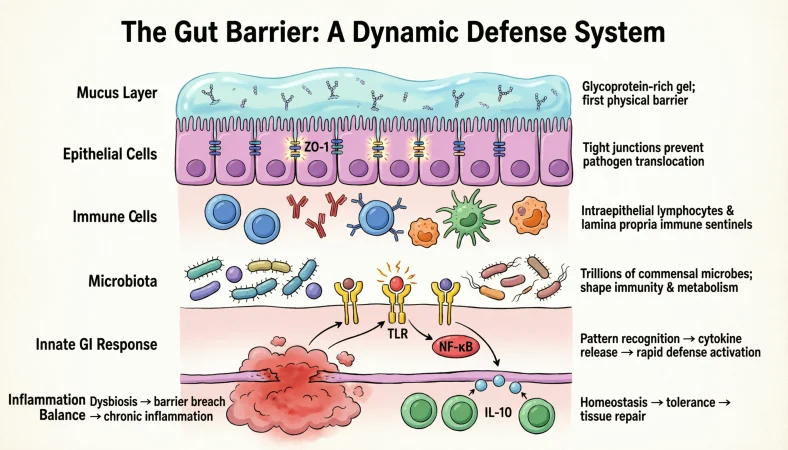
Quick Answer: The innate GI response refers to the rapid, built-in immune defenses of the gastrointestinal tract. It helps the gut recognize potential threats while maintaining a balance with food particles and beneficial microbes.
Top takeaways: gut barrier protection, mucus and antimicrobial defenses, pattern recognition, inflammation, immune cell activity
Your gut is doing far more than digesting breakfast while you scroll through your phone. Every day, the gastrointestinal tract encounters food, bacteria, viruses, toxins, and countless other substances. The innate GI response is part of the body’s built-in defense system that helps the gut deal with potential threats quickly while protecting the intestinal environment. Unlike the highly specific adaptive immune response, innate immunity works rapidly and relies on barriers, immune cells, chemical signals, and pattern-recognition mechanisms.
That makes the topic important whether you’re studying biology, reviewing medical terminology, preparing for an exam, or simply wondering what your gut is actually doing behind the scenes. The easiest way to understand it is to break the process into simple pieces. From mucus and epithelial cells to inflammation and immune signaling, these explanations make the innate GI response much easier to remember.
What Is the Innate GI Response?
It is the gut’s built-in first-line defense.
Use this explanation when you need a simple definition for notes or revision.
Meaning: The gastrointestinal tract uses innate defenses to respond quickly to potentially harmful organisms and substances.
Think of it as gut security.
Use this comparison when explaining the concept to someone who finds biology terminology confusing.
Meaning: The gut constantly checks its environment and reacts to potential threats.
It works before specific immunity kicks in.
Use this when comparing innate and adaptive immunity.
Meaning: Innate defenses respond rapidly without needing prior exposure to a particular pathogen.
It is part of innate immunity.
Use this when connecting GI defenses to the wider immune system.
Meaning: Gut defenses belong to the body’s general, nonspecific immune protection.
It helps protect the intestinal lining.
Use this when discussing the gut barrier.
Meaning: Innate defenses help prevent harmful substances and microorganisms from crossing into deeper tissues.
It reacts quickly.
Use this as a simple exam-friendly description.
Meaning: Innate immune mechanisms can respond rapidly when danger is detected.
It recognizes patterns rather than one specific enemy.
Use this when explaining pattern-recognition receptors.
Meaning: Innate immune cells and tissues detect molecular patterns associated with microbes or danger.
It balances defense with tolerance.
Use this when explaining why the gut is biologically complicated.
Meaning: The intestine must defend against pathogens while tolerating food and many resident microbes.
It involves physical and chemical defenses.
Use this when summarizing the major components.
Meaning: Gut protection includes barriers, mucus, antimicrobial substances, cells, and signaling molecules.
It can trigger inflammation.
Use this when connecting innate immunity with inflammatory responses.
Meaning: Detection of infection or tissue damage can activate inflammatory pathways.
It works alongside adaptive immunity.
Use this when explaining the immune system as a whole.
Meaning: Innate and adaptive defenses interact rather than operating as completely separate systems.
It is essential for gut defense.
Use this as a short revision statement.
Meaning: Without innate protection, the gastrointestinal tract would be more vulnerable to invading microorganisms.
Innate GI Response and the Gut Barrier
The gut barrier is the first major checkpoint.
Use this when introducing intestinal defense mechanisms.
Meaning: The intestinal barrier separates the gut contents from underlying tissues.
Epithelial cells form an important barrier.
Use this when studying intestinal anatomy and immunity.
Meaning: Intestinal epithelial cells create a physical boundary that limits unwanted penetration.
Tight junctions help control the space between cells.
Use this when discussing intestinal permeability.
Meaning: Junctional structures help regulate movement between intestinal epithelial cells.
Mucus adds another protective layer.
Use this when explaining chemical and physical defenses.
Meaning: The mucus layer can make it harder for microorganisms to reach epithelial surfaces.
The barrier is selective, not simply a wall.
Use this when explaining why nutrients can still be absorbed.
Meaning: The intestine must allow useful substances through while limiting harmful material.
Barrier defense begins before immune cells arrive.
Use this as a memorable study point.
Meaning: Physical and chemical defenses can prevent contact with tissues in the first place.
A healthy barrier supports immune balance.
Use this when connecting epithelial health with immunity.
Meaning: Maintaining the barrier helps regulate exposure of immune tissues to gut contents.
Mucus can limit microbial attachment.
Use this when describing the role of the intestinal mucus layer.
Meaning: Mucus can create an environment that makes it more difficult for some pathogens to contact epithelial cells.
Antimicrobial substances strengthen the barrier.
Use this when studying intestinal defense mechanisms.
Meaning: Molecules such as antimicrobial peptides contribute to protection against microorganisms.
The epithelial layer communicates with immune cells.
Use this when studying gut immunology.
Meaning: Barrier cells participate actively in detecting signals and coordinating immune responses.
Barrier failure can alter immune activity.
Use this when discussing intestinal inflammation.
Meaning: Changes in barrier integrity can affect exposure to microbial and dietary signals.
The gut barrier is part of innate immunity.
Use this when answering a short biology question.
Meaning: Physical and chemical barriers are fundamental components of the body’s innate defense system.
Funny Ways to Remember the Innate GI Response
“The gut has security on shift 24/7.”
Use this memory trick when studying late for an exam.
Meaning: Gut defenses constantly monitor potential threats.
“Mucus is basically the bouncer.”
Use this analogy when memorizing the gut barrier.
Meaning: Mucus helps prevent unwanted microorganisms from reaching epithelial surfaces.
“The immune system said, absolutely not.”
Use this playful revision phrase for pathogen detection.
Meaning: Innate defenses can rapidly respond when potentially harmful signals are recognized.
“Gut security does not clock out.”
Use this when trying to remember continuous barrier protection.
Meaning: The gastrointestinal tract is constantly exposed to external material and requires ongoing defense.
“Tiny invaders, big paperwork.”
Use this joke when reviewing immune signaling.
Meaning: Detecting threats can trigger multiple coordinated biological processes.
“The microbiome has house rules.”
Use this when studying gut microbial balance.
Meaning: The intestine must maintain controlled interactions between host tissues and resident microorganisms.
“Mucus said: stay over there.”
Use this for a quick classroom memory trick.
Meaning: The mucus layer helps separate microorganisms from epithelial surfaces.
“Inflammation has entered the group chat.”
Use this when remembering inflammatory signaling.
Meaning: Detection of danger can activate inflammatory pathways.
“The gut is running background security software.”
Use this when explaining innate immunity casually.
Meaning: Innate defenses operate continuously and respond quickly.
“Pathogens did not pass the vibe check.”
Use this for an informal study session.
Meaning: Protective mechanisms can detect and restrict potentially harmful microorganisms.
“The intestine has its own defense squad.”
Use this when memorizing immune cell involvement.
Meaning: Multiple immune and epithelial components cooperate to protect the gut.
“Biology, but make it gastrointestinal.”
Use this as a light mnemonic before an exam.
Meaning: The GI tract has a specialized but integrated innate defense system.
Professional Explanation of the Innate GI Response
The innate GI response provides rapid nonspecific defense.
Use this wording in academic notes or revision materials.
Meaning: The gastrointestinal tract can mount broad protective responses without relying on antigen-specific immune memory.
The intestinal epithelium contributes directly to innate immunity.
Use this in a formal biology explanation.
Meaning: Epithelial cells are active participants in barrier protection and immune signaling.
Pattern-recognition receptors detect microbial signals.
Use this when discussing molecular recognition.
Meaning: Receptors can identify conserved molecular features associated with microorganisms.
Innate defenses help maintain intestinal homeostasis.
Use this in academic writing.
Meaning: Immune mechanisms contribute to a stable relationship among the host, microbes, and intestinal environment.
The response includes cellular and molecular mechanisms.
Use this when describing the system broadly.
Meaning: Innate GI immunity involves cells, proteins, signaling molecules, and physical barriers.
Inflammatory signaling can recruit immune cells.
Use this when explaining what happens after danger detection.
Meaning: Chemical signals can help attract immune cells to affected areas.
The GI tract must distinguish pathogens from harmless material.
Use this when discussing immune tolerance.
Meaning: Gut immunity must defend against threats without unnecessarily attacking normal dietary and microbial exposures.
Innate mechanisms can influence adaptive immunity.
Use this when comparing immune system branches.
Meaning: Signals generated by innate defenses can help shape later adaptive immune responses.
Mucosal defenses are central to intestinal protection.
Use this in formal revision notes.
Meaning: The intestinal mucosa provides several layers of protection against harmful exposure.
Innate immunity operates without prior pathogen-specific memory.
Use this when defining the term.
Meaning: The response does not depend on previous exposure to a specific microorganism.
Inflammation is an important innate mechanism.
Use this when explaining the body’s reaction to injury or infection.
Meaning: Inflammation helps recruit protective cells and molecules to areas requiring defense.
Innate and adaptive immunity cooperate in the gut.
Use this as a concluding academic statement.
Meaning: Effective intestinal defense depends on communication between broad innate mechanisms and specific adaptive responses.
Creative Ways to Explain Innate GI Immunity
Imagine your intestine as a nightclub with several security checkpoints.
Use this analogy when teaching the concept to beginners.
Meaning: The gut uses multiple defensive layers rather than relying on one mechanism.
Mucus is the first velvet rope.
Use this when explaining physical separation from microbes.
Meaning: The mucus layer helps keep microorganisms away from epithelial surfaces.
Epithelial cells are the security desk.
Use this when describing barrier cells.
Meaning: Epithelial tissues can detect signals and participate in immune defense.
Pattern-recognition receptors are the scanners.
Use this when explaining microbial detection.
Meaning: These receptors recognize characteristic molecular patterns.
Cytokines are the emergency messages.
Use this when explaining immune communication.
Meaning: Cytokines can help coordinate immune activity and recruit cells.
Neutrophils are part of the rapid-response crew.
Use this when discussing inflammatory cell recruitment.
Meaning: Neutrophils can be recruited during innate inflammatory responses.
Macrophages are the cleanup team.
Use this when explaining phagocytosis.
Meaning: Macrophages can engulf microorganisms and cellular debris.
Natural killer cells are the suspicious-activity team.
Use this when introducing NK cells.
Meaning: NK cells can identify and destroy certain abnormal or infected cells.
Complement is part of the molecular backup system.
Use this when explaining innate immune proteins.
Meaning: Complement proteins participate in several defensive processes.
Inflammation is the alarm system.
Use this when simplifying inflammatory signaling.
Meaning: Inflammation helps coordinate a response to infection or tissue damage.
The microbiome is part of the neighborhood.
Use this when explaining resident microorganisms.
Meaning: The gut must maintain controlled relationships with its normal microbial community.
The whole system works like layered security.
Use this as a final analogy.
Meaning: Several physical, chemical, cellular, and molecular defenses work together.
Sarcastic Ways to Remember the Gut Immune Response
“Yes, because apparently digestion needed security too.”
Use this joke when studying the immune functions of the gut.
Meaning: The GI tract handles both digestion and substantial immune defense.
“The gut saw bacteria and opened a case file.”
Use this when memorizing microbial recognition.
Meaning: Innate mechanisms detect microbial patterns and initiate defensive signaling.
“Mucus really said, keep your distance.”
Use this for a quick revision caption.
Meaning: The mucus layer helps separate microbes from epithelial cells.
“Nothing gets past the intestinal group chat.”
Use this as an informal memory aid.
Meaning: Gut cells communicate through numerous biological signals.
“Inflammation arrived exactly when nobody invited it.”
Use this when remembering inflammatory activation.
Meaning: Inflammation can arise when infection or tissue injury triggers innate defenses.
“The intestine has trust issues, scientifically.”
Use this when explaining immune surveillance.
Meaning: The gut must constantly distinguish potentially harmful signals from harmless exposure.
“Pathogen detected. Meeting scheduled.”
Use this for a playful explanation of immune signaling.
Meaning: Detection can initiate coordinated cellular responses.
“The gut is not accepting random guests.”
Use this when explaining barrier defense.
Meaning: Protective mechanisms restrict potentially harmful organisms and substances.
“Microbes entered the chat, immunity replied.”
Use this for social-media-friendly study content.
Meaning: Microbial detection can trigger innate immune responses.
“The intestinal lining has standards.”
Use this as a simple analogy.
Meaning: Barrier mechanisms regulate what reaches underlying tissues.
“Immune cells said, we have receipts.”
Use this for a light exam revision joke.
Meaning: Innate immune mechanisms recognize signals associated with danger or microbes.
“Your gut has more security than your group chat.”
Use this as a memorable closing joke.
Meaning: The gastrointestinal tract relies on multiple layers of defense.
Cute and Simple Innate GI Response Explanations
“Your gut has tiny defenders on duty.”
Use this when explaining immunity to younger learners.
Meaning: Cells and proteins help protect the intestinal environment.
“Mucus gives the gut a cozy protective blanket.”
Use this when introducing the mucus barrier.
Meaning: Mucus helps create a protective separation between microbes and epithelial tissue.
“The gut likes friendly neighbors.”
Use this when explaining the relationship with normal microbes.
Meaning: The intestine maintains interactions with resident microorganisms while defending against pathogens.
“The immune system keeps watch while you eat.”
Use this when explaining constant exposure to food and microbes.
Meaning: Gut defenses operate while the digestive system processes external material.
“Your intestine has its own little alarm system.”
Use this when introducing innate signaling.
Meaning: Cells can detect danger and activate defensive responses.
“Helpful microbes get a different treatment.”
Use this when discussing immune tolerance.
Meaning: The gut must regulate responses toward resident microbes and harmless material.
“The barrier helps keep trouble outside.”
Use this when explaining epithelial protection.
Meaning: The intestinal barrier limits unwanted movement into tissues.
“Immune cells can rush toward trouble.”
Use this when describing recruitment.
Meaning: Chemical signals can attract immune cells to affected locations.
“Inflammation is the body’s emergency response.”
Use this as a beginner-friendly definition.
Meaning: Inflammation helps coordinate defense after infection or injury.
“The gut is protected from the inside out.”
Use this when summarizing multiple defense layers.
Meaning: Gut protection includes barriers, cells, and molecular defenses.
“Your digestive system has an immune side quest.”
Use this as a fun study caption.
Meaning: The GI tract has major immune functions beyond digestion.
“Tiny cells, serious teamwork.”
Use this when summarizing innate immunity.
Meaning: Different cells and molecules cooperate to protect intestinal tissues.
Dramatic Innate GI Response Explanations
“The moment danger appears, the gut goes into defense mode.”
Use this when describing rapid innate activation.
Meaning: Innate mechanisms can respond quickly to threatening signals.
“One suspicious signal can start a biological chain reaction.”
Use this when discussing immune signaling pathways.
Meaning: Recognition can activate multiple downstream defensive processes.
“The barrier stands between the pathogen and the tissue.”
Use this when emphasizing epithelial protection.
Meaning: The intestinal barrier is an important physical defense.
“Inflammation turns the alarm lights on.”
Use this when explaining inflammatory signaling.
Meaning: Inflammation coordinates cells and molecules at sites of infection or injury.
“The immune system mobilizes the response team.”
Use this when discussing immune-cell recruitment.
Meaning: Signals can bring protective cells toward an affected area.
“The intestine faces an endless stream of biological visitors.”
Use this when explaining why GI immunity matters.
Meaning: The gut continually encounters food-derived and microbial material.
“The gut cannot afford to treat everything as an enemy.”
Use this when explaining immune tolerance.
Meaning: It must distinguish harmful threats from harmless substances and resident microbes.
“Defense without balance would create another problem.”
Use this when discussing excessive immune activation.
Meaning: Effective gut immunity requires controlled responses rather than constant uncontrolled inflammation.
“The barrier is the first line before the battle gets deeper.”
Use this when teaching layered defense.
Meaning: Physical and chemical barriers can restrict threats before deeper immune activation occurs.
“Innate immunity reacts first, but it does not work alone.”
Use this when introducing adaptive immunity.
Meaning: Innate defenses interact with and help initiate more specific immune responses.
“The gut’s immune network never gets a completely quiet shift.”
Use this as a memorable biology analogy.
Meaning: The GI tract continuously manages exposure to microbes, food, and other substances.
“The intestine is defense, digestion, and diplomacy all at once.”
Use this as a memorable summary.
Meaning: The GI tract must protect the body while supporting digestion and microbial balance.
Chill and Casual Explanations of Innate GI Response
“Basically, it is your gut’s built-in defense system.”
Use this when someone wants the simplest possible explanation.
Meaning: Innate GI immunity provides rapid general protection.
“Your gut has its own security system.”
Use this when explaining the idea casually.
Meaning: Multiple defenses monitor and protect the intestinal environment.
“Mucus helps keep unwanted microbes away from the gut wall.”
Use this when explaining one simple defense mechanism.
Meaning: The mucus layer contributes to physical protection.
“The immune system checks what is happening down there.”
Use this when introducing immune surveillance.
Meaning: Gut tissues can recognize microbial and danger-related signals.
“It is fast, general, and already built in.”
Use this as a quick study sentence.
Meaning: Innate immunity is rapid and nonspecific rather than based on acquired memory.
“The gut has layers of protection.”
Use this when avoiding complicated terminology.
Meaning: Barriers, proteins, and immune cells work together.
“Your intestines are not just food pipes.”
Use this when correcting an oversimplified view of digestion.
Meaning: The gastrointestinal tract also has extensive immune functions.
“Inflammation is one of the big responses.”
Use this when introducing innate inflammatory defense.
Meaning: Inflammation is a major feature of innate immunity.
“The microbiome is part of the picture too.”
Use this when explaining host-microbe interactions.
Meaning: Gut immunity operates alongside resident microbial communities.
“The system has to know when to react and when to chill.”
Use this when explaining immune tolerance.
Meaning: Gut immunity requires both effective defense and controlled responses.
“It is basically biological crowd control.”
Use this analogy when simplifying the concept.
Meaning: Gut defenses help regulate contact between microbes, food-derived material, and tissues.
“The gut has backup plans on backup plans.”
Use this when summarizing multiple defense layers.
Meaning: Several mechanisms provide overlapping protection.
Confident Innate GI Response Statements
The innate GI response is a major part of intestinal defense.
Use this when writing a confident biology summary.
Meaning: Innate mechanisms play an important role in protecting the gastrointestinal tract.
The gut barrier is not passive.
Use this when correcting the idea that epithelial tissue simply blocks substances.
Meaning: Intestinal epithelial cells participate in sensing and immune communication.
Innate immunity responds rapidly.
Use this as a strong exam revision point.
Meaning: Innate mechanisms can react quickly to microbial or tissue-danger signals.
The intestine combines barrier and immune functions.
Use this when explaining GI immunity clearly.
Meaning: Physical barriers and immune mechanisms operate together.
Pattern recognition is central to innate defense.
Use this when discussing microbial sensing.
Meaning: Innate receptors recognize conserved molecular patterns associated with potential threats.
Mucus is biologically important.
Use this when emphasizing mucosal protection.
Meaning: The mucus layer contributes to separation and antimicrobial defense.
Inflammation is a coordinated process.
Use this when avoiding the misconception that inflammation is simply swelling.
Meaning: Multiple cellular and chemical events contribute to the inflammatory response.
Immune cells are recruited through signaling.
Use this when explaining how local responses expand.
Meaning: Chemical signals can direct immune cells toward affected tissues.
The gut must defend without overreacting.
Use this when explaining intestinal immune balance.
Meaning: The immune system needs to respond to pathogens while maintaining tolerance to harmless exposure.
Innate and adaptive immunity are connected.
Use this when explaining the wider immune network.
Meaning: Signals generated by innate defenses can influence adaptive immune activity.
Gut immunity is highly organized.
Use this when summarizing the overall concept.
Meaning: Multiple specialized mechanisms cooperate to maintain intestinal protection.
The response is fast, but the biology is complex.
Use this as an exam-friendly closing line.
Meaning: Rapid innate defense involves numerous interacting cellular and molecular pathways.
Emotional and Human-Friendly Explanations
“Your gut is working hard to protect you every day.”
Use this when making biology feel relatable.
Meaning: Innate defenses continuously help protect intestinal tissues.
“There is a whole defense network behind digestion.”
Use this when surprising someone with the immune role of the gut.
Meaning: The GI tract has extensive immune activity in addition to digestion.
“Your body does not wait around for every threat.”
Use this when explaining rapid innate immunity.
Meaning: Innate defenses can react quickly without prior exposure.
“The gut has to protect you while handling food at the same time.”
Use this when explaining immune tolerance.
Meaning: Intestinal immunity must balance defense with normal digestion.
“The intestinal barrier quietly does a lot of work.”
Use this when emphasizing epithelial protection.
Meaning: Barrier mechanisms help prevent harmful substances from reaching underlying tissues.
“Immune cells are constantly part of the gut’s defense story.”
Use this when explaining cellular immunity.
Meaning: Resident and recruited immune cells contribute to intestinal protection.
“The microbiome makes the situation more complicated.”
Use this when introducing host-microbe relationships.
Meaning: The immune system must coexist with large communities of resident microorganisms.
“The goal is protection without unnecessary damage.”
Use this when explaining immune regulation.
Meaning: Effective immunity requires appropriate activation and control.
“Inflammation can help, but balance matters.”
Use this when discussing inflammatory responses.
Meaning: Inflammation supports defense but needs to be regulated.
“The gut is constantly making biological decisions.”
Use this as a simple analogy for immune recognition.
Meaning: Gut tissues respond differently depending on the signals they encounter.
“Innate immunity gives the body a head start.”
Use this when comparing innate and adaptive responses.
Meaning: Innate defenses provide rapid protection before more specific responses develop.
“A healthy immune response is about balance, not maximum reaction.”
Use this when explaining controlled intestinal immunity.
Meaning: The gut needs effective defense without inappropriate immune activation.
Sweet and Memorable Study Responses
“Remember: barrier first, immune response next.”
Use this as a compact revision rule.
Meaning: Physical and chemical barriers can prevent threats before deeper immune responses occur.
“Mucus protects, cells detect, signals coordinate.”
Use this when memorizing the basic sequence.
Meaning: Different parts of innate immunity perform complementary jobs.
“Fast defense is the innate immunity clue.”
Use this before an exam.
Meaning: Rapid response is a defining feature of innate immunity.
“Gut immunity is teamwork.”
Use this when remembering multiple components.
Meaning: Epithelial cells, immune cells, proteins, and signals cooperate.
“Think layers, not one defense.”
Use this when studying the intestinal barrier.
Meaning: Gut protection depends on several overlapping mechanisms.
“Think patterns, not specific memories.”
Use this when comparing innate and adaptive immunity.
Meaning: Innate receptors recognize broad molecular patterns rather than relying on antigen-specific memory.
“Inflammation means the alarm has been activated.”
Use this as a simple mnemonic.
Meaning: Inflammatory pathways can be triggered by infection or tissue injury.
“The microbiome is part of the ecosystem.”
Use this when learning about resident gut microbes.
Meaning: Gut immunity operates within a complex host-microbe environment.
“The epithelial layer is more than a wall.”
Use this when studying intestinal cells.
Meaning: Epithelial cells also participate in sensing and immune signaling.
“Innate comes first.”
Use this as the easiest memory trick.
Meaning: Innate defenses generally provide an early response to threats.
“Defense and tolerance must coexist.”
Use this when learning gut immune regulation.
Meaning: The intestine must fight pathogens while avoiding unnecessary responses to harmless material.
“The gut has a built-in defense network.”
Use this as your final revision sentence.
Meaning: Innate GI immunity consists of interconnected physical, chemical, cellular, and molecular defenses.
Clever Exam-Friendly Innate GI Response Explanations
Innate means present from birth.
Use this when defining the term in an exam.
Meaning: Innate immunity is part of the body’s built-in defense system.
GI means gastrointestinal.
Use this when decoding the abbreviation.
Meaning: GI refers to the digestive tract and associated structures.
The response is nonspecific.
Use this when comparing it with adaptive immunity.
Meaning: Innate immunity does not target one particular pathogen through antigen-specific memory.
The response is rapid.
Use this as a high-value revision phrase.
Meaning: Innate defenses can react quickly after detecting danger.
The epithelial barrier is a major defense.
Use this when discussing the first line of protection.
Meaning: Intestinal epithelial tissue helps prevent harmful material from reaching deeper tissues.
Mucus supports barrier function.
Use this when describing mucosal protection.
Meaning: Mucus contributes to physical separation and antimicrobial defense.
Pattern-recognition receptors detect microbial features.
Use this when answering a more advanced question.
Meaning: PRRs recognize conserved molecular patterns associated with microbes.
Inflammation recruits and activates defense mechanisms.
Use this when explaining the inflammatory response.
Meaning: Inflammatory signals can increase local immune activity.
Phagocytes can engulf harmful material.
Use this when describing innate immune cells.
Meaning: Cells such as macrophages and neutrophils can remove microbes and debris.
Natural killer cells target certain abnormal cells.
Use this when reviewing innate immune cell types.
Meaning: NK cells can destroy certain infected or abnormal cells.
Complement contributes to innate defense.
Use this when listing innate immune proteins.
Meaning: Complement proteins participate in pathogen recognition, recruitment, and destruction.
Adaptive immunity follows with greater specificity.
Use this when comparing the two systems.
Meaning: Adaptive immunity provides antigen-specific responses and immune memory after exposure.
Smart Summary of the Innate GI Response
The gut combines physical barriers with immune surveillance.
Use this as a concise summary for revision notes.
Meaning: Protection depends on both barrier structures and active immune detection.
Mucus helps create distance between microbes and epithelial cells.
Use this when explaining mucosal protection.
Meaning: The mucus layer helps limit direct microbial contact with the intestinal surface.
Epithelial cells actively participate in defense.
Use this when studying intestinal immunity.
Meaning: These cells can detect signals and influence immune responses.
Innate receptors recognize conserved microbial patterns.
Use this when explaining pattern recognition.
Meaning: Innate immune receptors detect molecular features shared by groups of microorganisms.
Inflammatory signals coordinate local defense.
Use this when explaining immune communication.
Meaning: Signaling molecules can recruit and activate protective cells.
Phagocytes remove microbes and debris.
Use this when describing cellular defense.
Meaning: Certain innate immune cells engulf and digest unwanted material.
Natural killer cells provide another layer of cellular defense.
Use this when listing innate immune mechanisms.
Meaning: NK cells can identify and destroy certain infected or abnormal cells.
The complement system provides protein-based defense.
Use this when studying innate immune proteins.
Meaning: Complement contributes to several mechanisms of pathogen elimination.
The gut must tolerate harmless exposure.
Use this when discussing immune balance.
Meaning: The intestine encounters food and resident microbes that should not constantly trigger damaging inflammation.
Innate and adaptive responses communicate.
Use this when writing an advanced answer.
Meaning: Innate signals can help initiate and shape adaptive immune responses.
Inflammation can be protective when appropriately regulated.
Use this when discussing the purpose of inflammation.
Meaning: Controlled inflammation can help remove threats and support tissue repair.
The overall goal is intestinal homeostasis.
Use this as a concluding biology statement.
Meaning: Gut immunity helps maintain a stable environment while protecting against harmful threats.
FAQs
What does innate GI response mean?
The innate GI response generally refers to the built-in, rapid immune defenses operating in the gastrointestinal tract. These include epithelial barriers, mucus, antimicrobial substances, immune cells, inflammatory mechanisms, and microbial-sensing receptors.
Is the innate GI response the same as innate immunity?
Not exactly. Innate GI immunity is the part of the broader innate immune system that operates within the gastrointestinal environment. Innate immunity throughout the body includes many additional barriers, cells, and proteins.
Is the innate GI response fast?
Yes. Rapid response is one of the defining characteristics of innate immunity. It provides early protection while more specific adaptive immune responses develop.
What is the role of mucus in the innate GI response?
Mucus contributes to the intestinal barrier by helping separate microorganisms and other material in the gut from epithelial surfaces. It can also contain antimicrobial substances that support defense.
Does the innate GI response involve inflammation?
Yes. Inflammation is an important component of innate immunity and can occur in response to infection or tissue injury. It helps coordinate immune cells and other protective mechanisms.
Is the innate GI response specific to one pathogen?
Generally, no. Innate immunity is considered nonspecific because it recognizes broader patterns associated with microbes or danger rather than relying on the highly specific antigen recognition and memory characteristic of adaptive immunity.
How does the gut know something may be harmful?
Cells in the intestinal environment can use pattern-recognition receptors to detect molecular features associated with microorganisms or danger. These signals can activate downstream immune and inflammatory pathways.
Does the gut react to every bacterium in the same way?
No. The intestinal immune system has to maintain a balance between defending against harmful organisms and tolerating resident microbes and harmless material such as food-related antigens.
What is the difference between innate and adaptive GI immunity?
Innate immunity provides rapid, broad defense, while adaptive immunity develops more specific responses and can create immune memory. The two systems communicate and work together.
Conclusion
The innate GI response may sound like a textbook phrase designed to make biology students nervous, but the basic idea is surprisingly easy to understand. Your gastrointestinal tract has several layers of built-in protection, including epithelial barriers, mucus, antimicrobial mechanisms, immune cells, pattern recognition, and inflammation. Together, these defenses help the gut respond quickly while maintaining a careful relationship with food and resident microorganisms.
Whether you’re studying for an exam, creating revision notes, or simply trying to understand gut immunity, breaking the topic into smaller ideas makes it much easier. Save this guide, share it with a fellow biology student, and reuse the simple explanations whenever the terminology starts feeling like alphabet soup.










