Quick Answer: An inflammatory response diagram visually explains how the body reacts when tissue is injured, infected, or exposed to harmful stimuli. It commonly shows immune signals, blood vessel changes, white blood cells, inflammation, and tissue repair. Top alternatives include: acute inflammation diagram, immune response diagram, inflammation process diagram, inflammatory pathway diagram, immune system response chart.
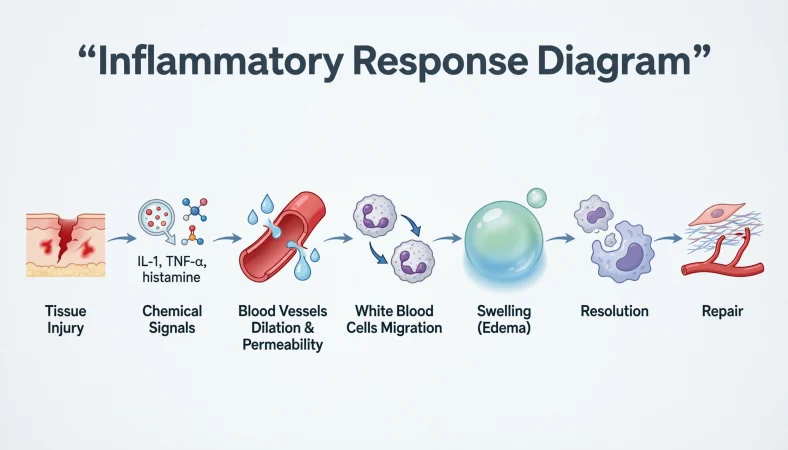
The human body has a pretty impressive emergency system, and inflammation is one of its fastest responses. Get a cut, infection, or irritated tissue, and your immune system basically says, “Okay, everyone to the meeting.” An inflammatory response diagram makes that complicated process much easier to understand by showing what happens from the initial injury or trigger through chemical signaling, blood vessel changes, immune-cell movement, and eventual recovery.
Whether you’re studying biology, preparing class notes, creating a presentation, explaining the process to a friend, or simply trying to understand why inflamed tissue becomes red and swollen, a good diagram can turn a confusing pathway into something surprisingly easy to follow. The best visual explanations keep the sequence clear, label the major players, and show how each stage connects to the next.
Simple Inflammatory Response Diagram Explanations
- “Injury happens, and the immune response gets started.”
Use this as the opening label in a basic diagram.
Meaning: Tissue damage or harmful stimuli can initiate inflammation. - “Damaged cells release chemical signals.”
Use this beside the first signaling stage.
Meaning: Injured tissue helps alert nearby immune and vascular cells. - “Blood vessels become more permeable.”
Use this when explaining fluid movement into tissues.
Meaning: Vessel permeability increases during inflammation. - “Blood flow increases near the affected area.”
Use this to explain why inflammation can look red or feel warm.
Meaning: Local vascular changes contribute to visible inflammatory signs. - “White blood cells move toward the affected tissue.”
Use this beside immune-cell movement.
Meaning: Immune cells are recruited to the site of inflammation. - “Chemical messengers coordinate the response.”
Use this as a general signaling label.
Meaning: Mediators help organize different parts of inflammation. - “Fluid enters the surrounding tissue.”
Use this when labeling swelling.
Meaning: Increased vascular permeability can contribute to tissue fluid accumulation. - “Immune cells help address the threat.”
Use this beside recruited leukocytes.
Meaning: Immune cells participate in removing harmful material and damaged components. - “The inflammatory response begins to resolve.”
Use this near the final stage.
Meaning: Once the trigger is controlled, the body can shift toward resolution. - “Tissue repair follows the response.”
Use this as the closing label.
Meaning: Healing processes can follow successful inflammatory resolution. - “Inflammation is part of innate immunity.”
Use this in an introductory biology diagram.
Meaning: Inflammation is an important component of the body’s early defense system. - “The process connects detection, defense, and repair.”
Use this as a summary beneath the diagram.
Meaning: Inflammation involves multiple coordinated stages rather than one isolated event.
Acute Inflammation Diagram Labels
- “Tissue injury”
Use this as the starting label in an acute inflammation diagram.
Meaning: Physical or biological damage can trigger the inflammatory process. - “Chemical mediator release”
Use this near activated cells and damaged tissue.
Meaning: Signaling molecules help initiate and coordinate inflammation. - “Vasodilation”
Use this beside the affected blood vessel.
Meaning: Blood vessels widen, increasing local blood flow. - “Increased vascular permeability”
Use this near fluid leaving the vessel.
Meaning: Vessel walls become more permeable during the response. - “Endothelial activation”
Use this when showing changes in blood-vessel lining cells.
Meaning: Endothelial cells participate in recruiting immune cells. - “Leukocyte recruitment”
Use this beside white blood cells approaching tissue.
Meaning: Immune cells are directed toward the affected location. - “Chemotaxis”
Use this to label directional immune-cell movement.
Meaning: Chemical signals help guide immune cells toward the inflammatory site. - “Phagocytosis”
Use this beside phagocytic immune cells.
Meaning: Certain immune cells engulf particles and cellular debris. - “Inflammatory exudate”
Use this near fluid accumulation.
Meaning: Protein-containing fluid can move from vessels into inflamed tissue. - “Local inflammatory signs”
Use this near redness, heat, swelling, or pain.
Meaning: These are common observable features of inflammation. - “Resolution”
Use this at the end of the pathway.
Meaning: The inflammatory process can subside when the initiating stimulus is controlled. - “Repair”
Use this as the final stage.
Meaning: Tissue restoration can follow resolution of inflammation.
Funny Inflammatory Response Diagram Captions
- “The immune system saw trouble and clocked in.”
Use this for a lighthearted educational graphic.
Meaning: Immune defenses become active when a problem is detected. - “One tiny injury, entire security team activated.”
Use this for a student-friendly infographic.
Meaning: Local damage can trigger coordinated immune activity. - “Redness has entered the chat.”
Use this beside visible inflammatory changes.
Meaning: Increased local blood flow can contribute to redness. - “White blood cells are on the way.”
Use this near leukocyte recruitment.
Meaning: Immune cells are being directed toward the affected area. - “The tissue group chat is extremely active.”
Use this beside inflammatory signaling.
Meaning: Numerous chemical signals coordinate the response. - “Emergency meeting: immune edition.”
Use this as a diagram title for younger learners.
Meaning: The immune system is responding to a perceived problem. - “Swelling did not RSVP, but here we are.”
Use this beside edema in a humorous diagram.
Meaning: Fluid accumulation can contribute to swelling. - “Inflammation is doing the most.”
Use this as a playful classroom caption.
Meaning: Multiple biological changes occur during inflammation. - “The cleanup crew has arrived.”
Use this near phagocytic immune cells.
Meaning: Some immune cells help remove debris and unwanted material. - “Body security has been notified.”
Use this near the initial immune response.
Meaning: Local signals alert immune defenses. - “Plot twist: the body noticed.”
Use this beside the trigger stage.
Meaning: The body detects tissue damage or harmful stimuli. - “From injury to repair, biology stays busy.”
Use this beneath a complete pathway.
Meaning: Inflammation connects defense with later recovery processes.
Professional Inflammatory Response Diagram Labels
- “Initiating stimulus”
Use this in an academic or professional diagram.
Meaning: This identifies the factor that initiates the inflammatory response. - “Recognition of tissue damage”
Use this near the beginning of the pathway.
Meaning: The body detects signals associated with injury or harmful stimuli. - “Mediator release”
Use this beside activated immune or tissue cells.
Meaning: Chemical mediators help regulate inflammatory events. - “Vascular response”
Use this above the blood-vessel stage.
Meaning: Blood vessels undergo changes during inflammation. - “Leukocyte recruitment”
Use this where immune cells enter the affected tissue.
Meaning: White blood cells are directed to the inflammatory site. - “Cellular response”
Use this above immune-cell activity.
Meaning: Recruited cells contribute to the inflammatory process. - “Removal of harmful material”
Use this beside immune clearance.
Meaning: Immune mechanisms help eliminate unwanted material. - “Resolution signaling”
Use this near the later phase.
Meaning: Biological signals help transition the response toward resolution. - “Inflammatory resolution”
Use this as a late-stage label.
Meaning: Inflammation decreases after the initiating problem is controlled. - “Tissue remodeling”
Use this near the recovery stage.
Meaning: Tissue structure can undergo changes during healing. - “Repair response”
Use this as a concluding stage.
Meaning: Biological repair mechanisms help restore affected tissue. - “Return toward tissue homeostasis”
Use this as the final label.
Meaning: The tissue moves toward its normal functional state.
Inflammatory Response Diagram For Students
- “Step 1: Something causes tissue damage.”
Use this as the first numbered stage.
Meaning: Injury or another trigger begins the process. - “Step 2: The body detects the problem.”
Use this as the recognition stage.
Meaning: Cells identify signals associated with damage or danger. - “Step 3: Chemical signals are released.”
Use this as the signaling stage.
Meaning: Mediators help coordinate the inflammatory response. - “Step 4: Blood vessels change.”
Use this when introducing vascular effects.
Meaning: Local vessels alter their diameter and permeability. - “Step 5: Fluid moves into tissue.”
Use this when explaining swelling.
Meaning: Increased vascular permeability can allow fluid to accumulate. - “Step 6: White blood cells arrive.”
Use this during leukocyte recruitment.
Meaning: Immune cells move toward the affected area. - “Step 7: Immune cells respond.”
Use this beside cellular activity.
Meaning: Recruited cells participate in defense and cleanup. - “Step 8: The trigger is controlled.”
Use this near the resolution phase.
Meaning: The initiating stimulus is reduced or removed. - “Step 9: Inflammation decreases.”
Use this during resolution.
Meaning: The active inflammatory response begins to subside. - “Step 10: Healing begins.”
Use this near tissue repair.
Meaning: Recovery processes become more prominent. - “Step 11: Tissue reorganizes.”
Use this in a more detailed diagram.
Meaning: Repair may involve remodeling of affected tissue. - “Step 12: Normal function is restored.”
Use this at the end of a simplified pathway.
Meaning: The tissue moves toward recovery and homeostasis.
Creative Inflammatory Response Diagram Ideas
- “Turn the pathway into an emergency-response timeline.”
Use this for a visually engaging educational graphic.
Meaning: The inflammatory process can be presented as sequential events. - “Use arrows to show the immune-cell journey.”
Use this when designing a leukocyte recruitment diagram.
Meaning: Arrows make directional movement easier to understand. - “Build the diagram around injury, signaling, defense, and repair.”
Use this for a four-stage infographic.
Meaning: These categories create a simple visual framework. - “Make the blood vessel the central character.”
Use this for a vascular-focused diagram.
Meaning: Vessel changes are central to acute inflammation. - “Create a zoom-in from tissue damage to immune-cell action.”
Use this for detailed educational visuals.
Meaning: Magnification can reveal processes occurring at the cellular level. - “Show chemical signals as visual alert icons.”
Use this for beginner-friendly diagrams.
Meaning: Symbols can make signaling easier to recognize. - “Use a before-and-after tissue layout.”
Use this to compare normal and inflamed tissue.
Meaning: Visual comparison can highlight major changes. - “Build a circular inflammation-to-repair pathway.”
Use this when emphasizing the relationship between stages.
Meaning: A circular layout can show the progression toward resolution and recovery. - “Separate vascular and cellular events into two lanes.”
Use this for a more advanced diagram.
Meaning: Parallel tracks can clarify simultaneous processes. - “Create a three-layer diagram: trigger, response, resolution.”
Use this for quick revision material.
Meaning: A layered design simplifies the overall pathway. - “Use numbered arrows for an exam-ready visual.”
Use this when creating study notes.
Meaning: Numbering makes the sequence easier to review. - “End the diagram with a clear repair pathway.”
Use this when the graphic needs a strong visual conclusion.
Meaning: The final stage highlights the transition from inflammation toward healing.
Inflammatory Response Diagram For Presentations
- “Start with the initiating stimulus.”
Use this as the first slide label.
Meaning: The audience first needs to understand what triggered the response. - “Introduce the key inflammatory mediators.”
Use this before explaining vascular effects.
Meaning: Mediators help connect detection with downstream events. - “Show vascular changes next.”
Use this when building a logical presentation sequence.
Meaning: Vascular events are an important part of acute inflammation. - “Then introduce leukocyte recruitment.”
Use this after the vascular stage.
Meaning: White blood-cell movement follows coordinated signaling and vascular changes. - “Highlight the affected tissue.”
Use this when directing attention to the local site.
Meaning: Inflammation is often concentrated around the triggering area. - “Use arrows to emphasize direction.”
Use this when presenting cellular movement.
Meaning: Directional arrows make pathways easier to follow. - “Keep each stage visually separate.”
Use this when designing a crowded slide.
Meaning: Separation improves readability. - “Label the major cells clearly.”
Use this in a detailed presentation.
Meaning: Clear labels help viewers identify immune participants. - “Mark the transition toward resolution.”
Use this near the end of the pathway.
Meaning: The response does not simply continue indefinitely. - “Finish with tissue repair.”
Use this as the final presentation stage.
Meaning: Recovery processes can follow inflammatory resolution. - “Add a one-line summary beneath the diagram.”
Use this for a presentation audience.
Meaning: A concise takeaway reinforces the pathway. - “Keep the visual flow left to right.”
Use this for a linear diagram.
Meaning: Consistent direction helps viewers follow the sequence.
Clever Inflammatory Response Diagram Captions
- “Detect, signal, recruit, respond, resolve.”
Use this beneath a simplified pathway.
Meaning: These words summarize major stages of inflammation. - “A local trigger can create a coordinated systemic defense network.”
Use this for an advanced educational graphic.
Meaning: Local inflammatory signaling involves coordinated immune mechanisms. - “The immune response is a sequence, not a single event.”
Use this as a diagram headline.
Meaning: Multiple biological stages contribute to inflammation. - “Follow the signal, then follow the cells.”
Use this when explaining signaling and recruitment.
Meaning: Chemical signals help direct cellular responses. - “Vessels change first, immune traffic follows.”
Use this as a simplified teaching caption.
Meaning: Vascular changes help facilitate leukocyte recruitment. - “Inflammation has a beginning, middle, and resolution.”
Use this for a beginner-friendly diagram.
Meaning: The response progresses through recognizable phases. - “The pathway connects injury to repair.”
Use this beneath a complete diagram.
Meaning: Inflammation can form part of the broader tissue response to injury. - “Signals create movement, and movement creates action.”
Use this for a cellular-response graphic.
Meaning: Signaling contributes to immune-cell recruitment and activity. - “Zoom out for the pathway, zoom in for the cells.”
Use this when explaining a detailed diagram.
Meaning: Different scales reveal different parts of the process. - “Every arrow should answer one biological question.”
Use this as a diagram-design principle.
Meaning: Clear directional labels improve understanding. - “From alarm to action to recovery.”
Use this as a concise diagram caption.
Meaning: The response can be summarized as activation, defense, and resolution. - “Biology loves a well-organized response.”
Use this for a friendly educational infographic.
Meaning: Multiple biological components coordinate during inflammation.
Inflammatory Response Diagram For Exams
- “Trigger → mediator release.”
Use this as the opening sequence in revision notes.
Meaning: An initiating stimulus can lead to inflammatory signaling. - “Vasodilation → increased local blood flow.”
Use this when reviewing vascular changes.
Meaning: Vessel widening contributes to increased blood flow. - “Increased permeability → tissue fluid accumulation.”
Use this beside the vascular pathway.
Meaning: Greater permeability can contribute to swelling. - “Leukocyte recruitment → affected tissue.”
Use this for immune-cell movement.
Meaning: White blood cells are directed toward the inflammatory site. - “Chemotaxis → directional movement.”
Use this when reviewing immune-cell guidance.
Meaning: Chemical gradients help guide leukocytes. - “Adhesion → movement across the vessel wall.”
Use this in a detailed leukocyte pathway.
Meaning: Leukocytes interact with the endothelium before leaving circulation. - “Phagocytosis → removal of material.”
Use this in cellular-response notes.
Meaning: Phagocytic cells can engulf particles and debris. - “Mediator activity → coordinated inflammation.”
Use this as a pathway summary.
Meaning: Chemical mediators regulate several inflammatory events. - “Resolution → reduced inflammatory activity.”
Use this near the final stage.
Meaning: Inflammation can decrease after the trigger is controlled. - “Repair → tissue recovery.”
Use this as the final exam label.
Meaning: Repair processes contribute to restoration after injury. - “Local signs → redness, warmth, swelling, pain.”
Use this for classic acute inflammation revision.
Meaning: These signs can accompany local inflammatory changes. - “Inflammation → defense plus repair.”
Use this as a final memory aid.
Meaning: Inflammation participates in protection and tissue recovery.
Cute And Friendly Inflammatory Response Diagram Ideas
- “Tiny injury, big immune-team response.”
Use this for a beginner-friendly biology graphic.
Meaning: A small local trigger can activate multiple immune processes. - “Meet the body’s cleanup crew.”
Use this beside phagocytic cells.
Meaning: Certain immune cells help clear unwanted material. - “Follow the little white blood cells.”
Use this for a child-friendly visual.
Meaning: The diagram tracks leukocyte recruitment. - “The body noticed something was wrong.”
Use this as a simple opening caption.
Meaning: Detection is the beginning of the response. - “Signals are sending the team directions.”
Use this near chemical mediators.
Meaning: Chemical signals help guide immune activity. - “Blood vessels are making room for the response.”
Use this beside vascular changes.
Meaning: Changes in vessels facilitate inflammatory activity. - “Swelling is part of the local response.”
Use this near tissue fluid accumulation.
Meaning: Fluid movement can contribute to swelling. - “Defense mode: activated.”
Use this as a short diagram caption.
Meaning: The immune response has become active. - “Next stop: the affected tissue.”
Use this beside leukocyte movement.
Meaning: Immune cells are traveling toward the inflammatory site. - “Then comes the cleanup.”
Use this after cellular activity.
Meaning: Immune mechanisms help remove debris and harmful material. - “Time to calm the response.”
Use this at the resolution stage.
Meaning: Inflammation can decrease after the trigger is controlled. - “And finally, repair mode.”
Use this at the end of the diagram.
Meaning: Tissue recovery follows the active inflammatory phase.
Inflammatory Response Diagram For Social Media
- “Inflammation Explained In One Visual.”
Use this as a short infographic headline.
Meaning: The graphic promises a simplified explanation. - “What Happens After Tissue Injury?”
Use this as a curiosity-driven title.
Meaning: The diagram explains the body’s response after damage. - “Follow The Inflammatory Response.”
Use this above a directional pathway.
Meaning: Viewers are invited to follow the biological sequence. - “From Injury To Immune Response.”
Use this for an educational carousel.
Meaning: The graphic connects the trigger with immune activity. - “Why Does Inflammation Happen?”
Use this as a social-media hook.
Meaning: It introduces the biological purpose and process of inflammation. - “The Body’s Emergency Response, Explained.”
Use this for a beginner-friendly graphic.
Meaning: The response is presented in an accessible way. - “Inflammation In 12 Simple Steps.”
Use this when the diagram contains numbered stages.
Meaning: The process is broken into easy-to-follow sections. - “Meet The Cells Behind Inflammation.”
Use this for a cell-focused visual.
Meaning: The graphic introduces immune participants. - “Redness, Heat, Swelling: What’s Happening?”
Use this when explaining visible inflammatory signs.
Meaning: The graphic connects common signs with biological processes. - “From Signal To Cellular Action.”
Use this for a more advanced infographic.
Meaning: It highlights the connection between mediators and immune cells. - “Inflammation Without The Confusion.”
Use this for a simplified educational post.
Meaning: The visual aims to make a complex process easier to understand. - “Save This Inflammation Cheat Sheet.”
Use this as a social-media callout.
Meaning: The graphic is positioned as a useful study reference.
Dramatic Inflammatory Response Diagram Captions
- “The moment tissue damage triggers a full biological response.”
Use this for a dramatic educational opening.
Meaning: Tissue injury can initiate coordinated inflammation. - “One signal can change the entire local environment.”
Use this beside mediator activity.
Meaning: Chemical signaling can produce multiple downstream changes. - “The vessels change. The immune cells move.”
Use this as a dramatic pathway caption.
Meaning: Vascular and cellular events work together. - “The defense response begins at the site of trouble.”
Use this at the start of a diagram.
Meaning: Inflammation develops around the affected tissue. - “Now the immune traffic begins.”
Use this beside leukocyte recruitment.
Meaning: Immune cells begin moving toward the affected area. - “The tissue has officially entered response mode.”
Use this as a playful dramatic label.
Meaning: Inflammatory activity is underway. - “Signals spread. Cells respond.”
Use this for a compact diagram.
Meaning: Chemical communication drives cellular activity. - “The cleanup phase begins.”
Use this beside immune-cell activity.
Meaning: Cellular mechanisms help remove unwanted material. - “Then the response must know when to stop.”
Use this near resolution.
Meaning: Controlled resolution is an important part of inflammation. - “The final chapter: tissue repair.”
Use this as the concluding label.
Meaning: Recovery processes follow the active response. - “From alarm to recovery.”
Use this as a complete infographic title.
Meaning: The diagram presents the full inflammatory sequence. - “The body responds, adapts, and works toward recovery.”
Use this beneath a complete pathway.
Meaning: Inflammation is part of a broader biological response to injury.
Calm And Clear Inflammatory Response Diagram Summaries
- “Inflammation begins when the body detects a problem.”
Use this as a simple opening statement.
Meaning: Detection initiates coordinated biological responses. - “Chemical mediators help coordinate the response.”
Use this beneath the signaling stage.
Meaning: Mediators regulate inflammatory activity. - “Blood vessels undergo local changes.”
Use this beside the vascular stage.
Meaning: Vascular changes help support the inflammatory response. - “Fluid can move into the surrounding tissue.”
Use this beside swelling.
Meaning: Increased permeability can contribute to tissue fluid accumulation. - “White blood cells are recruited to the affected area.”
Use this beside leukocyte movement.
Meaning: Immune cells are directed toward the site. - “Immune cells participate in defense and cleanup.”
Use this near cellular activity.
Meaning: Recruited cells can help address harmful material and debris. - “The local environment changes during inflammation.”
Use this as a general diagram note.
Meaning: Multiple vascular and cellular processes occur together. - “The response can become more organized as immune cells arrive.”
Use this beside recruitment.
Meaning: Cellular participation increases after initial signaling. - “Resolution reduces inflammatory activity.”
Use this near the end of the pathway.
Meaning: The body can actively move away from inflammation. - “Repair processes can follow resolution.”
Use this as the recovery label.
Meaning: Tissue restoration may occur after inflammation subsides. - “The pathway is coordinated rather than random.”
Use this as a diagram takeaway.
Meaning: Inflammatory events are regulated by interconnected mechanisms. - “A good diagram shows both the sequence and the connections.”
Use this as a visual-design reminder.
Meaning: Understanding improves when relationships between stages are visible.
FAQs
What Is An Inflammatory Response Diagram? An inflammatory response diagram is a visual representation of the biological events that occur when tissue experiences injury, infection, or another inflammatory trigger.
What Does An Inflammatory Response Diagram Usually Show? It commonly shows the initiating stimulus, chemical mediators, blood-vessel changes, immune-cell recruitment, cellular activity, resolution, and tissue repair.
What Are The Main Stages Shown In An Inflammatory Response Diagram? A simplified diagram often moves from tissue injury or detection to signaling, vascular changes, leukocyte recruitment, immune activity, resolution, and repair.
Is An Inflammatory Response Diagram Useful For Students? Yes. A well-organized diagram can make a complicated biological sequence easier to visualize, memorize, and explain during study or presentations.
Can An Inflammatory Response Diagram Be Used In A Professional Presentation? Yes. For academic or professional settings, use precise labels, clear arrows, appropriate terminology, and a logical progression between stages.
What Is The Difference Between An Acute And Chronic Inflammatory Response Diagram? An acute inflammation diagram generally emphasizes a rapid response, while a chronic inflammation diagram focuses on longer-lasting inflammation and different cellular patterns.
Can An Inflammatory Response Diagram Be Made Simple? Absolutely. A beginner-friendly version can use four major stages: trigger, signaling, immune response, and resolution or repair.
What Cells Are Commonly Shown In An Inflammatory Response Diagram? Depending on the level of detail, diagrams may include neutrophils, macrophages, mast cells, endothelial cells, and other immune or tissue cells.
What Is The Role Of Blood Vessels In An Inflammatory Response Diagram? Blood vessels undergo important local changes that influence blood flow, permeability, and the movement of immune cells into affected tissue.
Can Humor Be Used In An Inflammatory Response Diagram? Yes, especially for classroom or social-media content. Humor can make complex concepts memorable, but scientific labels should remain accurate.
Conclusion
An inflammatory response diagram can turn a complicated biological process into a clear visual story. Whether you’re studying for an exam, preparing class notes, building a presentation, or creating an educational infographic, the right labels and sequence make a huge difference.
From tissue injury and chemical signaling to vascular changes, immune-cell recruitment, resolution, and repair, each stage helps explain what the body is doing and why. The key is to keep the pathway organized, readable, and connected. Try different layouts depending on your audience, save the most useful explanations for revision, and turn complex biology into visuals people can actually understand.
Share, save, and reuse these ideas whenever inflammation needs a little less mystery and a lot more clarity.