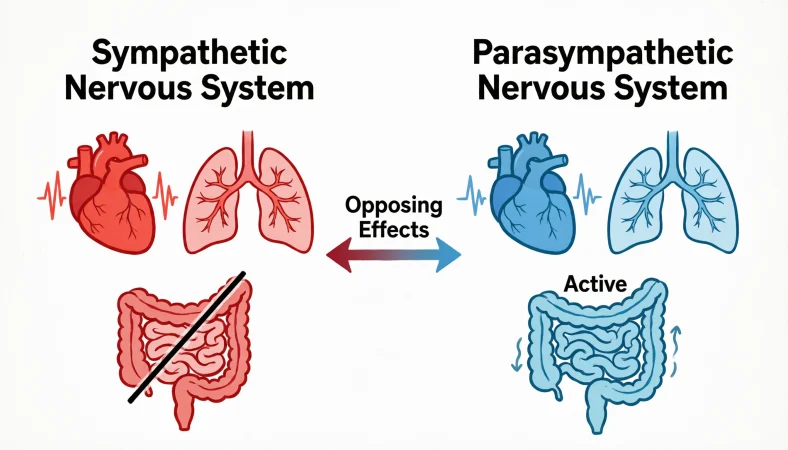
Quick Answer: The sympathetic vs parasympathetic response comparison is mainly about two complementary parts of the autonomic nervous system. The sympathetic system generally prepares the body for action during stress or activity, while the parasympathetic system supports rest, digestion, and recovery.
Fight or flight, rest and digest, increased heart rate, slower heart rate, stress versus recovery
Trying to remember the sympathetic vs parasympathetic response can feel like your brain has opened 17 biology tabs at once. You know one means fight or flight, the other means rest and digest, but then the exam question appears and suddenly every nervous system term looks suspiciously similar.
Whether you are revising for a biology test, studying nursing, making flashcards, explaining physiology to a friend, or trying to survive a last-minute study session, having simple wording makes a huge difference. The sympathetic and parasympathetic systems are two complementary divisions of the autonomic nervous system, which regulates many functions that happen automatically.
The sympathetic system generally helps prepare the body for stress or physical activity, while the parasympathetic system generally supports calmer, resting functions such as digestion. This guide gives you quick, memorable responses for understanding and explaining the difference.
Simple Sympathetic Responses
“Sympathetic means fight or flight.”
Use this when you need the fastest possible definition for revision.
Meaning: The sympathetic nervous system helps prepare the body for stressful or demanding situations.
“Sympathetic gets the body ready for action.”
Use this when explaining the concept to someone new to biology.
Meaning: It supports physiological changes needed during stress or physical activity.
“Think stress, speed, and survival.”
Use this as a memorable study phrase.
Meaning: Sympathetic activity is associated with increased readiness during demanding situations.
“Sympathetic is the body’s alert mode.”
Use this when making a quick flashcard.
Meaning: It increases physiological readiness when the body needs to respond quickly.
“Heart rate goes up with sympathetic activity.”
Use this when revising cardiovascular effects.
Meaning: Sympathetic activation can increase heart rate.
“Sympathetic activity slows digestion.”
Use this when revising digestive-system effects.
Meaning: During stress or activity, digestive activity is generally reduced so resources can support immediate demands.
“Sympathetic means prepare, not relax.”
Use this when distinguishing the two systems.
Meaning: The sympathetic system is associated with increased physiological activation.
“Think emergency mode.”
Use this as a simple memory cue.
Meaning: Sympathetic activity helps the body respond to demanding conditions.
“Sympathetic supports rapid action.”
Use this when answering a short-answer question.
Meaning: Its effects help prepare the body for physical activity and quick responses.
“Stress activates the sympathetic side.”
Use this when connecting the system with stressful situations.
Meaning: Stress can increase sympathetic nervous system activity.
“Sympathetic is the accelerator.”
Use this as an analogy during revision.
Meaning: It represents increased physiological activation rather than relaxation.
“Fight or flight is your shortcut.”
Use this when someone needs an easy way to remember sympathetic function.
Meaning: Fight or flight is the familiar shorthand for sympathetic activation.
Simple Parasympathetic Responses
“Parasympathetic means rest and digest.”
Use this when you need the quickest definition.
Meaning: The parasympathetic system supports resting functions including digestion.
“Parasympathetic helps the body calm down.”
Use this when explaining the system to a beginner.
Meaning: It helps return many body functions toward resting levels after activation.
“Think rest, recovery, and digestion.”
Use this as a revision shortcut.
Meaning: These ideas capture important parasympathetic functions.
“Parasympathetic is the body’s chill mode.”
Use this as an informal memory trick.
Meaning: It is associated with calmer physiological conditions.
“Parasympathetic can lower heart rate.”
Use this when revising cardiovascular effects.
Meaning: Parasympathetic activity generally reduces heart rate.
“Parasympathetic supports digestion.”
Use this when studying digestive effects.
Meaning: It increases digestive activity during resting conditions.
“Parasympathetic helps restore balance.”
Use this when explaining how the systems work together.
Meaning: It helps return physiological activity toward normal resting conditions.
“Rest and digest is your shortcut.”
Use this as a quick exam memory cue.
Meaning: The phrase summarizes the parasympathetic role.
“Parasympathetic is not the panic button.”
Use this when comparing it with sympathetic activity.
Meaning: It is associated more strongly with calm and resting states.
“Think recovery mode.”
Use this when creating simple flashcards.
Meaning: Parasympathetic activity supports functions that are important during rest.
“Calm conditions favor parasympathetic activity.”
Use this when explaining the basic contrast.
Meaning: The parasympathetic system is especially associated with quiet resting conditions.
“Parasympathetic helps the body settle.”
Use this when giving a beginner-friendly explanation.
Meaning: Its activity helps counter the heightened activation associated with sympathetic responses.
Funny Study Responses
“Sympathetic is panic mode; parasympathetic is snack mode.”
Use this when studying with friends and wanting a memorable comparison.
Meaning: One represents action and stress, while the other represents rest and digestion.
“Sympathetic says go; parasympathetic says breathe.”
Use this as a humorous flashcard line.
Meaning: Sympathetic activity prepares the body for action, while parasympathetic activity supports calmer states.
“Fight or flight versus sit down and digest.”
Use this when explaining the basic contrast casually.
Meaning: It turns the two textbook phrases into an easy mental image.
“Sympathetic has entered the group chat.”
Use this when joking about suddenly becoming alert.
Meaning: It represents heightened physiological activation.
“Parasympathetic has left the group chat to eat.”
Use this when making the rest-and-digest concept memorable.
Meaning: It highlights the parasympathetic connection with digestion and relaxation.
“Sympathetic: we have a problem. Parasympathetic: dinner first.”
Use this as a humorous revision reminder.
Meaning: It contrasts stress-related activation with resting digestive activity.
“One is emergency mode, one is sofa mode.”
Use this when explaining the difference to a friend.
Meaning: The comparison separates activation from rest.
“Your nervous system has an accelerator and a chill setting.”
Use this as an informal analogy.
Meaning: The two divisions help regulate different physiological states.
“Sympathetic brings the urgency.”
Use this when memorizing its general role.
Meaning: Sympathetic activity prepares the body for demanding conditions.
“Parasympathetic brings the post-chaos energy.”
Use this after explaining stress responses.
Meaning: Parasympathetic activity is associated with returning toward calmer physiological activity.
“Biology really said fight first, digest later.”
Use this as a playful study caption.
Meaning: Stress-related sympathetic activity can suppress digestion while the body responds to immediate demands.
“Same body, different settings.”
Use this when summarizing the comparison.
Meaning: Both systems regulate the same overall body but emphasize different physiological priorities.
Exam-Ready Responses
“The sympathetic nervous system is associated with fight or flight.”
Use this for a basic definition question.
Meaning: It prepares the body for stressful or physically demanding situations.
“The parasympathetic nervous system is associated with rest and digest.”
Use this for a basic definition question.
Meaning: It supports resting and digestive functions.
“Both systems are divisions of the autonomic nervous system.”
Use this when defining their relationship.
Meaning: Both regulate many involuntary body functions.
“Sympathetic activity generally increases heart rate.”
Use this in a cardiovascular physiology answer.
Meaning: Sympathetic activation helps increase cardiac activity during demand.
“Parasympathetic activity generally decreases heart rate.”
Use this when comparing cardiovascular effects.
Meaning: Parasympathetic signals help reduce cardiac activity during rest.
“Sympathetic activity generally reduces digestive activity.”
Use this in a digestion question.
Meaning: Digestion becomes less of an immediate priority during stress or strenuous activity.
“Parasympathetic activity promotes digestion.”
Use this in a physiology revision answer.
Meaning: The system supports digestive processes during calmer conditions.
“The two systems have complementary roles.”
Use this when explaining why they are compared.
Meaning: They help regulate body functions in different but coordinated ways.
“Sympathetic activity prepares the body for physical activity.”
Use this when explaining its purpose.
Meaning: Its physiological effects help support increased physical demand.
“Parasympathetic activity supports energy conservation and routine maintenance.”
Use this when explaining its broader role.
Meaning: It supports functions needed during resting conditions.
“The autonomic nervous system operates largely without conscious control.”
Use this when defining the larger system.
Meaning: It regulates many automatic functions such as heart rate and digestion.
“Sympathetic and parasympathetic activity contribute to homeostasis.”
Use this in a higher-level biology answer.
Meaning: Their coordinated effects help maintain internal physiological balance.
Sympathetic Vs Parasympathetic Comparison Responses
“Sympathetic means fight or flight; parasympathetic means rest and digest.”
Use this as the fastest side-by-side comparison.
Meaning: The phrases summarize their commonly taught roles.
“Sympathetic generally increases heart rate; parasympathetic generally decreases it.”
Use this when comparing cardiovascular effects.
Meaning: Their effects on heart rate generally move in opposite directions.
“Sympathetic reduces digestive activity; parasympathetic promotes digestion.”
Use this when comparing the digestive system.
Meaning: Digestive activity changes according to the body’s current physiological priorities.
“Sympathetic prepares; parasympathetic restores.”
Use this as a simple memory phrase.
Meaning: One emphasizes readiness, while the other supports calmer baseline functions.
“Sympathetic is associated with stress; parasympathetic with rest.”
Use this when answering a basic comparison question.
Meaning: Their activity tends to differ according to the body’s state.
“Sympathetic supports action; parasympathetic supports recovery.”
Use this when explaining the difference informally.
Meaning: Their physiological priorities differ during demanding and resting conditions.
“Sympathetic is the accelerator; parasympathetic is the brake.”
Use this as a study analogy.
Meaning: The analogy illustrates increased versus reduced physiological activation.
“Sympathetic raises readiness; parasympathetic promotes calm.”
Use this when making flashcards.
Meaning: Their effects generally reflect different body states.
“They are different systems with complementary functions.”
Use this when someone thinks they are simply opposites.
Meaning: Both contribute to regulation and balance rather than acting as unrelated systems.
“Both belong to the autonomic nervous system.”
Use this when answering a classification question.
Meaning: They are two major divisions of autonomic control.
“Both help regulate involuntary body processes.”
Use this when explaining their shared purpose.
Meaning: They influence automatic functions without requiring conscious control.
“The goal is balance, not one system winning.”
Use this when simplifying the relationship.
Meaning: The two systems work together to help maintain physiological stability.
Heart Rate Responses
“Sympathetic activity increases heart rate.”
Use this for a straightforward cardiovascular revision question.
Meaning: Sympathetic activation increases cardiac activity.
“Parasympathetic activity lowers heart rate.”
Use this when recalling the opposing cardiac effect.
Meaning: Parasympathetic signals generally slow the heart.
“Stress usually shifts the body toward sympathetic activation.”
Use this when connecting emotion with physiology.
Meaning: Stress can increase sympathetic nervous system activity.
“Rest supports parasympathetic activity.”
Use this when explaining why heart rate can be lower during calm conditions.
Meaning: Parasympathetic activity is associated with resting physiological states.
“Think faster heart for sympathetic.”
Use this as a flashcard cue.
Meaning: Sympathetic activation generally increases heart rate.
“Think slower heart for parasympathetic.”
Use this as a paired flashcard cue.
Meaning: Parasympathetic activation generally reduces heart rate.
“Sympathetic supports increased cardiac output during demand.”
Use this in a more detailed physiology answer.
Meaning: Its cardiac effects help the body meet increased physical demands.
“Parasympathetic helps return cardiac activity toward resting levels.”
Use this when explaining recovery.
Meaning: Parasympathetic activity counterbalances heightened sympathetic activity.
“Heart rate is a useful comparison point.”
Use this when choosing an easy example for an exam answer.
Meaning: The two systems have contrasting effects on cardiac rate.
“Sympathetic equals cardiac acceleration.”
Use this as a quick memory phrase.
Meaning: It emphasizes the increase in heart rate associated with sympathetic activation.
“Parasympathetic equals cardiac slowing.”
Use this as the matching memory phrase.
Meaning: It emphasizes the reduction in heart rate associated with parasympathetic activity.
“Remember the heart, then remember the pattern.”
Use this when building a physiology study strategy.
Meaning: Heart rate is an easy anchor for remembering the broader contrast.
Digestion Responses
“Sympathetic activity generally slows digestion.”
Use this when revising digestive-system effects.
Meaning: During stress or physical demand, digestion becomes less immediate.
“Parasympathetic activity supports digestion.”
Use this when learning the rest-and-digest concept.
Meaning: Parasympathetic activity promotes digestive processes.
“Stress is not digestion’s main-character moment.”
Use this as a playful study reminder.
Meaning: During stress, sympathetic activity can reduce digestive activity.
“Rest gives digestion the spotlight.”
Use this as a memory cue.
Meaning: Parasympathetic activity is associated with digestive function during calmer conditions.
“Sympathetic redirects resources toward immediate demands.”
Use this when explaining why digestion changes.
Meaning: The body prioritizes functions that support rapid action during stress.
“Parasympathetic supports normal digestive activity.”
Use this in a physiology answer.
Meaning: Digestion is one of the processes supported during resting conditions.
“Fight or flight is not the time for a full digestive priority.”
Use this when explaining the sympathetic effect casually.
Meaning: Stress-related activation can suppress digestive activity.
“Rest and digest is literally your memory shortcut.”
Use this when revising the parasympathetic system.
Meaning: The phrase captures its association with digestion.
“Sympathetic slows the gut; parasympathetic gets digestion going.”
Use this for a side-by-side flashcard.
Meaning: Their general effects on digestive activity contrast.
“Digestive activity is strongly linked with parasympathetic function.”
Use this when writing a longer study answer.
Meaning: Parasympathetic signals promote digestive processes.
“The body changes priorities depending on the situation.”
Use this when explaining why digestion differs between stress and rest.
Meaning: Autonomic regulation adapts organ activity to physiological demands.
“Sympathetic says survive first; parasympathetic says digest now.”
Use this as an informal memory line.
Meaning: It contrasts immediate stress responses with resting digestive functions.
Stress And Relaxation Responses
“Stress activates the sympathetic response.”
Use this when connecting the nervous system to stressful situations.
Meaning: Stress can increase sympathetic activity.
“Relaxation is associated with parasympathetic activity.”
Use this when explaining the calmer side of autonomic regulation.
Meaning: Parasympathetic activity is prominent during quiet resting conditions.
“Sympathetic means heightened readiness.”
Use this when defining the stress response.
Meaning: The body becomes more prepared for action.
“Parasympathetic means returning toward calm.”
Use this when describing recovery after stress.
Meaning: Parasympathetic activity helps reduce heightened physiological activation.
“Stress and rest are useful memory anchors.”
Use this when studying the two divisions.
Meaning: Stress commonly points toward sympathetic activity, while rest points toward parasympathetic activity.
“Think alarm versus recovery.”
Use this as a simple analogy.
Meaning: The sympathetic system supports immediate readiness, while the parasympathetic system supports calmer conditions.
“Sympathetic is the alert signal.”
Use this when explaining stress physiology.
Meaning: It prepares several body systems for increased demand.
“Parasympathetic is the recovery signal.”
Use this when explaining the transition toward rest.
Meaning: It supports lower physiological activation and routine maintenance.
“The body does not stay in one mode forever.”
Use this when explaining why both systems matter.
Meaning: Autonomic regulation changes according to circumstances.
“Stress changes body priorities.”
Use this when discussing sympathetic effects.
Meaning: Resources are shifted toward functions that support immediate demands.
“Rest changes the priorities again.”
Use this when discussing parasympathetic activity.
Meaning: Calm conditions support functions such as digestion and recovery.
“Balance is the bigger picture.”
Use this when finishing a stress-response explanation.
Meaning: Sympathetic and parasympathetic activity work together to regulate the body.
Creative Memory Trick Responses
“S = Stress, P = Peace.”
Use this as a very quick revision trick.
Meaning: The letters can help associate sympathetic with stress and parasympathetic with calmer conditions.
“Sympathetic = sprint; parasympathetic = snack.”
Use this when you want a funny two-word memory cue.
Meaning: Sprint represents action, while snack represents rest and digestion.
“Sympathetic = speed; parasympathetic = slow.”
Use this as a simple paired flashcard.
Meaning: It captures the broad contrast in physiological activation.
“Sympathetic = alarm; parasympathetic = unwind.”
Use this when memorizing their general roles.
Meaning: The terms represent heightened activation versus calmer regulation.
“Fight first, digest later.”
Use this when remembering the sympathetic versus parasympathetic contrast.
Meaning: Stress-related activation can suppress digestion while parasympathetic activity supports it.
“Run mode versus recharge mode.”
Use this as a modern analogy.
Meaning: One emphasizes immediate physical readiness and the other emphasizes resting functions.
“Gas pedal versus brake.”
Use this when explaining the systems to a beginner.
Meaning: The analogy represents increased versus decreased physiological activation.
“Emergency mode versus everyday maintenance.”
Use this when studying autonomic functions.
Meaning: Sympathetic activity supports demanding situations, while parasympathetic activity supports routine resting functions.
“Heart faster versus heart slower.”
Use this when you forget the cardiovascular difference.
Meaning: Sympathetic activity generally raises heart rate while parasympathetic activity lowers it.
“Digestion down versus digestion up.”
Use this when you need a digestive memory cue.
Meaning: Sympathetic activity generally suppresses digestive activity, while parasympathetic activity promotes it.
“Action mode versus rest mode.”
Use this when making simple notes.
Meaning: It provides an easy conceptual contrast between the two systems.
“Alert brain, calm body, remember the pairing.”
Use this when reviewing the two systems before an exam.
Meaning: The phrase encourages you to connect sympathetic activation with alertness and parasympathetic activity with calm.
Clever Biology Responses
“They are complementary, not simply enemies.”
Use this when someone oversimplifies the nervous system.
Meaning: Both divisions contribute to coordinated regulation and homeostasis.
“The autonomic nervous system is the bigger category.”
Use this when organizing your notes.
Meaning: Sympathetic and parasympathetic systems are divisions within the autonomic nervous system.
“Fight or flight is a shortcut, not the whole textbook.”
Use this when studying beyond basic definitions.
Meaning: Sympathetic activity affects multiple organs and functions, not just an emotional reaction.
“Rest and digest is a shortcut too.”
Use this when learning parasympathetic physiology.
Meaning: The phrase summarizes a broader set of autonomic functions.
“Both systems help maintain internal balance.”
Use this in a higher-level biology response.
Meaning: Their coordinated regulation contributes to homeostasis.
“The same organ can receive different autonomic signals.”
Use this when discussing coordinated regulation.
Meaning: Autonomic pathways can influence organs in complementary ways.
“The body adjusts rather than simply switches off.”
Use this when explaining autonomic regulation.
Meaning: Physiological activity changes continuously according to the body’s needs.
“Sympathetic activation is not automatically bad.”
Use this when correcting a common misunderstanding.
Meaning: Sympathetic responses are normal and useful during stress, exercise, and other demanding situations.
“Parasympathetic activity is not simply sleep mode.”
Use this when correcting another oversimplification.
Meaning: It regulates important functions during ordinary calm conditions, including digestion.
“Context matters more than a single label.”
Use this when answering detailed physiology questions.
Meaning: Autonomic activity changes according to physiological circumstances.
“Homeostasis is the bigger goal.”
Use this when explaining why the two systems matter together.
Meaning: Their regulation helps maintain stable internal conditions.
“Think coordinated control, not a simple on-off switch.”
Use this when studying autonomic physiology.
Meaning: The nervous system continually adjusts body functions rather than using only two fixed states.
Short Revision Responses
“SNS = fight or flight.”
Use this as a tiny flashcard.
Meaning: SNS refers to the sympathetic nervous system and its classic stress response.
“PNS = rest and digest.”
Use this as a matching flashcard.
Meaning: PNS refers to the parasympathetic nervous system and its classic resting role.
“Sympathetic = stress.”
Use this for a rapid recall exercise.
Meaning: Stress is a useful cue for sympathetic activity.
“Parasympathetic = rest.”
Use this for quick recall.
Meaning: Rest is a useful cue for parasympathetic activity.
“Heart up = sympathetic.”
Use this to remember the cardiac effect.
Meaning: Sympathetic activity generally increases heart rate.
“Heart down = parasympathetic.”
Use this to remember the cardiac effect.
Meaning: Parasympathetic activity generally decreases heart rate.
“Digestion down = sympathetic.”
Use this to remember the digestive effect.
Meaning: Sympathetic activity generally reduces digestive activity.
“Digestion up = parasympathetic.”
Use this to remember the digestive effect.
Meaning: Parasympathetic activity supports digestion.
“Action = sympathetic.”
Use this when you need a one-word cue.
Meaning: Sympathetic activity prepares the body for physical demand.
“Recovery = parasympathetic.”
Use this when you need the matching cue.
Meaning: Parasympathetic activity supports calmer resting functions.
“Alert = sympathetic.”
Use this when recalling stress physiology.
Meaning: Sympathetic activity is associated with heightened readiness.
“Calm = parasympathetic.”
Use this when recalling resting physiology.
Meaning: Parasympathetic activity is associated with calmer conditions.
Professional Study Responses
“The sympathetic division prepares the body for increased physiological demand.”
Use this in a formal assignment or study note.
Meaning: Sympathetic activation supports physical activity and stress responses.
“The parasympathetic division supports physiological functions during resting conditions.”
Use this in a formal biology explanation.
Meaning: It contributes to calm-state functions such as digestion.
“Both divisions regulate involuntary physiological processes.”
Use this when defining the autonomic nervous system.
Meaning: Their activity affects functions that generally occur without conscious control.
“Sympathetic and parasympathetic effects are generally complementary.”
Use this in a formal comparison.
Meaning: Their different effects help regulate body functions appropriately.
“Sympathetic activation increases cardiovascular readiness.”
Use this when discussing the heart and circulation.
Meaning: It can increase heart rate and support oxygen delivery during demand.
“Parasympathetic activation supports cardiovascular slowing.”
Use this when discussing resting physiology.
Meaning: Parasympathetic signals can lower heart rate.
“Sympathetic activation reduces gastrointestinal activity during stress.”
Use this in a digestive-system explanation.
Meaning: Digestive activity is reduced when immediate physical demands take priority.
“Parasympathetic activation promotes gastrointestinal activity.”
Use this in a physiology answer.
Meaning: It supports digestion during resting conditions.
“The autonomic nervous system contributes to homeostasis.”
Use this when discussing the overall purpose of autonomic regulation.
Meaning: It helps maintain stable internal physiological conditions.
“Sympathetic activity is particularly relevant during stress and exercise.”
Use this in a formal explanation.
Meaning: Both situations can increase the body’s physiological demands.
“Parasympathetic activity predominates during quiet resting conditions.”
Use this when describing normal resting physiology.
Meaning: Resting states are strongly associated with parasympathetic regulation.
“The two systems continuously contribute to autonomic regulation.”
Use this when writing a higher-level answer.
Meaning: Autonomic control involves ongoing adjustment rather than a permanent switch between systems.
Real-Life Example Responses
“A sudden scare is a sympathetic example.”
Use this when giving a simple everyday example.
Meaning: A sudden threat can trigger sympathetic activation.
“Running is a sympathetic example.”
Use this when explaining exercise physiology.
Meaning: Physical activity increases physiological demand and sympathetic activity can rise.
“Relaxing after exercise involves parasympathetic recovery.”
Use this when explaining what happens after physical demand.
Meaning: Parasympathetic activity contributes to returning toward resting conditions.
“Eating while relaxed is a parasympathetic example.”
Use this when connecting everyday behavior with digestion.
Meaning: Parasympathetic activity supports digestive processes during rest.
“A stressful presentation can involve sympathetic activation.”
Use this when explaining stress physiology.
Meaning: Stress can increase sympathetic nervous system activity.
“Sitting quietly after stress gives the parasympathetic system room to work.”
Use this when describing recovery.
Meaning: Calm conditions support parasympathetic activity.
“Exercise can increase sympathetic activity.”
Use this when giving a non-emergency example.
Meaning: The sympathetic system also responds to physical demand, not just danger.
“Digesting a meal is strongly associated with parasympathetic function.”
Use this when explaining the rest-and-digest phrase.
Meaning: Parasympathetic activity supports digestive processes.
“A racing heart during stress can reflect sympathetic activation.”
Use this when explaining a familiar physiological effect.
Meaning: Sympathetic activity can increase heart rate.
“A slower resting heart rate can involve parasympathetic influence.”
Use this when explaining resting cardiovascular regulation.
Meaning: Parasympathetic activity helps reduce heart rate.
“The body changes settings as circumstances change.”
Use this when explaining why both systems are necessary.
Meaning: Autonomic regulation adapts to activity, stress, and rest.
“Your nervous system is working even when you are not thinking about it.”
Use this when introducing autonomic regulation.
Meaning: The autonomic nervous system controls many automatic physiological functions.
Last-Minute Exam Responses
“Sympathetic equals fight or flight.”
Use this when you have five seconds left to remember the basics.
Meaning: It is the classic shorthand for sympathetic activation.
“Parasympathetic equals rest and digest.”
Use this when recalling the other side.
Meaning: It is the classic shorthand for parasympathetic activity.
“Heart rate up, sympathetic.”
Use this for a quick cardiovascular question.
Meaning: Sympathetic activity generally increases heart rate.
“Heart rate down, parasympathetic.”
Use this for the matching cardiovascular question.
Meaning: Parasympathetic activity generally reduces heart rate.
“Digestion slows, think sympathetic.”
Use this when answering a digestive-system question.
Meaning: Sympathetic activation generally reduces digestive activity.
“Digestion increases, think parasympathetic.”
Use this when answering the opposite question.
Meaning: Parasympathetic activity supports digestion.
“Stress points to sympathetic.”
Use this when you need a rapid context clue.
Meaning: Stress commonly increases sympathetic activity.
“Rest points to parasympathetic.”
Use this when you need the opposite context clue.
Meaning: Quiet resting conditions are associated with parasympathetic activity.
“Both are autonomic.”
Use this when asked where the systems belong.
Meaning: Both are divisions of the autonomic nervous system.
“Both help regulate the body automatically.”
Use this when asked about their shared role.
Meaning: They influence involuntary physiological functions.
“They work together for balance.”
Use this when answering a broader question.
Meaning: Their complementary activity contributes to homeostasis.
“Remember action versus rest.”
Use this when your brain suddenly forgets every biology word it has ever seen.
Meaning: Action is a useful sympathetic cue, while rest is a useful parasympathetic cue.
FAQs
What is the difference between sympathetic and parasympathetic responses?
The sympathetic response generally prepares the body for stress, danger, or physical activity, often described as “fight or flight.” The parasympathetic response generally supports resting functions such as digestion and is commonly described as “rest and digest.”
What is the easiest way to remember sympathetic vs parasympathetic?
Remember sympathetic = fight or flight and parasympathetic = rest and digest. For an extra memory trick, think sympathetic = action and parasympathetic = recovery.
Does the sympathetic system increase heart rate?
Generally, yes. Sympathetic activation can increase heart rate and help prepare the cardiovascular system for increased physical demand.
Does the parasympathetic system decrease heart rate?
Generally, yes. Parasympathetic activity can lower heart rate and is associated with calmer resting conditions.
Which system controls digestion?
Both systems influence digestion, but their effects differ. Sympathetic activity generally reduces digestive activity during stress, while parasympathetic activity promotes digestion during resting conditions.
Is sympathetic response always bad?
No. Sympathetic activation is a normal physiological response that helps the body respond to stress, danger, exercise, and increased physical demands.
Is parasympathetic response only active when sleeping?
No. Parasympathetic activity is involved during ordinary calm and resting conditions, including processes such as digestion.
Are sympathetic and parasympathetic responses opposites?
They often have contrasting effects, but they are better understood as complementary parts of autonomic regulation. Together, they help the body adjust to changing physiological demands.
What does fight or flight mean?
Fight or flight is the common phrase used to describe the sympathetic response to stressful or threatening situations. It involves coordinated physiological changes that prepare the body for action.
What does rest and digest mean?
Rest and digest is the common phrase associated with parasympathetic activity. It describes the system’s role in calmer conditions and processes such as digestion.
Can both systems be active at the same time?
Autonomic regulation is more nuanced than simply switching one system completely off and the other completely on. Their activity is continuously adjusted according to the body’s needs, helping maintain physiological balance.
What is the best exam sentence for sympathetic vs parasympathetic response?
A strong concise answer is: “The sympathetic nervous system generally prepares the body for stress or physical activity, while the parasympathetic nervous system generally supports rest, digestion, and recovery.”
Conclusion
Understanding the sympathetic vs parasympathetic response does not have to feel like memorizing an entire biology textbook overnight. Keep the main idea simple: sympathetic generally points toward action, stress, and increased physiological readiness, while parasympathetic generally points toward rest, digestion, and calmer regulation.
Once those two ideas are locked in, details such as heart rate and digestion become much easier to remember. Try the funny memory tricks when studying, use the professional explanations for assignments, and keep the short responses for last-minute revision. Save this guide for your next study session, share it with a classmate, and turn those confusing nervous-system questions into easy marks.